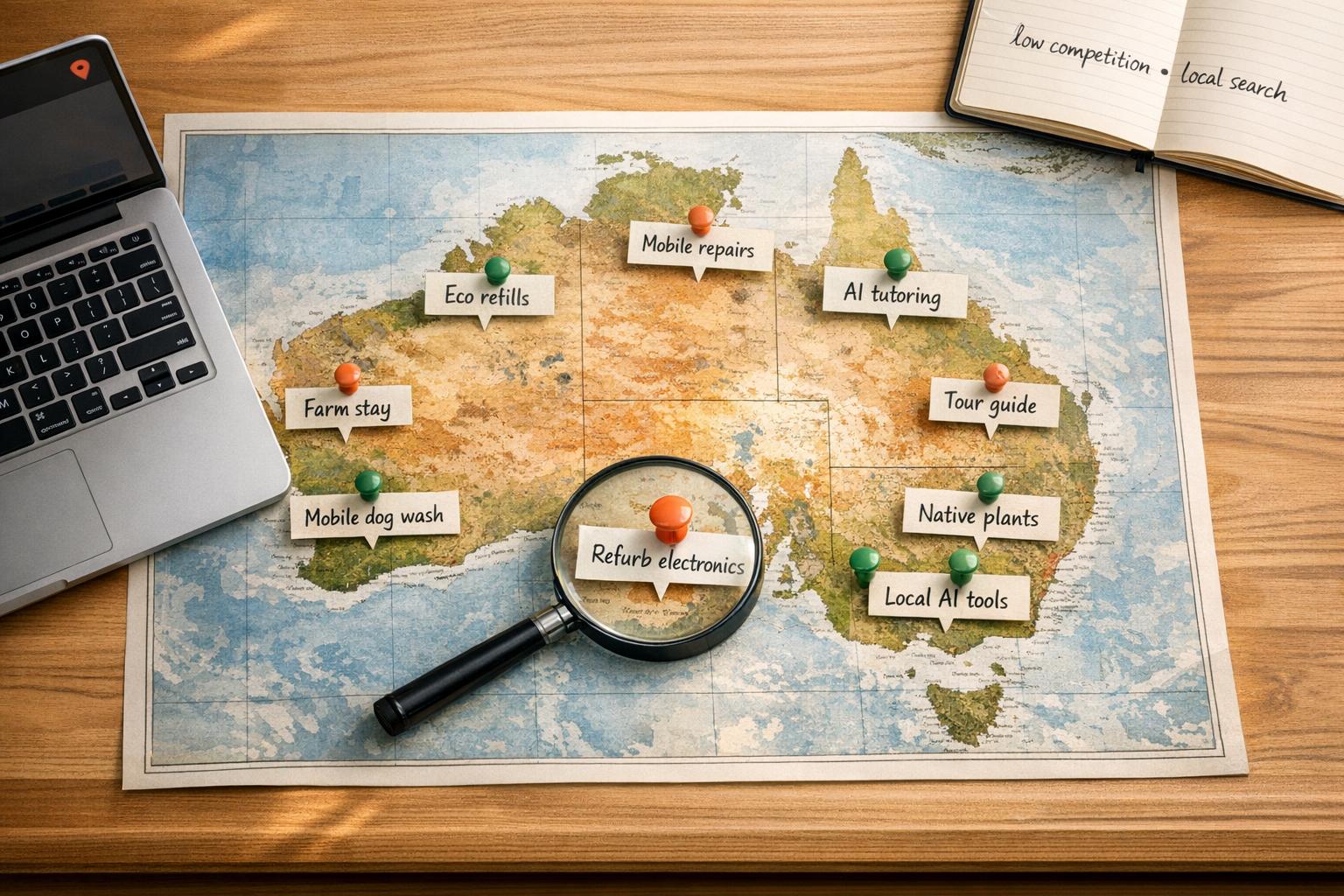
Australia in 2026 offers a wealth of opportunities for small businesses, especially in low-competition niches. The key to success lies in identifying underserved markets with real demand, validated through local search data. Here's a quick look at promising ideas and trends:
- Regional Services: Growing populations in smaller towns need services like tech setup for seniors, small handyman jobs, and unique tourism experiences.
- Eco-Friendly Products: High demand for zero-waste bathroom essentials, refill station supplies, and native landscaping products.
- Technology Solutions: AI-powered tools for rural healthcare, precision farming, and mining maintenance are gaining traction.
- Tourism and Leisure: Indigenous-led tourism and adventure experiences are on the rise, with a focus on personalized, high-value offerings.
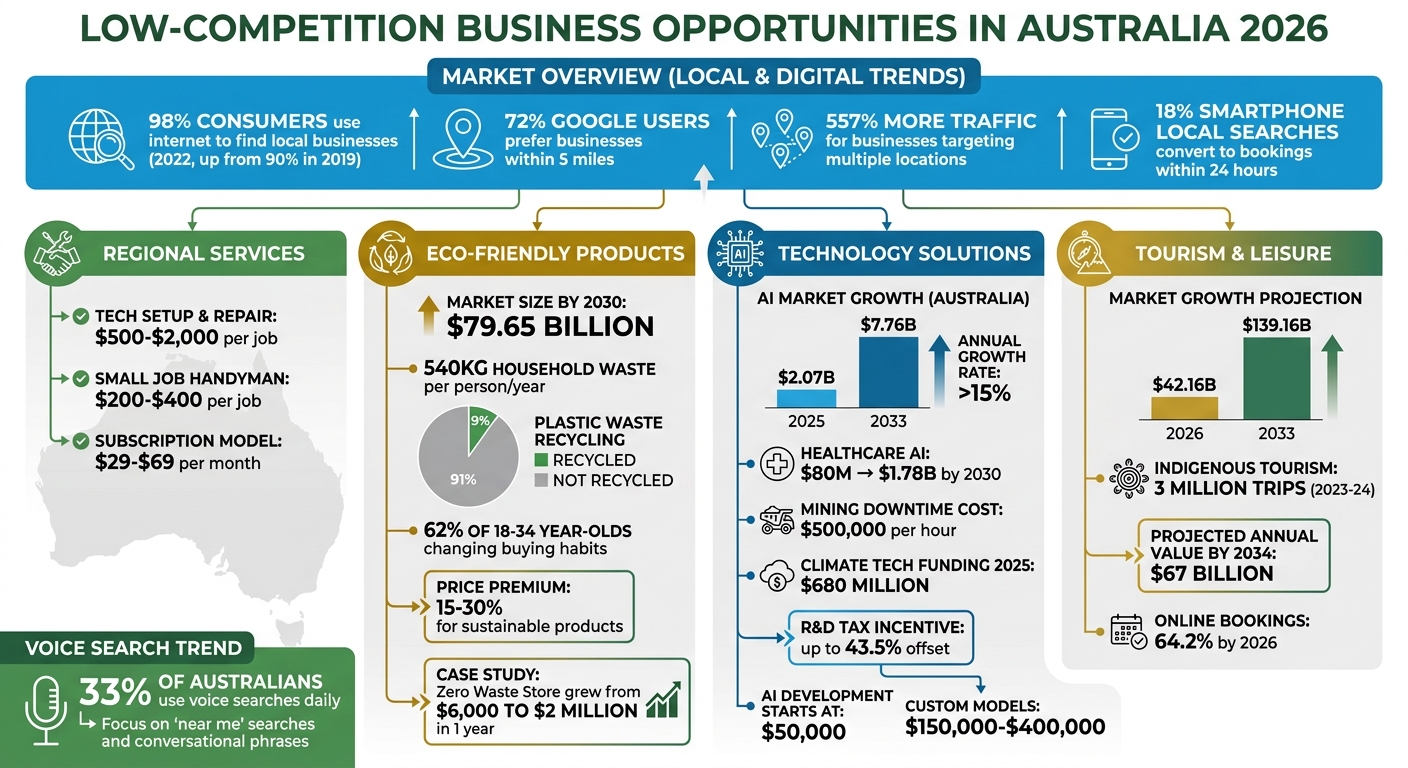
Low-Competition Business Opportunities in Australia: Market Data & Growth Statistics
🇦🇺5 Small Business Ideas in Australia for 2026 | Australia New Small Business Ideas
sbb-itb-08dd11e
Why Low-Competition Niches Thrive in Australia
Australia's unique geography and shifting demographics create fertile ground for low-competition niches, especially those catering to hyper-local needs.
The country’s vast geography makes long-distance operations impractical and often unprofitable. With many suburbs situated far from major commercial hubs, local services become a necessity. For instance, a homeowner in a regional area isn’t likely to wait weeks for a contractor from a major city to handle a $300 repair - they need fast, nearby assistance. This dynamic makes smaller, localized providers more appealing for these types of jobs.
Additionally, long travel distances deter larger companies from taking on low-value tasks, leaving room for small businesses to thrive.
Australia's regional migration boom has also transformed market dynamics. As more people move outside capital cities, they bring urban expectations to areas where local markets are still catching up. Professionals relocating from cities still want services like artisan coffee or reliable tech support, creating opportunities for businesses to meet these demands in underserved areas.
"Regional migration creates new markets. More consumers outside capital cities = more opportunity." - The Business Times Australia
Demographic changes further shape demand in regional communities. For example, Australia’s aging population increasingly requires recurring services like garden care and home maintenance. Meanwhile, busy families often seek out specialized options, such as healthy meal prep and delivery. Seniors moving to regional areas also face challenges with technology setup, paving the way for niche services like tech concierge assistance. These trends highlight the importance of using local search data to validate business ideas and align them with evolving community needs.
Validating Ideas with Local Search Demand
Before diving into a new business venture, it’s smart to confirm there’s actual demand for your idea. Using local search data can help you spot low-competition niches in Australia, ensuring your time and money are spent wisely. The goal? To ensure potential customers are actively searching for what you plan to offer.
Start with Google Trends to get a sense of interest over time. This tool can show whether a niche is growing, holding steady, or losing steam. For example, searching for "reformer pilates Melbourne" can help you see if this fitness trend is gaining traction or if it’s just a passing phase. A steady upward trend is a good sign of lasting demand, while sudden spikes followed by dips might point to short-lived fads.
Next, go deeper with keyword analysis to uncover underserved areas. Look at location-specific keywords, like "dog grooming in Geelong", to identify gaps in the market. Tools such as Google Keyword Planner and Keywords Everywhere can provide monthly search volumes and competition levels. Ideally, you’re looking for keywords with strong search volume but low competition - this combination often indicates an untapped market.
"Long-tail keywords - phrases that are typically three or more words - are instrumental for smaller businesses aiming for local SEO success." - Zoe, Guide Author
Don’t forget about "near me" searches and voice queries, which are becoming increasingly popular. Around 33% of Australians use voice searches daily. If competitors in your area aren’t optimizing for these conversational phrases, it could be your chance to stand out. Another trick? Check Google Business Profile listings in your target suburb. A lower number of optimized listings often means less competition and better visibility for your business.
1. Regional Services
Australia's regional migration is driving demand for city-like conveniences in smaller towns, creating opportunities for niche services that big players often miss. The key lies in identifying specific, unmet needs and using local search data to validate these opportunities. Here are some service ideas tailored to these regional shifts.
Tech Setup & Repair Concierge
Many seniors and less tech-savvy residents in regional towns need help with tasks like setting up Wi-Fi networks, smart TVs, or home routers. This is a gap traditional IT companies often overlook, as smaller jobs don’t justify their travel costs. By offering in-person support, you can appeal to this demographic while facing minimal competition. The potential earnings range from $500 to $2,000 per job.
Small Job Handyman Service
In regional Australia, large contractors frequently pass on jobs under $500, leaving homeowners with unaddressed minor repairs. Specializing in smaller tasks - like fixing leaky taps, patching drywall, or replacing door handles - at rates of $200 to $400 per job can fill this gap. Handling multiple small jobs daily can generate steady income, and offering a subscription plan for $29 to $69 per month for seasonal maintenance or priority booking can provide recurring revenue.
Tourism Micro-Experience Provider
Popular regional destinations like Noosa, Margaret River, and Tasmania are attracting tourists who crave unique, local adventures beyond the usual tours. You could offer tailored experiences like nature photography walks, foodie trails, or guided hiking tours to hidden gems. These personalized activities can command premium prices, especially during peak tourist seasons, making them both profitable and scalable.
2. Eco-Friendly Products
Australians generate an average of 540kg of household waste per person each year, but only 9% of plastic waste gets recycled. This opens up a big opportunity for businesses offering environmentally conscious alternatives. In fact, 62% of consumers aged 18 to 34 are actively changing their buying habits to combat climate change. The sustainability market is also on the rise, projected to reach $79.65 billion by 2030, with consumers willing to pay nearly 10% more for eco-friendly products. Here are three product ideas that tap into this growing demand for greener options.
Zero-Waste Bathroom Essentials: A Market Ready for Change
Australian bathrooms are a hotspot for single-use plastics, with items like toothpaste tubes, shampoo bottles, and disposable razors contributing to 130,000 tonnes of plastic pollution in waterways annually. To address this, consider offering plastic-free alternatives such as shampoo bars, deodorant pastes, and reusable makeup pads. A great example of this market's potential is Zero Waste Store, which grew its sales from $6,000 to $2 million in just one year by offering eco-friendly products made from renewable materials. Bundling these items into "Zero-Waste Starter Kits" can also encourage customers to explore multiple products while increasing your average order value.
Refill Station Supplies: Meeting the Demand for Reusability
The refill station trend is taking off in Australia, where customers bring their own containers to purchase pantry staples, cleaning products, and toiletries. This presents an opportunity to supply refill stations with bulk eco-friendly products or even start your own refill business, especially in underserved regional areas. Urban Ethos, an Australian-owned company based in Moorabbin, VIC, successfully expanded its reach by placing reusable and sustainable products, like water bottles, into major retailers like Woolworths. Partnering with local businesses can help you manage costs while building a loyal customer base.
Native Landscaping Products: Sustainable Gardening Solutions
Drought-resistant gardens featuring native plants are becoming increasingly popular among homeowners aiming to lower water bills and support local ecosystems. You could offer native plant seedlings, organic fertilizers, and water-efficient irrigation kits tailored to specific climates. Since sustainable landscaping products often command a price premium of 15–30%, this niche offers a profitable opportunity with relatively low competition, particularly in regional markets.
3. Technology-Driven Solutions
Technology continues to provide practical answers to regional challenges, complementing localized service trends. Australia's AI market is projected to grow from $2.07 billion in 2025 to $7.76 billion by 2033, with an annual growth rate exceeding 15%. This surge offers entrepreneurs the chance to focus on delivering dependable, user-friendly tools instead of experimental technologies. According to Karan Chugh, a tech consultant at VT Digital:
"Australian businesses demand reliable AI tools that integrate seamlessly with existing systems".
AI-Powered Rural Healthcare Diagnostics: Closing the Specialist Gap
In remote areas, accessing specialists often involves weeks of waiting, leaving a critical gap in healthcare services. AI imaging tools, capable of analyzing patient scans and movement tests through video, can provide immediate triage. This allows specialists to remotely identify urgent cases, addressing delays in care. The healthcare AI market in Australia is expected to grow from about $80 million today to $1.78 billion by 2030. A notable example comes from Royal Melbourne Hospital:
"Royal Melbourne Hospital has already implemented AI imaging software to analyze patient movement tests via video, allowing specialists to identify severe cases in rural areas without immediate travel".
AI development projects typically start at $50,000, with custom models ranging between $150,000 and $400,000. Businesses involved in AI research can also benefit from the R&D Tax Incentive, which offers up to a 43.5% tax offset.
AgriTech for Precision Farming: Tackling Vast Land Challenges
Australia's large-scale farms face unique challenges, including unpredictable weather and expansive land that is difficult to oversee manually. AI-powered tools, such as drones for livestock monitoring and pasture analysis, offer a way to manage these massive operations efficiently. For instance:
"AgriWebb developed a platform using AI drones to monitor livestock health and pasture conditions across thousands of hectares, providing farmers with real-time data on land conditions".
Medium-to-large farms are well-positioned to justify these investments. Additionally, climate tech in Australia attracted $680 million in funding in 2025, reflecting strong investor confidence. Subscription-based pricing or performance-based models can make these solutions more accessible to farmers.
Predictive Maintenance for Mining: Avoiding Expensive Downtime
Mining operations in regional areas face significant costs when equipment fails, with breakdowns costing up to $500,000 per hour. AI-powered predictive maintenance tools analyze equipment data to forecast potential failures, helping operations avoid costly disruptions. Mid-sized mining firms, which often require tailored solutions beyond off-the-shelf software, present a prime opportunity for entrepreneurs. However, ensuring compliance with the Australian Privacy Act and regulations like APRA CPS 234 is critical for building trust with enterprise clients.
These AI-driven solutions highlight the growing demand for specialized, data-backed tools tailored to local market needs.
4. Tourism and Leisure
Australia's adventure tourism market is on track to grow significantly, from $42.16 billion in 2026 to an impressive $139.16 billion by 2033. This surge offers entrepreneurs a chance to carve out unique niches with minimal direct competition. The market's evolution calls for fresh, creative strategies that merge authentic experiences with digital innovation.
Indigenous-Led Ecological Tourism: Deeply Connected Experiences
The rise of Indigenous-led tourism is reshaping the industry, with a record-breaking three million trips involving First Nations activities projected for 2023–24. Travelers are increasingly drawn to immersive experiences such as ecological restoration walks guided by traditional custodians, stargazing sessions interpreting ancient stories, and coastal foraging adventures.
Nicole Mitchell, Executive Officer at Discover Aboriginal Experiences, highlights this transformation:
"We're moving away from tokenistic gestures or surface-level storytelling, and into an era where Indigenous voices, cultures and communities are at the heart of tourism experiences."
This sector is anticipated to generate $67 billion ($101 billion) annually by 2034. Entrepreneurs have an opportunity to work closely with Indigenous communities to design experiences that connect traditional knowledge and stories with the landscapes they inhabit. These offerings particularly resonate with high-end travelers seeking meaningful and culturally enriching experiences. Phil Lockyer, Head of Indigenous Affairs at Tourism Australia, underscores this perspective:
"Our First Nations stories are rich and diverse and provide a unique opportunity to see our country through the lens of the world's oldest living cultures."
On the digital front, 64.2% of adventure tourism bookings are expected to occur online by 2026. Leveraging local search terms, such as "nature walks near me", can tap into the growing trend of smartphone users searching for activities nearby - 18% of these searches convert into bookings within just 24 hours. This highlights the importance of a strong digital presence to capture a share of this expanding market.
Conclusion
The Australian market presents a strong opportunity for entrepreneurs who leverage local search data. In 2022, 98% of consumers used the internet to find local businesses - an increase from 90% in 2019 - showing a growing reliance on online search for everyday needs. The difference between thriving businesses and those that struggle often comes down to one critical factor: basing decisions on actual search behavior rather than assumptions.
Local search data does more than reveal what consumers want - it shows where they want it. With 72% of Google users favoring businesses within 5 miles of their location, this geographic insight can give you a competitive edge. Businesses targeting multiple areas or specific suburbs see an average of 557% more traffic compared to those focused on a single location. This level of detail can help you uncover opportunities that larger, national competitors might overlook.
Beyond identifying demand, this data also shapes your strategic planning. Tools like Google Trends allow you to track long-term patterns and ensure keyword consistency, helping you avoid chasing short-lived fads. Combine these insights with keyword research to uncover untapped terms that your competitors haven't yet targeted.
Timely action is key. Keep your Google Business Profile updated regularly to signal activity to AI-driven search algorithms that dominate local discovery. Consistency is crucial - ensure your business name, address, and phone number are identical across all directories to build trust with search engines. Instead of obsessing over a perfect 5.0 rating, focus on accumulating a steady volume of reviews. By optimizing local listings and sticking to a data-driven approach, businesses can position themselves for long-term success in Australia's competitive market.
FAQs
How do I find low-competition local keywords in my suburb?
First, pinpoint your niche. What makes your business or content stand out? Once you’ve nailed that down, it’s time to brainstorm keywords that align with your focus. Think about the terms your audience might type into Google when looking for what you offer.
To take it up a notch, use keyword research tools to dig deeper. Check out metrics like search volume (how often people search for a term) and competition (how tough it is to rank for that keyword). Pay special attention to long-tail keywords - those longer, more specific phrases. Adding local modifiers like your suburb or city name can make these keywords even more precise. For example, instead of just “plumber,” try “emergency plumber in Brooklyn.”
Also, consider questions or topics that are unique to your local area. People often search for highly specific things, and these queries usually have less competition but higher intent. By combining these tactics, you’ll uncover keywords that tap into local search demand and set you up for success.
What search volume is “enough” to validate a local business idea?
When evaluating a local business idea, there’s no magic number for search volume that confirms its viability. Instead, what matters is identifying steady and relevant local search interest. To gauge this, tools like Google Trends or keyword research platforms can provide insights into search patterns, helping you confirm whether the demand aligns with your target audience.
How can I tell if a niche has real demand vs. a short-lived trend?
To figure out if you're looking at lasting demand or just a passing trend, tools like Google Trends can be incredibly helpful. By analyzing search interest over time, you can spot the difference: steady or increasing interest points to ongoing demand, while sudden spikes that quickly drop off usually signal a short-term trend.
Beyond that, pay attention to market signals. Look at search demand patterns and how websites in the niche are growing. You can also gauge real interest by running surveys or trying small-scale trials. These methods can help confirm whether the demand is real or just hype.
Related Blog Posts
- 21 Low-Investment Business Ideas for Women in Australia
- 18 Low-Investment Business Ideas in Australia for 2026
- Business Ideas for Rural and Coastal Australia
- Best Small Business Ideas in Australia Under $30,000