
Starting a home-based business in 2026 is easier and more affordable than ever. With tools like AI and no-code platforms, you can launch a profitable venture for as little as $0 to $500. Low-competition niches offer higher returns with fewer competitors, making them ideal for entrepreneurs. Here are some key ideas:
- AI-Powered Services: Offer webinar content repurposing ($1,000–$2,000/month) or AI-driven market research ($3,000–$8,000/project). These services require minimal setup and leverage automation tools.
- Eco-Friendly Products: Start small with handcrafted organic soap or beeswax food wraps. Initial costs range from $300 to $500, with strong demand for sustainable goods.
- Virtual Assistance: Specialize as an AI Operations Specialist ($3,000–$10,000/month) or Client Success VA ($3,000–$5,500/month) to manage workflows or customer relationships.
- Niche Education: Teach AI, coding, or test prep online, earning $60–$150/hour. Startup costs are under $500.
With minimal overhead, high demand, and growing acceptance of remote work, now is the perfect time to turn your skills into a thriving business.
9 PROFITABLE Home-Based Business Ideas (Low Startup Cost)
sbb-itb-08dd11e
Why Low-Competition Home Businesses Succeed in 2026
Low-competition businesses succeed because they fill gaps that larger companies often ignore. By focusing on a specific niche, these businesses position themselves as experts who truly understand their customers’ needs. This approach not only allows them to charge higher rates but also reduces marketing costs since they can target their ideal audience with precision. This kind of specialization also makes it easier to integrate tools like AI and other technologies to simplify operations.
The technical barriers that once gave established companies an edge have largely disappeared. Today, over 50% of small businesses in the U.S. already use AI to reduce costs, and more than 70% plan to expand their use of AI by the end of 2026. With AI-driven workflows, productivity increases by 30–50%, enabling even solo entrepreneurs to achieve the output of a small team. Tasks like customer support, bookkeeping, and social media management can run almost entirely on autopilot, giving business owners more time to focus on activities that directly drive growth.
The rise of remote work has also changed how businesses are perceived. Home-based businesses, once seen as less professional, are now widely accepted. In fact, the global home-based business market is expected to hit $455 billion by 2026. As highlighted in the Forbes Business Council's 2025 Annual Outlook Report:
"The home is the new headquarters. Entrepreneurs who leverage low-overhead models in 2026 will have a structural advantage over traditional businesses".
Shifts in consumer preferences are opening even more doors. People increasingly prioritize transparency and ethical production over mass-market brands. They’re willing to pay 17% more for handmade goods compared to machine-made ones, and personalized products often see an average order value 20–30% higher than standard items. This trend benefits small businesses that can offer the kind of authenticity and customization that big corporations struggle to replicate. All of these changes highlight why home-based entrepreneurs are thriving in niche markets today.
1. AI-Powered Services
Webinar Content Repurposing transforms lengthy webinar recordings into bite-sized assets like LinkedIn posts, newsletters, and blogs. With 61%-67% of B2B companies using webinars for lead generation, the demand for this service is on the rise. In fact, searches for "content repurposing" skyrocketed from 340 per month in August 2024 to 1,600 per month in August 2025. Tools like Swell AI can handle transcription, while automation platforms such as Make.com or Zapier can turn transcripts into ready-to-use social media posts. Pricing for these services typically ranges from $1,000 to $2,000 per month for unlimited repurposing, and the entire process can be managed remotely.
Another exciting opportunity lies in AI-Powered Market Research, which leverages AI to analyze patents, social media sentiment, and news trends, offering startups and venture capital firms valuable competitive insights. Traditional research firms often charge $50,000 to $100,000+ for reports that take months to complete, but you can deliver comparable results in just hours for $3,000 to $8,000 per project or $2,000 to $5,000 per month for ongoing updates. With the global market research industry valued at $84 billion, offering faster and more affordable solutions is a clear advantage. To attract clients, consider offering a "Free Market Opportunity Score" as a lead magnet. Tools like Perplexity AI for real-time research, Glimpse for trend discovery, and Brandwatch for social listening can help streamline the process.
2. Eco-Friendly Products
Handcrafted Organic Soap is a straightforward way to enter the sustainability market. Starting a home-based soap business requires about $400, which covers the cost of basic equipment and raw materials. Using the "hot process" method can speed things up, as it involves applying heat during the mixing process, allowing the soap to be ready for cutting in just 12–24 hours - far quicker than the weeks needed for the traditional cold-process method. A compelling example of this potential is a stay-at-home mom who, by February 2026, turned her $400 investment into a $320,000 annual revenue business. She achieved this by sharing behind-the-scenes videos of her production process on social media, amassing 450,000 followers and shipping 1,000 bars of soap weekly - all without spending on paid advertising. Her secret? Engaging content that showcased every step: pouring, cutting, and packaging.
Another eco-friendly product with strong potential is Beeswax Food Wraps, which offer an easy entry point into the zero-waste market. These wraps are reusable, compostable alternatives to plastic cling film, made from cotton cloth coated with beeswax, resin, and natural oils. With 46% of consumers already choosing eco-friendly products to reduce their environmental impact, and the sustainability market expected to hit $79.65 billion by 2030, growing at 23.1% annually, the timing couldn't be better. Additionally, consumers are willing to pay about 9.7% more for sustainable products, giving small businesses better pricing power. A smart strategy for starting out is to focus on a single "hero" product and test demand by running a small pre-order of 10–20 units before scaling.
This lean approach gives home businesses a strong advantage. As Adegbenga Adefemi, an online marketer, points out:
"Resourcefulness in the early stages of a profitable home business is not a limitation - it is a competitive advantage." - Adegbenga Adefemi
Small businesses can adapt quickly to meet the needs of niche markets like "zero-waste urban dwellers" or "plastic-free parents", while large corporations often struggle to do the same due to their slower decision-making processes. For example, in 2021, Zero Waste Store co-founders JJ Follano and Sarah Cieslinski grew their online shop's sales from $6,000 to $2 million in just one year by concentrating on plastic-free essentials like compostable pet waste bags and shampoo bars sourced from other small businesses. These success stories highlight how focusing on specialized niches allows entrepreneurs to build trust quickly and charge premium prices for their products.
3. Virtual Assistance
The role of an AI Operations Specialist is gaining traction as a sought-after niche for 2026. This position revolves around managing AI tools and streamlining automated workflows for small businesses. Tasks might include setting up CRM automation in platforms like HubSpot or Salesforce, managing email campaigns, or tweaking website layouts - all without needing advanced coding skills. By becoming proficient in automation tools like Zapier or Make, you could realistically earn between $3,000 and $10,000 per month. AI serves as a powerful efficiency booster, enabling one virtual assistant to handle tasks that once required an entire team. While this role leans heavily on technical automation, another emerging niche prioritizes human interaction for client engagement.
Shifting from technical expertise, the role of a Client Success VA focuses on fostering strong customer relationships. This involves interpreting emotional cues, reducing churn, and ensuring customer satisfaction for SaaS companies or membership programs. To break into this field, you could start by completing HubSpot Academy’s free Customer Success certification and offering a 30-day pilot program to manage onboarding for a startup’s first 10 customers. Client Success VAs typically earn between $3,000 and $5,500 per month, with hourly rates ranging from $30 to $50. According to virtual assistant expert Angie Nelson:
"The competitive advantage in 2026: AI proficiency plus specialized human skills. Every viable VA niche is now an 'AI-allied' niche."
Virtual assistance roles require minimal upfront investment - usually under $500 for basic equipment - making them perfect for home-based setups. To stand out, focus on delivering strategic outcomes that go beyond AI's capabilities, such as optimizing calendars or enhancing client satisfaction. With the global virtual assistant market expected to approach $50 billion by 2027, specializing in these high-demand niches can help you rise above generalist VAs who often compete on price alone. These specialized roles offer a great opportunity for solo entrepreneurs looking to thrive in a low-competition, home-based business model.
4. Niche Education
The online tutoring market is on track to grow significantly, with projections estimating an increase from $12.06 billion in 2026 to $23.73 billion by 2030. For educators specializing in niche subjects, this growth presents a lucrative opportunity, with annual earnings ranging from $50,000 to over $100,000 as independent practitioners. What sets niche education apart is its ability to deliver focused, results-driven learning that justifies premium pricing.
AI and Coding Coaching is a standout area, catering to career changers and tech enthusiasts looking to master practical skills in fields like Python programming and web development. Adding value with AI automation workflows through tools like Zapier or AI APIs can make your offerings even more appealing. Rates for these specialized lessons typically range from $60 to $120 per hour, significantly higher than the $30 to $60 per hour charged for traditional K–12 subjects. To stand out, emphasize clear outcomes, such as "Learn to build your first automated workflow in just 4 weeks."
High-Stakes Professional Test Prep is another lucrative niche, serving individuals preparing for rigorous exams like the MCAT, LSAT, or GRE. Tutors in this space often charge between $75 and $150 per hour. Success here depends on a deep understanding of test formats and a track record of helping students achieve measurable score improvements. Today, credibility in this area is less about formal credentials and more about demonstrable results.
To ensure steady income, consider offering session bundles of 10–20 classes. Startup costs are relatively low - under $500 - for essentials like a good-quality webcam, microphone, and interactive whiteboard software. With the global tutoring market projected to expand by $318.2 billion between 2024 and 2028, now is the perfect time to carve out your space in a specialized niche. This approach aligns with the broader trend of using technology to create efficient, profitable home-based businesses.
Validating Your Idea with IdeaFloat
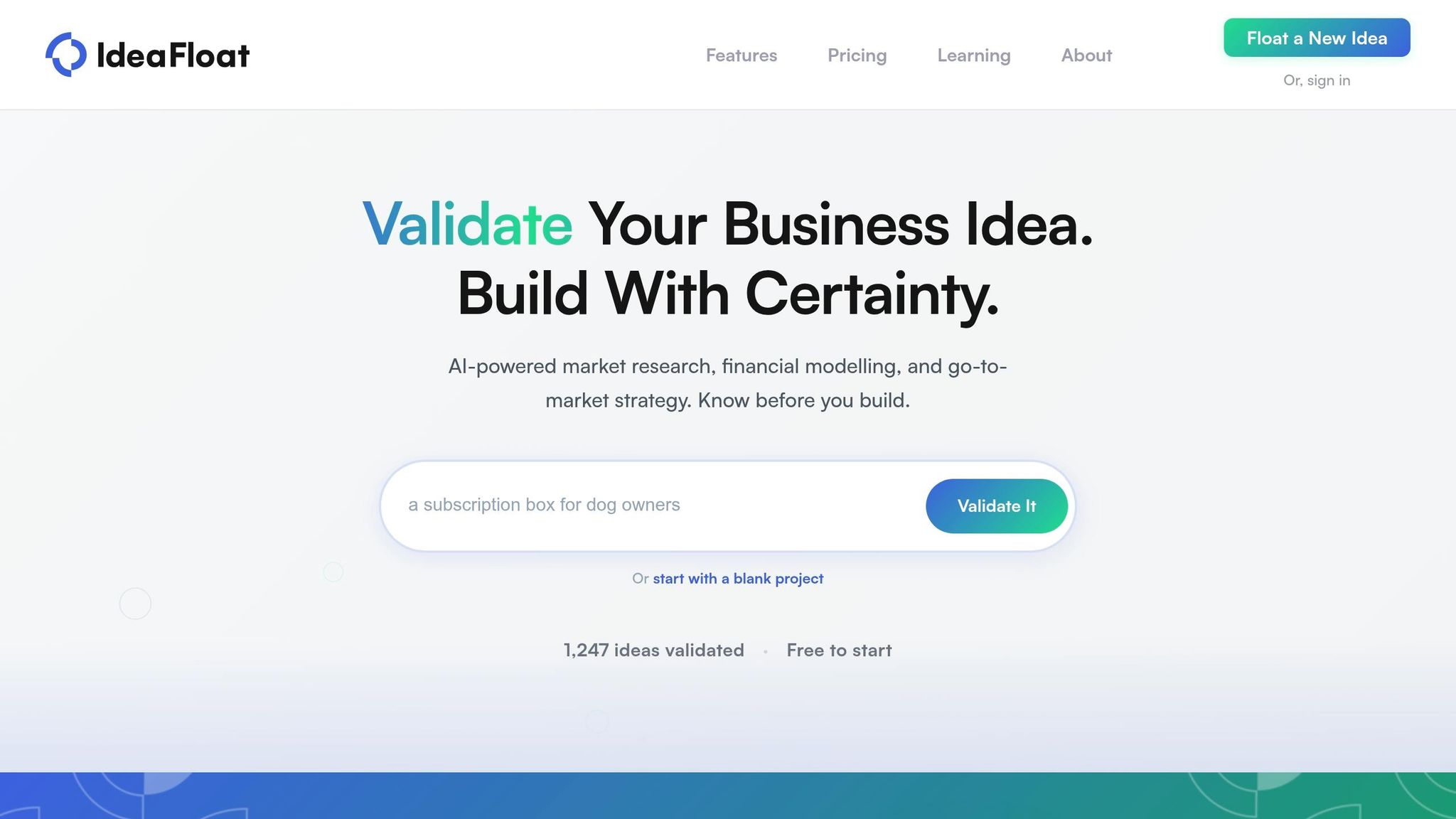
For entrepreneurs working from home, early validation is a game-changer when it comes to spotting low-competition opportunities. The key is to confirm that customers are willing to pay for your idea before spending any money. Surprisingly, about 73% of founders give up on their ventures without ever verifying if their target market would actually pay for their product or service. That’s why validating your idea as early as possible is so important.
IdeaFloat offers a streamlined, four-phase process that delivers actionable insights in just 15 minutes.
Phase 1: Problem Validation and Competitor Analysis
Kick things off with the Problem Validator, which helps you confirm your idea solves a pressing problem and uncovers early demand signals. Then, move on to Competitor Analysis to identify competitors and pinpoint low-competition gaps in the market. As Nick Sherwing, the founder of woohoPets, puts it:
"IdeaFloat saved us weeks of work by helping us explore demand for new products across different regions and took the guesswork out of finding gaps in the market."
This phase also includes Consumer Insights, a tool that dives into online conversations to capture the exact words potential customers use to describe their challenges. These insights set the foundation for more precise market sizing in the next phase.
Phase 2: Smart Market Sizing
In this phase, IdeaFloat’s Smart Market Sizing tool helps you calculate your Total Addressable Market (TAM), Serviceable Addressable Market (SAM), and Serviceable Obtainable Market (SOM). These calculations come with reliable citations that can build trust with potential investors.
Phase 3: Financial Breakdown
Phase 3 is all about the numbers. The Cost Analysis tool enables you to list all your expenses, from website hosting to materials, giving you a clear picture of your monthly burn rate. Then, the Financial Projections tool helps you forecast revenue and expenses, so you can identify when your business is likely to become profitable.
Phase 4: Launch Preparation
The final phase focuses on getting your idea off the ground. Tools like the Community Launch Map and Waitlist Landing Page help you collect emails and create excitement around your launch. So far, more than 1,247 business ideas have been validated using IdeaFloat. Plus, it’s free to get started - no credit card required.
This step-by-step process gives you the confidence to launch your business quickly and efficiently, all from the comfort of your home.
Startup Costs Comparison Table
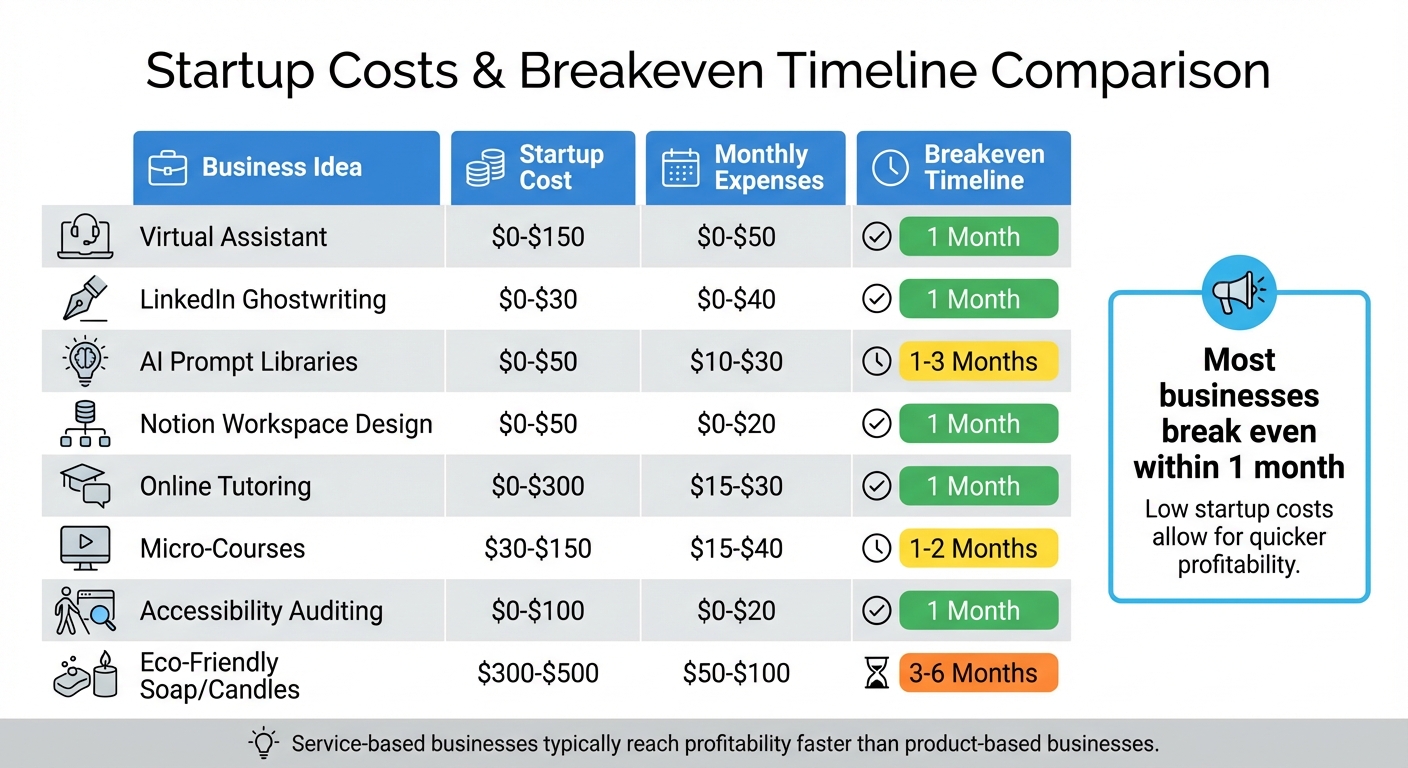
Startup Costs and Breakeven Timeline for 8 Low-Competition Home Businesses
When starting a business, understanding the costs involved is crucial. It helps you align your budget with your goals and pick a business model that fits your financial situation. Low-competition niches are particularly appealing because they often come with minimal overhead. By cutting out expenses like rent, utilities, and commuting, you can save anywhere from $500 to $2,000 monthly.
Service-based businesses tend to be less risky and easier to scale than product-based ones. For example, you can start a virtual assistant business for as little as $100 to $300, while eco-friendly product businesses usually need $300 to $500 upfront for materials and inventory. While the median startup cost for businesses without employees is $5,000, many low-competition ideas fall significantly under that figure.
Here’s a table comparing startup costs, monthly expenses, and estimated breakeven timelines for various business ideas:
| Business Idea | Startup Cost | Monthly Expenses | Breakeven Timeline |
|---|---|---|---|
| Virtual Assistant | $0 - $150 | $0 - $50 | 1 Month |
| LinkedIn Ghostwriting | $0 - $30 | $0 - $40 | 1 Month |
| AI Prompt Libraries | $0 - $50 | $10 - $30 | 1 - 3 Months |
| Notion Workspace Design | $0 - $50 | $0 - $20 | 1 Month |
| Online Tutoring | $0 - $300 | $15 - $30 | 1 Month |
| Micro-Courses | $30 - $150 | $15 - $40 | 1 - 2 Months |
| Accessibility Auditing | $0 - $100 | $0 - $20 | 1 Month |
| Eco-Friendly Soap/Candles | $300 - $500 | $50 - $100 | 3 - 6 Months |
Service-based businesses like virtual assistance and LinkedIn ghostwriting provide the quickest route to profitability, often within the first 30 days. These models require no inventory and let you start earning by leveraging your expertise right away. On the other hand, digital products, such as AI prompt libraries, come with low startup costs ($0–$50) and high profit margins. However, building consistent income with these may take one to three months.
Additionally, home office tax deductions can save you between $2,000 and $5,000 annually, which can significantly boost your bottom line. By starting with skills you already have, you can shorten the learning curve and focus on business models that offer automated sales or recurring revenue streams to reach profitability faster. This breakdown gives you the tools to make informed choices and achieve financial success quickly.
Conclusion
Starting a low-competition home business in 2026 is entirely possible for under $500. The secret to success is focusing on micro-niches - areas where there's genuine demand but less competition, rather than diving into oversaturated markets.
Thanks to AI tools, the barriers to offering professional services from home have never been lower. Whether you're building Notion templates, conducting accessibility audits, or crafting AI prompt libraries, the initial investment is minimal.
Before diving in, make sure to validate your idea. Engage potential customers and test demand with a simple landing page. As Warren Buffett wisely said:
"Never invest in a business you cannot understand".
Leverage your current skills, focus on delivering real results, and let your first clients fuel your growth. This practical approach allows you to start small but confidently.
With freelancing now outpacing traditional employment - 44% of freelancers earn more than full-time employees, and the market is growing at 17% annually - the moment to act is now. Whether it’s reaching out to a potential client, showcasing a demo portfolio, or using tools like IdeaFloat to validate your idea, taking that first step is what bridges the gap between planning and launching. These market trends mean your side hustle could quickly become a profitable business.
A successful home-based business doesn’t have to be complex or costly. It just needs to address a specific problem for a well-defined audience. The key? Start today. Use IdeaFloat to validate your concept, ensure market demand, and set yourself up for growth.
FAQs
How do I know if a niche is truly low-competition?
To uncover low-competition niches, start by evaluating market saturation and demand. The goal is to find areas where demand outpaces supply, competitors are scarce, and emerging trends - like AI advancements or eco-conscious solutions - are gaining traction.
Here’s how to approach it:
- Spot Market Gaps: Look for specific needs that aren’t being fully addressed. These gaps often present opportunities for unique offerings.
- Use Research Tools: Leverage market research platforms, gather customer feedback, and conduct competitor analysis to validate your findings.
- Focus on Profitability: Prioritize niches with unmet demand and strong profit margins. This helps ensure the niche is worth investing in before dedicating time and resources.
By taking these steps, you can confidently identify a niche that aligns with both market opportunities and your business goals.
Which home business can reach profit fastest with under $500?
A service-based business - like virtual assistance, cleaning services, or pet sitting - can be a quick way to turn a profit with startup costs under $500. These types of businesses typically need only a few basic resources to get started and can begin generating income almost right away, making them a great option for those seeking fast returns.
How do I get my first clients without paid ads?
To land your first clients without spending on ads, start by tapping into your personal and professional network. Reach out to friends, family, and colleagues to let them know about your services. Use social media platforms to share insightful content that highlights your expertise and builds trust.
Get involved in online communities or local groups where your target audience spends time - this is a great way to make connections and showcase your skills. Offering free consultations or limited-time discounts can spark interest and encourage people to try your services. Plus, focus on building a solid portfolio to demonstrate your capabilities. Don't hesitate to ask satisfied clients for referrals; word-of-mouth can be a powerful tool for growing your client base.
Related Blog Posts
 Report an issue
Get the newest tips and tricks of starting your business!