- Low Startup Costs, High Potential Revenue
- Initial investment: $2,000–$5,000 (basic setup) to $15,000–$40,000 (custom trailers).
- Annual revenue: $52,000–$260,000.
- Profit margins: Up to 88% with the "dry hire" model.
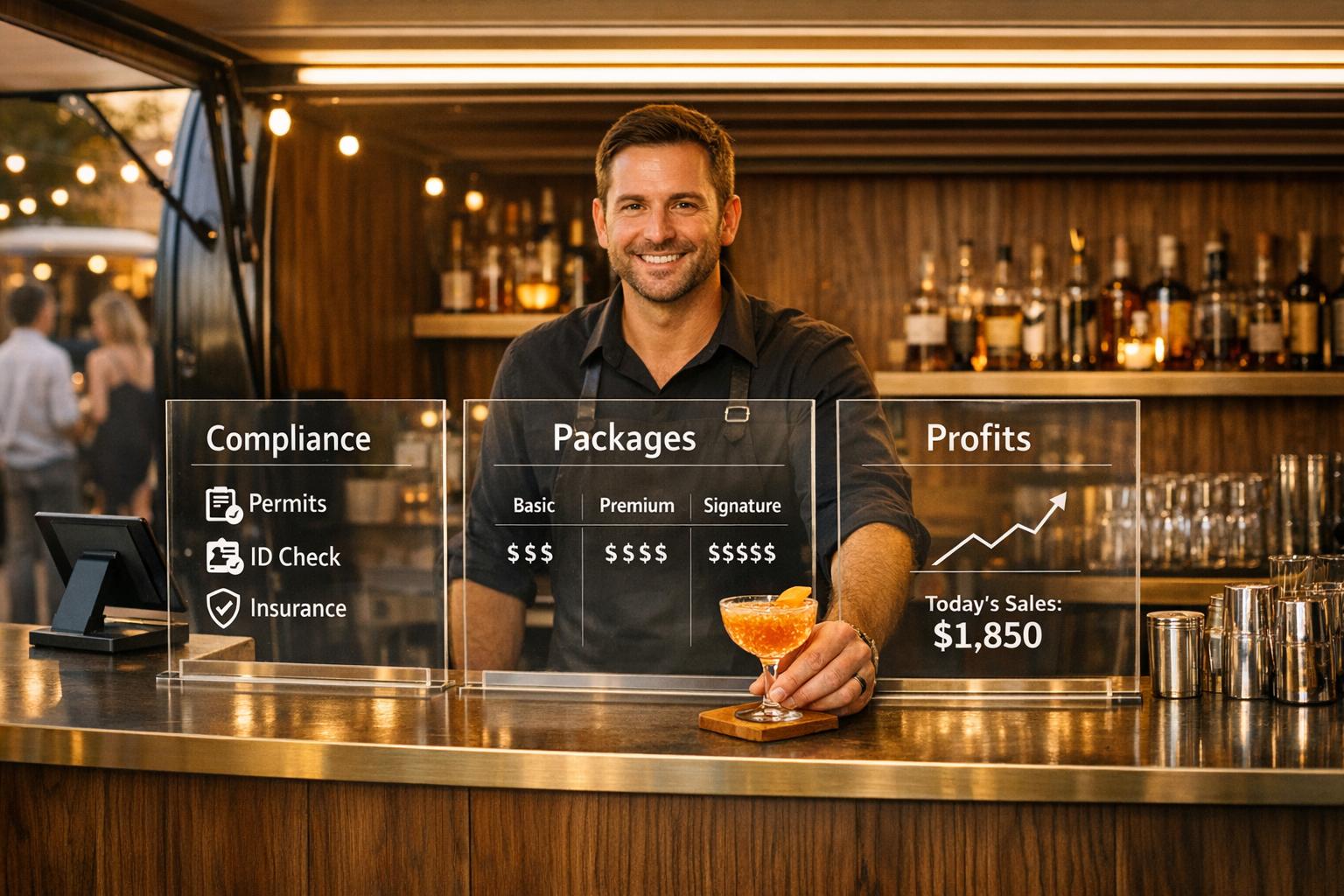
- Compliance is Key
- Licenses: Business license ($50–$400/year), liquor license (if selling alcohol), health permits, and event-specific paperwork.
- Penalties for non-compliance: $500–$10,000 or event shutdowns.
- Insurance is a Must
- Liquor liability coverage: $1M per occurrence, $2M aggregate.
- Estimated cost: $1,800 annually or $35/month.
- Service Packages Drive Sales
- Offer tiered packages: Basic (bartender only), Standard (mixers, ice), Premium (signature cocktails).
- Pricing: $10–$25/person or $900–$3,800 flat fee for events.
- Maximize Revenue with Add-Ons
- Upsell extras like glassware rentals ($3–$5 per guest), mocktail stations, or espresso martini setups ($50–$200/event).
- Charge travel fees ($2–$3/mile beyond 25 miles).
- Scale Your Business
- Expand by hiring staff to handle multiple events.
- Build partnerships with wedding planners and venues to secure steady bookings.
With the catering industry growing 6.2% annually and projected to hit $124 billion by 2032, mobile bars are a lucrative opportunity. Just focus on compliance, smart pricing, and strong branding to succeed.
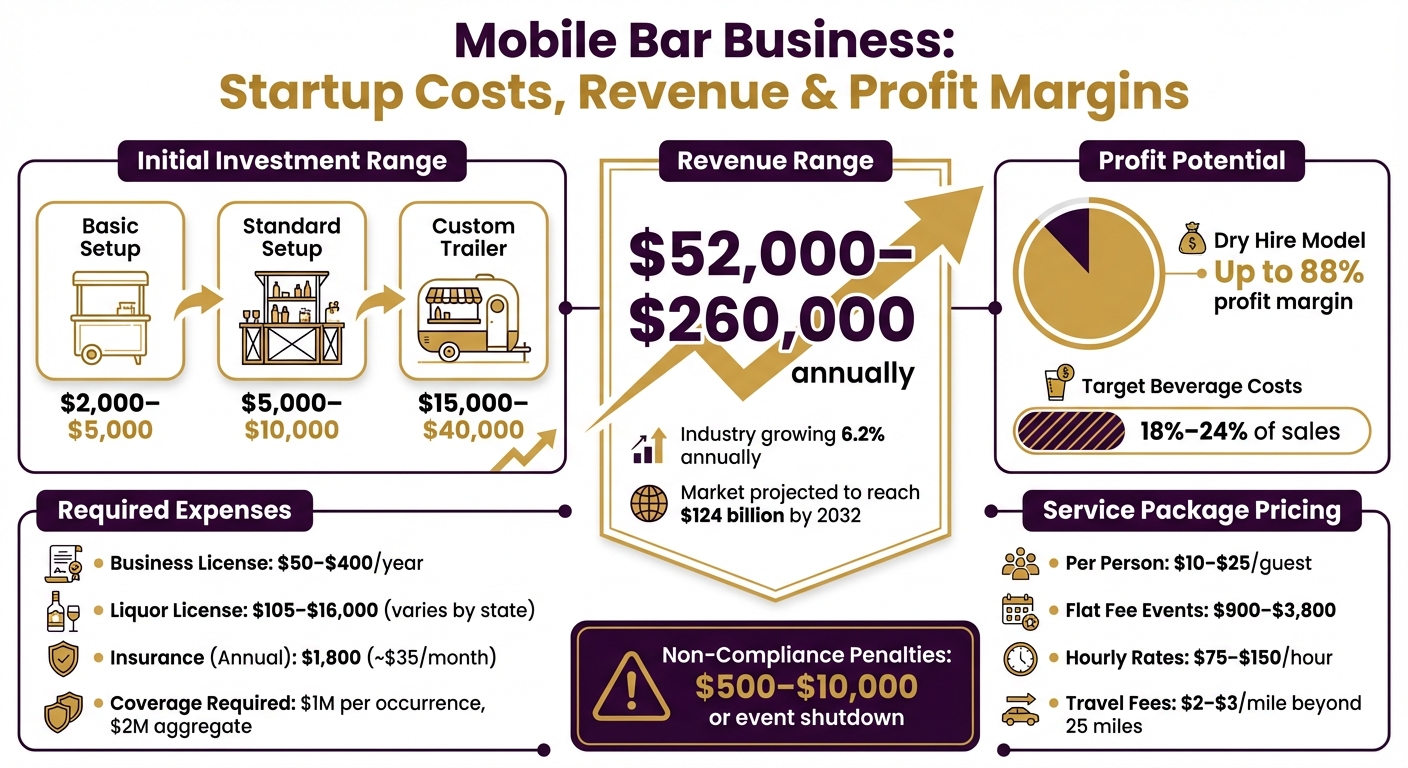
Mobile Bar Business: Startup Costs, Revenue & Profit Margins
How To Start A Mobile Bartending Business from Zero | Brittney Ave
sbb-itb-08dd11e
Compliance and Licensing Requirements
Running a mobile bar comes with strict legal obligations. Penalties for operating without the proper licenses can range from $500 to $10,000, and inspectors have the authority to shut down your event on the spot. While navigating these requirements may seem daunting at first, understanding your business model and local regulations makes the process manageable.
Required Licenses and Permits
The licenses you'll need depend on whether you're offering a full-service setup - where you supply and sell alcohol - or a dry hire model, where clients provide their own alcohol, and you handle bartending and equipment. A full-service operation typically requires a state liquor license, which can cost anywhere from $105 to over $16,000 in California alone. On the other hand, dry hire models often avoid this requirement entirely in most states.
Regardless of your setup, all mobile bars must have a business license (costing $50–$400 annually), a seller's permit for sales tax, and often a mobile vendor license. Many also require a local health permit. Health inspections usually focus on essentials like hand-wash stations with potable and waste tanks, NSF-listed coolers (standard coolers may not meet requirements), and properly labeled sanitizer (200 ppm).
"Mobile bar legal requirements begin with a liquor license, mobile‑vendor permit, general business license, and event‑specific paperwork." - Cedar Trailer
It's crucial to submit event-specific paperwork at least 30 days in advance to avoid delays. State regulations vary widely: California and Tennessee often require a physical location to obtain a mobile catering permit, while states like Oregon and Vermont only require annual paperwork. In Florida, a Series 10C license is common for mobile bars tied to catering companies, whereas Alabama has minimal state-level requirements. Always check local zoning maps before signing contracts - a North Carolina mobile bar owner learned this the hard way in 2024 when a neighbor's complaint led to a $7,500 refund after deputies shut down a lakeside wedding.
Some states also mandate bartender certifications, such as TIPS, LEAD, or ServSafe. Food handler's cards, which cost around $15 per employee in states like California, are often required as well. To stay organized, store digital copies of all permits in a cloud folder, naming files with expiration dates (e.g., "TABC-exp-2026-05-14.pdf") for easy access during inspections.
Once your licenses are in place, securing comprehensive insurance is the next step in protecting your business.
Liability Insurance and Event Permissions
Insurance is non-negotiable - it’s your financial safety net. Most venues require liquor liability coverage of $1 million per occurrence and $2 million aggregate before allowing you to operate. Policies often bundle liquor liability, commercial auto, general liability, and inland marine coverage, with annual costs around $1,800 and monthly premiums starting at $35.
Liquor liability insurance shields you from claims if an intoxicated guest causes damage or injury. For example, in 2024, a Georgia mobile bar owner faced a $75,000 medical claim after a guest was injured by a toppled garnish station. Fortunately, the owner's insurance covered the entire cost. General liability insurance covers third-party injuries like slips and falls, while commercial auto insurance protects your tow vehicle and trailer during transport.
"While all businesses need general liability insurance, mobile bars that sell or serve alcoholic beverages need liquor liability coverage because they can be held legally responsible for damages caused by intoxicated guests." - Insurance Canopy
In some states, such as Washington, proof of liability insurance is required before a liquor license can be approved. Keep in mind, claims may be denied if your licenses have expired, so staying on top of renewals is critical. Venues often request a Certificate of Insurance (COI) at least 48 hours before load-in.
Having robust insurance not only satisfies venue requirements but also ensures your business remains operational in the face of unexpected challenges.
Alcohol Regulations by State
State-specific alcohol laws further shape how mobile bars operate. Keeping a handwritten log of incidents - such as service refusals, spills, or unusual events - can satisfy inspectors and serve as vital documentation in case of liability claims.
Staff training is essential. Employees should know how to use ID scanners, recognize intoxication, and handle garnishes in compliance with health standards. If your events span state lines, confirm that your liquor liability policy covers out-of-state operations, as many policies are state-specific. To avoid surprises, consider hiring a retired health officer for a mock inspection (around $250) to identify potential violations before the real inspection. This small step can save you from event-day shutdowns and hefty fines.
The mobile bartending industry is thriving, with a market size of $4 billion and an annual growth rate of 3.4%. Establishing a solid legal and operational foundation allows you to focus on delivering outstanding service to your clients while staying compliant with all regulations.
Setting Up Your Mobile Bar
Once you've sorted out compliance details, it's time to focus on creating a mobile bar that's both functional and visually appealing. After securing your licenses and insurance, the next step is investing in the physical setup. Startup costs can vary greatly depending on your goals. A basic setup with a portable bar, essential tools, and glassware typically costs between $5,000 and $10,000. On the other hand, a high-end operation with a professional trailer and commercial-grade equipment can range from $15,000 to $30,000, while custom trailers with built-in refrigeration can exceed $40,000.
Equipment and Tools You'll Need
Your equipment choices will depend on your budget and the events you plan to serve. Lightweight folding bars are a budget-friendly option, though they lack the sturdiness of custom-built trailers with integrated systems. Essential bartending tools include shakers, jiggers, bar spoons, muddlers, strainers, bottle openers, corkscrews, speed pourers, and garnish caddies.
Refrigeration is critical for keeping beverages cold and satisfying health inspections. You'll need NSF-listed portable refrigerators, insulated ice bins, and portable ice makers. A compliant portable hand-washing station is also a must. Other essentials include sanitizer spray bottles (200 ppm QUAT or 100 ppm bleach), non-slip mats, a fire extinguisher, and a first aid kit.
For tech, invest in handheld POS systems and portable card readers to manage transactions and track inventory. Portable power sources, like generators or battery packs, are also necessary to keep your equipment running smoothly.
To stay profitable, aim to keep your beverage costs between 18% and 24% of sales. Regular maintenance is key - clean your draft lines and inspect seals and gaskets frequently to avoid breakdowns during events.
With the right tools and equipment, you'll be well-prepared to meet both client expectations and operational standards.
Vehicle Options for Transportation
Your choice of vehicle will depend on your budget, service style, and the size of the events you plan to serve. Trailers - such as converted horse boxes, campers, or utility trailers - offer ample space for refrigeration, storage, and built-in bar systems. However, they require a tow vehicle and can be challenging to maneuver.
For a more distinctive look, vintage trucks and cars are popular for weddings and upscale events. They provide eye-level service but often have limited storage and may require more maintenance due to older engines. Vans are another option, often featuring built-in refrigeration, though they may need significant modifications to function as a bar.
If you're looking for a simpler, more affordable option, consider pop-up or satellite bars. These portable units cost between $2,000 and $5,000, are easy to transport, and work well in indoor venues where trailers may not fit.
Before purchasing any vehicle, make sure it can handle your event needs. For events with 150+ guests, you'll likely need more than two taps and adequate cooling capacity. Branding is also important - use vehicle wraps, signage, and magnetic menus to create a professional, recognizable look.
Choose a vehicle that aligns with your event size, service style, and overall branding.
Branding and Visual Design
Your mobile bar's visual appeal plays a huge role in attracting high-end clients. The most successful bars focus on a specific aesthetic - whether it's sleek and modern, rustic, boho-chic, organic, or gothic - to appeal to their target audience. Consistency is key: your branding should carry across everything from your vehicle wrap and menu boards to staff uniforms and your online presence.
"We really try to make it a unique experience for every client, and not so cut-and-paste." - Nicole Sisson, Co-owner, Bad N' Boozy
Efficiency is just as important as aesthetics. Design your bar layout with a "tight triangle" setup (ice, well, garnish) to streamline service. Use magnetic menu boards, clip-on LED task lights, and dimmable accent lighting to create a welcoming atmosphere for guests and a functional workspace for staff.
A modular setup can make your bar more adaptable - create a core bar layout with optional add-ons, like "beer-forward" or "cocktail-forward" configurations, to suit different event themes and sizes. Sharing high-quality photos of your bar in action and proof of passed inspections on social media can also build trust and attract more clients.
A strong and consistent visual identity not only helps you stand out but can also justify charging premium prices.
Creating Service Packages That Sell
Getting your pricing structure right is a game-changer. Many successful operators use three simple tiers: Basic (just the service), Standard (service with mixers and ice), and Premium (full-service, including signature cocktails and a polished presentation). This clear setup makes decision-making easier for clients and helps you increase your revenue.
In states like California, where mobile bars can't legally sell alcohol without a fixed address, the dry-hire model is the go-to approach. Here, clients buy their own alcohol, while you handle the bartending, tools, and setup. This model keeps your profit margins high - up to 88% - since you're skipping inventory costs and complex licensing.
How to Structure Tiered Packages
Design your packages around guest count and the complexity of service. For example, a common staffing ratio is one bartender per 50–75 guests for beer and wine or one bartender per 25 guests for craft cocktails.
| Package Tier | Ideal For | Typical Inclusions |
|---|---|---|
| Bartender Only | Budget-conscious / DIY hosts | Professional staff and basic tools; client provides all liquids and ice |
| Essential Elegance | Private parties / Showers | Bartenders, house spirits/mixers, standard bar setup, and menu planning |
| Mixology Extravaganza | Weddings / Corporate Galas | Dedicated mixologists, themed menus, premium ingredients, and live demos |
| Specialty/Niche | Festivals / Themed events | Custom menus (e.g., Tiki, Whiskey Tasting) and specialized equipment |
Be sure to account for setup and teardown time - typically 2–3 extra hours - in your labor costs. In 2025, the average cost for a 100-guest wedding bar ranged between $3,000 and $5,000, reflecting a 7% annual price increase. And keep in mind, as of May 2024, the median hourly wage for bartenders was $16.12.
To stand out, consider offering niche packages like mocktails, coffee bars, matcha stations, or kombucha. These options appeal to health-conscious clients and help you tap into the growing demand for non-alcoholic beverages.
Tailoring Services to Event Types
Every event has its own vibe, and your services should match. For weddings, personalization is key. Offering "His and Hers" signature cocktails or curated menus can balance the couple's budget with a great guest experience. Secure wedding bookings 3–6 months in advance to lock in premium dates and allow for menu planning.
Corporate events often prioritize efficiency and professionalism. Sophisticated setups, branded cocktails for launches, and a team skilled in high-volume service can make all the difference. For these events, hourly rates between $75 and $150 - depending on the menu - are common.
For private parties, it's all about fun and flexibility. Add interactive elements like mixology lessons, garnish bars, or themed menus (think tropical tiki or whiskey tastings) to create memorable experiences. Smaller gatherings usually require only a few weeks' notice for bookings.
Festivals and public events demand speed and creativity. Highlight "Culinary Cocktails" with local ingredients or food pairings to stand out from the usual festival offerings.
Always provide clients with alcohol calculators to help them shop efficiently and avoid overbuying. This not only saves them money but also positions you as a helpful partner. And for every event, don't forget to include options for non-drinkers, like handcrafted mocktails or infused water stations.
Pricing Models for Maximum Profit
Once your tiered packages and tailored services are set, choose a pricing model that works best for your business. You have three main options: per-person rates, hourly rates, and flat-fee packages.
- Per-person rates are great for events with confirmed headcounts. Common ranges include $10–$12 per guest for beer and wine, $15–$18 for standard cocktails, and $20–$25 for premium craft cocktails.
- Hourly rates provide flexibility for events with uncertain end times. Typical charges are $75–$90 per hour for beer and wine, $100–$120 for mixed drinks, and $130–$150 for craft cocktails.
- Flat-fee packages offer budget certainty. For example:
- Classic package (beer/wine, 3 hours): $900–$1,200
- Signature package (mixed drinks, 4 hours): $1,500–$2,000
- Deluxe package (craft cocktails, 5 hours, extra staff): $3,000–$3,800
"The client only cares about the bottom line when you pitch them your mobile bartending services." - Eric Del Buono, Mobile Bar Hub
Don't forget to include travel fees - free within 25 miles, but charge $2.00–$3.00 per mile beyond that. Upselling extras like espresso martini stations, lawn games, or professional glassware (typically $3–$5 per guest) can add hundreds to your invoice while enhancing the client experience.
To keep costs in check, aim for beverage expenses to be 18% to 24% of sales. Streamline your offerings by limiting the menu to two signature cocktails plus beer and wine - this alone can cut supply costs by up to 25%. Use seasonal ingredients like citrus in winter or berries in summer to keep garnishes fresh and affordable.
Finally, implement a payment schedule to maintain cash flow: collect 30% as a booking deposit, 40% two weeks before the event, and the remaining 30% on the event day. This setup protects you from cancellations while giving clients manageable payment milestones.
To expand your reach, build connections with wedding planners and venue owners who can recommend your services to their clients. By integrating thoughtful add-ons and precise pricing, you can grow your revenue while covering all your operational costs.
Increasing Revenue and Growing Your Business
Startup Costs and Financial Planning
Laying a strong financial foundation from the start can save you a lot of headaches later. For most mobile bar startups, the initial investment ranges from $15,500 to $89,000, depending on whether you're starting with a simple portable setup or going all-in with a customized trailer and high-end equipment. These costs generally fall into four main categories: rig and equipment, compliance (like licenses and insurance), operating expenses, and profit margin planning.
If you're looking to keep things lean, consider launching with a portable "satellite" bar. This approach minimizes overhead and allows you to reinvest revenue from early events to grow your business. Insurance for liquor liability will cost you around $28 to $115 per month, while licenses and permits can run between $2,000 and $5,000, depending on your location.
Don't forget to budget for labor costs associated with setup, teardown, and travel - these tasks typically add about three extra hours to a standard four-hour event. It's also smart to have 1–2 months' worth of operating expenses as a financial cushion. To determine your minimum viable rate, divide your total fixed costs by the number of billable hours you expect annually, then add your desired profit margin. Create pricing models for both a basic package (serving 100 guests over 4 hours) and a premium package (serving 250 guests over 5 hours) to ensure your rates cover all costs while contributing to your overhead.
Once your baseline is set, you can focus on boosting revenue through additional services.
Upselling and Add-On Services
With your startup costs mapped out, the next step is to maximize revenue per event. Many successful operators streamline this process by offering a fixed menu of add-on services. Some popular options include espresso martini stations, barrel-aged cocktails, smoke infusers (typically priced between $50 and $200 per event), and champagne walls [3,25]. Even glassware rentals can add $3 to $5 per guest to your bottom line.
Interactive experiences are another great way to enhance events while increasing profits. For example, you might offer cocktail-making classes as a standalone service or set up garnish bars where guests can customize their drinks. Corporate clients often appreciate branded cocktails tied to product launches or company events, which can justify higher pricing.
Don't underestimate the demand for alcohol-free options, either. Mocktail stations, coffee carts, or kombucha bars are excellent choices for family-friendly events or wellness-focused gatherings [3,6].
To further protect your margins, consider adding surcharges for early access, late breakdowns, or challenging load-ins [5,25]. Offering additional staff, such as bartenders or barbacks for larger events, not only enhances service but also increases your labor revenue [3,26].
Once you've optimized your event revenue, it's time to think about scaling your business.
Expansion Strategies
Maximizing per-event profitability lays the groundwork for scaling your operation. One of the first steps is transitioning from an owner-operator model to managing a team. Hiring trustworthy lead bartenders and barbacks allows you to book overlapping events, increasing your capacity without requiring your personal presence at every gig [2,6].
Only invest in additional vehicles or trailers when your current setup consistently struggles to meet demand or results in long guest wait times [5,6]. While a second rig can help you serve multiple events in one day, it also comes with higher maintenance costs and added logistical challenges. To manage these complexities, invest in scheduling and inventory software early on. Keep in mind that while the median hourly wage for bartenders was $16.12 in May 2024, mobile bartenders working events often earn higher rates.
Geographic expansion and partnerships can also drive growth. Expanding your service area is as simple as implementing tiered travel fees for venues located 50+ miles away, helping you cover extra logistics costs. Building relationships with event planners, photographers, and venues without permanent bar setups can secure steady bookings year-round [6,7].
Finally, consider branching out into niche markets. Mocktail bars, coffee carts, and similar offerings can help you tap into family-friendly events and corporate wellness gatherings [3,6]. And with the catering industry growing at 6.2% annually, reaching a projected value of $124 billion by 2032, there's plenty of opportunity to carve out your share of the market.
Marketing and Getting Customers
Creating a Memorable Brand
Your mobile bar's vehicle is essentially your storefront. Whether you’re working with a vintage trailer, a horsebox, or even a bicycle cart, this setup becomes the heart of your brand identity. Choose a design that reflects your niche - craft cocktails, mocktails, or themed concepts like Tiki or Champagne bars.
From there, create a logo and stick to a consistent color scheme across all your materials. Equally important is your brand voice. Decide whether you want it to be playful, sophisticated, or something else entirely, and make sure it’s carried through your website and social media. Including trust signals, like certifications for alcohol service and insurance badges, adds credibility and sets you apart. A strong brand doesn’t just attract customers; it also showcases your professionalism and quality. Fun fact: 98% of consumers search for local businesses online.
"The brand of your bar is built on the foundation of your own personality, ethos, and spirit." - Dot Design Group
These branding basics lay the groundwork for effective social media strategies and partnerships.
Social Media and Partnership Strategies
Event footage is a gold mine for social media. Use it to create Instagram Reels, TikTok tutorials, Facebook posts, and Pinterest pins. Each platform has its strengths: Instagram is perfect for polished photos and behind-the-scenes content aimed at brides and event planners, while TikTok can grab the attention of younger audiences with quick, fun mixology clips. Facebook works well for community updates, and LinkedIn is a great way to network with corporate event managers.
Tagging is your best friend. Mention venues, photographers, and event planners in your posts to grow your referral network. For instance, in December 2025, Mr Flavour teamed up with Aston Martin London for their "Vanquish Christmas Soirée", crafting branded Espresso Martinis that matched the luxury brand’s image. Another example: a collaboration with Puma, where the bar designs and drinks reflected Puma’s aesthetic, earning a glowing 10/10 service rating.
Want to sweeten the deal for event planners? Offer them a referral fee of 10–15% to encourage partnerships. Make sure your business is listed on directories like The Knot or Mobile Bar Hub to boost your local visibility. Don’t forget to claim your free Google Business Profile and use localized hashtags like #YourCityMobileBar to help potential clients find you.
These digital strategies are key to building long-term client connections.
Managing Customer Relationships
After an event, follow up with clients within 48 hours. Thank them, ask for a review on Google or Yelp, and introduce a referral incentive like "Refer a friend, save $100".
Email marketing is another great way to keep your brand in front of clients. Share updates about your availability, seasonal cocktail offerings, or other news - this keeps communication consistent without requiring constant manual effort. Loyalty programs can also work wonders; businesses often see up to a 30% boost in customer retention by rewarding repeat clients with discounts or special add-ons. And don’t underestimate the power of consistency - use the same social media handle (e.g., @YourMobileBarName) across all platforms so clients can easily find and recommend you.
Conclusion
Launching a mobile bar business rests on three essential pillars: staying legally compliant, crafting smart service packages, and maximizing revenue. Skipping the necessary licenses, insurance, or permits could lead to fines between $500 and $10,000 - or even having your event shut down on the spot. The bright side? Dedicating just 8–10% of your projected revenue to compliance ensures you remain protected and operate professionally.
Your service packages are the driving force behind your sales. Offering tiered options - such as Classic, Signature, and Premium - makes it easier for clients to choose while safeguarding your profit margins. Don’t forget to account for all aspects of the job, including setup and teardown time. For example, a four-hour event typically requires around seven hours of labor in total. This kind of careful planning is what separates thriving businesses from those that unintentionally undercut themselves.
The industry data is encouraging. The catering sector is expanding at a rate of 6.2% annually, with projections pointing toward a $124 billion market by 2032. Mobile bars alone can bring in yearly revenues ranging from $52,000 to $260,000, and dry-hire models can achieve profit margins as high as 88%. These numbers highlight a lucrative opportunity - but only for those who approach the business with a mix of legal rigor and strategic pricing.
"Mastering mobile bar legal requirements isn't glamorous, but it's the backbone of a profitable, low-stress business." - Cedar Trailer Co.
Focus on informed, deliberate actions. Build a solid compliance framework, design packages that reflect your true costs, and apply effective marketing strategies to stand out. By starting with these fundamentals, your mobile bar business can succeed in this growing market.
FAQs
Do I need a liquor license if clients buy the alcohol?
If your mobile bar business involves clients purchasing alcohol directly from you, you’ll need a liquor license. Selling alcohol legally requires obtaining the appropriate license through your state’s Alcohol Beverage Control (ABC) agency. Always review your local laws and regulations to ensure you’re operating within legal guidelines.
What’s the fastest way to check local permit requirements?
To find out what permits you need for a mobile bar, your best bet is to reach out to local government offices. Start with the city or county health department, the zoning office, and your state’s alcohol control agency. These offices can give you detailed information on required licenses, like liquor licenses and health permits. Many of them also have online tools or resources to help you get the answers you need quickly.
How do I price packages without undercharging for labor?
To set package prices effectively, you need to factor in all costs. This includes staff wages, time spent on setup and breakdown, supplies, and day-to-day operational expenses. Once you’ve tallied those costs, add a profit margin - many businesses opt for a 10% buffer to account for labor and overhead.
When it comes to pricing, you can choose models like charging per hour, per person, or offering flat-rate packages. Don’t forget to include additional fees for things like travel or setup if they apply. Taking the time to calculate these details ensures your packages not only cover your expenses but also keep your business profitable.
Related Blog Posts
 Report an issue
Get the newest tips and tricks of starting your business!