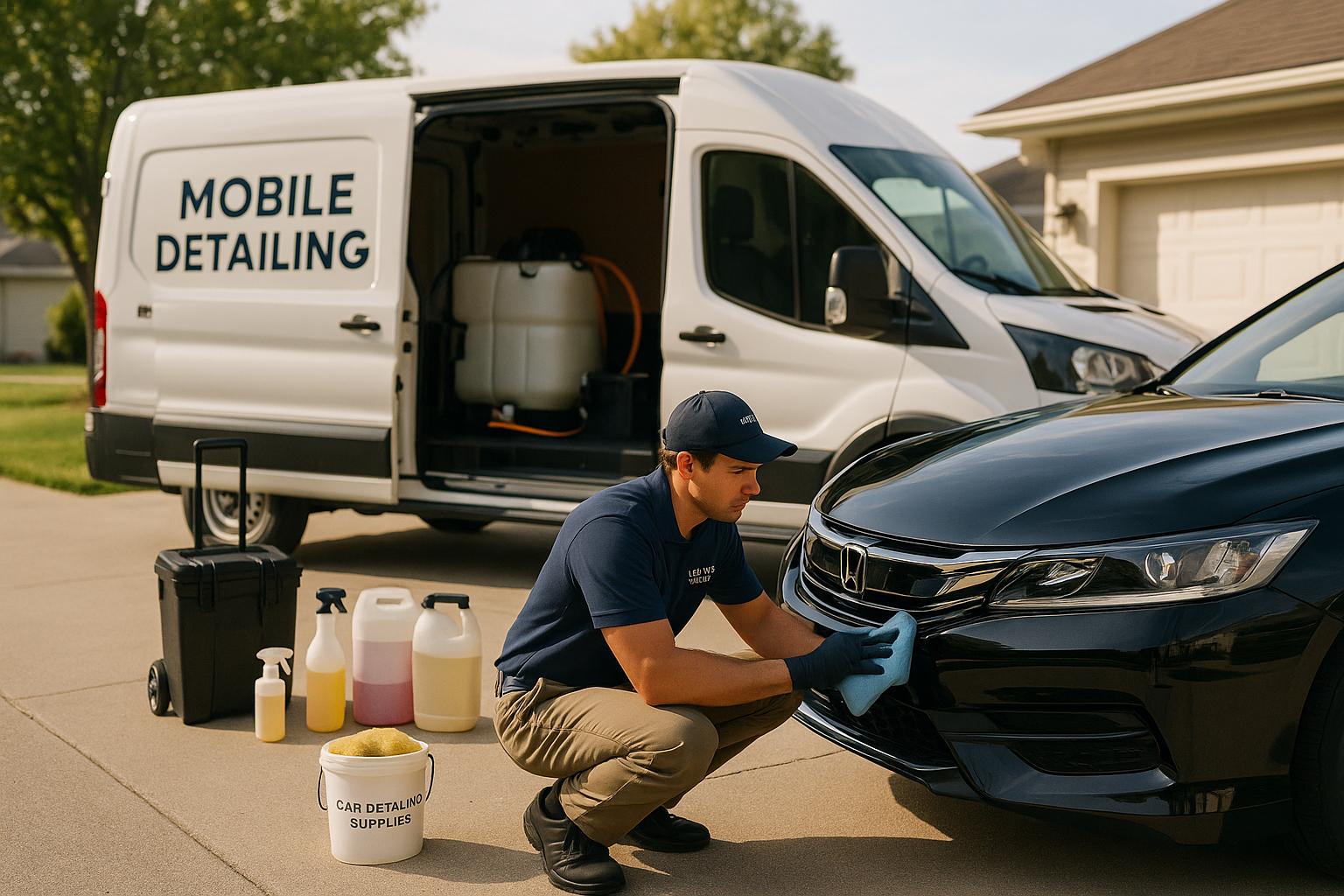
Starting a mobile detailing business can be affordable and profitable. With startup costs ranging from $5,000 to $15,000, you can launch without the need for a physical location. Mobile detailing offers convenience to customers by providing expert car cleaning and restoration services at their doorstep.
Here’s a quick breakdown of what you need to know:
- Startup Costs: $5,000–$15,000 (equipment, vehicle setup, legal requirements).
- Monthly Expenses: Insurance, supplies, fuel, and marketing.
- Profit Margins: Solo operators can see margins of 60%–80%; businesses with employees average 15%–35%.
- Pricing: Tiered service packages (basic, full-detail, premium add-ons) help maximize earnings.
- Break-Even Point: Calculate how many jobs you need to cover costs and turn a profit.
From $500 to $30K/Month with a Mobile Car Detailing Business
Startup Costs Breakdown
Starting a mobile detailing business is surprisingly affordable compared to many other ventures, with typical startup costs ranging from $5,000 to $15,000. Since you won’t need to rent commercial space or install expensive facilities, your primary expenses will focus on equipment, a vehicle, and meeting legal requirements. Let’s break it down.
Equipment and Tools
The tools you invest in will set the foundation for your business. High-quality equipment not only ensures better results but also makes your work more efficient.
- Pressure Washer: This is a must-have. A gas-powered pressure washer with at least 2,000 PSI will cost between $300 and $800.
- Wet/Dry Vacuum: A strong vacuum is essential for interior cleaning and water extraction. Commercial-grade models with 5–6 horsepower motors range from $150 to $400.
- Dual-Action Polisher: Crucial for paint correction and polishing services, entry-level polishers start at $150, while professional-grade options range from $250 to $500.
- Water Tank and Generator: Portable water tanks (50–100 gallons) cost $100–$600, while a 2,000–3,000-watt generator runs $400–$800.
- Cleaning Supplies and Chemicals: Stock up on soaps, waxes, microfiber towels, and other essentials for a total of $700–$1,600.
- Additional Tools: Don’t forget smaller items like extension cords, hose reels, buckets, and detailing brushes, which collectively cost $200–$400.
If you’re on a budget, consider purchasing gently used equipment from other detailers. Platforms like Facebook Marketplace and detailing forums often offer tools at 30–50% below retail prices. However, avoid compromising on critical items like your pressure washer and polisher - these are the backbone of your operations.
Vehicle Requirements
Your vehicle will double as your mobile workshop, so choosing the right one is crucial. Whether you use a vehicle you already own or buy one specifically for your business, it needs to accommodate your equipment and allow for efficient operations.
- Vehicle Options: Many detailers start with their personal vehicle, such as a pickup, SUV, or van, eliminating the need for an upfront purchase. If you’re buying, a used cargo van like a Ford Transit Connect or Chevrolet Express typically costs $15,000–$30,000, depending on its condition.
- Vehicle Modifications: Outfitting your vehicle with shelving, storage racks, and mounts will cost $300–$2,000, depending on whether you do it yourself or hire professionals.
- Branding and Wraps: A professional vehicle wrap turns your ride into a mobile advertisement. Partial wraps cost $1,500–$3,000, while full wraps range from $3,000–$5,000. For a budget-friendly option, consider magnetic signs ($100–$300) or vinyl decals ($200–$500).
Alternatively, some detailers prefer using a small enclosed trailer instead of modifying their vehicle. A used 5x8 or 6x10 enclosed trailer costs $2,000–$4,000 and can be towed by most vehicles, offering secure overnight storage for your equipment.
Business Formation and Legal Requirements
Getting your business set up legally is just as important as having the right tools. These costs ensure you’re compliant and protected.
- Business Structure: Many detailers choose between operating as a sole proprietor or forming an LLC. While a sole proprietorship costs nothing to establish, an LLC offers liability protection. LLC formation fees vary by state, typically ranging from $50 to $500, with an additional $25–$100 annually for required reports.
- Licenses and Permits: Depending on your location, you may need a general business license ($50–$200 annually) and possibly a mobile vendor or home occupation permit. Budget $100–$400 for these costs.
- Insurance: General liability insurance is essential to protect against property damage or injuries and costs $500–$1,500 annually for $1 million in coverage. If you’re using a work vehicle, commercial auto insurance adds another $1,200–$2,500 per year. Some detailers also carry garage keepers insurance, which costs $300–$800 annually and covers customer vehicles in your care.
- EIN and Business Bank Account: An Employer Identification Number (EIN) is free through the IRS and allows you to open a business bank account, keeping your finances organized. Most banks offer free business checking accounts, though some may have minimum balance requirements.
- Bonding: While not mandatory, being bonded can reassure customers. A surety bond costs $100–$300 annually and protects customers if you fail to complete a job as promised.
Total Startup Costs
If you already own a suitable vehicle, you can get started with a basic setup for $5,000–$8,000. For a mid-range operation with upgraded equipment and vehicle modifications, expect to spend $10,000–$15,000. If you’re going all-in with new equipment, professional wraps, and comprehensive insurance, costs can climb to $20,000–$25,000. The beauty of this business model is that you can start small and reinvest profits as your client base grows.
Monthly Operating Expenses
Once your startup costs are behind you, it's time to focus on the monthly expenses that keep your mobile detailing business running seamlessly. Managing these ongoing costs is key to maintaining profitability and ensuring your business thrives.
Fixed and Variable Costs
Your monthly expenses will fall into two categories: fixed and variable.
Fixed costs remain consistent each month, regardless of how many jobs you complete. These typically include insurance premiums for general liability and commercial auto coverage, loan payments (if you financed your vehicle or equipment), and business communication services like a dedicated phone line.
Variable costs, on the other hand, depend on how much work you’re doing. For instance, fuel costs will vary based on the distance you travel between appointments. Similarly, the cost of maintaining your equipment and restocking supplies - like cleaning chemicals, microfiber towels, and waxes - will fluctuate with usage. Keeping a close eye on your inventory can help you avoid unnecessary spending. If you’re using a portable water system, you might also have small refill costs to factor in.
Don’t forget to set aside part of your budget for marketing - it’s a crucial element in attracting steady business.
Marketing and Advertising Costs
Marketing is an investment in growing your customer base. In the early stages, you might spend more on digital advertising, like search engine ads or social media campaigns, to establish your presence and attract new clients. Over time, a balanced approach - combining online efforts, referrals, and targeted promotions - can help you maintain steady growth.
Your marketing budget may include expenses for building and maintaining a professional online presence. This could involve paying for domain registration, web hosting, or subscriptions for website design and search engine optimization tools. Don’t overlook traditional marketing, either - printing business cards or distributing flyers in your community can still be effective.
As your business grows, leveraging the right software can help you operate more efficiently.
Software and Technology Costs
Technology can simplify your operations and enhance the customer experience. While you can start with just a phone and a notebook, many mobile detailers eventually adopt software to manage their growing workload.
Scheduling and booking software can make appointment management easier, cutting down on back-and-forth communication with clients. Payment processing tools streamline transactions, often charging per transaction instead of a fixed monthly fee. Accounting software helps track income, expenses, and mileage, making tax season less stressful. As your business expands, you might also consider customer relationship management (CRM) tools to monitor service histories and client preferences. Email marketing platforms can help you stay connected with past customers and promote special offers. Additionally, route planning apps can save you time and fuel by optimizing your daily schedule.
To keep costs manageable early on, start with essential tools like scheduling, payment, and accounting software. As your business grows, you can add more advanced solutions, like CRM systems and marketing automation, to support your expansion.
sbb-itb-08dd11e
Service Packages and Pricing
Getting your pricing right is crucial for maintaining profitability. If your prices are too low, you might not cover costs; too high, and you risk losing customers. The key is to create service packages that appeal to customers while ensuring every job contributes positively to your bottom line.
Creating Service Tiers
One popular approach among mobile detailers is to offer services in multiple tiers. This gives clients the flexibility to pick a package that fits their needs and budget. For instance, you could start with a basic package focused on exterior cleaning, add an interior-only option, and then offer a full-detail package that combines both. On top of that, premium add-ons - like headlight restoration or ceramic coating - can increase the overall ticket size and cater to specialized requests.
When structuring your tiers, think about the time each service takes and how vehicle size might impact the workload. This helps guide customers toward the right package for their situation while making it easier to manage service demands. Once your tiers are set, ensure the pricing reflects both the costs involved and the value provided.
How to Set Prices
With your service tiers defined, pricing them effectively comes down to understanding your costs and desired profit margins. Start by calculating direct costs like labor, supplies, fuel, and vehicle upkeep. For example, the average supply cost per car is around $15, and the typical hourly rate for an auto detailer in the U.S. is about $29. Use these figures as a baseline to determine your costs, then add a markup that aligns with your profit goals.
Auto detailing businesses generally see profit margins between 15% and 35%. However, solo operators who handle most tasks themselves often achieve margins as high as 60% to 80%. Pricing your services too low can hurt profitability and undervalue the skill and effort you bring to the table.
Market research is another essential part of setting prices. Regularly analyze local rates and customer expectations to stay competitive. Rather than competing solely on price, highlight the quality, convenience, and expertise that set your services apart. It’s wise to review and adjust your pricing every three to six months, especially if operational costs change or you improve service efficiency.
Upselling can also boost revenue without feeling pushy. Offer upgrades or add-ons - like a deeper interior clean or a protective wax - that naturally complement your core services. These extras not only increase revenue but also enhance the customer’s overall experience.
For a more data-driven approach, tools like IdeaFloat's Advanced Pricing Research can help you analyze local market rates and refine your pricing strategy. This takes much of the guesswork out of the process, ensuring your prices are both competitive and profitable.
Profit Margins and Financial Projections
After figuring out startup costs and pricing strategies, the next step is understanding profit margins and cash flow to ensure your business stays afloat and grows. It's not just about what you charge - it's about what you actually keep after covering all your expenses. Let’s break down how to calculate profit margins, pinpoint your break-even point, and plan for steady growth.
Calculating Your Profit Margins
The formula for profit margin is simple:
Profit Margin = [(Revenue – Total Costs) ÷ Revenue] × 100
Here’s an example: if you charge $150 for a detailing job and your total costs (supplies, fuel, labor, overhead) are $90, your profit is $60. That $60 profit on $150 translates into a 40% margin - a solid figure for a mobile detailing business.
Your expenses fall into two categories: direct costs (like supplies, fuel, and labor, which vary with each job) and indirect costs (such as insurance, marketing, and software subscriptions, which stay the same regardless of how many cars you detail). To get an accurate picture of your service costs, you’ll need to allocate indirect costs across all jobs.
If you’re working solo, profit margins can range from 60% to 80%. However, once you hire employees, margins typically drop to 15%–35%, as labor costs become your largest expense. To maintain profitability, track every expense carefully and adjust your pricing or cut unnecessary costs as needed.
Don’t forget to include your own labor costs when calculating profitability. Even if you’re not paying yourself a salary yet, your time has value. Estimate what you’d pay someone else to do the work and factor that in. This approach gives you a clear picture of profitability and helps you decide when it’s time to hire extra help.
Once you understand your margins, the next step is figuring out how many jobs you need to break even.
Break-Even Analysis and Revenue Forecasts
Your break-even point is the moment your revenue covers all your expenses. At this stage, you’re not making a profit yet, but you’re no longer losing money. Knowing this number is crucial because it tells you how many jobs you need to book each month to stay afloat.
Start by adding up your monthly fixed costs. For instance, if your recurring expenses (vehicle lease, insurance, phone, software, marketing, etc.) total $1,200 per month, that’s your baseline. Next, calculate your profit per job. If you charge $150 per job with $90 in direct costs, your profit per job is $60. To cover $1,200 in fixed costs, you’d need to complete 14 jobs per month ($1,200 ÷ $90).
Now, let’s say you want to make $3,000 in profit each month. Add that to your fixed costs ($1,200 + $3,000 = $4,200) and divide by your profit per job ($90). You’d need to complete about 47 jobs per month - or roughly 12 jobs per week - to hit your target.
Revenue forecasting becomes more accurate as you gather real data. Track metrics like the number of inquiries you receive, your conversion rate (inquiries to bookings), and your average ticket size. For example, if you get 20 inquiries per week and convert 50% into bookings, that’s 10 jobs. Multiply that by your average ticket price to estimate weekly revenue. Adjust your marketing or services as needed to meet your goals.
Keep in mind that seasonality plays a big role in mobile detailing. Spring and summer are often busier, with customers preparing for road trips or sprucing up their cars. Winter, especially in colder regions, can be slower. To balance this, save extra during peak months or offer winter-specific services like salt removal or interior-only packages.
Tools like IdeaFloat’s Financial Projections & Breakeven Analysis can simplify this process. These tools provide month-by-month revenue and cost projections, helping you see when you’ll reach profitability and whether you’ll need additional funding to bridge any gaps. Interactive graphs make it easier to visualize your financial path and adjust your plans as needed.
With your break-even targets in place, the next step is scaling your operations while managing cash flow effectively.
Scaling and Managing Cash Flow
Scaling a mobile detailing business means growing your revenue without your costs ballooning at the same rate. One common way to scale is by hiring employees or subcontractors to handle more jobs, freeing you up to focus on sales and operations. However, scaling comes with challenges, especially around cash flow and maintaining quality.
Managing cash flow becomes critical as you grow. In mobile detailing, most customers pay immediately after service, but hiring employees introduces new costs, like regular payroll, which you’ll need to cover before their work generates enough revenue. A cautious approach is to start with part-time help or pay workers per job until demand justifies a full-time hire. This keeps your fixed costs low while you test whether the added capacity leads to more bookings.
Track your utilization rate - the percentage of available hours that are booked. If you’re consistently booked 80% to 90% of the time, it’s a good sign you’re ready to bring in another detailer.
Invest in tools to streamline operations as you scale. Scheduling software can help you organize jobs and avoid double bookings. Customer relationship management (CRM) tools make it easier to follow up with leads and encourage repeat business. Payment processing apps simplify transactions and reduce the hassle of handling cash. While these tools come with upfront costs, they save time and reduce errors, making them worthwhile investments.
Maintaining quality becomes even more important as you scale. Create detailed checklists and standard operating procedures to ensure every customer gets the same high level of service, regardless of who does the work. Regularly inspect completed jobs and gather customer feedback to catch issues early. A single bad review can undo months of effort building your reputation, so it’s critical to uphold your standards.
Another way to grow is by offering higher-margin services. Specialized offerings like ceramic coatings, paint correction, or headlight restoration require additional skills and equipment, but they also command premium prices. These services appeal to car enthusiasts who are willing to pay more, boosting your average ticket size without requiring you to book more jobs.
To manage cash flow during growth, keep a close eye on your bank balance and plan for irregular expenses. Set aside money each month for equipment repairs, vehicle maintenance, and slow periods. Aim to save at least three months’ worth of operating expenses before taking on significant new costs, like hiring full-time staff or buying a second vehicle.
If you need funding to scale - whether for a new vehicle, equipment, or marketing - understand your financing options. Small business loans, lines of credit, and equipment financing are common choices. Before borrowing, make sure your financial projections show you can handle the debt. Calculate whether the additional revenue from scaling will cover loan payments while still leaving you with a healthy profit margin.
IdeaFloat’s Financial Model tool can help you navigate these decisions. It tracks your income and expenses, models different growth scenarios, and shows how hiring, equipment purchases, or new services impact your bottom line. This helps you grow your business responsibly without overextending yourself.
Conclusion
Starting a mobile detailing business doesn’t have to drain your savings. The key is setting rates that cover your true costs - like supplies, fuel, labor, and overhead - while leaving room for a healthy profit. Offering tiered service packages, such as basic, premium, and specialty options, can help attract a range of customers and maximize your earnings.
Profit margins can differ widely depending on your setup. Solo operators often enjoy higher margins, typically between 60% and 80%, while businesses with employees see margins closer to 15% to 35%. Knowing these figures can help you plan and prioritize your financial goals.
A break-even analysis is a powerful tool to map out your path to profitability. Keep a close eye on performance metrics, adjust your marketing strategies as needed, and stay adaptable to what works best in your market.
As your business grows, pricing remains one of your most critical tools. Managing cash flow effectively becomes even more important. Save during busy seasons to cover slower months, set aside funds for unexpected equipment repairs, and expand your business at a pace you can handle. These financial habits, combined with efficient operations, are essential for long-term success.
The mobile detailing industry presents real opportunities for those willing to put in the effort. By building a solid financial plan, pricing your services fairly, and delivering consistent quality, you can create a business that not only generates steady income but also has room to grow. With careful planning and a confident approach, you’re ready to get started.
FAQs
What essential equipment do I need to start a mobile detailing business?
To kick off a mobile detailing business, you'll need the right tools to deliver top-notch results. Start with the basics: a pressure washer, rotary buffer, polishers, and a selection of waxes and detergents. For more specialized cleaning, stock up on tire and rim cleaners, carpet and upholstery shampoo, deodorizers, and proper chemical storage solutions.
Don't forget the smaller essentials that make a big difference. A vapor steamer, vacuum cleaner, brushes, buckets, sponges, chamois cloths, and microfiber towels are must-haves for detailed and efficient work. Investing in durable, high-quality equipment from the start will help you provide excellent service and build a strong reputation with your customers.
What are the best ways to market my mobile detailing business and attract loyal customers?
To market your mobile detailing business effectively, start by building a strong online presence. Create a clean, easy-to-navigate website that highlights your services, pricing, and contact details. On social media, share engaging content like before-and-after photos, customer reviews, and special offers to grab attention and build trust.
Use local SEO techniques to make sure your business shows up in "near me" searches. Collaborating with nearby businesses, such as car dealerships or auto repair shops, can help you tap into their customer base. Offering perks like referral discounts or loyalty rewards is another great way to keep customers coming back. For offline efforts, distribute flyers or business cards in busy areas and make an appearance at community events to get your name out there.
How can I manage cash flow and stay profitable during slower periods in my mobile detailing business?
To keep your cash flow steady and maintain profitability during slower times, consider broadening your services and trimming unnecessary costs. For instance, you could introduce seasonal promotions or bundled deals to draw in more customers and encourage them to return. Streamlining operations is another smart move - cut down on waste, negotiate better deals with your suppliers, and keep a close eye on your expenses.
Marketing is another area worth focusing on. Running targeted social media campaigns or teaming up with local businesses can help you reach new customers. A strong brand presence and regular engagement with your audience can create consistent demand, even when business is slow. And don’t overlook the basics: improving efficiency and keeping your customers happy are key to staying profitable in the long run.
Related Blog Posts
 Report an issue
Get the newest tips and tricks of starting your business!