Worried about losing customers when updating your pricing? A carefully planned 5-email sequence ensures you keep their trust while minimizing cancellations. Research shows up to 95% of customers stay loyal when businesses communicate price changes clearly and early. Here's how to do it:
- Email 1 (60 Days Out): Announce the change with clear details and reasons (e.g., added features or rising costs).
- Email 2 (45 Days Out): Highlight what customers gain from your product or service.
- Email 3 (30 Days Out): Offer options like locking in current rates or switching plans.
- Email 4 (7 Days Out): Send a final reminder before the new pricing takes effect.
- Email 5 (Post-Change): Confirm the new rate and thank customers for their loyalty.
This approach gives customers time to adjust, reinforces the value of your product, and reduces churn. By being transparent and offering choices, you can turn a challenging situation into an opportunity to strengthen relationships.
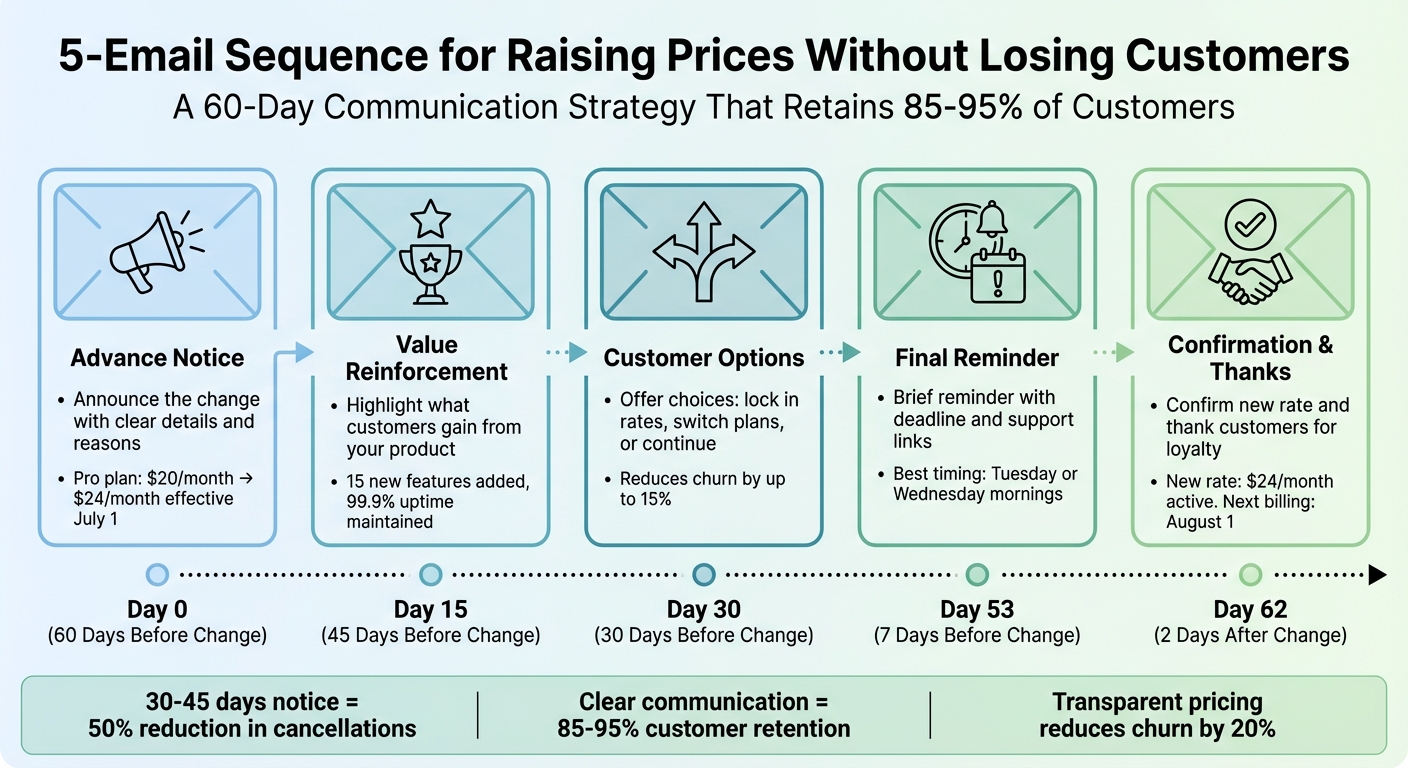
5-Email Sequence for Price Increase Communication Timeline
How To Raise Your Prices With A Price Increase Letter Email
sbb-itb-08dd11e
Why a 5-Email Sequence Works for Price Changes
Announcing a price increase can be tricky. When done abruptly, it often catches customers off guard, leading to frustration, cancellations, and a sense of broken trust. A single email simply doesn’t cut it - it feels too sudden and leaves little room for customers to process the change.
A phased approach, spread over 30–60 days, works far better. By using a 5-email sequence, you give customers time to adjust. They can lock in current rates, plan their budgets, or switch to a lower-tier plan if needed. This strategy avoids the feeling of being blindsided and gives them a sense of control over the situation. Data shows that providing at least 30–45 days' notice can slash cancellation rates by up to 50% compared to shorter timelines.
But it’s not just about giving notice - it’s about reinforcing value. Each email isn’t just a reminder of the price change; it’s a chance to highlight what customers are paying for. By showcasing new features, service upgrades, or measurable ROI, you help customers understand the "why" behind the increase. Instead of seeing it as arbitrary, they’re more likely to view it as a justified adjustment.
This gradual approach also benefits your support team. Spreading out communication prevents a flood of angry or confused inquiries all at once. Instead, questions come in waves, making it easier to respond thoughtfully and personally. This not only reduces stress on your team but also strengthens customer relationships by showing you’re listening and addressing their concerns.
Transparency is the foundation of this strategy. When you clearly explain the reasons for the price change - whether it’s due to higher operational costs, team growth, or improved services - customers are more likely to accept it. They see it as a necessary step to maintain or enhance the product they rely on, rather than a profit grab. Clear communication like this can help retain 85% to 95% of customers, while vague or abrupt price hikes risk losing 30% or more.
In short, a well-planned 5-email sequence doesn’t just inform - it builds trust, reinforces value, and helps maintain strong customer relationships.
The 5-Email Sequence for Communicating Price Increases
Here’s a guide to structuring a 5-email sequence that keeps your customers informed about price changes while maintaining trust. Each email builds on the last, making the transition smoother and reinforcing the value of your product.
Email 1: Advance Notice
Start by notifying customers well in advance - about 60 days before the new pricing takes effect. Use a clear and direct subject line like: "Pricing Update Effective July 1, 2026." Be upfront in your opening:
"Starting July 1, 2026, our Pro plan will increase from $20/month to $24/month."
Follow this with a concise explanation of why the change is happening. Avoid vague phrases like "rising costs." Instead, use specifics:
"Since you joined, we’ve added 15 new features," or "Our infrastructure costs have risen by 12% to maintain 99.9% uptime."
This keeps the tone factual and confident. As one expert puts it:
"If you sound too apologetic when announcing your price increase, you are undermining your product's value."
End the email by reinforcing the value of your service.
Email 2: Value Reinforcement
At the 45-day mark, shift the focus to the value your product delivers. This email isn’t about the price - it’s about what customers are getting in return. Highlight key improvements or features added since they first subscribed. For example, if you’re writing to IdeaFloat users, mention tools like Advanced Pricing Research or Financial Projections. Use clear, scannable points to show the impact:
- "You’ve validated 47 business ideas."
- "You’ve saved an estimated 120 hours of research time."
By showing tangible benefits, you make the price change feel more justified.
Email 3: Customer Options
Thirty days out, give customers control by presenting clear options. This empowers them to make a decision that works best for their needs. For example:
- Lock in the current $20/month rate by switching to an annual plan before the deadline.
- Commit to a 24-month term and secure the current rate for two years.
- Continue with the new $24/month pricing and enjoy full Pro features.
Here’s how this might look in a table:
| Option | Description | Benefit |
|---|---|---|
| Lock in Current | Switch to an annual plan | $20/month for 12 months |
| Grandfathered | Commit to a 24-month term | No price increase |
| New Rate | No action needed | Full Pro features at $24/mo |
This approach can reduce churn by up to 15%, as customers appreciate having choices.
Email 4: Final Reminder
Send a brief reminder seven days before the change takes effect. Recap the new rate, emphasize the deadline to lock in the old pricing, and include links for account settings or customer support. Timing matters - Tuesday or Wednesday mornings work best. Here’s an example:
"Questions? Email support@ideafloat.com or call us at (555) 123-4567."
Keep it short and actionable.
Email 5: Confirmation and Follow-Up
Two days after the new pricing goes live, send a confirmation email. Acknowledge the change with a simple statement like:
"Your new billing rate of $24/month is now active. Your next billing date is August 1, 2026."
Thank customers for their loyalty and include a link to their dashboard for easy account management. This final email closes the loop and reinforces the value of staying with your service.
Practical Tips for a Smooth Price Transition
Handling price changes requires more than just sending emails - it’s about building trust and being prepared for customer concerns. A well-trained support team plays a big role here. Before launching your email sequence, ensure your team knows how to confidently answer questions about timelines, affected services, and the reasons behind the change. When customers call or email, clear and confident responses help maintain trust and show that you’re ready to assist.
While emails set the stage for open communication, your support team is the backbone of customer confidence. Pay close attention to feedback from support channels to spot recurring concerns. For your most valuable accounts (the top 20%), consider skipping mass emails altogether. Instead, opt for personal outreach through phone calls or video meetings to address their concerns directly.
To reduce incoming inquiries, create a detailed FAQ page that answers common questions. Include a link to this page in every email you send. You might also want to add a scheduling link, allowing customers to book a direct call with your team if they need more personalized help.
Set aside a budget to assist customers facing genuine financial difficulties. Not all objections are attempts to negotiate - some customers might be dealing with real hardships. Having a flexible policy for these situations can help retain their loyalty without undermining your pricing strategy.
Keep an eye on support tickets, Net Promoter Scores (NPS), and churn rates during the 60-day transition period. If you notice a sudden rise in cancellations, act fast by offering enhanced retention options. These proactive steps reinforce the transparency and value communicated in your 5-email sequence.
Conclusion
Using our detailed 5-email strategy, it's clear how transparency can strengthen customer retention. When companies communicate price changes openly, they manage to retain between 85% and 95% of their customers during such transitions.
The key lies in building trust through every email - by giving advance notice, emphasizing the value customers receive, and offering them choices. Research supports this: when customers understand the benefits they’re getting, up to 84% remain loyal even after a price increase. The real issue isn’t the higher cost - it’s the feeling of being caught off guard or undervalued.
Clear communication about pricing can reduce churn by as much as 20%. That’s why this strategy spaces out messaging over 30–60 days, giving customers time to plan and make informed decisions. As Harvard Business Review wisely points out:
"Brands that avoid transparency... will face an uphill battle to regain lost trust".
Ultimately, success hinges on confidently owning your decision while showing genuine respect for your customers. Highlight the value you’ve delivered, provide practical options like annual pricing or downgrade opportunities, and ensure your team is equipped to address concerns effectively. By combining thoughtful communication with honesty, you not only simplify the transition but also strengthen customer loyalty for the long haul.
FAQs
How do I choose the right price increase amount?
To determine the right price adjustment, you’ll need to weigh factors such as rising operational costs, the additional value you’re offering, and the current market landscape. Typically, price increases fall between 5% and 15%, though this can vary based on your industry and what your customers expect.
When implementing a price change, clear communication is crucial. Be upfront about why the adjustment is necessary, give your customers advance notice, and consider easing the transition with measures like grandfather clauses for existing clients. Striking the right balance between boosting revenue and maintaining customer trust is essential for a smooth process.
What should I do if customers ask for an exception?
If a customer asks for an exception to your price increase, it’s important to respond with professionalism and respect. Acknowledge their concerns, but stand firm on your pricing. You might suggest cost-effective options or highlight what makes the updated pricing worthwhile. For instance, you could say:
"I truly appreciate your business and understand your concerns. Our pricing reflects both the costs we incur and the value we aim to deliver. I hope we can continue our partnership under these terms."
This way, you maintain transparency while reinforcing the value of your services.
What metrics should I track during the 60-day rollout?
When rolling out a price increase over 60 days, it’s essential to keep a close eye on specific metrics to understand how customers are reacting. Here’s what to focus on:
- Retention rate: This tells you how many customers stick around after the price change. A stable retention rate is a good indicator that your strategy is working.
- Churn rate: Look at whether customers are canceling their subscriptions or downgrading to lower-priced options. A spike here could signal dissatisfaction.
- Email engagement: Pay attention to open rates and click-through rates for emails announcing the price change. These numbers show how well your message is resonating.
- Revenue impact: Track any shifts in overall revenue - this will help you gauge whether the price increase is offsetting potential losses from churn.
By monitoring these metrics, you can assess how well your approach is balancing profitability with customer loyalty.
Related Blog Posts
 Report an issue
Get the newest tips and tricks of starting your business!