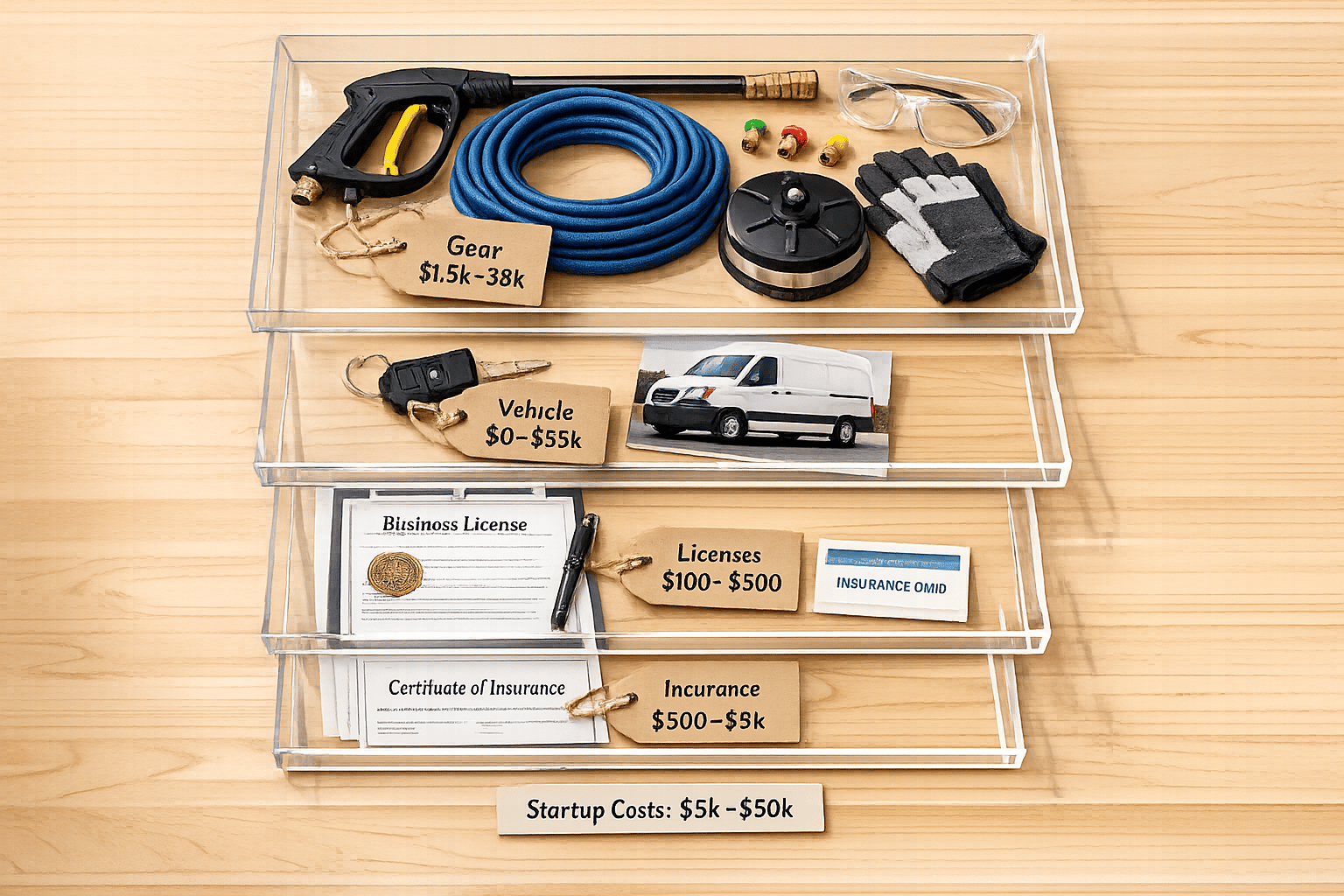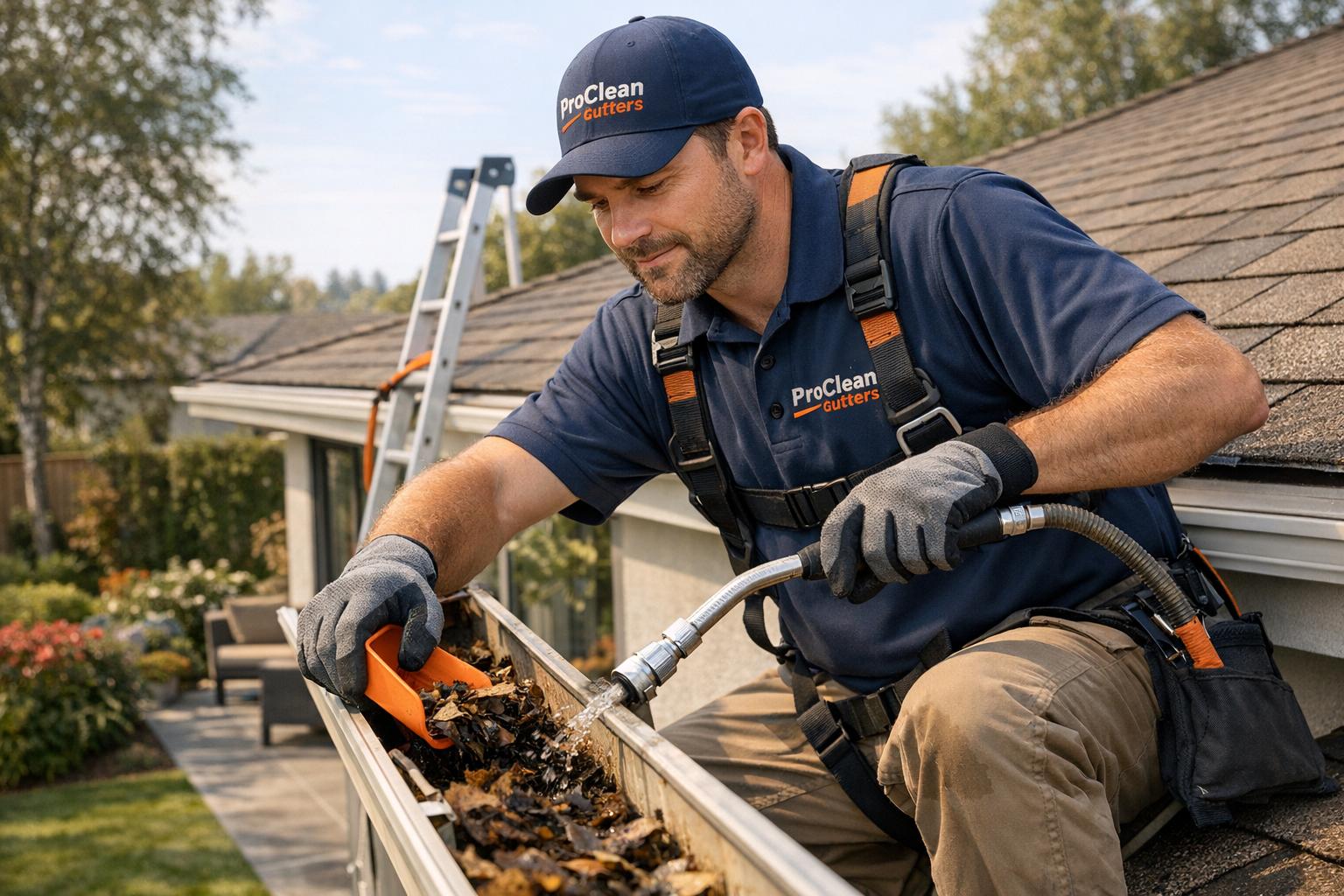
Starting a roof and gutter cleaning business is low-cost and offers strong earning potential. With minimal tools and no storefront needed, you can launch for under $2,000. A solo operator can earn $200–$600 daily, with profit margins up to 90%. This service is in high demand, especially in neighborhoods with older homes or mature trees. To hit $5,000/month, focus on 25 jobs per month at $200 each. Key steps:
- Validate demand: Target areas with high home values and overflowing gutters.
- Set up legally: Register your business and get liability insurance.
- Buy equipment: Start with basic tools like ladders and gloves.
- Market locally: Use Google Business, flyers, and door-to-door outreach.
- Price smart: Charge $0.95–$2.25/foot, with upsells for extra services.
Step 1: Validate Your Business Idea
Research Local Demand and Target Customers
Before diving in, it’s essential to confirm that there’s a local demand for your services. Start by exploring three neighborhoods, focusing on areas with older, two-story homes, mature trees, or steep roof pitches - features that suggest homeowners are more likely to hire professionals for roof and gutter cleaning. Pay attention to neighborhoods where residents have higher disposable incomes. Signs like overflowing gutters, algae-stained shingles, or damaged downspouts can indicate potential customers.
Don’t stop with just a drive-through. Use digital tools like Google Trends, Facebook Audience Insights, and local platforms like Nextdoor to gather more data. The roof cleaning industry is expected to grow at an annual rate of 5.1% through 2025, thanks to increased spending on home improvements. Focus on areas where home values are high, as homeowners in these neighborhoods often prioritize curb appeal. Once you complete a job in a neighborhood, word-of-mouth referrals can quickly expand your customer base.
Once local demand is clear, shift your attention to understanding your competition.
Analyze Your Competition
Knowing your competitors is key to carving out your place in the market. Use Google Maps and Yelp to search for terms like "gutter cleaning" and "roof cleaning" in your service area. Identify the top five businesses and the total number of local providers. For reference, there are about 4,440 gutter service businesses across the U.S., but the level of competition can vary widely depending on your region.
Take it a step further by calling two competitors under the guise of a potential customer. This "mystery shopping" approach can help you uncover their pricing models - typically ranging from $1.00 to $2.25 per linear foot - and any extra charges for steep roofs or gutter guards. While it might be tempting, avoid undercutting their prices. Instead, use this information to set rates that are competitive but sustainable.
Competitor reviews can be a goldmine for identifying service gaps. Look for common complaints like missed appointments, inadequate cleanup, or unprofessional behavior. Addressing these issues can make your business stand out as the most reliable option in the area.
Think about niches your competitors might be neglecting. For example, you could offer eco-friendly cleaning solutions, annual maintenance plans, or bundled services that include power washing or window cleaning. As John Smith, a 20-year veteran in the industry, points out:
"The most successful roof cleaning businesses specialize in a specific niche, such as eco-friendly cleaning or historic home restoration."
If the residential market feels crowded, consider targeting commercial clients like apartment complexes or homeowners associations. These often involve larger, recurring contracts and can be more profitable. Additionally, the growing use of gutter guards presents another opportunity - many cleaners aren’t equipped to handle these systems, but they still require specialized maintenance. By identifying underserved areas and addressing service gaps, you can strengthen your business idea and stand apart from the competition.
Step 2: Set Up Your Business Legally and Operationally
Register Your Business and Get Insurance
Getting your business set up legally is a key step. You can choose to operate as a sole proprietorship or register as an LLC. Many people lean toward an LLC because it protects your personal assets - like your home and savings - from any business-related liabilities.
Registering an LLC is simple. You’ll need to file Articles of Organization with your state’s Secretary of State. For example, in California, this costs about $70. You’ll also need a federal Employer Identification Number (EIN) for tax purposes, which you can get for free on the IRS website. If you plan to operate under a name other than your legal name, filing a DBA statement is necessary.
Next, secure general liability insurance. This insurance protects you if you accidentally damage a customer’s property or if someone gets injured because of your work. Expect to pay between $200 and $500 per month, with initial upfront costs ranging from $500 to $800. Many states require this insurance by law, and customers often won’t hire you without it. If you’re planning to hire employees, you’ll also need workers’ compensation insurance to cover medical bills and lost wages from any work-related injuries.
Once you’ve handled these legal and insurance requirements, you can turn your attention to gathering the tools you’ll need.
Buy Your Equipment and Tools
Now it’s time to gear up. Start with the basics. You’ll need a 23-foot multi-position ladder ($174), a ladder stabilizer ($66) to prevent wobbling and protect gutters, a gutter scoop ($10.50), puncture-resistant gloves ($5.50), and a 7-gallon bucket ($36). To make your job easier, consider adding a leaf blower attachment kit ($65) and a water extender wand ($23) for rinsing.
Safety should be a top priority. A ladder standoff can help keep you steady and avoid damaging customers’ gutters, while a safety harness is a must-have for working on steep roofs.
Your initial investment in tools will likely range from $380 to $600. As your business grows, you can upgrade to more advanced equipment, such as ground-based gutter vacuum systems. These systems, priced between $1,319 and $6,599, eliminate the need for ladders and reduce insurance risks. For now, stick to the essentials - they’re more than enough to start taking on jobs and earning revenue.
How to start a roof and gutter cleaning business from scratch
sbb-itb-08dd11e
Step 3: Set Your Pricing and Calculate Profits
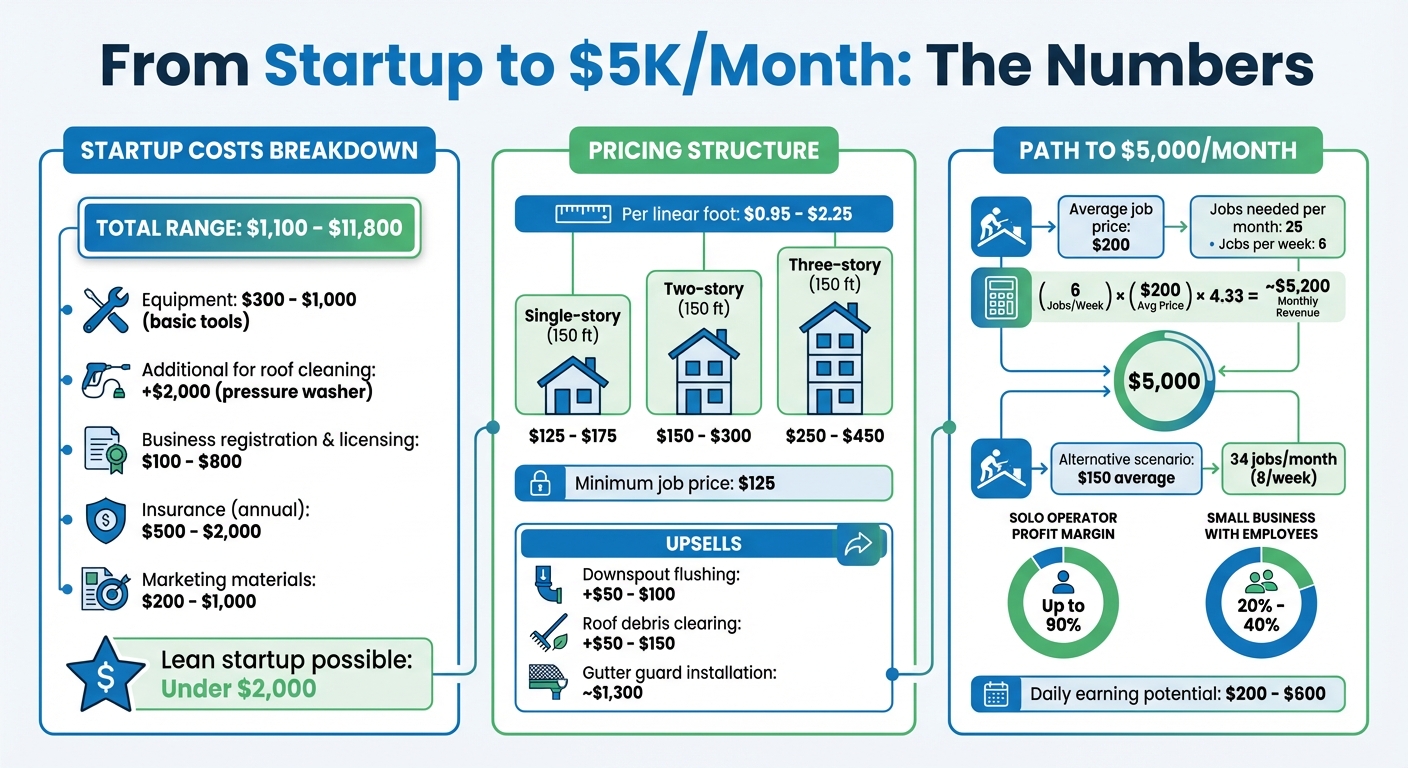
Roof and Gutter Cleaning Business Startup Costs and Revenue Breakdown
Calculate Your Startup Costs
Once you've handled the legal setup and purchased your equipment, it's time to get a clear picture of your total startup investment. Knowing your exact expenses upfront is crucial. Typically, your initial investment will range between $1,100 and $11,800, depending on your approach.
Here’s a breakdown of common costs:
- Equipment: Basic tools like ladders, scoops, and safety gear will cost between $300 and $1,000. If you plan to include roof cleaning, expect to spend an additional $2,000 for a pressure washer.
- Business registration and licensing: Fees vary by state but generally fall between $100 and $800.
- Insurance: General liability insurance is a must and will cost you $500 to $2,000 annually.
- Marketing materials: Flyers, business cards, and a basic website will add $200 to $1,000 to your budget.
Starting lean is a smart way to keep costs down. You can operate from home to avoid rental expenses, use your personal vehicle until you generate consistent revenue, and stick with manual tools instead of investing in costly vacuum systems. Many successful operators launch with less than $2,000 by focusing only on the essentials.
Set Your Service Prices
Pricing your services effectively is key to balancing workload and profitability. Rates should reflect local demand and be based on gutter length and home height, which are the main factors influencing your costs.
Here’s a general pricing guide:
- Per linear foot: Most professionals charge $0.95 to $2.25 per foot, depending on the job's complexity.
- Single-story homes: For 150 linear feet of gutters, expect to charge $125 to $175.
- Two-story homes: The same gutter length typically costs $150 to $300, as additional equipment and risk are involved.
- Three-story homes: Rates can climb to $250 to $450 or more.
Always establish a minimum job price, usually $125, to cover travel and setup costs. Upselling is another way to boost your earnings. For example, you can charge an extra $50 to $100 for downspout flushing and $50 to $150 for clearing roof debris. These add-ons require minimal extra effort but significantly increase your average ticket value.
As Jeel Patel, CEO of FieldCamp, explains:
"The difference between average contractors and profitable pros lies in one thing: a strategic pricing system that reflects your real costs, your market, and your value".
To stay competitive, research your local market. Request quotes from three to five businesses in your area and price your services similarly - or slightly lower - to attract your first customers.
Project Your Monthly Revenue
If your goal is to earn $5,000 per month, start by working backward. Assuming an average job brings in $200 (including base cleaning and a couple of upsells), you’ll need to complete 25 jobs per month to hit that target. That works out to about six jobs per week.
Here’s a simple formula to calculate revenue:
(Number of Jobs per Week) × (Average Price per Job) × 4.33 = Monthly Revenue
For example, if your average job earns $150, you’d need approximately 34 jobs per month, or eight jobs per week, to reach your goal.
Keep in mind, gutter cleaning is highly seasonal. Demand peaks in October and November during the fall and again in the spring. Plan to book more jobs during these busy months to offset slower periods. This strategy allows you to maintain a steady yearly income. Solo operators often enjoy profit margins of around 90% before overhead, while small businesses with employees should aim for margins between 20% and 40%.
Monitor your numbers closely. If you’re booking jobs consistently but still falling short of your revenue target, consider raising your prices by 10% to 15% or offering additional services, such as gutter guard installation, which averages $1,300 nationwide.
Step 4: Market Your Services and Get Customers
Create Your Online Presence
Your Google Business Profile is a must-have free tool for ranking locally. Make sure to fill it out completely, including service categories, coverage areas, and updated photos of your work each week. This profile often acts as your first impression, which is crucial since 75% of consumers judge a local business by its website.
Another platform worth your attention is Nextdoor, which is a treasure trove for gutter cleaning businesses. With 90% of its users making household buying decisions and over 75% being homeowners, it’s a great place to connect with potential customers. Instead of running ads, focus on answering questions and sharing seasonal tips to build trust. Similarly, join Facebook Groups for local communities, and engage by offering helpful advice rather than just promoting your services.
Tim Brown, Founder of Hook Agency, sums it up perfectly:
"People can't FLOW you leads if they don't KNOW you".
To quickly boost your local presence, try the "100-100-10" Method: follow 100 local accounts, like 100 posts, and leave 10 thoughtful comments each week. Regularly post before-and-after photos of your work to showcase your results - make sure these photos feature your actual crew, not stock images, to maintain authenticity.
Don’t stop at digital marketing; combine it with offline strategies to maximize your reach.
Use Local Marketing Methods
Offline marketing remains highly effective for service-based businesses. Start by distributing door hangers or flyers in neighborhoods where you’ve recently completed jobs. This low-cost strategy leverages local visibility. Rich Prue, Founder of The Roofer’s Helper, advises:
"Create a flyer to pass out in a neighborhood where you just finished a job. The flyer can let potential customers know that you just did a job in their neighborhood, and that they can take advantage of the same pricing".
Another powerful approach is the "3-Block Knock" strategy. After finishing a job, knock on the doors of three houses to the left, three to the right, and three directly across the street. Offer a free gutter inspection while you’re already in the area. This method works well because neighbors see your truck and equipment, which immediately establishes credibility.
Forge partnerships with real estate agents and property management companies to secure steady referrals. Realtors can recommend your services for pre-listing cleanings or post-storm repairs. Additionally, collaborating with Homeowners Associations (HOAs) to offer group discounts is a smart way to secure multiple jobs in one location, saving you time and travel costs. For your initial marketing push, plan to spend between $200 and $1,000 on essentials like business cards, flyers, and branding materials.
Build Customer Trust and Repeat Business
Attracting customers is just the beginning - building trust and fostering loyalty are key to long-term success. Happy customers are more likely to return and recommend your services. Right after completing a job, send a text or email requesting a Google review. Timing is everything, as customers are most satisfied immediately after the job is done. As Tim Brown puts it:
"Reviews are the rocket fuel for your Google Business Profile - more visibility, more trust, more leads".
Consider offering seasonal maintenance packages to keep customers coming back. Bi-annual cleanings during the busy fall and spring seasons create a steady, predictable revenue stream. Be transparent in your communication - if you notice roof damage or loose fasteners, inform the homeowner and provide a detailed receipt. This approach not only builds trust but can also lead to additional sales.
Finally, branding goes a long way. Equip your team with uniforms, vehicle magnets, and business cards to present a professional image. In this industry, simply being punctual and delivering quality work can set you apart. To encourage referrals, offer small incentives for customers who recommend your business. Word-of-mouth is incredibly powerful, with 88% of people trusting recommendations as much as personal ones.
Conclusion: Reaching $5,000 Per Month
Hitting $5,000 per month starts with a solid, well-thought-out plan. Begin by confirming there's demand in your local area, setting up your business legally with an LLC and insurance, and investing in essential equipment - typically between $550 and $2,000. From there, pricing your services competitively is key. For example, completing just 20 to 25 residential jobs at an average of $200 each will get you to your goal. Once your pricing and operations are in place, shift your focus to building a strong marketing strategy.
Marketing consistently will keep your schedule full. Use tools like your Google Business Profile to attract local customers, distribute door hangers in neighborhoods where you've already worked, and build relationships with real estate agents and HOAs. These efforts can help solo operators achieve profit margins as high as 90%.
Start small and focus on perfecting your process. Document everything you do and create systems that can be easily repeated. As demand grows and you're consistently booked weeks in advance, consider expanding your team to handle more work. Explore offering seasonal maintenance packages to create steady, recurring revenue, and think about adding complementary services like window washing or pressure washing to keep income flowing year-round. These steps can help you surpass $5,000 per month over time.
With your operations and marketing streamlined, the next step is to seize every local opportunity. Everything you've done - market research, legal setup, pricing - comes together to drive your revenue forward.
Now's the time to act. Target three neighborhoods, set up your Google Business Profile, and book your first job. With a structured approach, your roof and gutter cleaning business can grow from $0 to $5,000 per month faster than you'd think. The path is laid out - go for it!
FAQs
What basic tools do I need to start a roof and gutter cleaning business?
To kick off a roof and gutter cleaning business, you'll need some essential tools to ensure both safety and efficiency. Start with the basics: gloves, safety glasses, and anti-slip boots to protect yourself while working. A reliable extension ladder is a must for reaching roofs and gutters, and a bucket with hooks can be a handy way to collect debris without creating a mess. For clearing out gutters, a gutter scoop or trowel works well to remove leaves and dirt, while a garden hose or pressure washer is great for rinsing everything clean.
When it comes to roof cleaning, having a pressure washer, hoseline, and spray wand will make applying cleaning solutions and removing moss or grime much easier. With these tools in hand, you'll be well-prepared to offer professional roof and gutter cleaning services.
What are the best ways to market my roof and gutter cleaning business locally?
To grow your roof and gutter cleaning business locally, start by fine-tuning your Google Business Profile (GBP). Make sure all details - like your contact info, service areas, and business hours - are accurate. Upload high-quality photos of your work to showcase your expertise. Don’t forget to ask satisfied customers to leave reviews; they boost credibility and help you stand out in search results. You might also want to explore Google Local Service Ads, which can bring in highly targeted leads.
Social platforms like Nextdoor are perfect for connecting with your community. Set up a free business page, share striking before-and-after photos of your work, and post seasonal tips to engage your audience. Encourage happy clients to recommend your services to their neighbors. Additionally, running targeted ads on Google and Facebook with keywords such as "gutter cleaning near me" can help drive traffic to your business.
Collaborating with local contractors - like roofers or landscapers - can also be a smart move. You can exchange referrals, creating a mutually beneficial partnership. On top of that, consider distributing flyers or door hangers in neighborhoods with older homes, especially before storm season. These combined efforts can help you establish a strong local presence and steadily grow your customer base.
What legal steps are required to start a roof and gutter cleaning business in the U.S.?
To get your roof and gutter cleaning business off the ground, you'll need to tackle some important legal steps. Start by deciding on a business structure, such as a sole proprietorship, LLC, or corporation. Once that's settled, register your business name with your state. If you're planning to operate under a name that's different from your own, make sure to file a Doing Business As (DBA) statement. Next, apply for a federal Employer Identification Number (EIN) from the IRS. Don't forget to check with your local or state authorities to see if specific business licenses or permits are required in your area.
Insurance is a must-have for protecting your business. Secure general liability insurance, and if you’re planning to hire employees, you’ll probably need workers’ compensation insurance as well. Depending on where you’re located, you might also need a surety bond. Lastly, register for any required state and federal taxes, including income tax and, if applicable, sales tax.
By covering these bases - business registration, licensing, insurance, and tax compliance - you’ll be well-prepared to legally start your roof and gutter cleaning business in the U.S.
Related Blog Posts
 Report an issue
Get the newest tips and tricks of starting your business!