
Choosing between a sole trader and a company structure in Australia has major implications for taxes, liability, and growth potential. Here’s the key takeaway:
- Sole Trader: Simple and low-cost to set up, but taxed at personal rates (up to 45%) and carries unlimited personal liability.
- Company: Higher setup costs (starting at $611) and ongoing fees (e.g., $310 annual review), but benefits from a flat tax rate (25%-30%) and limited liability protection.
Switching to a company often makes sense when your income grows significantly, liability risks increase, or you need capital to expand. This guide explains costs, tax differences, and signs it’s time to switch, helping you decide the best structure for your business.
Sole Trader Basics in the United States
What is a Sole Proprietorship?
A sole proprietorship is a simple, unincorporated business structure where one individual owns and operates the business. Legally, there’s no distinction between the business and its owner. For tax purposes, the IRS classifies it as a "disregarded entity".
"A sole proprietorship is the simplest and most common structure for new businesses. It's an unincorporated business owned and operated by one person with no legal distinction between the business and the owner." – Rocky Mengle, Attorney
Setting up a sole proprietorship requires minimal paperwork. For instance, if you plan to hire employees, you’ll need to get an Employer Identification Number (EIN) from the IRS.
Now, let’s take a closer look at the financial and tax responsibilities tied to this business structure.
Costs and Tax Treatment
When it comes to taxes, all income and expenses from the business are reported directly on the owner’s personal tax return (Form 1040) using Schedule C. This setup, called pass-through taxation, means the business itself isn’t taxed separately. Instead, profits are added to your personal income and taxed at your individual rate. On top of that, you’ll pay self-employment tax, which is 15.3% - broken down as 12.4% for Social Security and 2.9% for Medicare - on 92.35% of your net earnings.
For the 2025 tax year, Social Security tax applies only to the first $176,100 of combined wages. If your income surpasses $200,000 (single) or $250,000 (joint), you’ll also owe an extra 0.9% Medicare tax. The good news? You can deduct 50% of your self-employment tax from your adjusted gross income. This tax structure is one reason many business owners reconsider their setup as their income grows.
You can also claim deductions for common business expenses like advertising, office supplies, travel, and vehicle use. For 2025, the standard mileage rate is 70¢ per mile. If you expect to owe $1,000 or more in taxes for the year, you’ll need to make quarterly estimated tax payments to avoid penalties.
Personal Liability and Risk
While the cost benefits of a sole proprietorship are appealing, the risks are worth serious consideration. The biggest concern is unlimited personal liability. Since there’s no legal separation between you and your business, you’re personally responsible for all debts, losses, and legal judgments. If your business faces financial trouble or a lawsuit, creditors can go after your personal assets - your home, car, savings, and even jointly owned property.
This level of risk highlights the importance of securing adequate business insurance. The right coverage can help safeguard your personal finances and provide some peace of mind.
Corporation Basics in the United States
What is a Corporation?
A corporation is a separate legal entity, distinct from its owners. This means it can conduct business, take on debts, and pay taxes independently. There are two main types of corporations: C-Corporations and S-Corporations.
C-Corporations are the default type and allow for unlimited shareholders and multiple stock classes. This structure is especially appealing to high-growth startups looking to attract venture capital. On the other hand, S-Corporations are limited to 100 shareholders and offer pass-through taxation. With this setup, profits and certain losses are reported on shareholders' personal tax returns instead of being taxed at the corporate level. Regardless of the type, corporations must have a board of directors to handle major decisions and officers to oversee daily operations.
"The minute you have two people, there are problems, like who owns the intellectual property?"
- David Raynor, Founder, Accelerate Legal
Costs and Tax Treatment
Setting up a corporation involves higher initial and ongoing costs compared to sole proprietorships. Filing fees for Articles of Incorporation typically range from $50 to $300, depending on the state. Additional expenses include fees for a registered agent and annual report filings. For instance, Delaware, a popular state for incorporation due to its business-friendly laws, requires companies to pay an annual franchise tax.
When it comes to taxes, the treatment varies based on the corporation type. C-Corporations are subject to double taxation: the corporation pays income tax on its profits, and shareholders pay individual taxes on dividends. In contrast, S-Corporations avoid this double taxation. Their profits and certain losses pass through to shareholders' personal tax returns, bypassing corporate-level taxes. However, S-Corporation owners who actively work in the business are required to pay themselves a "reasonable salary" subject to employment taxes. Any remaining profit may then be distributed as dividends.
"C Corp income is taxed twice; first the corporation pays taxes on its business profit, then shareholders pay individual taxes on dividends they receive."
- H&R Block
Next, we'll dive into how corporations offer liability protection and the responsibilities of directors.
Limited Liability and Director Duties
One of the biggest advantages of forming a corporation is the limited liability protection it provides. Shareholders generally risk only the money they've invested in the business, keeping personal assets like homes or cars safe from corporate debts or legal claims. However, this protection isn't absolute. Directors can still be held personally liable for specific legal obligations, such as unpaid payroll taxes or misconduct during insolvency.
To maintain this shield of liability, corporations must follow specific formalities. These include holding annual meetings, keeping written minutes, adopting bylaws, and filing required reports. Many directors also choose to obtain Directors and Officers (D&O) liability insurance for extra protection, though this isn't a legal requirement.
Direct Comparison: Sole Proprietorship vs Corporation
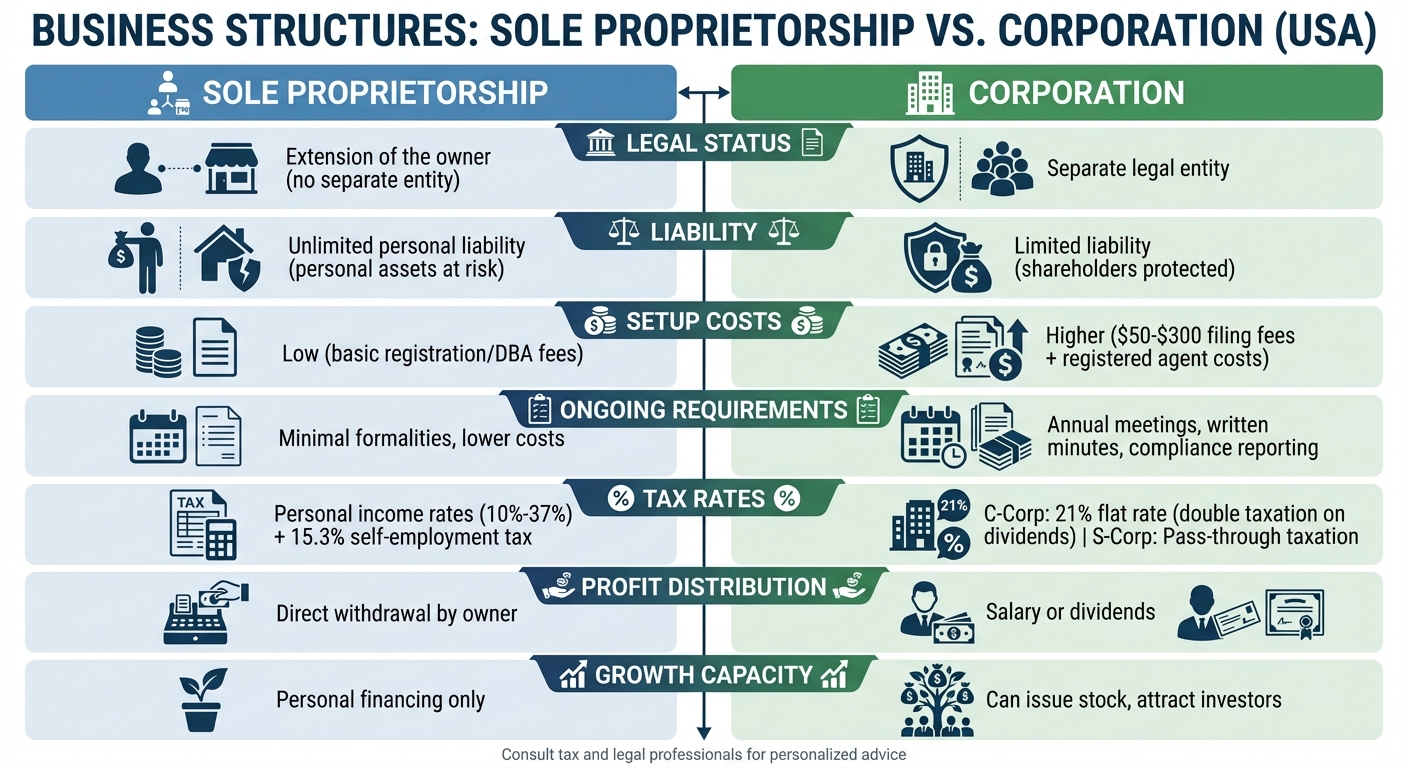
Sole Proprietorship vs Corporation Comparison: Costs, Taxes, and Liability
Comparison Table: Key Differences
Choosing the right business structure plays a big role in managing both risk and costs as your business grows. Here’s a quick comparison to help highlight the differences:
| Factor | Sole Proprietorship | Corporation |
|---|---|---|
| Legal Status | Operates as an extension of the owner | Functions as a separate legal entity |
| Liability | Unlimited personal liability | Shareholders enjoy limited liability |
| Setup Costs | Low (basic registration or DBA fees) | Higher (includes filing fees, registered agent costs, etc.) |
| Ongoing Requirements | Minimal formalities and lower costs | More demanding, with compliance and reporting obligations |
| Tax Rates | Taxed at personal income rates (10%–37%) | Flat 21% corporate tax for C-Corps or pass-through taxation for S-Corps |
| Profit Distribution | Withdrawn directly by the owner | Distributed as salary or dividends |
| Growth Capacity | Relies on personal financing | Easier to raise funds (e.g., through stock issuance) |
The table provides a snapshot of the major differences. Let’s dive deeper into some of these areas.
Cost and Tax Analysis
A sole proprietorship keeps initial costs low, often limited to local licenses or DBA (Doing Business As) registration fees. On the other hand, corporations come with higher upfront costs, including filing fees and services like hiring a registered agent. Additionally, corporations face ongoing compliance expenses, such as annual reporting and meeting formalities.
Taxes also vary significantly. Sole proprietors report business income on their personal tax returns, with rates ranging from 10% to 37%. While C-Corporations are taxed at a flat 21% federal rate, they may face double taxation when profits distributed as dividends are taxed again at the shareholder level. S-Corporations, however, offer a way around this by allowing income to pass through to the owners’ personal tax returns, potentially reducing self-employment taxes by splitting income into salary and distributions.
Liability Protection Differences
Liability is another critical distinction. Sole proprietors bear unlimited personal liability, meaning their personal assets - like a house or savings - are at risk if the business faces lawsuits or debt. In contrast, corporations provide a legal shield for shareholders, protecting personal assets from business liabilities. However, this protection requires strict adherence to corporate formalities, such as maintaining separate finances and keeping accurate records. Directors may still face personal liability under specific circumstances, but overall, corporations offer a stronger safety net.
This sharp contrast in liability protection is often a deciding factor for many entrepreneurs.
sbb-itb-08dd11e
When to Switch from Sole Proprietorship to Corporation
Knowing when to transition from a sole proprietorship to a corporation can be a game-changer for your business. This decision isn’t just about hitting revenue milestones - it’s about aligning your structure with the evolving needs of your company. Factors like rising tax obligations, increasing liability risks, and the need for more capital often signal that it’s time to make the switch. Let’s break down three key indicators that suggest incorporation might be the right move.
Income Reaches Higher Tax Brackets
As your business profits grow, the tax burden can become overwhelming. Sole proprietors pay progressive tax rates on all business income, with rates climbing to 37% for taxable incomes over $135,000 - and hitting 45% once income surpasses $190,000. On the other hand, small businesses with an aggregated turnover below $50 million benefit from a flat corporate tax rate of 25%. If your earnings place you in these higher brackets, switching to a corporate structure can lead to noticeable tax savings.
Increasing Liability and Expanding Operations
Business growth often comes with greater risk. As a sole proprietor, your personal assets - like your home or savings - are exposed to potential legal or financial claims. Incorporating separates your personal finances from your business by creating a distinct legal entity. While directors can still be held accountable for certain breaches, the limited liability of a corporation offers much stronger protection for personal assets. This safeguard becomes increasingly important as your operations and liabilities grow.
Preparing for Growth or Investment
If you’re planning to scale your business, a corporate structure opens doors that a sole proprietorship simply can’t. Corporations can issue shares to attract investors or bring on partners, providing access to the capital needed for expansion. Whether you’re entering new markets, launching new products, or seeking investment, incorporation signals stability and professionalism to potential investors and clients. Plus, the perpetual nature of a corporation ensures the business can continue seamlessly through changes in ownership, making it ideal for long-term planning.
Recognizing these signs can help you prepare for a smooth transition to a corporate structure, setting the foundation for future growth.
How to Switch from Sole Proprietorship to Corporation
Step-by-Step Process
Switching from a sole proprietorship to a corporation involves several legal and administrative steps. First, you'll need to pick a unique business name and verify its availability with your Secretary of State's office. Once confirmed, file your Articles of Incorporation, which should include details like your corporation's name, address, purpose, registered agent, and initial board members.
Next, apply for a new Employer Identification Number (EIN) through the IRS. Since a corporation is a separate legal entity, it can't use the tax ID associated with your sole proprietorship. You'll also need to appoint a registered agent - someone with a physical address in your state who can handle legal documents on behalf of your corporation. Draft corporate bylaws to outline internal operating rules, and hold an initial board meeting to appoint officers (e.g., CEO, CFO) and formally approve the bylaws.
Afterward, set up a dedicated business bank account for your corporation and transfer all assets, like intellectual property or trademarks, to the new entity. Be sure to update all existing licenses and permits to reflect your corporate structure. If you'd like to avoid double taxation and meet eligibility requirements, you can file IRS Form 2553 to elect S-corporation status. Keep in mind, this option is only available if your corporation has fewer than 100 shareholders, all of whom must be U.S. citizens or residents. Filing fees for these steps vary by state, typically ranging from $50 to $300.
Using IdeaFloat to Analyze the Change

Once you've completed the legal steps, take a closer look at your financial position using advanced tools like IdeaFloat's Financial Model. This tool allows you to input your current revenue and future growth projections to compare the tax advantages of corporate rates against the added administrative costs of incorporation. This analysis can help you determine whether the switch is financially beneficial in the long run.
Additionally, IdeaFloat's Smart Market Sizing feature can help you project future business growth. It evaluates whether you're prepared for the operational demands of issuing stock or attracting investors. This ensures you're transitioning to a corporation for sound financial reasons, rather than simply reaching a revenue milestone.
Conclusion
Deciding between a sole proprietorship and a corporation involves weighing simplicity and control against liability protection and tax benefits. Sole proprietorships are straightforward, cost-effective, and give you complete control, but they also come with the risk of unlimited personal liability. On the other hand, corporations offer limited liability protection and a flat federal tax rate of 21% for C-Corps, which can be more favorable than progressive individual tax rates. However, they come with added paperwork and higher ongoing compliance costs.
As your business grows, factors like increased income, greater risks, or the need for outside investment might push you toward a more structured entity. Seeking professional tax and legal advice is crucial to ensure that incorporation aligns with your goals while avoiding any unexpected tax complications during the transition.
If you're looking to dig deeper into the financial impact, tools like IdeaFloat's Financial Model can help. By inputting your current revenue and growth projections, you can evaluate potential tax savings against the costs of setting up and maintaining a corporation. Additionally, IdeaFloat's Smart Market Sizing tool can help assess whether your business is ready to handle the operational demands of incorporation.
Restructuring isn’t just about compliance - it’s a step toward protecting your personal assets, improving your tax situation, and setting the stage for future growth. Take the time to crunch the numbers, consult experts, and leverage available tools to make the best decision for your business.
FAQs
What are the main tax benefits of switching from a sole trader to a company in Australia?
Switching to a company structure in Australia offers notable tax benefits compared to operating as a sole trader. Companies are taxed at a flat corporate rate - 30% for most companies and 25% for eligible small businesses. In contrast, sole traders are taxed based on personal income tax rates, which climb as income increases. This flat rate enables businesses to retain earnings within the company, deferring personal taxes until profits are distributed as dividends.
Companies also enjoy tax perks that sole traders can't access. These include the instant asset write-off, the ability to carry forward tax losses to offset future profits, and lower capital gains tax (CGT) rates. Shareholders gain from franking credits on dividends, which account for taxes already paid at the company level, reducing their overall tax liability. These benefits make a company structure especially attractive for businesses with fluctuating or growing income.
What’s the difference in liability protection between a sole trader and a company?
The main distinction comes down to personal liability. When you're a sole trader, there's no legal separation between you and your business. This means you're personally on the hook for any debts, losses, or legal claims. If your business runs into financial trouble, your personal belongings - like your house or car - could be at stake.
On the other hand, a company operates as a separate legal entity. This setup generally limits liability to the company’s assets, shielding the personal assets of its shareholders and directors. That said, directors aren't completely off the hook - they can still face personal accountability if they violate legal responsibilities or act negligently. While a company structure provides more protection, it doesn’t eliminate risk entirely.
When should I switch from being a sole trader to a company structure?
The ideal time to shift from being a sole trader to adopting a company structure is when your business grows beyond the simplicity and personal liability that comes with operating as a sole trader. Here are some key indicators that it might be time to make the switch:
- Higher income: If your revenue is pushing you into a higher personal tax bracket, transitioning to a company structure could help lower your tax obligations. Companies benefit from a flat corporate tax rate, which is currently 25% for businesses earning under $50 million annually.
- Increased risk: Are you taking on larger contracts, debts, or liabilities? Forming a company can act as a protective shield for your personal assets, separating them from business risks.
- Plans for expansion: If you're considering bringing in investors, partners, or shareholders, a company structure is much better equipped to handle these changes.
- Reinvestment goals: Planning to reinvest earnings into the business instead of withdrawing all profits as personal income? A company structure allows for retained earnings, which can fund growth.
Business owners often start exploring this transition when their annual revenue consistently surpasses $200,000–$300,000, or when their personal tax rate nears 30–37%. Other factors, like hiring more employees or seeking external funding, can also signal that it’s time.
Before making the leap, consult a legal or tax professional to carefully weigh the costs and benefits to ensure the move aligns with your long-term business objectives.
Related Blog Posts
 Report an issue
Get the newest tips and tricks of starting your business!