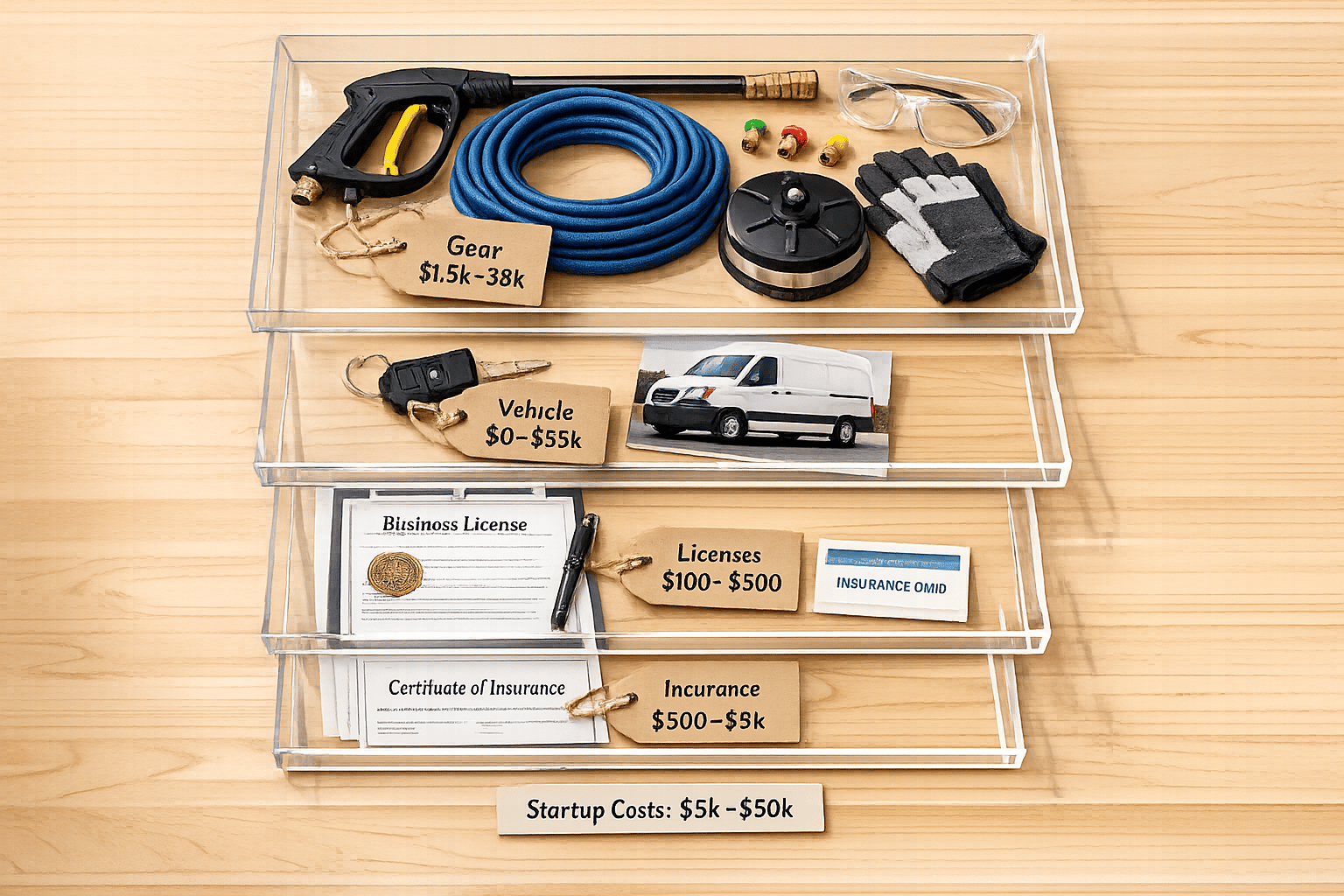
Starting a pressure washing business with less than $1,000 is achievable and profitable if you focus on residential customers, affordable tools, and free marketing. Here's how:
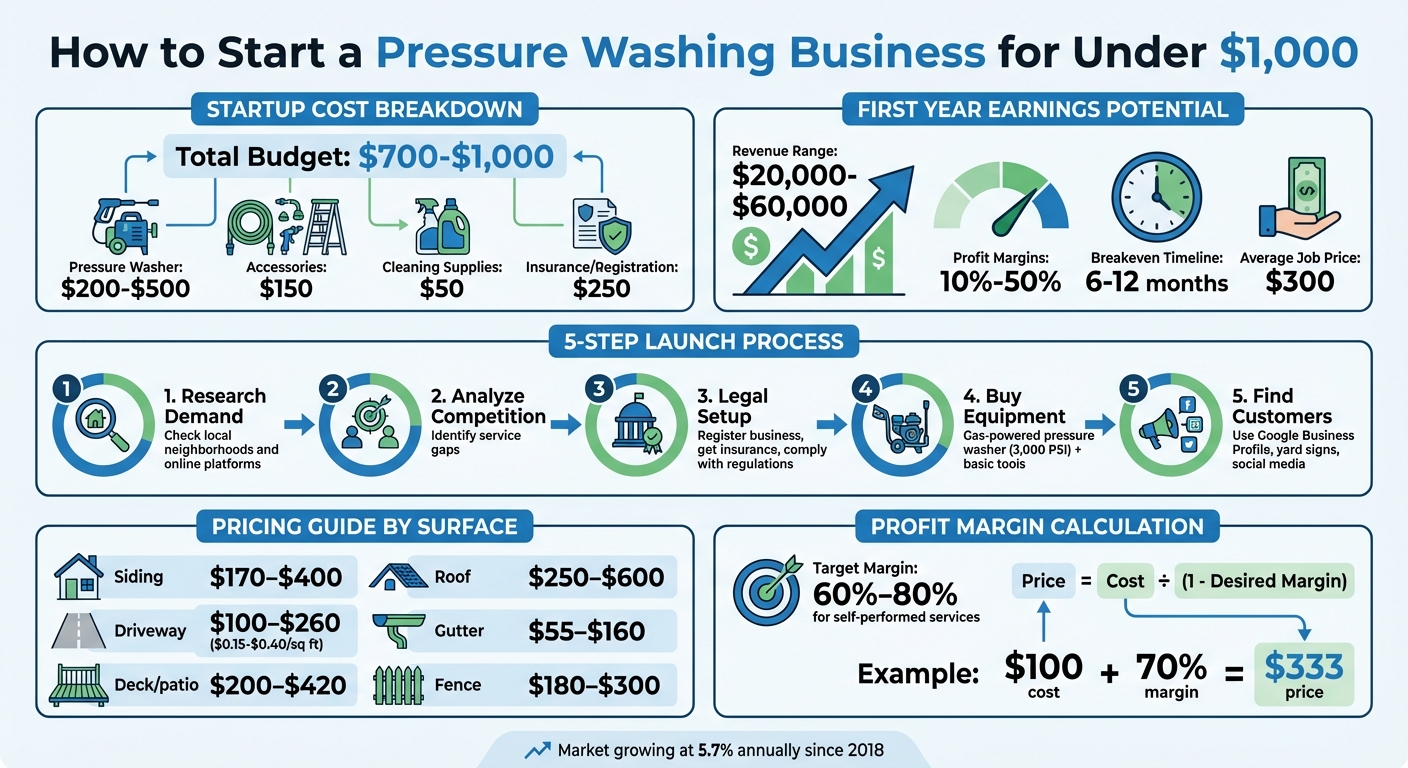
- Initial Costs: Spend $700–$1,000 on essentials like a pressure washer ($200–$500), accessories (hoses, nozzles, ladder, $150), cleaning supplies ($50), and insurance/registration ($250).
- Potential Earnings: New businesses typically make $20,000–$60,000 in the first year with 10%–50% profit margins.
- Steps to Start:
- Research Demand: Check local neighborhoods and online platforms for signs of need.
- Analyze Competition: Identify gaps in local services to stand out.
- Legal Setup: Register your business, get insurance, and comply with regulations.
- Buy Equipment: Start with a gas-powered pressure washer (3,000 PSI) and basic tools.
- Find Customers: Use free tools like Google Business Profile, yard signs, and social media.
With low overhead, you can break even in 6–12 months by pricing services competitively and managing costs effectively.
Starting a Pressure Washing Business Under $1,000: Costs, Equipment & Profit Breakdown
Step 1: Validate Demand and Research Your Market
Research Local Demand for Pressure Washing
Before investing in equipment, it’s essential to confirm that your community actually needs pressure washing services. Start by driving through neighborhoods you want to target. Look for signs like dirty driveways, moss-covered sidewalks, grimy siding, or weathered decks and fences. These are clear indicators of potential demand for your services.
Next, check online search activity for terms like "pressure washing near me" or "driveway cleaning [your city name]." Platforms like Nextdoor and local Facebook groups can also be goldmines of information. Pay attention to posts where residents ask for referrals or vent about dirty outdoor spaces. These discussions can reveal exactly what services people are looking for.
For a more data-driven approach, tools like IdeaFloat’s Consumer Insights can analyze online chatter about pressure washing in your area. This tool helps you understand the specific language customers use to describe their cleaning needs, giving you a clearer picture of local demand.
Don’t forget to factor in the climate. Warmer, coastal, or rainy regions - like much of the Southern U.S. - tend to have higher demand due to faster mold and grime buildup. Also, consider specialized services that competitors might overlook, such as solar panel cleaning, gutter brightening, graffiti removal, or even headstone cleaning.
Once you’ve gauged demand, the next step is to analyze your competition.
Study Your Competitors and Find Your Angle
After confirming local demand, it’s time to size up the competition and identify opportunities to stand out. Start by searching Google Maps and Yelp for pressure washing businesses in your area. A market with plenty of businesses and reviews often signals strong demand, while fewer competitors might indicate untapped potential. Dive into customer reviews to uncover common complaints - issues like slow response times, lack of weekend availability, or outdated equipment could be areas where you can shine.
Tools like IdeaFloat’s Competitor Analysis can provide deeper insights by mapping out competitors and highlighting underserved market segments. This helps you pinpoint exactly where you can position yourself as the go-to provider.
"The single most important thing I learned is that you must be different from your competition in terms of the value you bring to the market, and you must very definitively articulate the nature of that differentiation." - Kevin Dubrosky, President and Founder, Dubrosky Group
Visit competitor websites to see what’s missing. Do they lack online booking options? Are they not promoting eco-friendly detergents or specialized services like roof cleaning? These gaps represent opportunities for you to step in and offer something better. For example, if local businesses charge $250 per job but customers often complain about poor communication, you could stand out by providing text updates and online scheduling - all while keeping your pricing competitive.
How To Start A Pressure Washing Business In 2026 (Complete Guide)
Step 2: Handle Legal Requirements and Licensing
Getting your business legally squared away is essential - not just to meet regulations but to protect your growing venture.
Starting with your business identity is a smart move. If you're on a tight budget, registering as a sole proprietorship is free. Want personal asset protection? Forming an LLC will cost anywhere from $50 to $500, depending on your state.
Next, you'll need an Employer Identification Number (EIN) from the IRS. The good news? It’s free and easy to get. An EIN is necessary for opening a business bank account and filing taxes.
Most cities also require a general business license, which typically costs between $50 and $400 per year. Check with your local city hall to confirm the requirements in your area. If you're in a smaller town, you might not even need one.
To protect yourself and your business, invest in general liability insurance, which starts at about $40 per month. Many clients will ask for proof of insurance, so it’s worth the investment.
Pressure washing comes with specific environmental responsibilities. Runoff from your work may contain chemicals, so you’ll need to comply with the Clean Water Act and any local wastewater rules. Contact your city’s environmental department to learn if you need permits or a reclamation system to handle contaminants. Ignoring these regulations could lead to hefty fines, so it’s better to be safe than sorry.
Looking to cut costs? Consider acting as your own registered agent instead of paying a third-party service, which usually runs $100 to $300 annually. Taking this route can save you money while keeping your business compliant.
Step 3: Buy Equipment for Under $700
Setting up your pressure washing business doesn’t have to break the bank. With a budget of under $700, you can start with just the essentials and upgrade as your business grows. For instance, Scott Anderson, the owner of Spoon River Pressure Washing, launched his business with a used machine for about $100. He recovered that cost with his very first job.
If you’re looking to save even more, buying used equipment from platforms like Facebook Marketplace or Craigslist can slash your costs by 50–70%. Just make sure to inspect the pump thoroughly and test it before committing. Not ready to buy? Renting a pressure washer for around $100 a day is another smart option. It allows you to complete a few jobs, generate quick revenue, and then invest in your own equipment.
"If you have no budget to start with and you want to get started, go rent a machine for a hundred bucks a day. And then go wash five or six driveways, and turn around at the end of the day and buy your own machine".
By focusing on essential tools, you can keep your startup costs low while building profits early on. Below is a breakdown of the equipment you’ll need to get started.
Equipment You Need to Get Started
Here’s a list of must-haves for your pressure washing toolkit:
- Pressure Washer: A gas-powered model with at least 3,000 PSI and 2.5 GPM is ideal. Prices range from $300–$600 for new machines or $100–$400 for used ones.
- Surface Cleaner: This attachment can cut job times significantly, turning a two-hour task into just 30 minutes. Expect to spend $150–$200.
- High-Pressure Hose: Opt for a non-marking hose (50–100 ft) to avoid leaving marks on concrete. These typically cost $75–$100.
- Quick-Connect Nozzles: A set of nozzles costs $10–$30 and allows you to switch tasks quickly. Use the color-coded system: Red (0°) for tough grime, Yellow (15°) for stripping, Green (25°) for general cleaning, and White (40°) for delicate surfaces [21,24].
- Safety Gear: Protect yourself with goggles, chemical-resistant gloves, and non-slip waterproof boots. Plan to spend about $50–$100.
- Downstream Chemical Injector: This tool, priced at $25–$50, safely mixes detergents with water, protecting your machine from damage.
- Cleaning Chemicals: Budget $15–$30 per gallon for detergents and cleaning solutions.
Gas-Powered vs. Electric Pressure Washers
Choosing between gas and electric pressure washers depends on the type of jobs you plan to take on. The table below compares the two options to help you decide:
| Feature | Gas-Powered | Electric |
|---|---|---|
| Typical Cost | $300–$1,000+ | $100–$500 |
| Power (PSI/GPM) | 2,800–4,000+ PSI / 2.5–4.0+ GPM | 1,500–2,500 PSI / 1.2–2.0 GPM |
| Best Jobs | Driveways, siding, fences, decks | Patio furniture, stairs, vehicles |
| Portability | High; no cord needed | Limited by cord length |
| Maintenance | Requires oil changes and fuel | Low; plug-and-play |
Gas-powered machines are your go-to for heavy-duty commercial tasks, offering more power and mobility. On the other hand, electric models are quieter, easier to maintain, and great for smaller jobs. If you’re planning to grow your business and tackle tougher projects, a gas-powered washer is a solid investment that can help you complete jobs faster [27,28].
sbb-itb-08dd11e
Step 4: Set Up Your Business and Find Customers
Now that you’ve got your equipment, it’s time to focus on building your business presence and landing your first customers. By using free tools and local marketing strategies, you can start booking jobs within days.
Build Your Business Presence
A Google Business Profile is one of the easiest and most effective tools to get noticed by potential customers searching for services like "pressure washing near me" [5,6]. Setting it up is quick - just 15 minutes. Claim your profile, upload photos of your work, and define your service area. To increase visibility further, create free business pages on platforms like Nextdoor and Yelp, where local recommendations can help attract more customers.
For branding, spend around $50 on custom t-shirts and another $50–$100 on business cards. If you need a logo, platforms like Fiverr or Upwork offer affordable design options. You can also create a simple website for free using tools like Wix or Squarespace, upgrading later as your business grows.
Once your online presence is solid, it’s time to focus on cost-effective ways to market locally.
Low-Cost Marketing Methods That Work
A great way to build awareness is through yard signs. For instance, one entrepreneur placed bold signs reading "We Wash Homes" with a phone number at every job site. This approach grabbed neighbors' attention and often resulted in multiple bookings from the same area. Make sure to get permission from customers before leaving signs on their property.
Another effective tactic is door-to-door outreach. Target neighborhoods with larger homes and driveways, where homeowners are more likely to invest in curb appeal. You can print flyers or door hangers for about $50 and distribute them in these areas.
Social media is also a powerful tool to showcase your work. Share before-and-after photos and videos on platforms like Facebook and Instagram to highlight the quality of your services. These posts are engaging and easily shareable, helping you reach a wider audience. Don’t forget to ask happy customers for Google reviews - they’re invaluable for building trust and credibility.
From May 2018 to May 2019, Patrick Goodman, owner of The Shine Brite Co in Kentucky, grew his sales by 120%. His secret? An active Facebook presence with customer shoutouts, crew videos, and giveaways - all without hiring extra staff.
Step 5: Price Your Services and Calculate Profit
Once you’ve set up your low-cost operations and streamlined your services, it’s time to tackle pricing. Your pricing strategy needs to cover all your expenses while leaving room for profit. Jason Geiman, Founder of King of Pressure Washing, puts it plainly:
"The number one reason why people go out of business is financial management... they don't know their cash flow, they don't know their money in, money out".
To avoid falling into this trap, base your pricing on actual costs and include a healthy profit margin. This ensures every job contributes to your business's growth and stability.
How to Price Different Surfaces
Pressure washing services are typically priced either per square foot or as a flat rate, depending on the type of job. For residential work, rates generally fall between $0.15 and $0.40 per square foot, depending on the surface and the level of difficulty. Here’s a quick look at average pricing:
| Surface Type | Average Price Range | Pricing Method |
|---|---|---|
| House Siding | $170 – $400 | Flat Rate / Sq Ft |
| Driveway | $100 – $260 | $0.15 – $0.40 per sq ft |
| Deck or Patio | $200 – $420 | Flat Rate |
| Roof Cleaning | $250 – $600 | Difficulty / Sq Ft |
| Gutters | $55 – $160 | Linear Foot / Flat Rate |
| Fencing | $180 – $300 | Linear Foot |
For a better understanding of your local market, call at least three competitors and request quotes for similar jobs. This will give you a baseline to work from. You can then adjust your pricing based on factors like job complexity, regional demand, and any additional challenges - such as hard-to-reach spots, stubborn stains, or the need for specialized cleaning solutions.
Calculate Your Breakeven Point and Margins
Knowing your breakeven point is crucial for tracking your business’s financial health. To calculate it, divide your startup costs by the profit you make per job. For instance, if a $300 job costs you $90, your $210 profit means you’ll need about five jobs to cover your initial investment. Most pressure washing businesses hit this milestone within 6 to 12 months.
For self-performed services, aim for profit margins between 60% and 80%. Use this simple formula to set your prices: Price = Cost ÷ (1 – Desired Margin). For example, if a job costs you $100 and you’re targeting a 70% margin, you should charge at least $333.
To refine your pricing and forecast profits, tools like IdeaFloat’s Advanced Pricing Research and Financial Model can be game-changers. They help you analyze market rates and visualize profit and loss without the headache of complex spreadsheets.
In May 2023, Julius Marchi, co-founder of Father N Son House Washing, brought in $45,269 in monthly revenue by completing 59 jobs with a single truck and a two-person crew.
That’s an average of $767 per job - a testament to how smart pricing and efficient operations can drive significant growth, even with limited resources.
Conclusion
Starting a pressure washing business with less than $1,000 is entirely within reach if you plan carefully, keep overhead low, and focus on high-demand residential services. Many entrepreneurs break even within 6 to 12 months, making smart financial management a priority from day one.
A strong foundation begins with thorough market research and proper legal setup, but the real work lies in execution. Success hinges on choosing the right equipment, using cost-effective marketing strategies, and setting prices that not only cover expenses but also generate profit. Considering that about 82% of businesses fail due to poor cash flow management, keeping a close eye on your finances from your very first job is non-negotiable.
To stay on track, use data-driven tools to plan your finances, set realistic pricing, and forecast profits. These insights will help you make quick, informed decisions as you grow your client base.
The U.S. pressure washing market has been expanding at an annual rate of 5.7% since 2018. With average job prices hovering around $300, it’s possible to recoup your initial investment after just a few jobs. The potential is there, the barriers to entry are low, and the path forward is clear - time to roll up your sleeves and get started.
FAQs
What should I consider when deciding between gas and electric pressure washers?
When deciding between gas and electric pressure washers, consider your budget, the type of work you'll be tackling, and where you'll be using the equipment.
Gas-powered pressure washers are built for heavy-duty tasks. They deliver higher pressure and water flow, making them a solid choice for larger or commercial projects. Plus, they’re portable since they don’t rely on an electrical outlet. On the flip side, they come with a higher upfront cost, need regular maintenance, and emit exhaust fumes.
Electric pressure washers, on the other hand, are quieter, easier to maintain, and generally more affordable. They’re a great fit for smaller, residential jobs and are lightweight and compact - perfect if you’re working with a budget under $1,000. That said, they typically offer lower pressure and may struggle with tougher or large-scale cleaning tasks.
Ultimately, your decision should align with the services you want to provide, your budget, and what your clients are likely to need.
What are the best ways to market my pressure washing business on a small budget?
To promote your pressure washing business on a tight budget, focus on strategies that deliver impact without breaking the bank. Start by building a simple, professional website. This site should highlight your services, pricing, and contact details. Affordable website-building tools make this step accessible, and having an online hub gives potential customers an easy way to find you.
Next, tap into social media platforms like Facebook, Instagram, and Nextdoor to connect with your local community. Share eye-catching before-and-after photos of your work, post testimonials from happy clients, and actively engage with your followers. Joining neighborhood groups or forums on these platforms can also help you network and attract customers nearby.
Lastly, don’t underestimate the power of word-of-mouth. Ask satisfied clients to leave online reviews and recommend your services to friends and family. Combining strong reviews with a consistent online presence can boost your visibility and help grow your business - all without a hefty marketing budget.
What legal steps do I need to take to start a pressure washing business?
To get your pressure washing business up and running legally, there are a few critical steps to follow. Start by obtaining a business license, which typically costs anywhere from $25 to $100, depending on where you're located. Next, make sure to secure business insurance - this generally starts at about $52 per month and will protect you against potential liabilities. Additionally, apply for a free Employer Identification Number (EIN) from the IRS. This number is essential for handling taxes and setting up a business bank account.
Keep in mind that legal requirements can vary based on your state and city. Some areas may require extra permits for commercial activities or adherence to environmental regulations. Take the time to research local laws thoroughly to ensure you meet all necessary requirements. By handling these steps upfront, you'll establish your business on solid legal ground and steer clear of any fines or legal troubles later on.
Related Blog Posts
 Report an issue
Get the newest tips and tricks of starting your business!