Starting a cleaning business is one of the easiest and most affordable ways to become your own boss. With startup costs as low as $550 and the potential to earn $30,000–$60,000 annually, it’s a low-risk opportunity in a growing market. The global cleaning industry is projected to grow to $734.81 billion by 2032, fueled by increasing hygiene awareness and demand for eco-friendly services.
Here’s what you need to know to get started:
- Validate Your Idea: Research local demand, identify underserved niches (e.g., Airbnb turnovers, post-construction cleaning), and analyze competitors.
- Choose a Niche: Focus on areas like residential cleaning (low startup cost) or high-margin services like post-construction cleanup.
- Create a Business Plan: Define your pricing, financial goals, and marketing strategy. Ensure your rates cover costs and deliver a profit margin of 30–50%.
- Handle Legal Setup: Register your business, secure licenses, and get insurance (e.g., liability, workers’ compensation).
- Launch and Market: Build an online presence with a Google Business Profile and website. Use local SEO, flyers, and partnerships to attract customers.
How To Start a Cleaning Business: Easiest Step-By-Step Guide for 2026
sbb-itb-08dd11e
Step 1: Validate Your Cleaning Business Idea
Before diving into purchasing supplies or launching marketing efforts, it's essential to confirm that your cleaning business idea is unique and has real customer demand. While the cleaning industry is growing - 97% of consumers use the internet to find local businesses - not every concept will succeed in every location. Testing your idea ensures you're not wasting time or money on something that won't bring in revenue.
Tools to Test Your Idea
The first step is to make sure your idea addresses a real problem that people are willing to pay to solve. Tools like IdeaFloat's Problem Validator can guide you through evaluating customer urgency and identifying subtle signals that indicate demand. Additionally, the Consumer Insights tool allows you to explore online forums and communities, where you can see how potential customers talk about their frustrations with cleaning services. This insight can later help you tailor your marketing by using the same language they use to describe their pain points.
You can also input your startup budget and target location into an AI business plan tool to generate a 12–24 month revenue forecast. For instance, if you're planning to offer cleaning services for Airbnb rentals in a tourist-heavy area, the tool can estimate potential earnings by analyzing local rental activity and average cleaning fees.
Researching the Competition
To understand your market, start by searching "cleaning services near me" on platforms like Google Maps and Yelp. Compile a list of competitors and dig into their reviews. Look for recurring complaints such as missed appointments, poor communication, or a lack of eco-friendly options. These pain points could highlight opportunities for you to stand out.
You can also check local platforms like Facebook Groups, Nextdoor, and Craigslist to see what services people are actively requesting. Pay attention to trends - are there frequent calls for same-day service or non-toxic cleaning products? These could point to underserved niches. Additionally, take note of geographic gaps in service. Are certain neighborhoods or commercial areas lacking cleaning providers? These insights can help you identify where your business might thrive.
Crafting Your Unique Value Proposition (UVP)
Your Unique Value Proposition (UVP) sets you apart from the competition by explaining why customers should choose your service. Instead of trying to undercut competitors on price, focus on solving specific problems they overlook.
"New owners usually want to be the cheapest and that doesn't leave any margin at all. Price for value, not volume."
- Brian Davis, CEO of Handy Rubbish
IdeaFloat's Unique Value Proposition tool can help you refine your messaging. It guides you in creating a one-liner pitch, defining your positioning, and crafting language that resonates with your target audience. For example, if local competitors frequently receive complaints about missed appointments, your UVP could highlight guaranteed punctuality with real-time text updates. Or, if eco-friendly cleaning options are hard to find, position yourself as the area's top choice for non-toxic cleaning services. These insights will be crucial as you define your niche and services in the next step.
Step 2: Choose Your Niche and Services
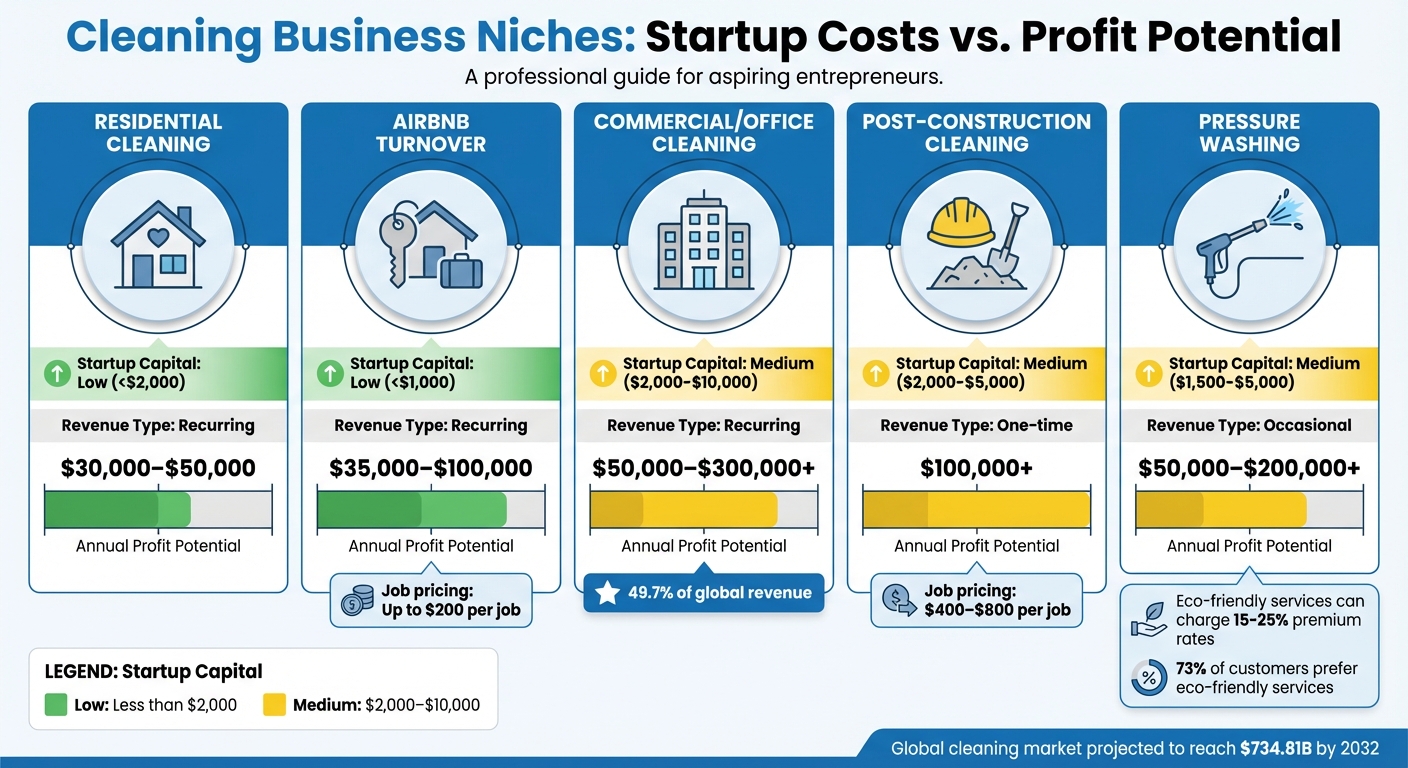
Cleaning Business Niche Comparison: Startup Costs and Profit Potential 2025
With your concept validated, it's time to narrow your focus. The global cleaning market is projected to hit $472 billion by 2026, growing at 7.1% annually. However, not every niche offers the same opportunities. Your ideal niche should reflect three key factors: local demand, your startup budget, and the skills you bring to the table.
Popular Cleaning Niches and Trends
Commercial cleaning leads the industry, making up 49.7% of global revenue. A single office cleaning contract worth $2,000 per month can often be more lucrative than managing multiple residential clients. If you're starting with less than $1,000, consider niches like residential cleaning (earning $30,000–$50,000 annually), Airbnb turnovers (up to $200 per job), or window cleaning. These options are budget-friendly and don't require specialized equipment.
For higher earnings, you could explore post-construction cleaning, where annual income can exceed $100,000, with jobs priced between $400 and $800. Another profitable option is pressure washing, which can generate $50,000 to over $200,000 annually. Additionally, eco-friendly cleaning services are gaining traction - 73% of customers prefer them, and you can charge 15–25% higher rates for such services.
Your choice should also align with local conditions. For example, pool cleaning thrives in warmer states, chimney sweeping is ideal in New England, and short-term rental or post-construction cleaning works well in areas with active construction or high tourism. Local market insights can help you refine your niche further.
Using Market Data to Make an Informed Decision
Leverage local data to assess your market potential. Tools like IdeaFloat's Smart Market Sizing can help you analyze three critical metrics:
- Total Addressable Market (TAM): The overall cleaning demand in your area.
- Serviceable Available Market (SAM): The specific niche you aim to serve.
- Serviceable Obtainable Market (SOM): The realistic share you can capture, considering local competition.
For instance, if you're eyeing medical facility cleaning in a mid-sized city, the tool can estimate the number of clinics in your area, their typical cleaning budgets, and the share you could secure in your first year. This ensures you don't invest in a niche that looks profitable nationally but lacks local demand. Combine these insights with your competitive research from Step 1 to find underserved segments. For example, if competitors focus on offices, you might target gyms or retail spaces instead.
Align your services with your available budget. Here's a quick comparison of startup costs and profit potential across different niches:
| Niche Type | Startup Capital | Revenue Type | Profit Potential |
|---|---|---|---|
| Residential | Low (<$2,000) | Recurring | Moderate ($30,000–$50,000) |
| Commercial/Office | Medium ($2,000–$10,000) | Recurring | High ($50,000–$300,000+) |
| Post-Construction | Medium ($2,000–$5,000) | One-time | Very High ($100,000+) |
| Pressure Washing | Medium ($1,500–$5,000) | Occasional | High ($50,000–$200,000+) |
| Airbnb Turnover | Low (<$1,000) | Recurring | Moderate ($35,000–$100,000) |
Before investing in specialized equipment, talk to at least 10 potential customers or property managers. For example, if you're considering cleaning commercial kitchens, reach out to local restaurant owners to learn about their cleaning budgets and challenges. These conversations can confirm demand and help you set competitive pricing right from the start.
Step 3: Create Your Business Plan and Financial Model
Once you’ve validated your niche, the next step is to craft a business plan. Think of this as your guide to making informed, profitable decisions. It’s not just for investors - it’s for you, ensuring you don’t underprice your services or lose money, even when you’re busy.
Key Components of a Business Plan
A solid business plan should cover six main areas:
- Start with a one-page executive summary. This should clearly outline your business concept, mission, and financial goals.
- Conduct a market analysis. Identify who your target customers are (residential or commercial), analyze competitors, and determine the gaps you’ll fill.
- Define your services and pricing model. Decide if you’ll charge hourly, flat rates, or per square foot.
- Build a financial plan. Estimate your startup costs, project monthly revenue, and calculate your breakeven point.
- Develop a marketing strategy. Detail how you’ll attract customers - whether through local SEO, flyers, or referral programs.
- Outline your operational plan. Include your legal structure (LLC or sole proprietorship), licenses, insurance, and required equipment.
Having a plan ensures you stay on track and avoid common pitfalls. For instance, many independent cleaners underestimate costs by 30–40% - a mistake that can eat into profits.
Choosing the Right Pricing Model
Pricing is one of the most critical decisions you’ll make. The U.S. home cleaning market is growing at about 7.6% annually, but only businesses with healthy profit margins - typically between 10% and 35% - can sustain long-term success.
Here are some common pricing models:
- Hourly Rates: Ranging from $25 to $75 per cleaner, this works well for first-time or unpredictable jobs.
- Flat-Rate Pricing: Usually $100 to $250 per visit, ideal for recurring residential clients who value predictability.
- Per-Square-Foot Pricing: Typically $0.05 to $0.16 per square foot, this model is great for commercial spaces or large homes.
- Per-Room Pricing: Base fees plus $15–$30 per room, often used for apartments or condos.
Many businesses combine these methods - charging hourly for one-time deep cleans and using flat rates for regular clients. Offering discounts for recurring services (e.g., 15% off for weekly cleanings) can also encourage long-term commitments.
"Pricing is the single highest-leverage decision in a cleaning business. Get it wrong and you'll stay busy while going broke." - Tarik Khribech, Founder & CEO, AllBetter
To set your rates, calculate your cost per hour: (Monthly Overhead + Supply Costs + Insurance) ÷ Billable Hours. Add your desired profit margin, and avoid basing prices solely on competitors. Your costs - like travel time and supplies - are unique, so accurate pricing is essential for managing operations effectively.
Financial Planning and Breakeven Analysis
Start by estimating your initial costs. A solo operator typically needs between $1,400 and $10,500 to cover essentials like equipment, registration, insurance, and marketing. If you’re hiring employees, startup costs may increase to $61,000–$73,000.
Next, calculate your monthly fixed overhead. This might include:
- Insurance: Around $80 to $300 per month.
- Software subscriptions, legal fees, and salaries: Varies depending on scale.
- Variable costs: Labor (wages plus 15–20% for payroll taxes), cleaning supplies ($3–$8 per job), and travel expenses (using the IRS mileage rate of $0.67 per mile).
Don’t overlook drive time - it can account for up to 60% of early expenses. Grouping jobs by location can help reduce this cost.
To find your breakeven point, use this formula:
Total Fixed Costs ÷ (Average Revenue per Job – Variable Cost per Job)
For example, if your fixed costs are $2,000 per month, you charge $150 per job, and each job costs $50 in labor and supplies, you’ll need 20 jobs per month to break even.
Tools like IdeaFloat’s Financial Projections can simplify this process. By inputting your pricing, job estimates, and expenses, you’ll get detailed revenue and cost forecasts. This helps you identify when you’ll turn a profit and whether external funding might be necessary.
Tracking your actual performance against these forecasts is crucial. If you’re falling short of your breakeven target, you can adjust by either raising rates or cutting costs. Often, increasing your prices by even 10% can have a bigger impact than focusing solely on reducing expenses.
Step 4: Handle Legal and Operational Setup
Once your financial plan is in place, it’s time to formalize your business by tackling legal registration and setting up operations. This step ensures your business is legally protected, builds credibility with clients, and keeps you compliant with regulations.
Business Registration and Licenses
Start by deciding on a legal structure. Many cleaning businesses choose an LLC (Limited Liability Company) because it protects personal assets from lawsuits and simplifies tax obligations. The cost to form an LLC varies by state, ranging from $50 to $800. If you're a solo operator, a sole proprietorship is a cheaper option, though it doesn’t shield personal assets.
After choosing your structure, register your business name with your state’s Secretary of State office. If you plan to operate under a different name, file for a DBA (Doing Business As). Then, apply for a free Employer Identification Number (EIN) from the IRS. This number is essential for managing taxes, opening a business bank account, and hiring employees.
Most cities or counties require a general business license, which typically costs $50 to $400 annually. If you’re working from home, check local zoning laws and secure a Home Occupation Permit if needed. Additionally, if you’re operating in states like Texas, Florida, or New York where cleaning services are taxable, you’ll need a Sales Tax Permit.
"A general business license is the baseline requirement before you start cleaning homes or offices for pay. Without it, you're technically operating illegally and risking your entire business." – Jeel Patel, CEO, FieldCamp
Plan for one to two weeks to complete licensing. Keep track of renewal deadlines - some permits require reapplication as early as 90 days before expiration.
Once the legalities are sorted, it’s time to gather the tools and supplies you’ll need to deliver professional cleaning services.
Required Supplies and Equipment
Starting doesn’t require a massive investment in supplies. A basic setup for residential or commercial cleaning can cost between $150 and $600. Here’s what you’ll need:
- Core tools: Color-coded microfiber cloths (24-pack costs $15–$25), mop and bucket systems ($30–$60), brooms, dustpans, extendable dusters, and scrub brushes.
- Cleaning chemicals: Stock all-purpose cleaners, EPA-registered disinfectants, glass cleaners, and floor-specific solutions. Save money by buying professional chemical concentrates instead of ready-to-use bottles - this can lower your cost per 32oz bottle from $4.00 to $0.30–$0.50.
- Vacuum cleaner: Invest in a commercial-grade vacuum with a HEPA filter, priced between $150 and $500. Look for "field-repairable" models, like those from ProTeam, which are easier to maintain.
- Specialized equipment: For tasks like floor buffing ($300–$800) or carpet extraction, consider renting until your client base grows.
Don’t forget safety gear, including gloves, non-slip footwear, goggles, and "Wet Floor" signs. These items help prevent accidents and protect your team. Organizing standardized supply kits for different job types can also reduce waste and streamline operations.
With your equipment ready, the next step is securing insurance to protect your business and build client trust.
Setting Up Insurance and Liability Coverage
Insurance is a must for protecting your business and reassuring clients. Start with General Liability Insurance, which covers third-party injuries (like a client slipping on a wet floor) and accidental property damage (such as bleach spilling on carpeting). This coverage typically costs $300 to $600 annually for small cleaning businesses.
If you hire employees, Workers' Compensation Insurance is required in most states. It covers medical expenses and lost wages for work-related injuries, with annual premiums ranging from $500 to over $2,000, depending on your payroll.
For vehicles used in your business, you’ll need Commercial Auto Insurance. Personal auto policies don’t cover accidents during business activities, so expect to pay $1,000 to $3,000 per year for this coverage.
A Janitorial Surety Bond (or dishonesty bond) is another safeguard. It protects clients in cases of employee theft and is often required for commercial contracts. This bond usually costs 1% to 5% of the bond amount annually, meaning a $10,000 bond might cost $100 to $500 per year. For commercial clients, it’s common to require at least $1,000,000 in general liability coverage before signing a contract.
| Coverage Type | What It Protects | Estimated Annual Cost |
|---|---|---|
| General Liability | Third-party injury and property damage | $300–$600 |
| Workers' Compensation | Employee medical expenses and lost wages | $500–$2,000+ |
| Janitorial Bond | Protection against employee theft | $100–$500 |
| Commercial Auto | Business vehicles and transit-related accidents | $1,000–$3,000 |
Consider bundling policies into a Business Owner's Policy (BOP), which combines general liability and commercial property insurance at a lower cost. Once you’re fully licensed, insured, and bonded, highlight these credentials in your marketing materials to build trust with potential clients.
Step 5: Launch Your Business and Acquire Customers
With your legal setup and insurance sorted, it’s time to bring your business plan to life. This is the stage where your concept starts generating revenue. The cleaning industry is expected to grow by 5.9% annually through 2029, but your success will depend on how quickly you can establish trust and visibility in your local community. Let’s dive into building your online presence and crafting a launch strategy that gets results.
Building an Online Presence
A Google Business Profile (GBP) is your most powerful free tool for attracting local customers. When people search for "cleaning services near me", a complete GBP - featuring 20–30 high-quality photos and regular updates - dramatically boosts your chances of showing up in the coveted top three Map Pack results. Make sure to fill out every field, including business hours, service areas, and descriptions. Weekly updates with fresh photos of completed jobs can signal activity to Google’s algorithm, helping you stand out.
Your website also plays a critical role. Since 50% of visitors leave websites that take longer than 3 seconds to load, optimize yours with compressed WebP images and ensure it’s mobile-friendly. Adding an online booking feature is a smart move, especially since younger customers often prefer scheduling online - and the first business to respond secures the job 80% of the time.
Tailor your social media efforts to your audience. Platforms like Facebook and Instagram are ideal for residential clients aged 30–60, while LinkedIn is better for connecting with property managers and corporate clients. Consistency is key: ensure your business name, address, and phone number match across your website, GBP, social media, and online directories to build Google’s trust.
A polished online presence lays the groundwork for a launch strategy that converts interest into bookings.
Creating a Launch Strategy
Start by announcing your business to friends, family, and close contacts. These early clients can provide those all-important first testimonials. To attract new customers, consider offering a 10–15% discount for first-time bookings.
Use tools like IdeaFloat's Launch Checklist to organize tasks leading up to your launch, and a Waitlist Landing Page to collect email addresses from interested clients before your official opening day.
For offline marketing, try the "10-Around" strategy: after completing a job, leave flyers or door hangers at the 10 nearest homes or offices. Adding a QR code that links directly to your booking page makes it easy for potential clients to take action.
Building partnerships can also be a game-changer. Connect with realtors, property managers, and Airbnb hosts who need regular move-in/move-out cleaning services. Joining local organizations like your Chamber of Commerce or a BNI chapter can help you network with other business owners.
Don’t underestimate the power of physical branding. As MethodCleanBiz says:
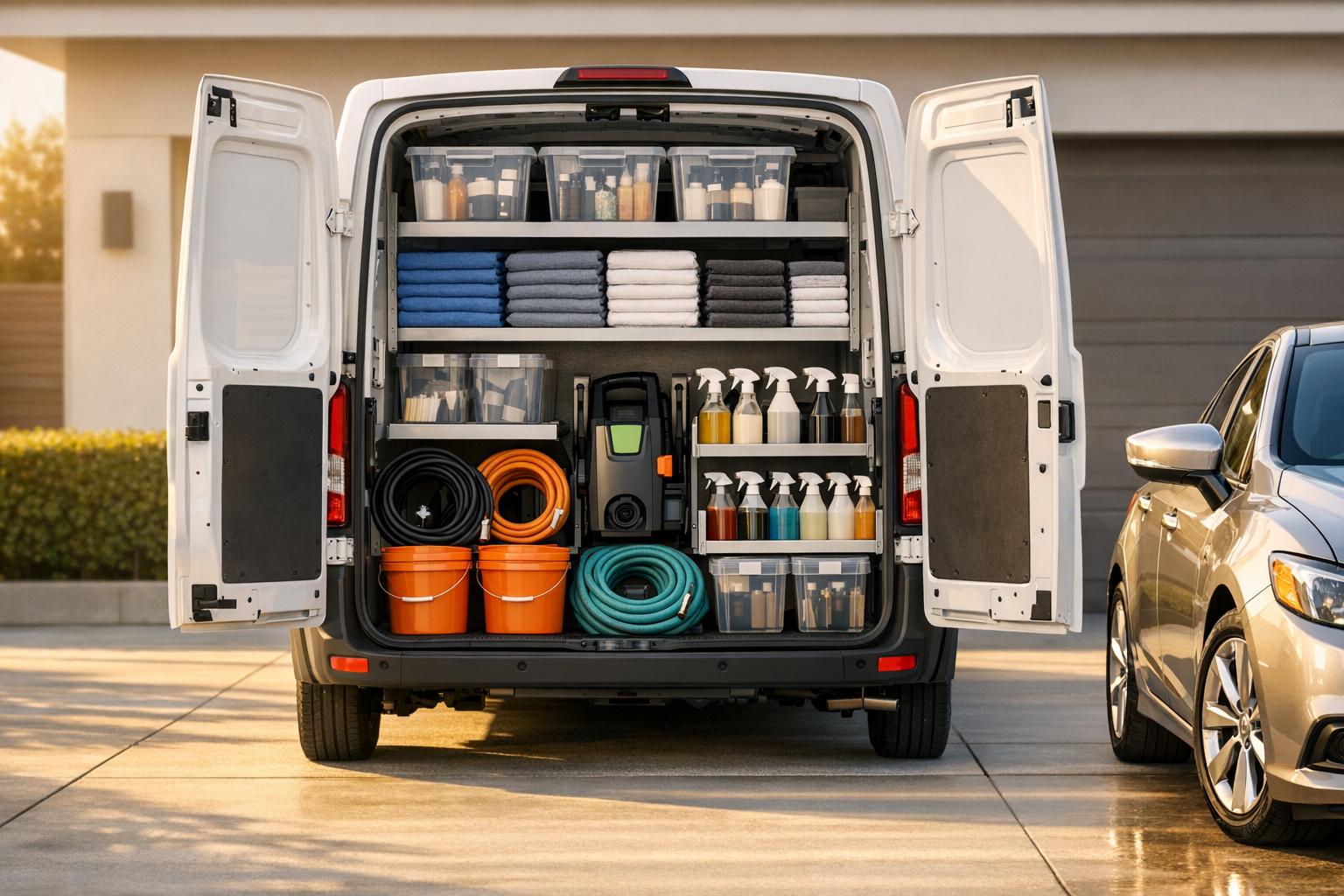
"Your van is free advertising on wheels".
Plan to allocate 15–20% of your gross revenue to marketing during your first year. A good breakdown might include 40% for Google Ads, 25% for Facebook/Instagram Ads, and the rest for direct mail, email automation, and SEO.
Customer Retention and Scaling
Retention is where profits grow. Automate follow-ups by sending a text or email within 24 hours of completing a job to address any concerns early. Tools like NiceJob or Jobber can request reviews automatically after service, which helps improve your local search rankings.
Encourage loyalty by offering tiered discounts - such as 20% off for weekly cleanings, 15% for bi-weekly, and 10% for monthly services - and a referral program that rewards clients for bringing in new customers.
Upselling is another way to boost revenue. Offer add-ons like interior window cleaning, fridge detailing, or laundry services. Grouping clients geographically can reduce travel time and increase daily earnings. Once you’re handling 15–20 recurring jobs or working more than 40 hours a week, it’s time to hire your first employee.
As your business grows, maintaining quality is crucial. Standardize your services by creating digital checklists and Standard Operating Procedures (SOPs) for every service level. Delegate administrative tasks like scheduling and invoicing to virtual assistants or specialized software, freeing up your time to focus on expansion.
Specializing in high-margin services can also drive growth. For instance, targeting Airbnb turnovers or post-construction cleanups allows you to charge premium rates. Consider this example: in 2025, a solo cleaner in Dallas used a virtual assistant to handle scheduling and invoicing, saving over 15 hours a week. By focusing on high-ticket deep cleans, she doubled her income in just four months. Similarly, a Miami-based cleaning team implemented an automated review and referral system, boosting their client retention rate by 40%.
The cleaning market is projected to hit $112 billion in the U.S. by 2026, with commercial cleaning taking up 55% of the market and green cleaning services making up 30%.
Conclusion: Making Your Cleaning Business Profitable
Key Takeaways
Starting a successful cleaning business in 2025 requires a clear vision, a specialized niche, and well-organized systems. The U.S. cleaning services market is expected to hit $74 billion by 2025, with a steady annual growth rate of 6%. To stand out, focus on a specific niche - like eco-friendly residential cleaning, Airbnb turnovers, or post-construction deep cleaning. This approach often allows for higher rates and less competition. Competing solely on price can be a race to the bottom; instead, highlight the unique value you bring to your clients.
Recurring contracts are key to stability. Weekly or bi-weekly agreements create reliable cash flow, reducing the stress of constantly finding new clients. Combine this with thoughtful pricing that covers labor, supplies, overhead, and a 20–40% profit margin to avoid cash flow pitfalls - an issue that causes 80% of small businesses to fail. Streamline your operations by automating administrative tasks with business management software or virtual assistants, saving over 15 hours each week and giving you more time to focus on growing your business. Build a solid online presence with a complete Google Business Profile, a fast and mobile-friendly website, and consistent local SEO efforts.
As your business grows, maintaining quality is critical. Standardized processes help ensure consistency, while tracking metrics and optimizing client routes geographically can improve efficiency. Offering add-on services to existing clients is another way to boost revenue without significantly increasing costs. In the cleaning industry, businesses that balance operational efficiency with exceptional customer service tend to thrive.
Take Action on Your Business Idea
Now’s the time to put your plan into motion. Use tools like IdeaFloat’s Problem Validator to confirm your niche, the Consumer Insights tool to understand what your customers want, and a Waitlist Landing Page to gauge early interest and build momentum. These tools, combined with a strong financial model, provide a solid foundation for profitability and growth.
Running a cleaning business is about more than just providing a service - it’s about creating systems, earning trust, and consistently delivering value. With thoughtful planning, smart pricing, and a customer-first mindset, you can turn a straightforward service into a thriving, scalable business in 2025 and beyond.
FAQs
How do I pick the best cleaning niche in my city?
To set your cleaning business up for success, start by digging into your local market. Identify gaps or underserved areas where demand is strong. For example, services like eco-friendly cleaning, crime scene cleanup, or specialized commercial cleaning for certain industries often have untapped potential.
Some niches, like post-construction cleaning or commercial kitchen cleaning, are known for their higher revenue possibilities. These areas can be especially lucrative if there's limited competition in your region.
The key is to align your business with local needs, your expertise, and areas where the market falls short. By focusing on a niche that fills a gap and meets demand, you'll position your business to thrive.
What should I charge to stay profitable from day one?
To make sure your business stays profitable from the start, set your prices by factoring in all your costs - like supplies, labor, and overhead - and then adding a profit margin. At the same time, keep your rates competitive. For residential cleaning, hourly rates usually fall between $25 and $50.
A good approach is to use a formula that considers local demand, the complexity of the services you offer, and your desired profit. Be prepared to tweak your rates over time to ensure they cover your expenses while staying in line with what the market can bear.
What licenses and insurance do I need to start?
To launch a cleaning business, you'll need to take care of a few important steps. Start by registering your business and applying for a cleaning business license. Depending on your location, you may also need to secure specific permits. Another critical step is obtaining insurance to safeguard your business against potential liabilities and damages. Since licensing and insurance requirements differ from one state or city to another, it’s essential to review local regulations carefully to ensure everything is in order before you begin operations.
Related Blog Posts
 Report an issue
Get the newest tips and tricks of starting your business!