
Want to turn your love for dogs into a profitable business? Starting a dog walking service is one of the most accessible and rewarding ways to do it. With low startup costs ($500–$2,000), flexible hours, and a growing demand for pet care, this guide breaks down everything you need to know to get started.
Here’s the quick version:
- Why Now? The U.S. pet care market hit $147 billion in 2023, with dog walking in high demand as professionals return to offices.
- Earnings Potential: Full-time walkers can make $30,000–$60,000 annually, with over $100,000 possible in high-demand cities.
- Steps to Start:
- Research Your Market: Identify local demand, target customers, and competitors.
- Plan Your Business: Define services, set pricing, and calculate costs (startup: $500–$2,000; ongoing: $800+/month).
- Handle Legal Setup: Register as an LLC, get permits, and secure insurance.
- Build Your Brand: Create a website, use social media, and optimize for local search.
- Launch and Operate: Use tools for scheduling, set clear policies, and prioritize client trust.
With the pet industry expected to triple in value by 2030, now is the perfect time to start. Keep reading for actionable steps to build a profitable dog walking business.
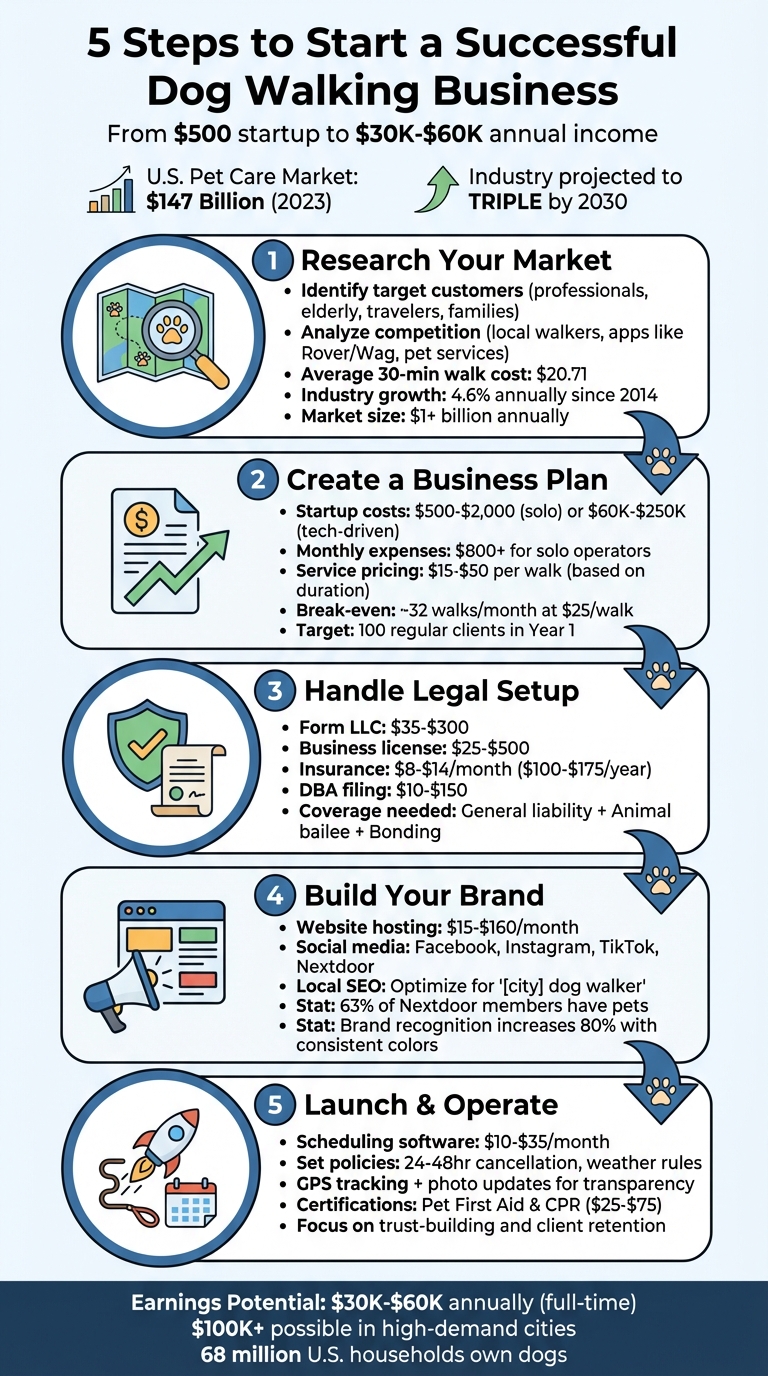
5 Steps to Start a Dog Walking Business
Step 1: Research Your Market
Identify Your Target Customers
Your ideal clients generally fall into a few distinct groups: busy working professionals, elderly pet owners with mobility issues, frequent travelers who need consistent care, and families juggling high-energy puppies or multiple dogs. To find these customers, focus on areas near large apartment complexes, dog parks, and nature trails. Tools like the U.S. Census or real estate sites such as Zillow can help you identify neighborhoods with higher median incomes or a concentration of seniors and working professionals. Once you've narrowed down potential areas, visit local dog parks or pet stores to get a feel for what pet owners want and whether current services meet their needs.
Analyze Local Competition
Your competition isn't limited to just other dog walkers. You'll also be up against professional dog walking companies, groomers or vets offering walking services, individuals walking dogs as a side gig, and tech platforms like Rover and Wag. Each has its strengths: local professionals often provide personal relationships and direct contact, while apps focus on convenience, though they may lack the personal touch of a small business.
Take time to study what competitors offer. Look at details like walk durations, whether they provide group or solo walks, and extras like GPS tracking or pet first aid certifications. Reviews on platforms like Yelp and Google can be especially revealing - common complaints, such as last-minute cancellations or inflexible scheduling, can highlight gaps you could address. As Surefire Local emphasizes:
"Know your enemy is a concept that applies just as much in business as it does in war."
Pricing is another key factor. Are competitors charging by the hour or per visit? Do they offer discounts for multiple dogs or bundle deals? For reference, the average cost of a 30-minute walk is about $20.71, but this varies widely depending on location and service quality. If you notice local walkers on apps like Rover are consistently booked weeks in advance, that’s a strong sign the market has room for another dependable service provider. Once you've mapped out the competition, it’s time to confirm if there's enough demand to support your business.
Confirm Demand in Your Area
The U.S. dog walking industry generates over $1 billion annually and has been growing at an average rate of 4.6% since 2014. But national trends won’t mean much if your neighborhood doesn’t have a need for dog walking services. To gauge local demand:
- Check platforms like Rover or Wag: If walkers in your area are booked solid or have limited availability, demand is likely high.
- Monitor local Facebook groups and Nextdoor: Look for posts from people asking for dog walker recommendations or advertising pet care jobs.
- Visit veterinary clinics: Ask if they keep a referral list for dog walkers. A short or nonexistent list could signal an opportunity.
- Use Google Maps: Pinpoint parks and other walking-friendly areas where dog owners tend to gather.
Talking directly to potential customers can also be incredibly helpful. Ask about their experiences with current services, their satisfaction levels, and how much they’re willing to pay. Even simple conversations can uncover whether existing options are too expensive, unreliable, or just not available. With 68 million U.S. households owning dogs and 71% of homes having pets overall, the customer base exists - you just need to confirm they’re nearby. This groundwork will guide how you design and market your services in the next stages.
sbb-itb-08dd11e
Step 2: Create a Business Plan
Define Your Services and Pricing
Your service offerings are the backbone of your business and set you apart from competitors. Common services include 30-minute solo walks ($15–$30), group walks for 2–4 dogs ($15–$25 per dog), quick potty breaks lasting 10–15 minutes ($10–$15), and extended 60-minute walks ($30–$50). To expand your income streams, consider add-ons like overnight pet sitting ($75–$100+ per night), training reinforcement, or concierge services such as vet appointment transportation.
Specialized services can help you stand out. Options like senior dog strolls, puppy socialization, trail hikes, or rehabilitation walks often justify higher rates. These niche offerings address specific needs identified in your market research. Marketing expert Ivana Taylor highlights the importance of research:
"Market research is the first and most important step. Your goal is to uncover the ideal outcome your potential clients are expecting... and then figure out what's missing."
When setting prices, consider your local market and business costs. Use a "starting at" pricing model for transparency, with final quotes tailored to each pet's needs. A good guideline: allocate 45–50% of revenue for labor, 20–30% for overhead, and 20–30% for profit. Simplify billing by charging for time blocks rather than itemizing tasks. Offering bundle deals, like discounted rates for five weekly walks, can encourage recurring bookings and provide steady income.
Calculate Startup and Operating Costs
After defining your services, it’s time to figure out your costs.
Startup costs vary depending on the scale of your business. A small solo operation might start with $500–$2,000, covering essentials like business registration ($50–$500), insurance and bonding ($150–$500 annually), basic gear like leashes and first-aid kits ($5–$400), and marketing materials ($10–$300). Professional dog walker insurance can cost as little as $14.58 per month. On the other hand, a tech-driven business with scheduling software and employees may require $60,000–$250,000, with app development alone ranging from $47,000–$250,000.
Monthly expenses fall into fixed and variable categories. Fixed costs include subscriptions, insurance, and office rent. Variable costs cover fuel, wages, and payment processing fees (typically 2.9% + $0.30 per transaction). For solo operators, taxes and travel are often the largest ongoing expenses. Hiring employees adds payroll taxes and wages, which can account for 32–38% of total revenue.
To find your break-even point, divide your fixed monthly costs by your average charge per walk. For instance, if your monthly expenses are $800 and you charge $25 per walk, you’ll need 32 walks to cover costs. Grouping routes by neighborhood can lower travel expenses and let you fit more walks into each shift, boosting profitability. Certifications like pet first aid and CPR ($25–$75) not only enhance client trust but can also justify higher rates, often paying off quickly.
Set Financial Goals and Growth Milestones
With your expenses mapped out, set specific financial goals to guide your business growth.
Start with realistic revenue targets based on your business model. A solo walker might aim to earn $21,000–$44,000 annually, while a larger operation with employees could target $970,000 in the first year, growing to over $3 million by Year 3. The pet services industry has grown 11.7% from 2020 to 2023, and the $100 billion pet industry is projected to triple by 2030. In your first year, focus on building a loyal customer base of about 100 regular clients booking weekly services.
Monitor key performance indicators (KPIs) weekly, such as revenue per walk, time slot utilization, customer retention, and labor efficiency. Use revenue milestones to decide when to expand - whether that’s hiring staff, increasing marketing efforts, or offering services in new areas. Diana Ludwiczak, CEO of Wolfie’s Place, advises:
"This is a serious business and should not just be treated as a side hustle."
Recurring revenue is key. Aim for clients to book five weekly walks for consistent income. Efficient operations, as outlined in your cost analysis, will help you meet these financial targets.
Profitability should always take precedence over raw revenue. For businesses with significant upfront costs (like app development), breaking even may take up to three years. A scaled operation could see an EBITDA of $203,000 by Year 3, growing to $646,000 by Year 4. Once your core business is stable, consider expanding with high-margin services like reactivity training, grooming, or adventure walks. Keep a cash reserve to handle seasonal slowdowns or unexpected expenses - several months’ worth of operating costs is a smart safety net for growth-focused businesses.
How to Start a 6-Figure Dog-Walking Business (COMPLETE GUIDE)
Step 3: Handle Legal and Administrative Setup
Getting your legal and administrative setup in order is essential for running your business smoothly and protecting yourself from potential risks. It’s about staying compliant while building a strong foundation for your dog walking business.
Choose a Business Structure
The type of business structure you choose determines your personal liability and tax responsibilities. If you go with a sole proprietorship, your personal assets could be on the line if something goes wrong, like a lawsuit or an accident.
For dog walkers, forming a Limited Liability Company (LLC) is often the better choice. An LLC helps shield your personal assets from business-related debts or lawsuits. Setting one up typically costs between $35 and $300, depending on your state. To create an LLC, you’ll need to:
- Choose a unique business name.
- File Articles of Organization.
- Appoint a registered agent.
- Obtain an EIN (Employer Identification Number).
If you’re planning to operate under a name other than your legal one - like "Paws & Paths" instead of "John Doe" - you’ll also need to register a DBA (Doing Business As). Filing a DBA usually costs between $10 and $150. Additionally, most businesses need to file a Beneficial Ownership Information (BOI) report with FinCEN to comply with the Corporate Transparency Act. You can even act as your own registered agent if you’re available at your business address during standard working hours.
After setting up your LLC, the next step is to make sure you have all the licenses and permits required to legally operate your business.
Obtain Licenses and Permits
Many cities and counties require a business license, which can cost anywhere from $25 to $500. Check with your local city or county clerk’s office to confirm the specific requirements in your area. If you’re running your business from home, you might also need a home occupation permit to comply with zoning regulations.
In some locations, commercial dog walkers may need special use permits to access public parks or trails. It’s a good idea to contact local authorities before signing any leases or starting operations to avoid unexpected fines or violations.
Don’t forget to make sure that all dogs you care for have up-to-date rabies vaccinations, as required by local health codes. You’ll also need to comply with waste removal ordinances - violations can result in fines of up to $500. And if you plan to sell products, like dog treats or leashes, a sales and use tax permit will be necessary.
Get Insurance and Bonding
Once your legal setup is in place, it’s time to focus on protecting your business with insurance and bonding.
Insurance is crucial for shielding your business and your clients from financial losses. General liability insurance covers third-party injuries (like if a dog bites someone) and property damage. Standard policies usually offer coverage ranging from $1 million to $2 million per occurrence, though they often don’t cover incidents involving animals in your care. For that, you’ll need animal bailee insurance, which covers injuries, illnesses, or even the death of pets under your supervision.
Fidelity bonding is another layer of protection, safeguarding your clients from theft or dishonest acts by you or your employees. This is especially important since you’ll likely have access to clients’ homes. Diana Ludwiczak, CEO of Wolfie's Place, advises:
"I would suggest getting pet insurance and bonding. Having this will let your clients know that you take the safety of their dog very seriously."
Dog walking insurance is surprisingly affordable, with basic plans costing between $8 and $14 per month, or around $100 annually. Providers like Pet Sitters Associates, PCI, and NEXT Insurance offer tailored coverage and quick access to certificates of insurance. If you hire employees, workers’ compensation insurance is usually required by law. And if you’re transporting dogs in your vehicle, you’ll need commercial auto insurance, as personal policies typically don’t cover business-related incidents.
Highlighting your insured and bonded status in your marketing materials can boost your credibility with potential clients. In some areas, you may even need to provide proof of professional liability insurance or bonding to secure your business license.
Step 4: Build Your Brand and Market Your Business
Now that you've laid the legal groundwork, it’s time to focus on establishing your brand and connecting with your audience. You don’t need a huge marketing budget - what matters is reaching the right people in the right places.
Create an Online Presence
Your website acts as your digital storefront, shaping the first impression potential customers have of your business. Studies show people form opinions about a brand's trustworthiness in just seven seconds, so make those moments count.
Start by securing matching handles on key platforms like Facebook, Instagram, TikTok, and X to maintain brand consistency. Even small details, like using a specific brand color, can make a big impact - consistent use of a signature color can boost brand recognition by up to 80%.
For your website, tools like Wix, Squarespace, or WordPress make it easy to create a professional-looking site. Depending on your needs, costs can range from free to over $1,000 for professional design work. Hosting and domain fees typically fall between $15 and $160 per month. Be sure to include these essential pages: Homepage, About Us, Services, Service Area, FAQ, Reviews/Testimonials, Blog, Policies, Job Page, and Contact Page.
Local SEO should be a priority. Optimize your site with keywords like "dog walker near me" or "dog walking in [city]" to help your business appear in local search results. Register your business on directories like Google Business Profile, Yelp, Angie's List, and pet-specific sites such as PetSitUSA or Rover. A blog featuring pet care tips, grooming advice, or exercise suggestions can boost your search rankings and position you as a trusted expert.
Adding an online booking and payment system simplifies operations and meets customer expectations for convenience. Social media is another powerful tool - post daily photos of the dogs you walk or share pet care tips to stay visible and build credibility. As Dale Buchanan, Owner of K9 Business Coach, puts it:
"Post photos and videos of the dogs you walk daily".
Short-form videos, like TikToks or Instagram Reels, showcasing "a day in the life" or adorable dog moments, can be especially effective in growing your audience. These online strategies pair well with the local outreach methods discussed below.
Use Community Networks
Did you know that 63% of Nextdoor members have a pet in their household? With over 100,000 pet-related posts each month, Nextdoor is a goldmine for reaching local pet owners. Create a free Business Page to share updates, post special offers, and collect recommendations from nearby residents. Including photos on your page can increase engagement by 61%.
Join local Facebook groups for your neighborhood or pet owners, and share useful tips to build trust and engage with potential clients. Spend time at local dog parks during busy hours to meet owners and observe dogs that might benefit from regular walks. Flyers and business cards can also go a long way - place them in high-traffic spots like coffee shops, apartment complexes, and pet stores. Focus your efforts within a one-mile radius to create a strong local presence.
Collaborations with other pet-related businesses can expand your reach. Partner with veterinarians, dog trainers, groomers, pet stores, and animal shelters for mutual referrals. For example, leave your business cards at vet offices and offer emergency walk services for pets recovering from surgery. Hosting events like pet first aid workshops, dog birthday parties, or charity fundraisers can also help you connect with the community and showcase your services.
Offer Promotions to Get Your First Clients
Getting those first clients is often the hardest part of starting a business, but well-placed promotions can make all the difference. Introductory offers are a great way to encourage hesitant pet owners to give your services a try.
Consider offering discounts on the first booking or a "Buy One, Get One Free" deal for initial walks. Some businesses even provide a complimentary first walk to build trust and show reliability. As pet care expert Scout explains:
"A discount on the first walk can be an effective way to encourage new clients to give you a try".
Referral programs are another powerful tool. Reward existing clients with discounts or free services for every new customer they bring in. Scout adds:
"Offer existing clients discounts or freebies for referring new customers to your service. This not only incentivizes current customers but also builds trust with new ones who hear about you from someone they know".
Incentives for bulk bookings can also help turn one-time clients into regular ones. Deals like "Book five walks, get one free" encourage repeat business. Partnering with local shelters to include promotional offers in "new pet parent" packets is another great way to reach people who are actively looking for pet care services.
When walking a client's dog, leave "Bark Cards" for neighbors whose dogs are barking. A friendly note like, "I heard your dog wanted to join the fun!" can be an effective way to attract new clients on the same street. Bella from Jump Consulting emphasizes:
"Every dog walker would love to have clients on the same street... Create your own bark cards and you will get responses".
Lastly, always highlight that you’re insured and bonded in your marketing materials - this can be a major trust factor for first-time clients. Offering gift certificates for silent auctions or raffles at local pet events is another way to attract attention and generate leads. To build anticipation, start distributing flyers and promotional materials about six weeks before you officially launch your services.
Step 5: Launch and Manage Your Operations
Now that your marketing is set up, it’s time to shift gears and focus on the nuts and bolts of running your business day-to-day. The leap from a casual side hustle to a full-fledged business often hinges on how smoothly your operations run. With your marketing in motion, these systems ensure efficiency and keep your customers happy.
Set Up Scheduling and Payment Systems
A strong brand presence is just the beginning. To keep things running smoothly, you’ll need reliable scheduling and payment tools. Software like Time To Pet or Precise Petcare can handle client profiles, track walks, and more, with subscription costs ranging from $10 to $35 per month. If you’re just starting out, platforms like Square Appointments or PocketSuite offer budget-friendly options, including free tiers for solo users.
Automated tools can handle self-booking, reminders, and instant payments, saving you time and reducing errors. Digital invoicing ensures you stay on top of billing, while integration with tools like QuickBooks makes tax season less of a headache. As Clare S. from Acton Critter Sitters explains:
"I save hours upon hours of administrative time on billing, processing payments, and generating paychecks."
Transparency is key to building trust. Real-time updates like GPS tracking, visit reports, and photo updates let clients see exactly what they’re paying for. If you accept in-person payments, mobile card readers like Square Reader make it easy to process contactless transactions. Offering prepaid packages - such as discounted weekly or monthly plans - can simplify scheduling and create a steady cash flow.
Create Business Policies
Operational systems work best when supported by clear, well-defined policies. For example, a cancellation policy should outline required notice periods (typically 24 to 48 hours) and whether late cancellations or no-shows incur full or partial fees. Weather policies are equally important; while many walkers work rain or shine, you’ll need safety measures for extreme conditions like severe storms or heat waves.
Digital service agreements should include key handling forms and vet release clauses to address emergencies and ensure secure home access. You might also consider charging holiday fees during busy times like Thanksgiving, Christmas, or the Fourth of July to account for irregular hours. Written agreements should clearly detail billing terms, liability, and specific rules - such as limits on the number of dogs per walk. Keep in mind that some cities, like San Francisco, enforce legal limits. Lastly, opening a dedicated business bank account can simplify tax tracking and protect your personal finances.
Build Trust with Pet Owners
Trust and professionalism go hand in hand. Highlighting your insured and bonded status reassures clients that their pets and homes are in safe hands. Bonding specifically protects against theft or damage to a client’s property, which is especially important when you have access to their home. Certifications in Pet First Aid and CPR, available through organizations like the American Red Cross or Pet Tech, can further boost your credibility.
Every interaction is an opportunity to build trust. Punctuality, completing services as promised, and maintaining a calm, professional demeanor go a long way. As Time To Pet notes:
"A neighbor might see you berating a pet and report it to the client... these seemingly small instances can accumulate and lead to greater trust breaks in the future."
Keep clients reassured with concise visit reports that include photos and notes. GPS tracking through professional software provides real-time proof of services. Small gestures, like a birthday treat or holiday card, can turn a satisfied client into a loyal advocate. Heather Doll, co-owner of RuffCity in New York City, shares her perspective:
"Focus on the owners - taking care of the owners and obviously taking care of the dogs - because those are the ones that are really going to help get you to the next level."
Her business, which started in 2007, has grown into a six-figure operation with a team of 50 employees. This growth came from prioritizing exceptional care for both pets and their owners. Hosting meet-and-greet sessions before taking on new clients can help you assess compatibility and make a strong first impression. A referral program, such as offering a free walk for every successful referral, can also encourage word-of-mouth growth and reward your most loyal customers.
Conclusion
Review of Key Steps
You've now walked through the essential steps to launch your dog walking business. It all starts with market research, where you assess local demand and competition to discover service gaps you can fill. From there, you move into business planning, where you define your services, set pricing, and estimate startup costs - which can range from $0 to $1,000. The legal and administrative setup ensures you're protected, covering tasks like forming an LLC, obtaining permits, and securing insurance such as general liability and animal bailee coverage. Next, you focus on branding and marketing, creating a professional website, establishing a social media presence, and networking locally. Finally, you implement operational systems, incorporating scheduling software, clear policies, and tools like GPS tracking and visit reports to build client trust.
The pet industry is booming, with projections indicating it will triple in size by 2030. Average household spending on pet services is expected to grow from $980 in 2020 to $1,909 by 2030. Diana Ludwiczak, CEO of Wolfie's Place, underscores the importance of approaching this venture with professionalism:
"This is a serious business and should not just be treated as a side hustle".
With these steps complete, you’re set to focus on sustaining and growing your business in the years ahead.
Tips for Long-Term Success
Stay adaptable as the market changes. Consider expanding your offerings to include services like adventure walks, puppy check-ins, or training reinforcement to meet the evolving needs of your clients.
Professional growth is key. Join organizations like the National Association of Professional Pet Sitters (NAPPS) or Pet Sitters International (PSI) to stay informed about industry standards. Keep your certifications up to date and explore additional training opportunities to enhance your skills. Delivering top-quality service - through punctuality, clear communication, and genuine care - will help you retain clients and grow your reputation. Track your progress with metrics like revenue and client retention to ensure steady improvement.
Building a successful business takes time, but consistency pays off. Lean on your network, provide outstanding service, and let word-of-mouth referrals work in your favor. With the groundwork you've laid, you're ready to grow your dog walking business into a thriving venture.
FAQs
How many clients do I need to make this profitable?
The number of clients you need to turn a profit depends on several factors: your pricing, expenses, and overall business model. For instance, if you charge $20 per walk and handle 10 dogs daily, 5 days a week, you’d bring in about $4,000 per month. Typically, starting with 10 to 20 regular clients can help cover your costs and move you toward profitability. However, the exact number will ultimately depend on your unique financial goals and operating expenses.
What insurance do I actually need to start?
To get your dog walking business off the ground, having the right insurance is a must. It’s not just about protecting your business - it’s about safeguarding yourself and the dogs in your care. Two key types to consider are liability insurance, which covers damages or injuries that might happen during a walk, and bonding insurance, which protects against theft or loss of a client’s property. Take the time to explore insurance plans that align with the size and scope of your business. This way, you can operate with peace of mind, knowing you’re covered legally and financially.
How do I get my first 10 clients fast?
To land your first 10 clients quickly, start by letting your friends, family, and neighbors know about your services. Ask them to help spread the word. You can also promote your business by placing flyers in places like pet stores, grocery stores, and community centers.
Create a basic website to showcase your services, use social media to reach a wider audience, and list your business on popular online directories. Additionally, connecting with established pet sitters or dog walkers in your area can open doors to valuable referrals.
Related Blog Posts
 Report an issue
Get the newest tips and tricks of starting your business!