Starting a business with $5,000 or less is not only possible but also practical. Whether you're aiming for a side hustle or a full-time venture, there are plenty of options that require minimal upfront costs and can generate steady income. Here’s the breakdown:
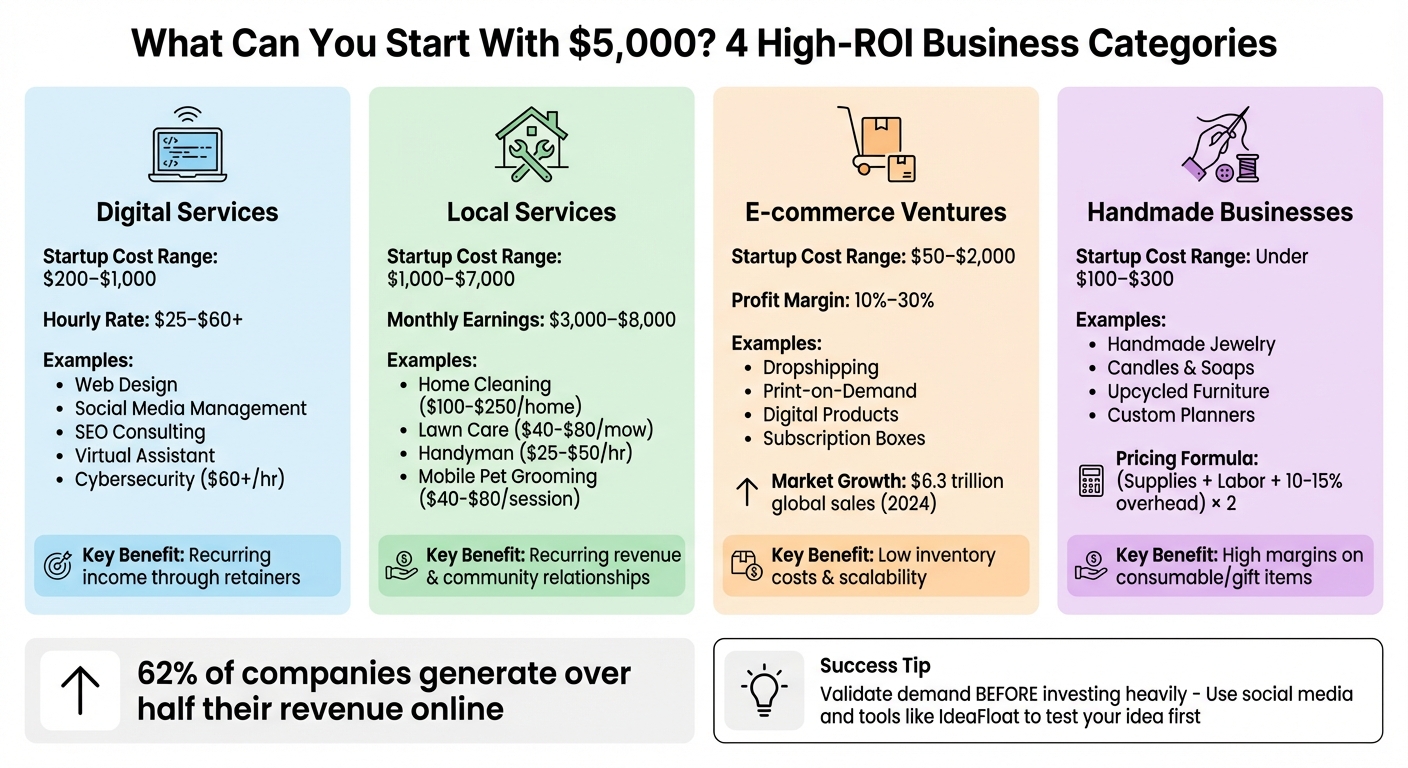
- Digital Services: Start with a laptop and internet connection. Offer services like web design, social media management, SEO consulting, or virtual assistance. Costs range from $200–$1,000, and hourly rates can go from $25 to $60+.
- Local Services: Use basic tools or equipment you already own. Ideas include home cleaning, lawn care, handyman services, or mobile pet grooming. Startup costs vary from $1,000–$7,000, with consistent monthly earnings potential.
- E-commerce Ventures: Leverage platforms like Shopify or Etsy to sell products. Options include dropshipping, print-on-demand, digital products, or handmade goods. Initial costs are as low as $50–$2,000, with profit margins of 10%–30%.
- Handmade Businesses: Use your skills to create jewelry, candles, planners, or upcycled furniture. Costs start under $100, with high potential for repeat customers.
Key Tip: Validate demand before investing heavily. Tools like IdeaFloat or social media platforms can help you test your idea and build an audience. This ensures your $5,000 investment goes toward a business that meets market needs.
Examples of Success: Entrepreneurs like Colin Johnson and Myriam Leblanc started small and scaled quickly by focusing on market demand and leveraging affordable tools.
With the right approach, your $5,000 can become the foundation of a profitable business. Pick an idea, test it, and take action today.
4 Business Categories You Can Start With $5,000: Costs, Earnings & ROI Comparison
Top 5 Business Ideas Under $5000 Investment
1. Digital Services
Digital services are a fantastic starting point for entrepreneurs, offering low upfront costs and the flexibility to work with tools you likely already have - like a laptop and smartphone. With initial expenses often staying below $1,000, these businesses are not only affordable but also scalable, often providing recurring income through retainer agreements once clients are secured.
A significant 62% of companies generate over half their revenue online, and with cybercrime causing losses exceeding $8 trillion in 2023, there’s a growing demand for expertise in digital fields like cybersecurity.
1. Web Design & Maintenance
Creating and managing websites for local businesses can be a lucrative venture. With startup costs around $1,000 for design software and hosting, you can charge $25 or more per hour for your work. Maintenance contracts offer an opportunity for consistent monthly income, making this a reliable option for steady earnings.
2. Social Media Management
Help brands manage their presence on platforms like Instagram, Facebook, and LinkedIn by handling their content and engagement strategies. You’ll need an initial investment of $300 to $600 for tools like Buffer or Canva. Monthly fees for your services can range from $500 to over $2,500 per client, especially if you focus on offering recurring packages that ensure predictable income.
3. SEO & Digital Advertising Consulting
Businesses are always looking to improve their search engine rankings and maximize their advertising campaigns. With startup costs under $1,000, you can charge $50 or more per hour to help companies boost their online visibility. Offering ongoing consulting packages can further solidify your revenue streams.
4. Cybersecurity Consulting
With cyber threats like phishing and ransomware on the rise, small businesses need protection now more than ever. As a cybersecurity consultant, you can charge $60 or more per hour. Specializing in industries like healthcare or legal services can help you stand out as a trusted expert, allowing you to command higher rates.
5. Virtual Assistant Services
Provide remote support for administrative, technical, or creative tasks to entrepreneurs and small businesses. Startup costs are minimal, ranging from $200 to $500 for tools like project management software. You can charge between $25 and $50 per hour, and as your client base grows, you can scale by hiring additional assistants.
6. Online Course Creation
Turn your knowledge into a profitable business by creating video lessons or downloadable guides. With an initial investment of $150 to $1,000 for tools like Camtasia and platforms like Teachable, you can tap into the booming e-learning market, which is expected to surpass $842 billion by 2030. Courses typically sell for $150 to $800 or more, and once created, they require no additional production costs - making this a high-margin opportunity.
7. Media Buying Agency
Help businesses plan and execute advertising campaigns on platforms like Google and Facebook. The media buying market, valued at $69 billion in 2022, is projected to grow to $125.9 billion by 2032. Starting with local campaigns allows you to build credibility and scale as you deliver measurable results.
These digital services set the stage for equally adaptable local business ideas, which we’ll explore in the next section.
2. Local Services
Local services offer a fantastic return on investment, especially when you can operate from home or a mobile setup. This approach cuts out the need for expensive leases. For example, the handyman industry generates over $1.8 billion annually, and lawn and garden businesses in the U.S. bring in more than $135 billion. If you already own tools and a vehicle, you could start many of these ventures for under $1,000.
While online services are booming, local businesses thrive by focusing on community needs with minimal overhead. Services like lawn care or cleaning, which rely on recurring revenue, can give you an edge. Nearly 80% of customers are open to switching providers after multiple bad experiences, so offering reliable service is crucial. For businesses that involve entering clients' homes or physical labor, securing general liability insurance is a smart move. This typically costs between $30 and $100 per month. These types of businesses not only generate steady income but also allow you to build personal relationships with clients.
8. Home Cleaning Service
Starting a residential or commercial cleaning business is straightforward. You'll need supplies like a multi-surface vacuum, mops, and eco-friendly cleaning products. Initial costs range from $1,760 to $3,700, and you can charge between $100 and $250 per home. Monthly earnings typically fall in the $3,000–$6,000 range.
9. Lawn Care & Landscaping
Lawn care and landscaping services are always in demand. Offering services like mowing, trimming, and landscaping can bring consistent work. Startup costs for equipment such as a commercial mower, trimmer, and edger are between $3,100 and $7,250. You can charge $40 to $80 per mow, with peak season earnings reaching $4,000 to $8,000 per month.
10. Handyman Services
If you have a knack for home repairs, handyman services could be a great fit. From fixing leaky faucets to patching drywall, this business requires an initial investment of $2,570 to $4,750 for tools. Hourly rates typically range from $25 to $50, with small jobs earning $150 to $400. Word-of-mouth referrals are key to growing this type of business.
11. Mobile Pet Grooming
Mobile pet grooming is a convenient service for pet owners and eliminates the need for a physical storefront. With about 66% of U.S. households owning at least one pet, there’s no shortage of demand. Startup costs include grooming tools, a portable table, and reliable transportation. Grooming services usually charge $40 to $80 per session, and platforms like Rover can help you find clients quickly.
12. Mobile Personal Training
Fitness enthusiasts can turn their passion into profit by offering mobile personal training. You can coach clients at their homes, in parks, or at gyms, avoiding the overhead of operating a facility. Certification costs range from $200 to $2,000, and trainers typically charge $60 to $100 per session. With personal training demand projected to grow by about 10% through 2026, this is a promising option.
13. Mobile Notary Public
Becoming a mobile notary is a flexible way to earn extra income. After obtaining your state commission, which costs $50 to $300, you can charge $50 to $200 per signing appointment. This is a great option for part-time work or supplemental income.
14. Window Washing Service
Window washing is another solid local service option. You’ll need basic equipment like squeegees, extension poles, and cleaning solutions. Rates typically range from $4 to $8 per pane and $0.50 to $8 per screen. One entrepreneur, Johnny Robinson, purchased a window washing business with a down payment of less than $5,000 using seller financing. He grew the business from $250,000 to $700,000 in annual revenue by streamlining operations.
sbb-itb-08dd11e
3. E-commerce Ventures
E-commerce offers an efficient way to maximize returns on a $5,000 budget. With the industry projected to grow by 8.8% in 2024, global sales are expected to surpass $6.3 trillion, accounting for 20.1% of the total retail market. Business models like dropshipping and print-on-demand make it possible to start without the hassle of purchasing, storing, or shipping inventory upfront. In fact, many successful e-commerce ventures can be launched for less than $1,000. Subscription-based models provide steady income streams, while selling digital products yields high profit margins, as there are no inventory or shipping costs involved.
Take the story of Selom Agbitor and Oliver Zak, who started a dropshipping swimsuit business in 2019 to gain experience in e-commerce. After selling that business, they launched Mad Rabbit, a tattoo aftercare brand that grew into a $56 million company within four years, even catching the attention of Mark Cuban on Shark Tank. Similarly, Andrew Feld, founder of Fresh Patch, shared in 2025 that over 80% of his company’s sales came from a subscription model. His advice?
"Try and find something that is necessary and needs to be replenished".
To get started, you can use free tools like Google Trends to identify emerging consumer interests. Focus on items that are small, lightweight, and affordable to source, which helps keep storage and shipping costs low. Platforms such as Shopify (starting at $25–$30 per month) and Etsy provide accessible ways to set up your store and tap into existing customer bases.
Below are several e-commerce models that allow you to start with minimal upfront costs and take advantage of these opportunities.
15. Dropshipping Store
Dropshipping enables you to sell products without holding any inventory. When a customer places an order, the supplier ships the product directly to them. Startup costs range from $50–$100 for a basic setup to $2,000 if you include paid advertising. Profit margins typically fall between 10%–30%, with a small transaction fee of around 3% per sale.
16. Print-on-Demand Products
Print-on-demand lets you sell custom-designed items like t-shirts, mugs, and phone cases without stocking inventory. Services such as Printful handle production and shipping, allowing you to focus on creating designs and marketing. With the personalized gift market predicted to reach $54.1 billion by 2033, this model has strong potential.
17. Digital Products & Downloads
Selling digital goods - like e-books, templates, or stock photos - offers excellent profit margins since there are no manufacturing or shipping expenses. Initial costs typically involve website hosting (about $50–$100 annually) and tools for creating the content. The e-learning sector alone is projected to hit $614.87 billion by 2029.
18. Handmade & Artisanal Goods
If you’re crafty, platforms like Etsy allow you to sell handmade items such as jewelry, candles, or home decor. Startup costs for materials usually range from $100 to $300. Focus on products with high margins, where the cost of goods sold is only 15%–20% of the retail price.
19. Vintage & Thrift Resale
The resale market is booming, with the fashion resale sector expected to grow 127% by 2026, outpacing the broader apparel market in North America. You can source inventory from thrift stores, estate sales, or garage sales, then resell items on platforms like Poshmark, eBay, or Depop. Initial costs include purchasing inventory and photography equipment, such as a used professional camera, which can cost $200–$600.
20. Subscription Box Service
Subscription boxes cater to specific niches like snacks, pet supplies, or eco-friendly products, providing recurring revenue. Focus on products that need regular replenishment to maintain consistent cash flow. Startup costs include inventory, packaging materials, and an e-commerce platform subscription, which typically costs $25–$30 per month.
21. 3D Printed Products
The 3D printing industry is set to grow to $135.4 billion by 2033. A business-grade 3D printer costs between $500 and $2,000, and you can create items like custom phone accessories, jewelry, or home organization tools. The AR/VR market, which often incorporates 3D-printed components, is projected to generate $40.4 billion in revenue in 2024, while the activewear market is expected to reach $242.5 billion by 2027.
4. Creative and Handmade Businesses
Starting a creative business is one of the easiest ways to dip your toes into entrepreneurship. Most ventures in this space only need basic supplies, an internet connection, and a platform to sell your products. With minimal upfront costs, these businesses can deliver impressive returns by focusing on unique, craft-based items. The secret? Choose products that are either consumable - like candles or soaps - or popular gift items such as jewelry and custom mugs. Consumable goods encourage repeat purchases, while gift items often fetch higher prices during holidays and special occasions. Pricing your products correctly is equally important to ensure profitability.
To price handmade goods, calculate the total cost of supplies, labor, and add a 10%–15% overhead. Then, double this amount to set your wholesale and retail prices. This formula helps cover expenses and maintain healthy profit margins. For selling handmade items, platforms like Etsy are ideal for reaching buyers quickly, while Shopify allows you to build a personal brand.
Social media is a game-changer for creative businesses. Platforms like Pinterest, Instagram, and TikTok let you showcase your products visually without spending a dime on ads. High-quality photos, behind-the-scenes content, and engaging posts help build trust with your audience. And don’t underestimate the power of good packaging - it can make all the difference, especially in competitive niches like candles and bath products.
Here are some creative business ideas that require little investment but have the potential to grow into profitable ventures.
22. Handmade Jewelry
Jewelry remains a top choice for entrepreneurs due to its steady demand and low shipping costs. With an investment of under $100, you can start with materials like beads, resin, wire, or clay. To stand out, focus on creating unique designs or catering to a specific niche.
23. Scented Candles & Soaps
Consumable products like candles and soaps naturally encourage repeat purchases. Startup costs are manageable, requiring only basic supplies such as wax, lye, molds, essential oils, and containers. Eye-catching packaging can set your products apart in a competitive market.
24. Custom Apparel
Print-on-demand services like Printful make it easy to sell custom apparel without holding any inventory. If you enjoy sewing, you can also create specialty items like children’s clothing, experimenting with designs on a budget.
25. Upcycled Furniture & Decor
Transforming thrift store finds or discarded items into stylish home decor is a great way to maximize profits. Popular styles, such as farmhouse and rustic aesthetics, continue to attract buyers looking for sustainable, one-of-a-kind pieces.
26. Pottery & Ceramics
Functional art like mugs, planters, and ring dishes combines creativity with practicality. While investing in a pottery wheel and kiln can be pricey, you can start with hand-building techniques to keep initial costs low.
27. Planners & Organizers
The market for planners and organizers is huge, with millions spent annually in this niche. You can design and print physical planners or opt for digital downloads, which eliminate inventory costs altogether. Target specific groups - like students, parents, or small business owners - to create products that solve real organizational challenges.
Conclusion
Starting a business with just $5,000 can lead to real profits. From offering digital services that only require a laptop to creating products from raw materials, the possibilities are endless. The secret? Pick an idea that matches your skills and meets a clear market demand.
Before diving in, make sure your idea resonates with potential customers. Take Myriam Leblanc, for example. She’s the founder of Bloire, a cat accessory brand. Before launching, she spent six months growing a TikTok audience of 140,000 followers and nearly 20,000 on Instagram. This gave her the confidence to invest most of her under-$10,000 budget into inventory, knowing there was demand for her products.
"The phrase 'build it and they will come' is mostly a myth. You must have an audience to launch to if you don't want to launch to crickets." - Myriam Leblanc, Founder, Bloire
This approach of validating demand before investing can turn a modest budget into measurable success.
Platforms like IdeaFloat can make this process smoother. They help you validate your idea, study the market, and fine-tune your pricing strategy. Plus, they offer tools like waitlist landing pages to capture early interest from potential customers.
Whether you’re tutoring for $25 to $75+ per hour, offering virtual assistance for $25 to $50+ per hour, or diving into handmade creations with solid profit margins, your $5,000 can be the stepping stone to financial freedom. Pick your idea, test it out, and take that first step today.
FAQs
What are the best digital businesses I can start for under $1,000?
If you’re planning to start a digital business with less than $1,000, there are plenty of profitable opportunities that don’t require a hefty investment. All it takes is a computer, internet access, and a few affordable tools to get started.
One of the easiest ways to dive in is by offering virtual assistance services. With startup costs as low as $200–$300, you just need a reliable laptop, fast internet, and basic software to begin. Tasks like scheduling, managing emails, and handling data entry can earn you anywhere from $25,000 to $75,000 or more per year.
Another promising option is web design or digital marketing. By investing $500–$1,000 in a domain, website-building tools, and online courses to sharpen your skills, you can create a portfolio that attracts clients. Services like website creation, SEO, and ad management can bring in annual earnings of $40,000 to $100,000 or more.
Other affordable ventures include social media management, online tutoring, and podcast production. These typically require startup costs between $100–$300 for tools like scheduling apps, design software, or basic recording equipment. With demand steadily increasing, these businesses can generate annual incomes ranging from $30,000 to $60,000 or higher.
These digital business ideas are perfect for those on a tight budget. They offer low overhead, high demand, and the added bonus of being able to work from anywhere.
How can I check if there’s demand for my business idea before investing?
Before you dive into spending your $5,000 budget, it’s crucial to ensure there’s genuine demand for your idea. Start by gathering real feedback from potential customers. One way to do this is by creating a simple landing page or survey. Then, invest $50–$100 in ads to gauge interest - track how many people sign up or engage with your idea. You might also consider running pre-sale campaigns to test whether people are willing to pay for your product or service before it’s fully developed.
Another effective strategy? Talk directly to potential customers. Ask them about their pain points, how they’re currently solving those issues, and what they’d be willing to spend on a better solution. These conversations can reveal valuable insights and help you fine-tune your idea while identifying any hurdles you might face. For additional data, use free tools like Google Keyword Planner to check search volumes and analyze your competitors. This can help you spot opportunities or gaps in the market.
To reduce risk, start small with a minimum viable product (MVP) - a stripped-down version of your idea designed to test the waters. Share it with a small audience and track key metrics like sign-ups, purchases, or user feedback. If the results look promising, you’ll have the confidence to move forward with your business.
What should I consider when choosing the right e-commerce model for my business?
When choosing an e-commerce model, it's important to weigh your budget, the type of products you plan to sell, and the demand in your target market. For instance, a stock-and-ship model - where you buy inventory upfront and manage fulfillment yourself or through a third-party service - can lead to better profit margins. However, it requires upfront investment for inventory and storage. Alternatively, dropshipping or print-on-demand models eliminate the need to hold inventory. These options are great for smaller budgets, though they often come with slimmer margins and a reliance on dependable suppliers.
You'll also need to decide where to sell. Established marketplaces like Amazon provide access to a massive customer base, but they come with fees and stiff competition. On the flip side, building your own online store with platforms like Shopify or WooCommerce gives you more control and can save on long-term costs. Keep in mind your technical abilities - if setting up a store feels daunting, you might need to invest in professional help.
Don't overlook logistics. Shipping, return policies, and compliance with regulations - such as collecting sales tax and adhering to product safety standards - are all critical factors. The key is to pick a model that matches your niche, budget, and operational strengths, ensuring your e-commerce business thrives within your $5,000 budget.
Related Blog Posts
 Report an issue
Get the newest tips and tricks of starting your business!