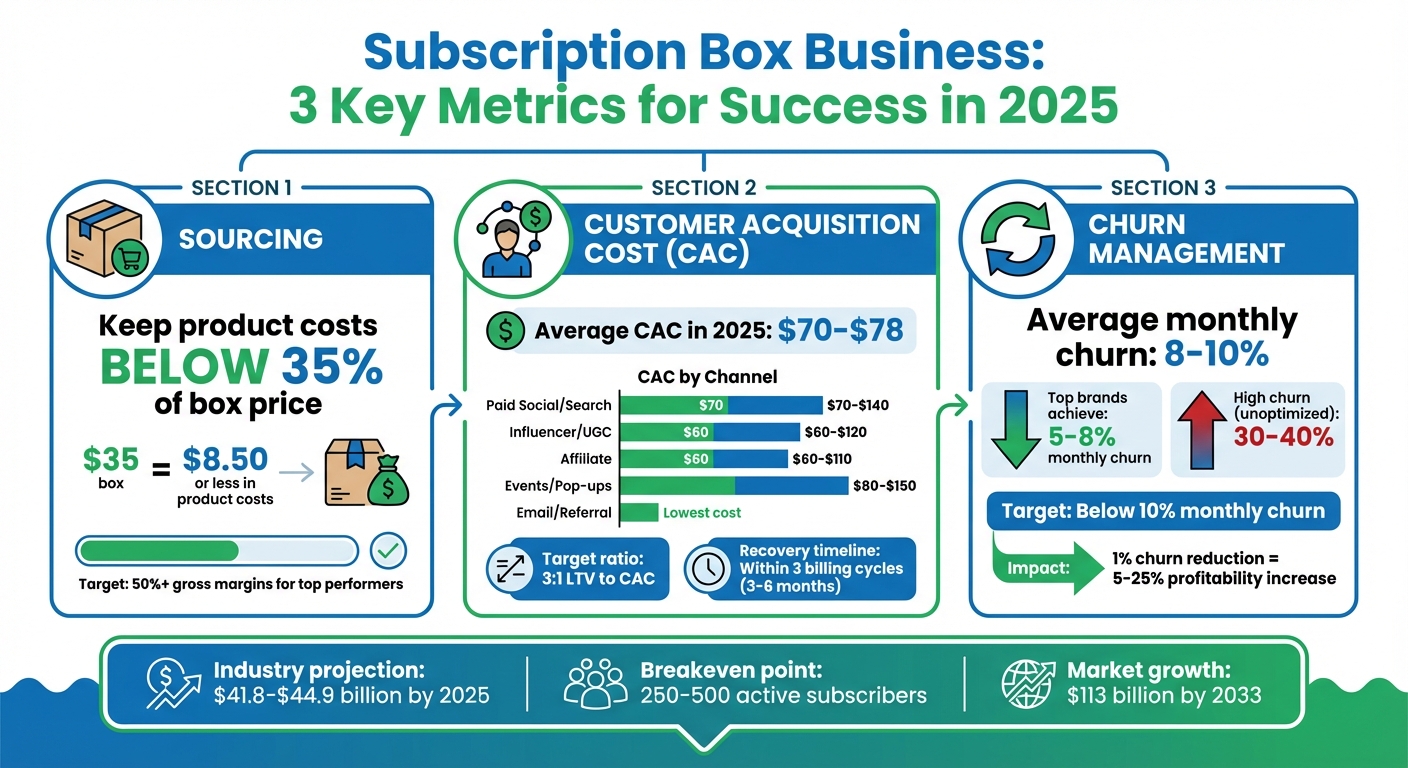
The subscription box industry is growing fast, with projections of $41.8–$44.9 billion by 2025. But success isn’t guaranteed. To thrive, you need to focus on three key areas:
- Sourcing: Keep product costs below 35% of your box price to maintain healthy margins. For a $35 box, aim for $8.50 or less in product costs.
- Customer Acquisition Cost (CAC): Recover CAC (typically $40–$100 per subscriber) within three billing cycles. Target a 3:1 Lifetime Value (LTV) to CAC ratio for profitability.
- Churn Management: Reduce churn to under 10%. High churn (10–15%) means constant subscriber replacement, draining resources.
Efficient sourcing, strategic marketing, and retention efforts are essential. Tools like IdeaFloat can help calculate costs, optimize payback periods, and track churn. The most successful subscription businesses achieve gross margins of 50%+ and churn rates below 8%.
Key Insights:
- Average CAC in 2025: $70–$78.
- Monthly churn for top brands: 5–8%.
- Retention strategies (e.g., personalized offers, flexible plans) can cut churn by 10–25%.
Master these metrics, and you’ll be better positioned to grow your subscription box business sustainably.
Subscription Box Business Key Metrics: Sourcing, CAC, and Churn Benchmarks 2025
The ULTIMATE Subscription Box Financial Model | Part 1 of 2
sbb-itb-08dd11e
How to Source Products for Your Subscription Box
Sourcing the right products is crucial - not just for managing costs but for keeping your subscribers engaged and loyal.
Finding Your Niche and Selecting Suppliers
Your choice of suppliers will depend on your subscription box model. For replenishment boxes, such as those featuring beauty samples or snacks, wholesalers are a strong option. They often offer bulk discounts of 40% or more off the MSRP, making them cost-effective. On the other hand, curated discovery boxes thrive on exclusive, handmade items. Platforms like Etsy are a goldmine for connecting with artisans and makers who can supply unique products that feel tailored to your audience. If you're considering private-label or custom products, working directly with manufacturers gives you control over both branding and formulation. And for a low-overhead approach, dropshipping suppliers handle inventory and shipping, though keep in mind that margins may be slimmer.
Always request product samples to ensure quality - subpar items can drive subscribers away. Look for suppliers who can consistently meet high standards, like 98–99% on-time delivery and defect rates under 1%. A quick tip: legitimate wholesalers will typically require a business ID or tax number. This ensures you're dealing with the real deal and not middlemen. Keep in mind that poor delivery experiences can damage loyalty; 94% of consumers report that delays or issues with shipping impact their trust in a brand.
Here’s a savvy strategy: position your subscription box as a marketing platform. Vendors might even provide products at cost - or free - in exchange for exposure to your audience. To safeguard your supply chain, avoid relying on a single supplier for your key products. Instead, establish relationships with at least two approved vendors per critical item to navigate backorders or seasonal demand spikes.
Once you've locked in dependable suppliers, shift your focus to balancing inventory that delivers both value and surprise.
Managing Inventory for Curated Boxes
For curated subscription boxes, flexibility is key. A good rule of thumb is a 70/30 product mix: aim for 60–70% staple items that consistently deliver value, and 30–40% discovery items that add an element of surprise. This mix keeps your subscribers engaged while giving you room to test new products without breaking the bank.
To avoid overstocking, use a rolling 8-week demand coverage plan. Subscription models have a major advantage over traditional retail here: predictable inventory needs. This precision helps you cut down on waste and reduce storage costs. Another way to optimize costs? Standardize your packaging sizes. Carriers often charge based on box dimensions rather than weight, so keeping packaging uniform can save you from dimensional weight surcharges.
Additionally, sign Service Level Agreements (SLAs) with your suppliers. These agreements should cover key details like defect thresholds, replacement windows, and surge capacity for busy seasons. This ensures you're prepared for any unexpected spikes in demand.
Once your inventory strategy is in place, you’ll need to confirm your costs with accurate data.
Calculating Product Costs with IdeaFloat
Keeping your product costs under control is non-negotiable. Aim to keep them at or below 35% of your retail price. For example, if your subscription box sells for $35, your core product costs should hover around $8.50. But don’t stop there - factor in your landed cost, which includes everything from core items to packaging materials, shipping, kitting, and payment fees.
IdeaFloat’s Cost Analysis tool makes this process straightforward. By entering supplier quotes, packaging expenses, and shipping estimates, you can calculate your true per-box expense. The Product & Service Creator tool then helps you design your product lineup while determining how many boxes you need to sell each month to hit profitability. Meanwhile, the Financial Projections feature provides a month-by-month breakdown of revenue and expenses, so you’ll know whether you need outside funding and when you’re likely to break even.
When negotiating with distributors, aim for tiered pricing based on your projected volume. For smaller vendors, be upfront about your budget. For instance, you might set a per-unit target of $1 to $3 to keep costs in check.
How to Calculate and Lower Your Customer Acquisition Cost (CAC)
Once you've figured out your sourcing and product costs, the next step is to determine how much you're spending to bring in each new subscriber. While precise sourcing ensures solid margins, managing your CAC keeps your overall profitability in check.
The CAC Formula Explained
The formula for calculating your Subscriber Acquisition Cost (CAC) is simple:
Total Marketing Costs ÷ Number of New Subscribers.
But accuracy is key. Make sure you’re only counting net new customers in the denominator - exclude repeat buyers or reactivations.
When calculating CAC, include all marketing-related expenses: ad spend (on platforms like Meta and Google), influencer gifting, discount codes, creative production, marketing software, prorated marketing salaries, and even custom packaging costs.
Here’s a practical example: Let’s say you’re running a fashion subscription box with a 30% return rate. If your reported CAC is $85, your true CAC adjusts to $121.43 using this formula:
True CAC = Reported CAC ÷ (1 - Return Rate).
This adjustment ensures you’re not underestimating the real cost of acquiring a paying, retained customer.
By late 2025, the average blended CAC for subscription boxes ranged between $70–$78. However, your actual CAC will depend heavily on your niche and the marketing channels you use.
Now, let’s dive into how CAC varies across different platforms.
2025 CAC Benchmarks by Channel
Breaking down CAC by channel can reveal inefficiencies. For example, TikTok might have a CAC of $140, while your email referral program could bring in subscribers for just $12. Tracking the cost per subscriber for each platform (Channel CAC) is crucial to understanding where your money is best spent.
Here’s a look at typical CAC ranges across key channels in 2025:
| Channel | Typical CAC Range |
|---|---|
| Paid Social/Search | $70–$140 |
| Influencer/UGC | $60–$120 |
| Affiliate | $60–$110 |
| Events/Pop-ups | $80–$150 |
| Email/Referral | Varies (Typically lowest) |
Source:
The broader ecommerce space has experienced similar cost pressures. For instance, the average ecommerce CAC now ranges from $68 to $84, marking a 60% increase over the past five years. This spike is partly due to rising ad costs - Google Shopping CPCs jumped 33.72% in 2025, and Meta’s Q4 CPM averaged $22.98, peaking at $25.22 during Black Friday. Global advertisers like Temu and Shein have also driven up costs, spending an estimated $2.7 billion on digital ads in 2023 alone.
The key takeaway? A low CAC isn’t the ultimate goal. What really matters is balancing your CAC with your customer’s Lifetime Value (LTV). Aim for an LTV:CAC ratio of at least 3:1.
“A $200 CAC is bad with a $220 LTV. It’s excellent with a $1,000 LTV. High CAC + high LTV = great business”.
With these benchmarks in mind, let’s explore actionable strategies to reduce your CAC.
Lowering CAC with Data-Driven Marketing
You can lower your CAC by addressing conversion gaps and focusing on attracting high-quality subscribers. For example, with an average cart abandonment rate of 70.19%, implementing a three-step email and SMS abandoned cart sequence can recover 10–15% of lost sales, effectively reducing your CAC.
Tools like IdeaFloat’s Go-to-Market Strategy feature make this process easier. It identifies your customers’ most active channels, calculates acquisition costs for each, and provides pre-built outreach scripts for smoother launches. Its Financial Projections feature also lets you monitor your LTV:CAC ratio and track your “Months to Payback” - the time it takes to recover your CAC from gross profit. A healthy target is 3–6 months.
Here are some proven tactics to help reduce CAC:
- Build retention-focused lookalike audiences. Use Meta to create lookalike audiences based on subscribers who’ve stayed with you for 6+ months. This targets leads more likely to stick around.
- Strategically tier discounts. Offer modest discounts (10–20%) for cold prospects to attract committed subscribers, while reserving deeper discounts (40%+) for retargeting campaigns. Avoid front-loading too many deals, as this can attract one-time buyers who cancel after their first box, inflating your CAC.
- Promote annual plans. Offering annual subscriptions at a 20% discount helps you recover CAC upfront and ensures steady cash flow.
- Leverage referral programs. Referred customers are typically 5–10 times cheaper to acquire and often have a higher LTV.
How to Reduce Customer Churn
You've got your customer acquisition costs (CAC) under control and a solid strategy to bring in subscribers. Now it’s time to focus on keeping them around. On average, e-commerce subscription boxes see a monthly churn rate of 8%–10%. However, for those without proper optimization, churn can skyrocket to 30%–40%. And here’s the kicker: bringing in a new subscriber costs five times more than retaining an existing one.
The top subscription brands manage to keep churn as low as 5%–8%. Even a small improvement - like reducing churn from 15% to 8% - can double your customer lifetime value (LTV).
How to Calculate and Track Churn Rate
Your churn rate shows the percentage of subscribers lost during a specific period. The formula is simple: (Customers Lost ÷ Total Customers at Start of Period) × 100.
For instance, if you start March with 1,000 subscribers and lose 80 by month’s end, your churn rate is 8%. Keep in mind, a monthly churn rate of just 5% adds up to a 46% annual churn rate, meaning nearly half your subscribers could leave in a year.
To get the full picture, break down churn by cohort (e.g., new subscribers vs. long-term customers) or acquisition channel. Subscribers gained through heavy discounts often churn at rates 2–3x higher than those paying full price.
It’s also helpful to distinguish between voluntary churn (customers canceling actively) and involuntary churn (failed payments). Involuntary churn makes up 25%–35% of total churn. Automated dunning systems, which retry failed payments, can recover 10–25% of these customers, cutting involuntary churn to just 2%–5%.
These metrics are essential to understanding where your retention efforts should focus.
Retention Strategies That Work
Reducing churn, even slightly, can have a major impact on profitability. One effective strategy is personalization, which can lower cancellation rates by 20%–35% compared to generic offerings. Use tools like signup quizzes and preference profiles to customize box contents. For example, Birchbox uses beauty profile quizzes to create tailored product selections, driving repeat engagement.
Another key tactic is offering flexible subscription options. Features like "skip a month", "pause", or "swap product" give customers more control, reducing the likelihood of cancellations. In 2024, a direct-to-consumer coffee brand cut its churn by 22% in just 60 days by adding a "Snooze Subscription" option. Their data revealed that many customers were canceling due to overstocking, and half of those who used the snooze feature reactivated within two weeks.
"Retention isn't about fancy dashboards or automated flows; it's about creating continuity in trust." - Sunny Dodeja, eCommerce Operator
The first three months are critical for onboarding. Use this period to engage customers with welcome guides, personalized emails, and incentives like discounts on their second box. A skincare brand that worked with Sunny Dodeja in 2025 introduced a gamified retention system with "streaks" and exclusive milestone content. This approach boosted their six-month retention rate from 62% to 75% in just one quarter, as customers shared their progress on social media.
When customers attempt to cancel, deploy exit-intent surveys to understand why. Offer tailored incentives like a two-month 50% discount or a downgrade to a cheaper plan. Customers who pause their subscriptions are 40%–60% more likely to return, compared to only 5%–15% of those who cancel outright.
Using IdeaFloat Consumer Insights to Prevent Churn
IdeaFloat Consumer Insights provides a proactive way to tackle churn. This tool scans online conversations to uncover what customers think about your niche and competitors. By identifying common complaints and understanding why customers leave similar services, you can refine your messaging and product offerings to better resonate with your audience.
Predictive analytics is another game-changer. It can flag at-risk subscribers - such as those skipping multiple shipments, ignoring emails, or visiting the cancellation page - and trigger automated rescue campaigns. These efforts can cut churn by 10–25%. Engaged users are also 3–5x more likely to stick around for 12 months.
Additionally, IdeaFloat’s Financial Projections feature helps you track how churn affects your bottom line. By analyzing churn alongside LTV and CAC, you can see how even a 1% reduction in churn can boost profitability by 5%–25%.
Churn Prevention Tactics for 2025
Reducing churn is just as critical as managing acquisition costs and sourcing quality products when it comes to subscription box profitability. By building on earlier retention strategies, these advanced tactics offer additional ways to keep customers engaged.
Improving the Unboxing Experience
The unboxing moment can make or break a subscription renewal. In fact, more than 30% of subscribers cancel due to damaged products or poorly designed packaging during shipping. Investing in better packaging can increase renewal rates by over 24%.
For example, one brand replaced standard folding boxes with drawer-style hard boxes featuring EVA trays. The result? A 23% jump in user renewal rates. Packaging isn’t just about protection - think of it as a key feature of your product. Durable materials like E-flute or B-flute corrugated paper work well for shipping, while magnetic rigid boxes add a premium feel and can double as reusable storage, keeping your brand top of mind.
"Subscription box packaging is not a supporting role, it is the first window of communication between the brand and the customer."
- XiangGe Package
To elevate the experience further, include one standout "hero" item alongside smaller discovery products. Personal touches, like handwritten notes or custom printing with the customer’s name, can create a deeper connection. Celebrate loyalty milestones by surprising subscribers with gifts or upgrades in their 3rd, 6th, or 12th box. Jill Lodato, Founder of Kids Baking Club, also suggests optimizing box weight to 13 oz or less to qualify for USPS First-Class shipping, saving $3+ per box on shipping costs.
Running Effective Win-Back Campaigns
Winning back a former customer is far cheaper than acquiring a new one - 5 to 7 times less expensive, to be exact. The most effective win-back campaigns follow a four-step sequence: start with a soft "we miss you" message, then educate them on new features or updates, follow up with a time-sensitive incentive, and close with a final "last chance" offer.
Segmentation is key here. Group inactive customers based on factors like the time since their last interaction, their lifetime value, or why they stopped engaging. For high-value customers, consider offering steep discounts of 25-30%, while others might respond better to perks like early access to new products - this approach protects your brand’s perceived value.
"Research consistently shows that reactivating an existing customer costs five to seven times less than acquiring a new one."
- Terrence Ngu, Agentic Marketing
Use multiple channels to reach out. Emails are great for detailed messaging, SMS grabs attention quickly, and retargeting ads on social platforms can re-engage customers effectively.
Using Predictive Analytics to Stop Churn Before It Happens
Predictive analytics helps you identify customers who are likely to cancel before they actually do. It works by tracking behaviors like skipped shipments, late payments, reduced engagement, or changes in order patterns. Once flagged, you can intervene with tailored actions such as personalized offers, bonus items, re-engagement surveys, or tutorials.
"Predictive analytics identifies patterns in customer behavior that signal cancellation risk (skipped shipment or late payments)."
- Anchita Mehta
Tools like IdeaFloat’s Financial Projections enhance these capabilities by analyzing customer demographics, product usage, billing patterns, and support history. Metrics such as "days since last login" or shifts in usage frequency can act as early warning signs. Even reducing churn by just 1% can increase profitability by 5%–25%.
Pay close attention to key milestones. For example, if data shows a drop-off in renewals after the 3rd month, launch a targeted retention campaign during the 2nd month. Set up real-time alerts for high-risk customers and offer flexible options like skipping a month, downgrading their plan, or switching to less frequent shipments instead of canceling altogether. Aim for a predictive model AUROC of ≥0.70 to ensure accuracy.
Conclusion
To build a profitable subscription box business in 2025, you need to focus on three key pillars: sourcing products at the right price, controlling customer acquisition costs (CAC), and minimizing churn to sustain growth. A solid formula to follow is keeping product costs at or below 35% of the retail price, recovering your CAC within three months, and maintaining monthly churn below 10%.
Most subscription boxes reach their breakeven point with 250–500 active subscribers. To achieve this and grow sustainably, aim for a 3:1 lifetime value (LTV) to CAC ratio - each customer should generate at least three times what it costs to acquire them. This metric isn’t just a benchmark; it’s essential for scaling your business without draining resources.
"A subscription box can transform lumpy one-off sales into dependable monthly revenue but only when product, margin, and story align."
- Matt Buxbaum, Writer and Growth Analyst, 1-800-D2C
Tools like IdeaFloat's Financial Projections can help you model unit economics, monitor margins, and identify subscribers at risk of churning. From calculating landed costs to forecasting churn patterns, having access to detailed data allows you to make informed decisions - whether you're just starting out or scaling to thousands of subscribers.
To stand out in this competitive market, focus on what truly matters: build strong relationships with reliable suppliers, create an unforgettable unboxing experience, and offer flexible subscription plans to keep your customers engaged. By aligning your product margins, acquisition strategies, and retention efforts, you’ll be well-positioned to grow in a market projected to surpass $113 billion by 2033.
FAQs
What should I include in “landed cost” per box?
Landed cost per box accounts for all expenses involved in producing and delivering each box. This includes:
- Product sourcing: The cost of acquiring the items inside the box.
- Packaging: Materials used to wrap and protect the products.
- Shipping materials: Boxes, labels, and other supplies for shipping.
- Custom branding: Any personalized touches like logos or designs.
- Testing and quality assurance: Ensuring the products meet standards.
- Printed inserts: Flyers, thank-you notes, or promotional materials.
- Unexpected costs: Any unplanned expenses that might arise.
To figure out the per-unit cost, calculate these expenses based on your order quantity. This gives you a clear view of the total cost for each box.
How do I know if my LTV:CAC is actually profitable?
To keep your LTV:CAC ratio profitable, strive for a minimum ratio of 3:1 - this means your customer lifetime value should be three times your customer acquisition cost. If your ratio exceeds 5:1, it indicates room to spend more on acquiring customers while still staying profitable. This standard is a useful way to measure how efficient and sustainable your customer acquisition efforts are.
Which churn fix should I prioritize first?
Improving customer retention is the smartest way to tackle churn. Start by focusing on key areas like onboarding, communication, and support - these are often the root causes of a poor customer experience, which is a major reason customers leave. By addressing these factors, you can keep customers more engaged. Even a slight drop in churn rates can lead to a noticeable increase in profits, making retention efforts essential for long-term growth.
Related Blog Posts
 Report an issue
Get the newest tips and tricks of starting your business!