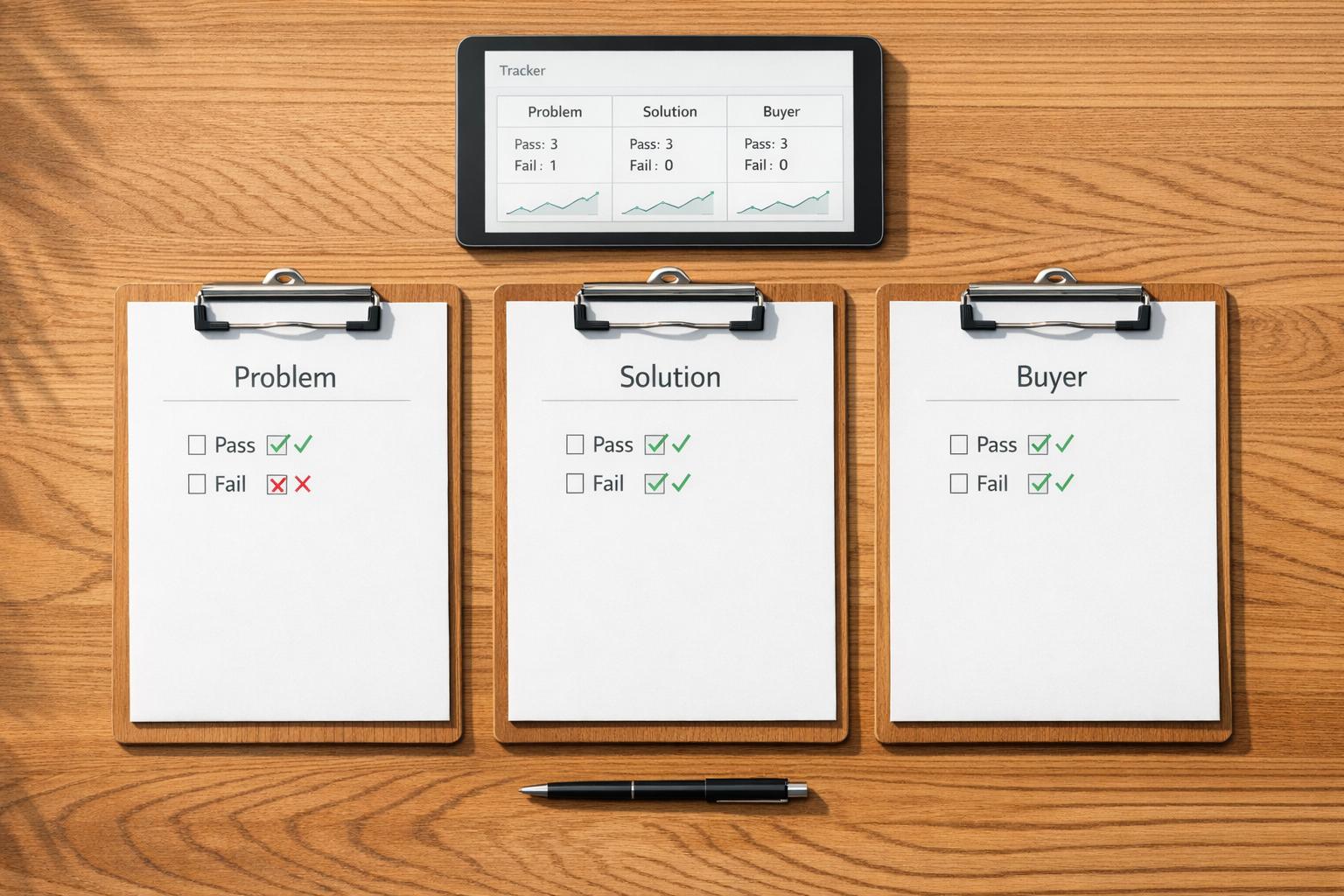
Want to know if your business idea will succeed? The 'Three-Customer' Test is a simple framework to validate your idea in weeks, not months. It focuses on three key areas: the Problem, the Solution, and the Revenue Model. By testing with three types of customers - those who feel the problem, those seeking a solution, and those ready to buy - you can avoid building a product no one wants.
Key Steps:
- Identify the Problem-Afflicted: Find customers who face the issue often and urgently.
- Engage Solution-Seekers: Test if your product solves their needs better than current alternatives.
- Validate Buyer-Readiness: Confirm people are willing to pay for your solution.
Why It Works:
- Saves time and money by confirming demand before building.
- Uses measurable criteria (e.g., 70% problem confirmation, 3–5% click-to-pricing rates).
- Involves quick feedback loops (7–14 days) to refine or pivot.
The process includes clear pass/fail benchmarks, practical tools like landing pages and interviews, and a tracker to organize insights. This approach ensures you're solving a real problem for paying customers. Ready to test your idea? Start small, measure results, and make data-driven decisions.
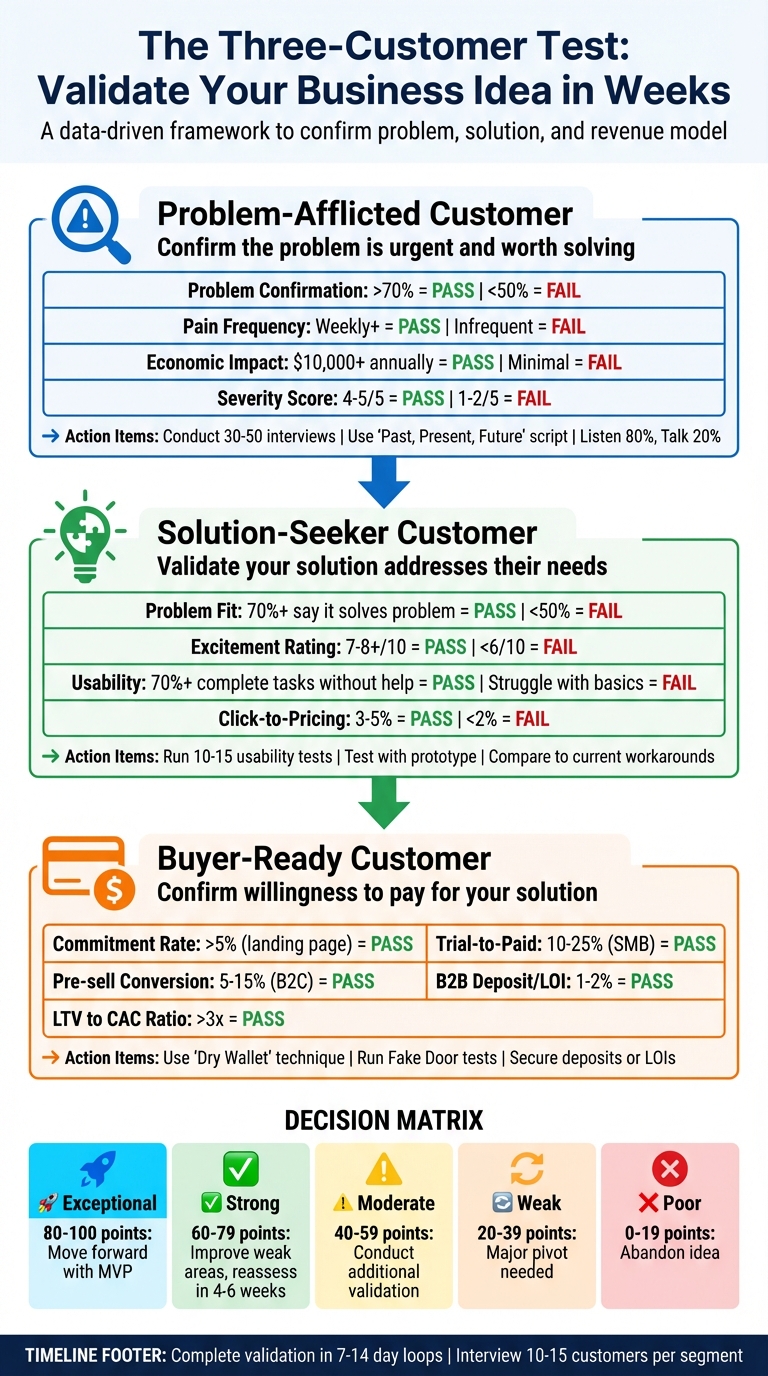
Three-Customer Test Framework: Validation Process and Pass/Fail Criteria
Use This PROVEN Formula to Validate Your Next Startup Idea
Customer 1: Problem-Afflicted Customer
To confirm the urgency of a problem, focus on customers who have recently encountered it - ideally within the last 30 days. These individuals can provide detailed accounts of their experiences, helping you gauge whether the issue is pressing enough to build a business around.
How to Find Problem-Afflicted Customers
Start by defining a specific customer archetype. For example, instead of targeting "small businesses" or "busy professionals", narrow it down to something like: "Shopify store owners processing 200–1,000 orders monthly who handle fulfillment in-house". A precise definition makes it easier to locate the right people and interpret their feedback effectively.
Next, seek out customers in spaces where they naturally voice frustrations. This could include:
- Reddit threads and Twitter/X posts
- Industry-specific forums
- Review platforms like G2, Capterra, or TrustRadius
- Niche Slack or Discord communities
Engage with these groups by offering something of value, like a free teardown or benchmark report, to initiate conversations without coming across as pushy.
When screening potential interviewees, ask two key questions: "When was the last time this problem occurred?" and "Do you have authority to make purchasing decisions?". If they can’t recall a recent incident, the problem might not be urgent. Similarly, if they lack purchasing authority, their feedback may not reflect actual buying behavior. To reach more potential customers, send 20 targeted emails daily with a concise hypothesis and a 15-minute interview request.
Once you’ve identified candidates, apply clear criteria to validate whether the problem is worth solving.
Pass/Fail Criteria for Problem Validation
Use measurable benchmarks to assess the problem’s urgency and significance. For example, a 70% or higher confirmation rate during interviews suggests strong validation. If fewer than 50% of interviewees relate to the issue, it may be too niche or not impactful enough.
| Metric | Pass Threshold (Strong Validation) | Fail Signal (Weak Validation) |
|---|---|---|
| Problem Confirmation | >70% of interviewees confirm the problem exists | <50% of interviewees relate to the problem |
| Pain Frequency | Problem occurs weekly or more frequently | Problem is infrequent or a minor annoyance |
| Economic Impact | Clear cost (e.g., $10,000+ annually per B2B customer) | Economic impact is unclear or minimal |
| Urgency | Customers are actively seeking better solutions | Current workarounds are "good enough" |
| Severity Score | 4–5 on a 1–5 scale (Critical blocker) | 1–2 on a 1–5 scale (Minor inconvenience) |
Also, assess whether the problem ranks in the customer’s top three priorities. If it’s ranked lower, they’re unlikely to allocate budget or resources to resolve it. Look for signs of “hacky” workarounds, like manually exporting data to CSV files every Friday - this often indicates the problem is significant enough to drive change.
With these thresholds in place, structure your interviews to extract actionable insights.
Designing Customer Interviews and Surveys
Use a "Past, Present, Future" script to steer clear of hypotheticals and focus on real behavior. Start by asking: "Describe the last time this occurred." This helps capture specific examples. Follow up with: "How are you handling this today? What tools or workarounds are you using?" to understand their current solutions. Finally, ask: "If this disappeared, what would change? What would you pay to make that happen?" to gauge urgency and willingness to invest.
During interviews, follow the 80/20 rule: listen 80% of the time and speak only 20%. Avoid leading questions like "Is this frustrating?" Instead, ask open-ended ones such as "What is the hardest part about [process]?". When a pain point emerges, dig deeper by asking "Why is that hard?" to uncover the root cause and emotional urgency. Take note of exact phrases (e.g., "painful", "expensive mistake") for future marketing purposes.
"A strong interview replaces weeks of guesswork with direct insight into how people behave, what they pay for today, and what actually frustrates them enough to change." – Matt Rowe
Aim to conduct 10 to 15 interviews per customer segment to identify recurring patterns with about 85% accuracy. Always conclude by asking: "Who else should I talk to about this?" This can help expand your pool of problem-afflicted customers. Before moving on to the next customer profile, complete 30–50 problem interviews to ensure consistent patterns emerge, rather than relying on outliers.
Customer 2: Solution-Seeker Customer
Once you've identified that a problem exists, it's time to focus on customers actively searching for solutions. These individuals aren't just dealing with minor inconveniences - they're actively looking for better options. They’ve likely tried existing tools or workarounds and found them lacking, making their feedback essential for determining if your solution truly addresses a gap in the market.
How to Find Solution-Seeker Customers
To locate these customers, look for digital signals that show frustration. Platforms like G2, Capterra, and TrustRadius are goldmines for feedback, where users often highlight missing features or pain points. Additionally, explore industry-specific Slack channels, Discord servers, and Reddit communities where discussions about current tools take place. Instead of diving straight into a pitch, offer something valuable, like a benchmark report, to spark genuine conversations.
Understanding the "job to be done" (JTBD) is key. This means focusing on the specific tasks your solution helps with. For instance, instead of targeting a broad group like "small business owners", narrow it down to "bookkeepers struggling with messy spreadsheets who need automated reconciliation". Interestingly, only 19% of founders report having clear insight into their customers' JTBD, which often makes it harder to connect with the right audience.
When reaching out, keep it simple and direct. For example: "I'm building a tool to help bookkeepers automate reconciliation without switching platforms. Do you have 15 minutes to explain your current process?" During interviews, ask targeted questions like, "What was the last thing you tried to solve this?" or "Where did you encounter friction?". If they can’t name a specific tool or workaround they've tried recently, they might not be actively seeking a solution.
Pass/Fail Criteria for Solution Fit
To determine if your solution meets the needs of these customers, use clear benchmarks. A 70% or higher confirmation rate during interviews - where customers explicitly say your solution addresses their problem - indicates strong validation. If fewer than 50% relate to your approach, it’s likely you haven’t found the right gap.
| Criteria | Strong Validation (Pass) | Weak Validation (Fail) |
|---|---|---|
| Problem Fit | 70%+ say it solves their specific problem | <50% say it fully solves the problem |
| Excitement | Average rating of 7–8+ out of 10 | Excitement rating <6 |
| Usability | 70%+ complete key tasks without help | Users struggle with basic tasks |
| Commitment | Willing to pre-purchase or beta test | Prefer to wait until the product is complete |
| Differentiation | Clear preference over current workarounds | No clear advantage over current tools |
Pay attention to qualitative signals during demos or prototype walkthroughs. Webb Brown, Co-founder of Kubecost, explains:
"When talking to potential customers, their eyes should light up. They should be engaged in the conversation and ready to pull out their wallets on the spot".
If customers can describe your solution’s value in their own words, it’s a strong sign they understand how it addresses their needs. High-signal actions - like asking to join a beta, signing a Letter of Intent (LOI), or making a deposit - further validate their interest.
For landing page metrics, aim for a 3–5% click-through rate to pricing on qualified traffic. In B2B scenarios, a 1–2% deposit or LOI rate is considered a strong indicator of interest. These metrics separate genuine enthusiasm from polite feedback.
Testing Solution Usability
Your solution needs to be compelling enough to replace existing workarounds. Instead of relying on customer opinions, use task-based observation. Have users complete specific tasks - like importing a CSV file or generating a report - with your prototype and note any difficulties. Follow the 80/20 rule: listen 80% of the time and talk only 20%.
Present your solution neutrally to avoid leading responses. Instead of saying, "This feature will save you hours," ask, "Try completing [task] and share your thoughts." Encourage comparisons with their current process by asking, "How does this compare to what you're using today?".
To validate your solution without heavy investment, consider the "Wizard of Oz" method. This involves manually performing tasks behind a seemingly automated interface to test whether users perceive value. For simpler tools, track the "time to first value" - aim for 40–60% of users to hit a key milestone (like generating their first report) within seven days.
Conduct 10 to 15 usability tests per segment to identify consistent patterns. If 70% or more of users can complete core tasks without help, you’ve hit the usability threshold. If users struggle with basic functions or need constant guidance, it’s a sign the solution isn’t ready yet. These insights confirm whether your solution can overcome existing workarounds.
"Building is secondary to delivering value to your target market. You're nothing until you have customers who want your product".
Strong usability validation sets the stage for deeper market commitment analysis.
Customer 3: Buyer-Ready Customer
Once you've validated that your solution fits the problem, the next big test is seeing if people are willing to pay for it. This is where many founders stumble - 42% of startups fail due to lack of market demand, and a staggering 95% of new products flop annually. The line between polite interest and genuine demand becomes crystal clear when money enters the conversation. Gavin Bryant, Founder of First Principles Ventures, sums it up perfectly:
"People stop lying to you when you ask them for money".
Buyer-ready customers feel the problem so acutely that they're ready to spend. These are the people already paying for alternatives, cobbling together workarounds, or actively seeking solutions on platforms like Reddit and Discord. The key is to identify them and test their willingness to commit resources - be it money, time, or even just their contact details.
This stage builds on earlier insights about the problem and solution, ultimately confirming if real buying intent exists.
How to Find Buyer-Ready Customers
Start by targeting those with "skin in the game." These are the individuals who will give something tangible - a deposit, a pre-order, or even their time for a demo. Use the knowledge gained from earlier validation rounds to zero in on specific customer segments already spending on alternatives. Instead of casting a wide net, focus on industry-specific communities, email lists from earlier research, or targeted paid ads.
One effective tactic is the "Dry Wallet" technique. Add a real "Buy Now" button to your landing page. When clicked, show a price and ask for an email to join a waitlist or beta program. This helps distinguish serious buyers from casual browsers. For instance, Nomad List tested a new course by running "Fake Door" experiments with price points ranging from $29 to $1,299. Out of 45,525 visitors, 54 people showed willingness to pay, revealing a potential monthly revenue of $5,000–$10,000 at the $29–$119 range.
For B2B products, pilot programs or Letters of Intent (LOI) can validate demand before full-scale development. Gong, for example, interviewed over 200 sales managers and secured 15 pilot customers with annual contracts over $20,000 before building their sales intelligence platform. This approach eventually helped them scale to over $200 million in annual recurring revenue. Another option is the "concierge MVP," where you manually deliver the service to a small group of customers to test if they'll pay for the results before automating the process.
Avoid relying on feedback from friends, family, or general surveys. People tend to overestimate their willingness to buy by 30–40%. Instead, focus on customers already spending money on similar tools or actively seeking solutions to their problems.
Pass/Fail Criteria for Market Viability
To determine if your idea has legs, track metrics that show genuine commitment. For instance, if less than 2% of users on a landing page provide their email after seeing a price, it's a red flag for product-market fit. For qualified traffic, a 3–5% click-to-pricing rate signals healthy demand.
| Metric | Threshold | Significance |
|---|---|---|
| Commitment Rate | >5% (Landing page) | Indicates strong interest and intent |
| Click-to-Pricing | 3–5% (Qualified traffic) | Reflects interest in the offer |
| Trial-to-Paid | 10–25% (SMB tools) | Confirms value delivery during trial |
| Pre-sell Conversion | 5–15% (B2C) | Shows purchase intent |
| LTV to CAC Ratio | >3x | Vital for long-term growth |
For B2B, a 1–2% deposit or LOI rate is a strong indicator of demand. If at least 20% of prospects who show interest in your solution express strong purchase intent and fit your pricing, you've validated willingness to pay. Think of commitment as a scoring system: a full payment or subscription signup scores 100 points, a deposit or pre-order earns 90, and casual interest scores zero.
Set clear "Go/No-Go" rules before testing. For example, if you can't secure payments after three pre-sell attempts, it might be time to rethink your value proposition or pause the project. Research shows that companies conducting customer research before development are 34% more profitable.
Running Willingness-to-Pay Tests
When testing pricing, focus on actions, not words. Instead of asking, "Would you pay for this?" ask, "What are you currently paying for a similar solution?" This approach, often called the "Mom Test," helps avoid overly optimistic responses.
The Van Westendorp survey is another useful tool for pricing. Ask customers:
- "At what price would this be too expensive?"
- "At what price would it feel like a bargain?"
- "At what price does it start to feel expensive?"
- "At what price would you question the quality?"
For more direct feedback, run Fake Door tests. Dropbox famously used this method in 2008 by creating a 3-minute demo video showing how their product would work. The video brought in 75,000 email signups overnight, proving market demand without writing a single line of code.
When testing multiple price points, start high and lower the price if needed. This anchoring technique makes subsequent prices seem more appealing. Offer three pricing tiers with clear plan names to see which resonates most with buyer-ready customers. And always include a "Would Not Purchase" option in surveys to avoid skewing results.
For B2B products, pilot programs with refundable deposits or purchase agreements can confirm intent. Finally, measure how quickly customers reach a key value milestone - ideally, 40–60% of users should hit this milestone within seven days. If customers hesitate or struggle to see the value, it might mean your offering needs adjustment.
sbb-itb-08dd11e
The Complete Pass/Fail Evaluation Framework
Use a weighted scoring system to decide whether your business idea passes or fails, reflecting the importance of each validation stage.
"Pass/fail criteria act as a compass for testers, providing clear guidelines to determine whether a test case or software feature meets the desired standards."
Not all validation tests carry the same impact. A deposit or signed letter of intent from a Buyer-Ready customer, for example, holds far more weight than a casual expression of interest. This structured approach ensures customer feedback leads to actionable decisions.
Scoring and Combining Customer Insights
Evaluate each customer profile using pass/fail criteria. Assign weights to five key areas: Problem Validation (25), Market Assessment (25), Solution Validation (20), Competitive Landscape (15), and Business Model Viability (15). For instance, if 70% of Problem-Afflicted customers report experiencing the issue weekly, assign a strong Problem Validation score. Similarly, clear purchase intent from Buyer-Ready customers boosts your Business Model Viability score.
Track the confidence level of each score - categorized as high, medium, or low - based on the quality of evidence. A financial deposit from a Buyer-Ready customer would earn a high-confidence score, while a verbal "I would buy this" might only qualify as low confidence. Michael Bolton, Founder of DevelopSense, cautions:
"A passing test is no guarantee that the product is working correctly or reliably. Instead, a passing test is an observation that the program appeared to work correctly... a passing test is merely an indication of potential success."
Define kill criteria before testing. For instance, decide to pivot if 10 pre-orders aren’t secured after three attempts. Maintain a central log or worksheet to track evolving assumptions and the results of experiments. This ensures alignment among team members and keeps the idea’s status clear. These scores will guide your next steps using the decision matrix below.
Decision Matrix for Validation Outcomes
After scoring each category, combine the results to determine your idea’s overall viability. Calculate a total score out of 100 and use the decision matrix below to outline your next steps:
| Total Score | Outcome | Next Steps |
|---|---|---|
| 80–100 | 🚀 Exceptional Opportunity | Move forward with MVP development, secure funding, and launch your go-to-market strategy. |
| 60–79 | ✅ Strong Opportunity | Focus on improving the three lowest-scoring areas, refine your business model, and reassess in 4–6 weeks. |
| 40–59 | ⚠️ Moderate Opportunity | Conduct additional validation; revisit problem validation and test solution concepts before proceeding. |
| 20–39 | 🔄 Weak Opportunity | Reevaluate key assumptions about the problem and market; consider major changes. |
| 0–19 | ❌ Poor Opportunity | Abandon the idea and redirect resources toward better opportunities. |
For scores in the 60–79 range, focus on the three weakest areas, such as Buyer-Ready validation, and perform further tests. Apply the "Two-Miss" Rule: if you fail to meet a target metric twice, try higher-signal experiments or consider pivoting based on qualitative evidence.
Startups that rely on systematic validation frameworks tend to have higher success rates. Research shows that 90% of startups fail because their founders make decisions based on emotion rather than evidence. By adopting this decision matrix, you replace guesswork with data-driven clarity - giving you a much greater chance of building something people genuinely want.
Three-Customer Tracker Tool
The Three-Customer Tracker is a practical way to organize customer insights, ensuring your decisions are based on solid evidence rather than fuzzy recollections. Depending on memory alone can lead to missed details or misunderstanding customer pain points. This tool brings together the key signals from Problem-Afflicted, Solution-Seeker, and Buyer-Ready customers, as outlined in earlier sections, to guide your decision-making with clarity.
At its core, the Three-Customer Tracker is a downloadable spreadsheet where you can log every validation interaction. It’s designed to capture essential details like customer types, trigger events, and even direct quotes. By doing so, it bridges the gap between your customer interviews and actionable steps, all while reinforcing the Three-Customer Test framework.
Key Features of the Tracker Template
The spreadsheet is built around seven key columns to help you organize and analyze feedback effectively:
- Customer Type: Identifies whether the customer is Problem-Afflicted, a Solution-Seeker, or Buyer-Ready.
- Trigger Event: Notes the event that caused the problem to arise.
- Current Workaround: Tracks how customers are currently managing the issue.
- Frequency of Problem: Records how often the problem occurs.
- Willingness to Pay: Documents any evidence of budget allocation or spending.
- Exact Phrases: Logs verbatim quotes from customers for accurate messaging.
- Pain Score (1–5): Rates the severity of the issue, with 1 being minor and 5 being critical.
Each customer interaction is recorded as a single row. To add another layer of insight, you can include a Confidence Level (High, Medium, Low) for each dimension. This ensures that stronger signals, like a financial commitment from a Buyer-Ready customer, carry more weight than simple verbal interest.
For IdeaFloat users, the tracker integrates seamlessly with tools like the Problem Validator and Consumer Insights. This makes it easier to cluster feedback and pinpoint market opportunities.
How to Use the Tracker
To get the most out of the tracker:
- Log interactions immediately after customer calls to ensure details are fresh and accurate.
- Set clear thresholds for success at the top of the tracker. For example, you might decide that a 70% problem confirmation rate or a 10–25% trial-to-paid conversion rate for SMB tools will determine whether to proceed. This keeps your team aligned on what success looks like.
- Use the tracker to run 7–14 day validation loops. For example, spend one day scoping, two days building or recruiting participants, and one day measuring and deciding. After each loop, review entries and apply the "Two-Miss" Rule: if you fail to meet a target metric twice, it’s time to pivot or try higher-signal experiments.
- Group entries by similar triggers, constraints, and buying processes to uncover trends. Regularly logging interactions will help you identify and validate pain points.
By following these steps, you turn raw customer feedback into a structured dataset that informs your go/no-go decisions.
Benefits of Using the Tracker
The tracker simplifies customer validation by consolidating insights into a single, organized source. It also helps you track your validation velocity - the time it takes to move from initial feedback to a final decision - so you can avoid overanalyzing and keep moving forward. In a survey of 317 founders, 34% identified "access to target users" as their biggest hurdle during validation. The tracker addresses this by making your data actionable and accessible.
Collaboration becomes easier, too. When co-founders, advisors, or investors ask, "How do you know customers will pay for this?" you can point to deposits, letters of intent, or trial conversion rates logged in your tracker. As Steve Blank famously said:
"There are no facts inside your building".
This tool ensures your decisions are rooted in real customer interactions, not assumptions.
Conclusion and Next Steps
Now that you've explored the structured insights provided by the Three-Customer Tracker, it's time to wrap up your validation process.
The Three-Customer Test framework turns customer feedback into actionable steps, helping you create a product that aligns with market needs. By focusing on Problem-Afflicted, Solution-Seeker, and Buyer-Ready customers, you can fast-track your journey to revenue while sidestepping the top reason startups fail: a lack of market demand.
Key Takeaways from the Three-Customer Test
This framework ensures you're addressing the right problem, offering a solution that resonates, and confirming customers are ready to pay. Problem-Afflicted customers highlight urgency and frequency, Solution-Seekers validate your approach, and Buyer-Ready customers confirm their willingness to pay. Missing insights from any of these groups leaves you guessing, but input from all three provides a clear path to profitability.
Validation isn't a one-and-done task - it’s an ongoing process. Use 7–14 day focused loops: define the task, design a lean test, recruit participants, analyze results, and decide whether to pivot or iterate. Earlier sections outlined benchmarks like a 3–5% click-to-pricing rate on qualified traffic and a 10–25% trial-to-paid conversion rate for SMB tools. These metrics allow you to make data-driven decisions instead of relying on instinct.
With these insights, you're ready to take action.
Start Validating with IdeaFloat
IdeaFloat offers tools like the Problem Validator and Consumer Insights to speed up the Three-Customer Test. The Problem Validator identifies urgency and detects demand signals in just 15 minutes, while Consumer Insights scans online communities to uncover authentic customer language and pain points. These tools address a common challenge - 34% of founders cite accessing target users as their biggest hurdle during validation.
You can also set up a Waitlist Landing Page to gauge early interest and use the Community Launch Map to locate the online spaces where your target audience gathers. As Michael R., a first-time founder, shared:
"IdeaFloat showed me real data that my problem was worth solving. Saved me months of guessing."
The Three-Customer Tracker integrates seamlessly with these tools, transforming raw feedback into structured data to guide your decisions. Start your first validation loop today and test your idea with real customers.
FAQs
How many customer interviews do I need to run the test?
To get a solid understanding of whether your business idea has potential, aim to conduct at least 30 customer interviews. This number gives you a broad enough range of feedback to assess your idea and uncover whether there’s real demand in the market.
What should I do if I pass problem validation but fail buyer readiness?
If you clear problem validation but stumble at buyer readiness, it’s time to shift your focus. Work on building trust with your audience, refining your messaging, or better educating potential buyers about your product or service. The goal is to ensure your target customers are not only interested but also ready to make a purchase. Adjust your strategies, test them, and validate buyer readiness as a separate step to meet both requirements before scaling further.
How do I measure willingness to pay without a finished product?
You don’t need a finished product to gauge how much customers are willing to pay. There are practical ways to test this early on by observing real customer interest and intent to pay. For example, you can run pre-order campaigns, set up fake door tests, create landing pages with pricing, or even collect deposits or pilot agreements. These methods provide clear insights into demand while minimizing risk, as they rely on actual customer actions rather than assumptions.
Related Blog Posts
 Report an issue
Get the newest tips and tricks of starting your business!