
Most startups fail because they build products no one wants. In fact, 42% of failed startups cite a lack of market demand as the primary reason. But this can be avoided by validating your idea before investing time and money. Here's a simple 7-day framework to test your idea and turn it into a validated offer:
- Day 1-2: Define the problem you're solving and identify your target audience.
- Day 3: Test market demand with tools like landing pages, AI prototypes, or small ad campaigns.
- Day 4: Research competitors, analyze gaps, and refine your value proposition.
- Day 5: Calculate market size (TAM, SAM, SOM) and estimate revenue potential.
- Day 6: Build a financial model to ensure profitability and scalability.
- Day 7: Create launch materials and test your offer with real users.
This process, powered by AI tools like IdeaFloat, reduces guesswork and helps you make data-driven decisions. Instead of spending months on untested ideas, you can validate demand, refine your approach, and decide whether to proceed, pivot, or stop - all in just one week.
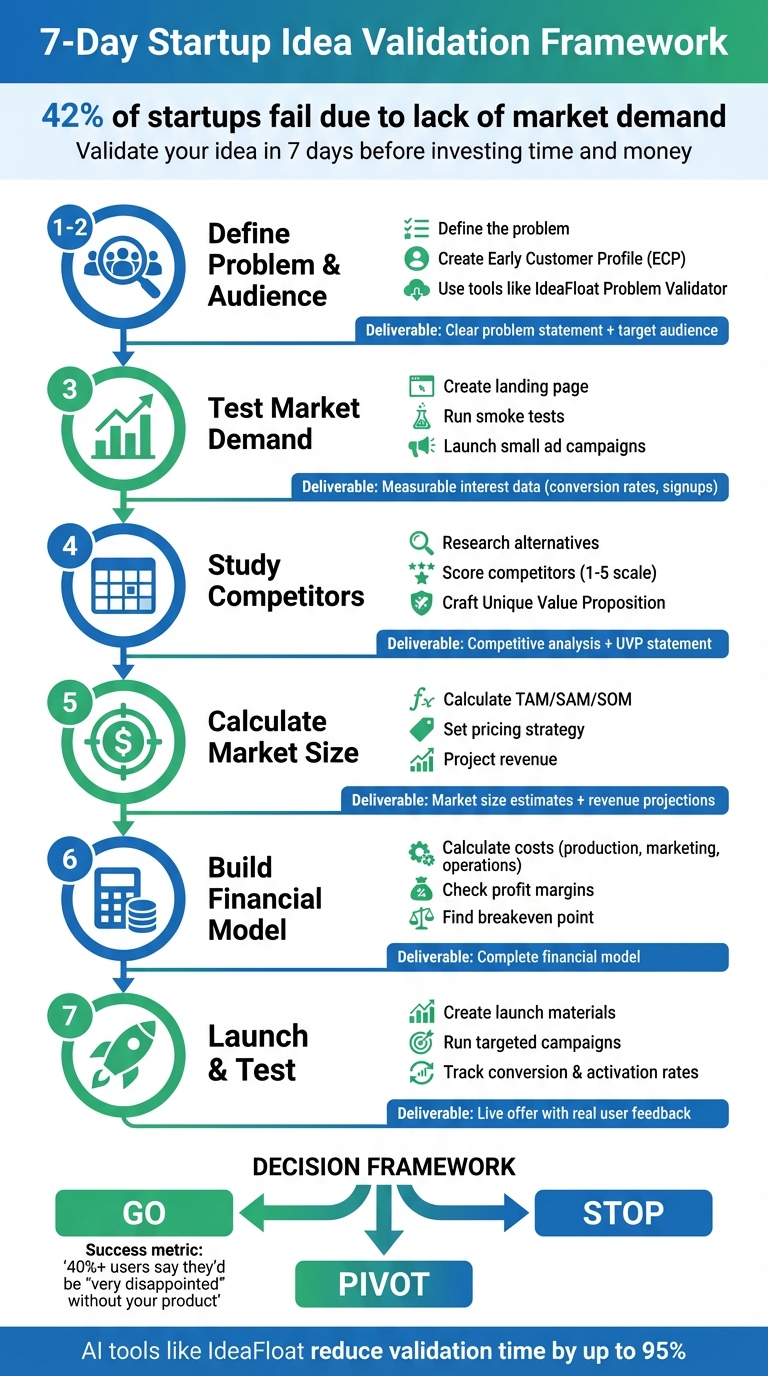
7-Day Startup Idea Validation Framework
Day 1-2: Define the Problem and Find Your Audience
Describe the Problem You're Solving
Start by focusing on the problem, not your product. One of the most common missteps entrepreneurs make is falling in love with their solution before confirming if anyone actually needs it.
"Focus on the pain point, not the product idea" - Kossi Adzo, Editor at Startup.info
Clearly define the problem and highlight the shortcomings of current solutions. If people are relying on clunky workarounds or combining multiple tools to get by, you’ve likely found a real need. On the other hand, if there are no existing alternatives, it might suggest the issue isn’t urgent enough.
Tools like IdeaFloat's Problem Validator can help you gauge whether your idea addresses a problem people are willing to pay to solve. This tool assesses urgency and flags weak signals before you commit resources. You can also explore online forums like Reddit, LinkedIn, or Slack communities to see if the problem is a hot topic. If discussions around the issue lead to long comment threads, that’s a strong indicator of demand.
Another way to check demand is by using Google Trends. If search volume for related terms is stagnant or declining, it may signal low interest.
In December 2024, Popl - a digital business card company led by COO and co-founder Nick Eischens - discovered through customer interviews that their product was being used primarily for professional networking instead of casual social interactions. This insight prompted a pivot to a professional business card model, which significantly boosted subscription rates.
Once the problem is clear, the next step is identifying who’s experiencing it.
Identify Your Target Customers
To zero in on your audience, create an Early Customer Profile (ECP). Focus on three key traits: a pressing pain point, willingness to pay, and proximity within your network. The more specific you get, the quicker you’ll validate your idea.
Look for underserved groups - people overlooked by existing solutions tend to be more open to giving feedback and adopting new products. Tools like SparkToro or LinkedIn Sales Navigator can help you pinpoint where your potential customers hang out online. Additionally, IdeaFloat's Consumer Insights can analyze online conversations to uncover customer opinions, confirm demand, and even identify the language that will resonate in your marketing.
When conducting customer interviews, steer clear of leading questions. Instead, ask open-ended ones like, “What are your biggest frustrations around [problem]?” or “How are you solving it now?” This ensures unbiased feedback.
"To increase your chance of creating something that is solving a real problem you need to be more rigorous in your approach" - Sunita Mohanty, Former Product Lead at Meta and Oculus
In 2025, a solo founder tested a service idea by spending $40 on Instagram ads targeting freelance designers. Within three days, the campaign attracted 60 waitlist signups - enough initial interest to justify moving forward with early-stage fundraising.
Founders Webb Brown and Ajay Tripathy validated the concept for Kubecost by interviewing over 120 teams in just two months. This helped them confirm they were solving a problem that users were "ready to pull out their wallets for" before diving into full-scale development.
Day 3: Test Market Demand
Gather Data on Customer Interest
Now that you’ve pinpointed your audience, it’s time to validate whether your solution has real demand. The quickest way to do this? Put something tangible in front of them and see how they react.
Take advantage of tools like IdeaFloat's Consumer Insights, which can comb through forums, reviews, and social media to analyze what people are saying about your problem. This tool doesn’t just identify whether the issue matters to people - it also reveals the urgency of the problem and the exact words customers use. Those insights can be gold when it comes to crafting marketing messages that truly resonate.
Another option is to test an AI chatbot prototype. Platforms like Chatbase allow you to create a basic chatbot and engage potential users. By tracking conversation volume and how deeply users interact with the chatbot, you can gauge their interest and curiosity.
"The goal of validation is to reduce the risk of building something no one wants." - Hanson Cheng, Founder, Freedom to Ascend
You can also run a “smoke test” by creating a simple landing page. Add a clear call-to-action like “Join the Waitlist” or “Sign Up for Early Access.” AI website builders like Mixo make it easy to get a page live in just a few minutes. Once it’s up, drive traffic to the page through LinkedIn posts, Slack groups, or even a small ad campaign. The number of sign-ups will give you a clear sense of whether people are interested enough to take action.
Record Measurable Feedback
Once you’ve gathered initial reactions, focus on collecting hard data that confirms demand. Quantifiable metrics are essential for making informed decisions. Key metrics to track include conversion rates (how many visitors sign up), click-through rates on ads, and engagement volume (e.g., the number of messages or questions users ask).
If you conduct customer interviews, record the sessions (with permission) and look for recurring themes. Pay close attention to repeated phrases or complaints. If several people describe the same frustration in similar terms, you’ve likely uncovered a problem worth solving. Start small - 5 to 10 interviews are usually enough to spot patterns.
| Metric to Measure | Tool Example | What It Tells You |
|---|---|---|
| Conversion Rate | Mixo, Carrd | How many visitors are signing up for your waitlist |
| Message Volume | Chatbase | Level of user interest and engagement |
| Click-Through Rate | Facebook Ads, Google Ads | How appealing your value proposition is |
Here’s another strong indicator of demand: watch how users react when your prototype isn’t available. For example, when Maja Voje’s chatbot went offline, 15 users actively requested its return, and 2 even offered to pay for it. This kind of “pull” signal is a clear sign that you’re on the right track and gives you confidence to move forward with further validation steps.
Day 4: Study Competitors and Improve Your Offer
Research Your Competition
Now that you’ve gathered demand data, it’s time to dive into the competitive landscape. The goal isn’t to mimic what’s already out there but to pinpoint gaps that your offer can fill.
Start by listing all the alternatives your target audience might consider. This includes direct competitors, DIY solutions, freelancers, or even the option of doing nothing at all. Evaluate each option on a 1–5 scale based on key criteria like price, quality, speed, and ease of use - factors that matter most to your potential customers. This scoring exercise will highlight areas where you can stand out.
To streamline this process, try using IdeaFloat's Competitor Analysis tool. It helps you map competitors, assess their strengths and weaknesses, and spot underserved market segments. Plus, it scans customer reviews and social media to uncover pain points and track shifts in market preferences.
But don’t stop at remote research. Take a hands-on approach by using the secret shopper method. Sign up for competitors’ email lists, request demos, or even make small purchases. This firsthand experience can reveal hidden aspects of their operations, such as their sales tactics, customer service quality, or overlooked flaws like poor visuals, generic messaging, or slow follow-ups.
"The only way to win is to learn faster than anyone else." - Eric Ries, Author, The Lean Startup
Once you’ve mapped out the competition, shift your focus to what makes your solution stand out.
Write Your Value Proposition
With a clear understanding of your competitors’ weaknesses and your target audience’s needs, it’s time to craft a compelling value proposition. This statement should clearly communicate three things: who you serve, the problem you solve, and what makes your solution different.
Zero in on the most pressing pain point your audience faces - the one they’re desperate to fix. Then, connect that challenge to the better outcome your solution provides. Be specific about how quickly customers will see results. The faster they can experience value, the stronger your positioning will be.
From this foundation, develop your Unique Value Proposition (UVP) - a concise statement that sets your solution apart. Then, support it with targeted Unique Selling Propositions (USPs) that explain why your approach works better. This could be due to a proprietary process, faster delivery, or superior quality.
For extra help, check out IdeaFloat’s Unique Value Proposition tool. It can guide you through crafting a one-liner pitch, defining your brand’s positioning, and creating strategies to differentiate your offer from the rest.
Day 5: Calculate Market Size and Revenue Potential
Measure Your Market Opportunity
You’ve confirmed there’s demand for your idea. Now it’s time to figure out how big the opportunity really is - so you can focus on ideas that have the potential to generate solid revenue.
To do this, calculate three key metrics: TAM, SAM, and SOM. Here’s what they mean:
- TAM (Total Addressable Market): The total revenue opportunity if you captured 100% of the market.
- SAM (Serviceable Available Market): A narrower segment of the market that your product can realistically serve.
- SOM (Serviceable Obtainable Market): The portion of SAM you can actually capture in your first year.
For the most accurate results, use the bottom-up method, which relies on real-world data like pricing, customer segments, and usage patterns. For example, if 50,000 freelance designers each pay $20 monthly, your SAM would be $12 million annually. Capturing just 1% of that would give you a first-year SOM of around $120,000.
"The concept of total addressable market is important for both startups and existing businesses because it allows them to prioritize specific products, customer segments, and business opportunities." - Anna Talerico, Corporate Finance Institute
Tools like IdeaFloat's Smart Market Sizing make these calculations faster and easier by pulling live data from sources like search volumes, industry reports, and competitor analysis. What once took 40 hours of manual research can now be done in about an hour with AI. These tools align your market insights with the rapid pace of idea validation.
Before finalizing your numbers, do a sanity check. If your revenue projection suggests capturing an unusually large chunk of the market in your first year, it’s probably unrealistic. Compare your SOM against your TAM to ensure your goals are achievable.
Once you have a solid understanding of your market size, the next step is determining a price that reflects the value you’re offering.
Set Pricing and Project Revenue
Pricing isn’t just about picking a number - it’s a strategic decision that needs to be backed by data. Start by studying what your competitors charge and how they structure their pricing. Look for trends like volume discounts, seasonal offers, or bundled deals to get a sense of customer expectations.
A common starting point is the cost-plus method: calculate your costs (production, operations, marketing) and add a markup to ensure profitability. Then, test different price points based on what customers have indicated they’re willing to pay during your earlier demand validation.
For example, in August 2025, Exploding Startup evaluated an "AI Legal Document Analyzer" idea. With 14,800 monthly searches for "AI contract review", they assigned the idea a validation score of 78/100. Their analysis revealed that lawyers valued the tool enough to generate $50,000 in monthly recurring revenue.
To project your first-year revenue, multiply your SOM by your chosen price point and factor in conversion rates from your landing page tests. For instance, if a solo founder spent $40 on ads and got 60 waitlist signups while testing an idea for freelance designers in 2025, they could use that data to estimate customer acquisition costs and scale it into their revenue model.
AI tools can also help you simulate revenue across different pricing scenarios. Research shows that 32% of companies using AI validation tools have cut costs by 20% or more year-over-year, while 63% have reported revenue growth of at least 5% after implementing these tools.
sbb-itb-08dd11e
Day 6: Build Your Financial Model
Calculate Your Costs
Once you've confirmed demand and estimated revenue potential, it's time to build a financial model to ensure your idea can turn a profit.
Start by categorizing your expenses into three main areas: production costs (the resources needed to create your minimum viable product), marketing expenses (what you'll spend to attract customers), and operational costs (the ongoing expenses to deliver and support your service). For early-stage ideas, you can often keep production costs minimal by using free or low-cost tools like Google Forms, Typeform, or Carrd.
In 2023, a solo founder targeting freelance designers spent just $52 on Instagram ads over three days. This small, focused investment resulted in 60 waitlist signups - proving how modest budgets can effectively validate demand.
To streamline this process, tools like IdeaFloat's Cost Analysis can help you organize all your expenses, from website hosting to customer support. Once you've tallied your total costs, calculate your potential revenue by multiplying your estimated customer count by your price point. Subtract your total costs from this figure to see if you're in the green. If the result is negative, you may need to tweak your pricing, expand your target market, or cut back on expenses.
Before committing further, perform a scalability check to ensure you can handle growth. Ask yourself: Can you serve 1,000 customers without incurring unsustainable costs?
Finally, make sure your pricing allows for healthy profit margins.
Check Your Profit Margins
With your expenses outlined, it's time to evaluate whether your revenue can comfortably cover them. Start by calculating your breakeven point - the point where your total revenue equals your total costs. Multiply your price by a realistic customer count, subtract your total costs, and see where you stand. If you end up with a positive margin, you're on the right track. If not, adjustments are in order.
AI tools like IdeaFloat's Financial Model make it easier to test different scenarios. You can explore how changes in pricing, cost reductions, or customer growth could impact your bottom line. These tools often include interactive graphs and monthly forecasts to help you make informed decisions.
"The validation of business ideas allows selection of those that add most value to the customer and company." - Kaizen Institute
If your profit margins are solid and your breakeven timeline looks reasonable, you’re ready to move forward. If not, use these insights to refine your approach before committing more resources.
Day 7: Prepare and Launch Your Offer
Create Your Launch Materials
Day 7 is all about turning your validated idea into a real-world launch. Start by creating a landing page that clearly outlines the problem you're solving, emphasizes the key benefits, and includes a strong call to action like "Join the waitlist" or "Get early access."
Focus on the "atomic unit" of your offer - this is the smallest version of your product or service that delivers its core value. For example, if you're creating a search tool, test it with just one query. If it's a service, focus on delivering one specific result. This approach allows you to validate your idea without overcomplicating things. Tools like IdeaFloat's Logo Generator can help you design professional branding quickly, while their Waitlist Landing Page tool helps you build a page with persuasive copy that captures emails before you're fully operational.
Keep your messaging straightforward. Instead of claiming to be an "all-in-one solution", focus on the single problem you solve better than anyone else. Make sure your landing page is mobile-friendly, and prepare outreach materials like LinkedIn posts, email sequences, and visual prototypes to showcase your offer.
Once your launch materials are ready, it's time to put your plan into motion.
Run Your Launch
Now comes the exciting part: turning your validated idea into real customer engagement. Use IdeaFloat's Launch Checklist to stay organized and ensure everything goes smoothly.
Combine organic methods with direct outreach. For example, in December 2024, Maja Voje validated an AI chatbot in just seven days through targeted LinkedIn outreach, generating 418 chats and 3,724 messages in a single week. Similar targeted strategies can help you achieve strong engagement.
Leverage IdeaFloat's Community Launch Map to pinpoint online spaces where your potential customers are active. Use custom-written posts to spark discussions and drive traffic. Consider setting aside a small budget ($40–$65) for social media ads on platforms like Facebook, Instagram, or LinkedIn. These ads can help you test your messaging and attract early signups.
As you launch, keep an eye on metrics like your conversion rate (the percentage of visitors who take action) and activation rate (users who complete a key step that shows they’ve experienced your product's value). If 40% or more of your early users say they’d be "very disappointed" without your product, you’ve reached a strong validation milestone.
How to Validate Your Startup Idea for $50 (Same Method That Built a $100M Brand)
Conclusion
Over the past week, you've followed a 7-day framework designed to replace guesswork with actionable insights. By using this method, you've tackled one of the biggest reasons startups fail: 42% of failures are due to a lack of market demand. Instead of pouring months into building something that might not resonate, you've gathered real-world data, tested actual interest, and based your decisions on what people do - not just what they say.
Tools like IdeaFloat have made this process faster and more accessible. Tasks that once required weeks of manual effort, expensive focus groups, or advanced spreadsheet skills can now be done in days. With IdeaFloat’s validation tools, you’ve been able to transform a rough concept into a tested idea without needing a team of analysts or a hefty budget. In fact, this approach can reduce validation time by up to 95% while keeping the results reliable.
This process isn’t about getting a perfect "yes" from the market - it’s about making an informed decision: whether to Go, Pivot, or Stop. If your data shows strong engagement and people are signing up, you can move forward confidently. If the response has been lukewarm, you've avoided wasting months on an idea that wouldn’t work. As Isabel Isidro wisely said, "Going forward with clarity beats uncertain optimism".
Now it’s time to take action. Use the insights you've gathered to refine your messaging, adjust your pricing, and better target your audience. Think of the data from the past seven days as your roadmap - not something static, but a guide that evolves as you continue to test, learn, and adapt. The best founders embrace this cycle of improvement, always refining their approach.
You’re no longer relying on hope. You’re building with evidence. That’s the difference between wishing your idea will succeed and knowing it has the foundation to thrive.
FAQs
How can I quickly identify my target audience in two days?
To pinpoint your target audience in just two days, start by focusing on the problem your idea addresses and identifying who it impacts the most. Break down the defining traits of this group - think about their roles, industries, or specific circumstances. Then, take it a step further by crafting detailed customer personas. Include details like age, income, hobbies, and their biggest frustrations. Adding a brief "day-in-the-life" snapshot can help you grasp their motivations and the type of language they use.
On day two, put your assumptions to the test with quick online research. Tools like Google Trends can help you gauge interest by showing search volumes for relevant keywords. Dive into platforms like Reddit, LinkedIn, or niche forums to see what people are saying in real conversations. For more direct insights, create a short survey with 5–6 targeted questions about the problem, current solutions, and openness to new options. Share the survey in relevant online communities and aim for 50–100 responses. Once you’ve gathered the data, analyze it to spot the most common traits and prioritize your audience based on their level of need and potential size.
These steps will give you a clear, research-backed understanding of your target audience, setting the stage for further refinement.
What are the best tools to quickly test if there’s demand for my idea?
To quickly gauge market demand, start with Google Trends to check search interest and see what's trending around your idea. Combine this with social media platforms by exploring relevant hashtags to measure audience engagement and buzz. Another effective approach is setting up a basic landing page to gather sign-ups or pre-orders. This gives you a direct way to measure interest and gather early feedback. These methods allow you to test your idea swiftly and make adjustments based on initial responses.
How can I calculate TAM, SAM, and SOM for my business idea?
To figure out your TAM (Total Addressable Market), start by estimating the total revenue you'd generate if you captured 100% of the market. This can be done using two methods: a top-down approach, where you apply your target segment percentage to the total industry revenue, or a bottom-up approach, where you multiply the number of potential customers by the average annual revenue each customer would generate.
Once you have your TAM, move on to calculating your SAM (Serviceable Available Market). This is a more focused subset of your TAM, representing the portion of the market you can realistically serve. Factors like geography, customer demographics, or how well your product aligns with customer needs play a role here.
Finally, determine your SOM (Serviceable Obtainable Market). This is the share of your SAM you can reasonably capture in the short term, often around 1-5%. Your SOM depends on things like your sales capabilities and how quickly early adopters are likely to engage with your product or service.
Related Blog Posts
 Report an issue
Get the newest tips and tricks of starting your business!