In 5–30 seconds, most visitors decide whether to stay or leave your page. The key to capturing their attention? A clear, concise value proposition. This message should explain who you serve, the results you deliver, and why you’re the best choice. Without it, potential customers will move on.
A simple formula can help: "We help [target customer] achieve [specific outcome] by [unique mechanism] in [timeframe or condition]." Each part ensures your message is precise, relevant, and actionable. For example, Warby Parker's promise of designer glasses for $95 disrupted an overpriced market, helping them grow to a $3 billion valuation.
To create a strong value proposition:
- Focus on clarity and specific outcomes. Avoid vague claims like "industry-leading."
- Differentiate yourself by highlighting what makes your solution better.
- Align your message with customer needs, using their own words to resonate.
Test and refine your proposition through customer interviews, surveys, and tools like IdeaFloat to ensure it addresses real problems. A well-crafted value proposition not only grabs attention but also drives decisions.
The Perfect Value Proposition | Business Mastery
The Value Proposition Formula
Value Proposition Formula: 4-Step Framework with Examples
The Formula Explained
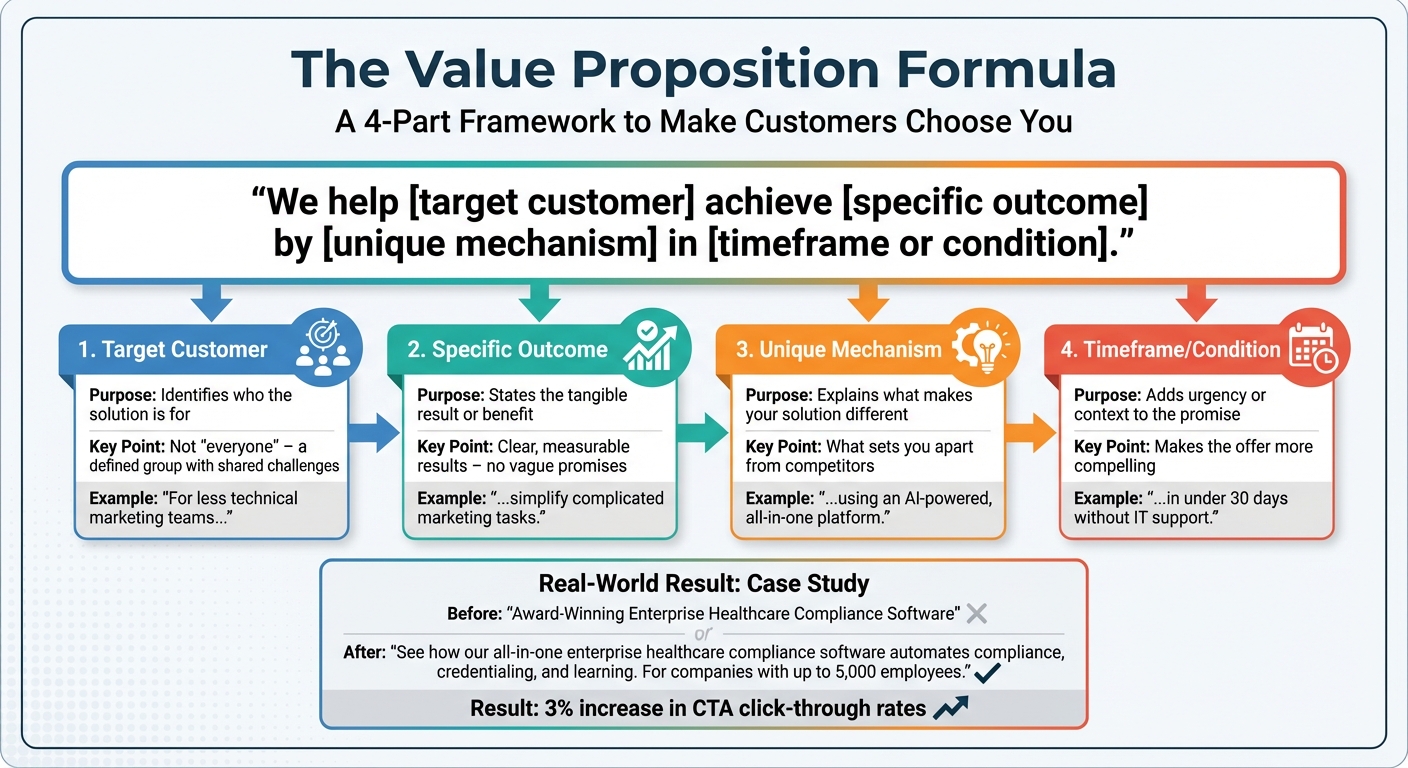
A strong value proposition follows this structure: "We help [target customer] achieve [specific outcome] by [unique mechanism] in [timeframe or condition]."
Each part of the formula plays a crucial role. The target customer specifies exactly who you're helping - not "everyone", but a defined group with a shared challenge. The specific outcome highlights the clear, measurable result they can expect - no vague promises like "improved performance." The unique mechanism explains what sets your solution apart from others. Finally, the timeframe or condition adds urgency or situational context, making the offer more compelling.
Here’s how these elements work together:
| Component | Purpose | Example |
|---|---|---|
| Target Customer | Identifies who the solution is for. | "For less technical marketing teams..." |
| Specific Outcome | States the tangible result or benefit. | "...simplify complicated marketing tasks." |
| Unique Mechanism | Explains what makes your solution different. | "...using an AI-powered, all-in-one platform." |
| Timeframe/Condition | Adds urgency or context to the promise. | "...in under 30 days without IT support." |
For example, in July 2025, Modus partner Graham Ericksen revamped the homepage meta-description for an enterprise healthcare compliance software client. The original description, "Award-Winning Enterprise Healthcare Compliance Software", was replaced with: "See how our all-in-one enterprise healthcare compliance software automates compliance, credentialing, and learning. For companies with up to 5,000 employees." The result? A 3% increase in CTA click-through rates - a testament to the power of specificity. This structured approach ensures your value proposition directly addresses customer needs.
What Makes a Value Proposition Work
Now that you know the formula, let’s dive into why this structure consistently delivers results.
Clarity is king. Your value proposition has to be instantly understandable. If visitors can’t quickly grasp what you offer and why it matters, they’ll move on.
Specificity matters more than flashiness. Statements like "cutting-edge solutions" or "industry-leading service" are too vague to resonate. Companies that excel in four or more specific value areas see three times the Net Promoter Score and up to four times the revenue growth compared to those focusing on just one. Use clear, concrete language to address real customer pain points.
Differentiation is the dealbreaker. If your value proposition sounds like your competitors’, you’re missing the mark. As Kassandra Rodriguez, Founder of 1st House Branding, explains:
"If your value proposition matches your competitors', then there's something wrong".
Your unique mechanism should spell out why your solution is the better choice.
Customer alignment is the foundation. A value proposition isn’t about what you think is impressive - it’s about what your customer truly needs. Dan Demsky, Co-founder of Unbound Merino, puts it this way:
"At its core, a value proposition is a promise you make to your customer post-purchase. You're essentially saying, This purchase will outperform your expectations and solve the problem that needs solving".
If your solution doesn’t deliver on this promise, the entire proposition falls apart.
Next, we’ll explore how to use customer insights to refine and perfect your value proposition formula.
Gathering Customer Insights for Your Value Proposition
Understanding Customer Pains, Gains, and Jobs-to-Be-Done
To craft a strong value proposition, you need a clear, data-driven understanding of your customers' needs, challenges, and goals. This is where the Value Proposition Canvas becomes invaluable. It helps you map out your Customer Profile (their jobs, pains, and gains) and align it with your Value Map (how your product addresses those pains and delivers gains). When these two align, you've hit the sweet spot of product-market fit.
Start by identifying the functional, social, and emotional jobs your customers are trying to accomplish. From there, list their primary frustrations (pains) and aspirations (gains). Prioritize the top three to ensure your efforts have the greatest impact. Interestingly, research highlights that social and emotional needs often drive deeper customer loyalty than purely functional benefits. Once you've gathered this information, rank pains and gains by their intensity and frequency. This step is critical - 6 out of 10 new product ideas fail because they solve problems no one cares about.
Talk directly to your customers. Conduct customer validation interviews with at least five target users, using open-ended questions to uncover their real priorities. Pay close attention to the words they use - it’s these insights that should shape your value proposition. Amanda Natividad, VP of Marketing at SparkToro, emphasizes the importance of this process:
"Get really good at doing customer interviews and talking to your customers. Understand what they want, what they need, and what they use your tool for".
This groundwork sets the stage for validating your findings with advanced tools. You might also consider building a lean canvas to visualize how these insights fit into your broader business model.
Using IdeaFloat to Validate Customer Insights
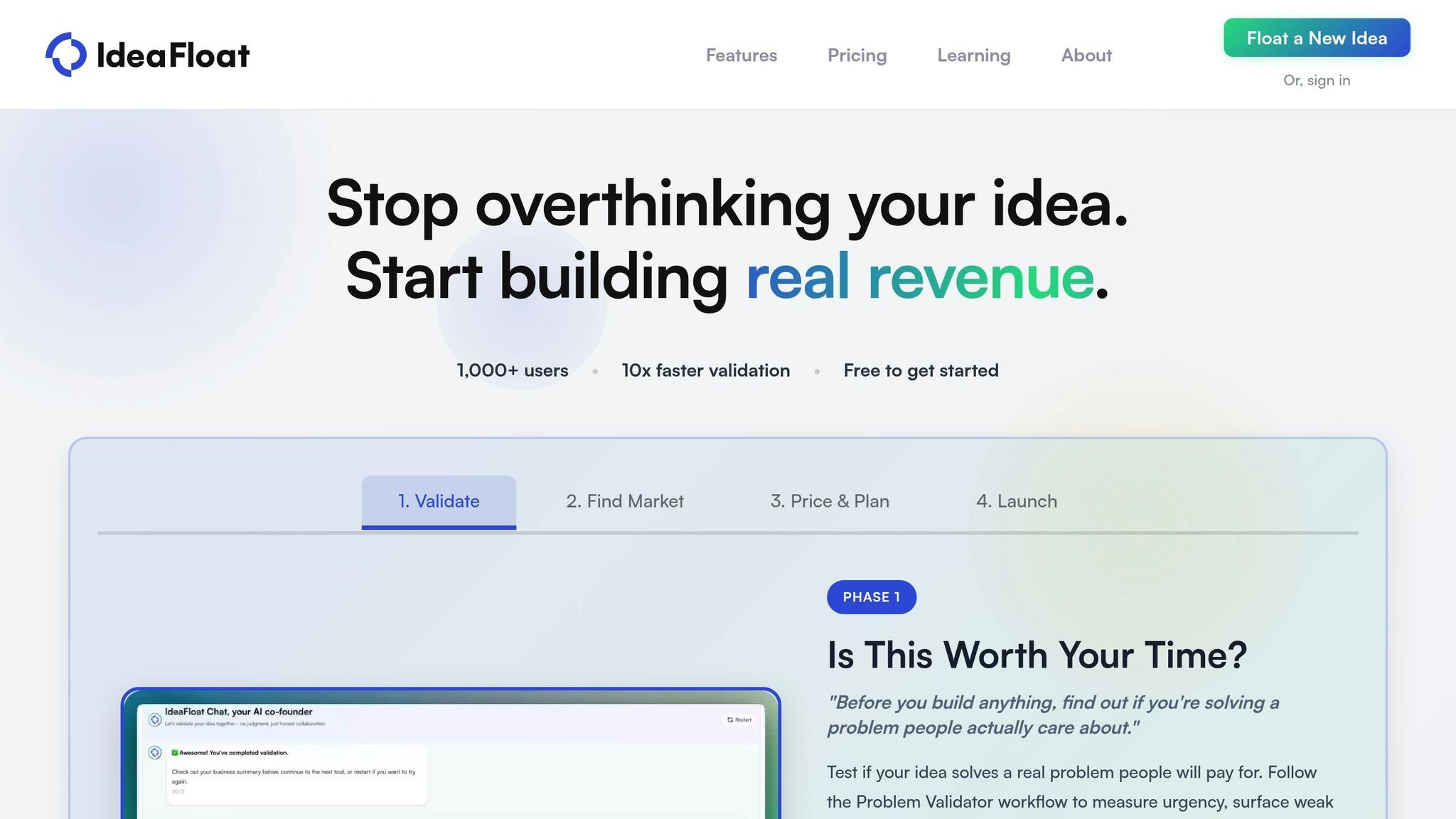
IdeaFloat offers a suite of AI-driven tools - Problem Validator, Consumer Insights, and Unique Value Proposition Generator - to help you confirm that your value proposition targets genuine, pressing customer needs.
The Consumer Insights tool dives into online spaces like forums, social media, and community discussions to capture how customers describe their challenges. By using their exact words, you can create messaging that feels personal and tailored. This tool also helps determine whether the problem you're addressing is significant enough for people to pay for a solution.
The Problem Validator assesses how urgent and widespread an issue is, providing early feedback before you commit too much time or money. Many successful brands have relied on similar methods to ensure they’re solving the right problems from the start.
Finally, the Unique Value Proposition Generator guides you through questions designed to uncover what sets your offering apart. It then synthesizes these insights into a clear, compelling statement. These tools take the guesswork out of the process, giving you confidence backed by real data. Plus, they’re free to use, making professional-grade validation accessible to everyone.
With IdeaFloat’s tools, you can refine your approach and ensure your value proposition resonates with your audience.
sbb-itb-08dd11e
How to Craft and Refine Your Value Proposition
Building Your First Draft
The first step in creating a strong value proposition is to identify your target audience. Conduct customer interviews and pay attention to how they describe their challenges in their own words. Then, pinpoint the exact issue your product is designed to solve. As Clayton Christensen, a Harvard Business School professor, puts it:
"A 'job to be done' is a problem or opportunity that somebody is trying to solve. We call it a 'job' because it needs to be done, and we hire people or products to get jobs done".
Once you've defined the "job", focus on the specific outcomes and benefits your product provides - go beyond listing features. Highlight what sets you apart and use a simple formula to organize your thoughts: "We help (X) do (Y) by doing (Z)". Alternatively, Geoff Moore’s framework can add more depth: "For [target customer] who [needs or wants X], our [product/service] is [category] that [benefits]". Begin with detailed sentences and then refine them into a concise, impactful message.
Once your draft is complete, focus on precision and clarity.
Refining for Clarity and Impact
You’ve got only 5–30 seconds to grab someone’s attention on a landing page, and most visitors will only skim the headline. Every word matters. Simplify your language - if a 12-year-old wouldn’t understand it, rewrite it. Replace vague statements with specific, measurable claims. For instance, MECLABS Institute tested this principle in June 2021 for a market solutions provider. Their original value proposition made generic claims about "most accurate mailing lists." The revised version included concrete details: access to 210 million U.S. consumers and a team of 600 researchers conducting 26 million verification calls annually. This change led to a 201% increase in email leads during an A/B test.
To make your value proposition easy to scan, structure it as follows:
- Headline: A strong, single sentence that grabs attention.
- Subheadline: Two to three sentences that expand on the headline.
- Bullet points: Highlight key features or benefits.
Jan Bogaert, Product Marketer at HubSpot, emphasizes the importance of iteration:
"Write a lot of variations. Be descriptive. And then edit and edit and edit".
Once you’ve refined your draft, ask yourself these critical questions: Is it truthful? Does it resonate with your audience? Can you deliver on the promise? Kassandra Rodriguez, Founder and Brand Strategist at 1st House Branding, cautions:
"If your value proposition matches your competitors', then there's something wrong".
Finally, consider leveraging AI tools to validate and refine your message.
Using IdeaFloat for Faster Results
IdeaFloat simplifies the process of refining your value proposition by helping you uncover what makes your offering stand out. Its Unique Value Proposition Generator guides you through a series of targeted questions, such as identifying the main challenge you solve and how your solution outperforms others. Based on your responses, the tool generates a clear, compelling statement that communicates your unique value.
After generating a draft, IdeaFloat allows you to share it with at least five potential customers or stakeholders for feedback. This helps you gauge clarity and uniqueness. Use their input to refine your message further, ensuring it’s both concise and customer-focused. The best part? These tools are free to use, offering professional-grade assistance without the expense. By combining systematic generation with real-world validation, you can create a value proposition that truly connects with your audience.
Validating and Testing Your Value Proposition
Validation Methods That Work
Before launching, it’s crucial to test your value proposition with actual customers. Angel Annunciacao, Senior Business Director at IDEO, emphasizes this point:
"At the end of the day, value propositions are about testing the consumer's needs, and that's something you want to do early and often."
Start with qualitative research to understand the "why" behind customer decisions. Conduct in-depth interviews where potential customers describe their challenges in their own words. To dig deeper, try card sorting - present participants with benefit cards and have them choose between two options repeatedly until they rank their top three. This method mimics real-life trade-offs and uncovers what truly matters to them.
For broader insights, move to quantitative surveys with at least 100 respondents to achieve reliable results. Instead of traditional rating scales, consider Max-Diff studies, which require respondents to select the most and least important features. This forces clearer prioritization. Combining these qualitative and quantitative approaches helps reveal what resonates most with your audience.
Behavioral tests also provide actionable insights. For example, run targeted PPC campaigns featuring your value proposition on a landing page to see which messaging drives the highest click-through rates. To gauge willingness to pay, use reference anchoring - compare your product's value to familiar items like a coffee, a pair of jeans, or a Spotify subscription. However, Annunciacao cautions:
"When it comes to willingness to pay, there's often a large 'say-do gap,' where what people say they'll pay for something is very different from what they're actually willing to pay."
Improving Your Value Proposition with IdeaFloat
Once you’ve validated your value proposition manually, refine it further with digital insights. IdeaFloat offers tools that provide market-verified data to help you adjust your messaging.
The Consumer Insights tool analyzes online conversations to validate demand, understand the language customers use, and identify the words that resonate most. This method bridges the "say-do gap" by focusing on what customers prioritize in real discussions rather than survey responses.
Meanwhile, the Competitor Analysis tool maps out your competitive landscape and identifies competitors, evaluates their strengths and weaknesses, and highlights underserved segments. This tool has demonstrated a 665% ROI over three years, delivering an estimated $2.03 million in value. By leveraging these insights, you can ensure your value proposition emphasizes benefits that truly set you apart from competitors.
Both tools provide actionable, data-driven insights, allowing you to refine your messaging based on real customer needs rather than internal assumptions.
Examples of Validated vs. Unvalidated Value Propositions
The contrast between an unvalidated and a validated value proposition is striking. Here’s a side-by-side comparison based on real-world testing:
| Element | Unvalidated | Validated |
|---|---|---|
| Target Audience | Broad: "Business owners" | Specific: "The novice entrepreneur" |
| Problem Addressed | Generic: "Need help with transactions" | Acute Pain Point: "Doesn't know how to launch an e-commerce business" |
| Benefit Focus | Feature-based: "Manage checkout process" | Outcome-based: "Step-by-step process to set up, grow, and manage transactions" |
| Differentiation | Vague; easily imitated by competitors | Unique; highlights specific competitive advantages |
A validated value proposition connects directly with a specific audience, addresses a clear problem, and promises a tangible outcome. Achieving this level of clarity requires testing your ideas with real customers and refining your approach based on their feedback. As Annunciacao wisely notes, a strong value proposition acts as a "north star", guiding the entire organization in the same direction.
Conclusion
Key Takeaways
A solid value proposition is the foundation of your business's competitive edge. When you pinpoint your target audience, address their specific challenges, and clearly demonstrate how your solution outshines the competition, you create a protective moat around your market position. Companies that deliver on 4 or more value elements see impressive results - triple the Net Promoter Score and double the revenue growth compared to their peers.
While the concept may seem straightforward, the real challenge lies in validation. Research shows that 86% of business buyers are more likely to make a purchase when they feel their goals are understood. Yet, 59% report that most salespeople fail to grasp their unique needs. A strong value proposition bridges this gap by addressing your customers' core goals and concerns.
However, assumptions can derail even the best intentions. Validation - through interviews, surveys, and testing - is essential to ensure your value proposition aligns with customer insights. This step is the foundation for building a successful strategy.
These principles lay the groundwork for using advanced tools to refine and strengthen your approach.
How IdeaFloat Supports Your Journey
IdeaFloat simplifies and accelerates the process of building a validated value proposition. Traditionally, this process involves weeks of customer interviews, survey analysis, and competitive research. IdeaFloat cuts through the complexity with AI-powered tools and market-tested data.
The Consumer Insights tool dives into real online conversations, uncovering the exact language your customers use and the priorities that matter most to them. This approach closes the gap that traditional surveys often leave behind. At the same time, the Competitor Analysis tool provides a clear view of your competitive landscape, highlighting overlooked opportunities and underserved segments.
To bring it all together, the Unique Value Proposition tool helps you craft messaging that resonates instantly with your audience. By combining these insights, IdeaFloat equips you with the data to create precise, impactful messaging and positioning. Whether you're launching a new business idea or fine-tuning an existing offer, IdeaFloat gives you the confidence to move forward. This streamlined approach transforms your value proposition into a powerful driver of customer acquisition and revenue growth.
FAQs
What’s the best way to make my value proposition stand out?
To make your value proposition stand out, focus on answering a simple yet crucial question: “Why should customers choose you?” Be specific - highlight the problem you solve, the measurable results you deliver, and what sets your approach apart. Skip vague features and aim for a clear, outcome-driven statement, like “Cut your energy bills by 25% in just 60 days.”
Back up your promise with solid evidence. This could include data, real customer success stories, or even proprietary technology - anything that builds credibility and trust. Tailor your message to fit your audience. For instance, technical buyers might want detailed metrics, while others may care more about the broader business benefits. Experimenting with different versions of your value proposition can also help you zero in on what resonates most.
Lastly, make sure your value proposition is consistent everywhere your customers interact with you - your website, ads, sales materials, and emails. A message that’s clear, backed by proof, and easy to remember doesn’t just set you apart - it builds trust and loyalty that keeps customers coming back.
How can I effectively validate my value proposition to ensure it resonates with customers?
To validate your value proposition, start by crafting a clear and straightforward statement that outlines the problem you address, the benefit your customers gain, and what makes you different. Once you’ve nailed that down, estimate the potential market size in U.S. dollars to ensure there’s enough demand to make your offering viable.
From there, gather direct input from your target audience. Use surveys or conduct interviews to understand how relevant they find the problem, how appealing your solution is, and whether they see it as distinct from other options. You can also experiment with A/B testing by tweaking your messaging and tracking metrics like click-through rates or sign-ups to see what resonates most.
Additionally, leverage AI tools to dive into market trends and analyze competitor messaging. This helps you ensure your value proposition not only meets customer expectations but also stands out in the crowd. Keep refining your statement based on the feedback and data you collect to make sure it continues to engage and retain your audience effectively.
Why is understanding your customers crucial for creating a strong value proposition?
Understanding your customers is the key to connecting with them. It helps you pinpoint who they are, what they need, and what truly matters in their lives. By digging into their challenges, goals, and what they hope to achieve, you can create a value proposition that speaks directly to their needs and highlights the benefits they care about most.
When your value proposition is shaped by real customer insights, every part of it - whether it's the problem you're addressing or the unique solution you're offering - is grounded in data, not guesswork. This approach makes your message more relevant and effective, helping it stand out in a crowded market. A well-crafted, customer-centered value proposition doesn’t just grab attention - it builds trust and delivers stronger results for your business.
Related Blog Posts
 Report an issue
Get the newest tips and tricks of starting your business!