Starting a window cleaning business is a low-cost, high-margin opportunity. With just $500 for basic tools, you can enter an industry generating over $40 billion annually in the U.S. Here's what you need to know:
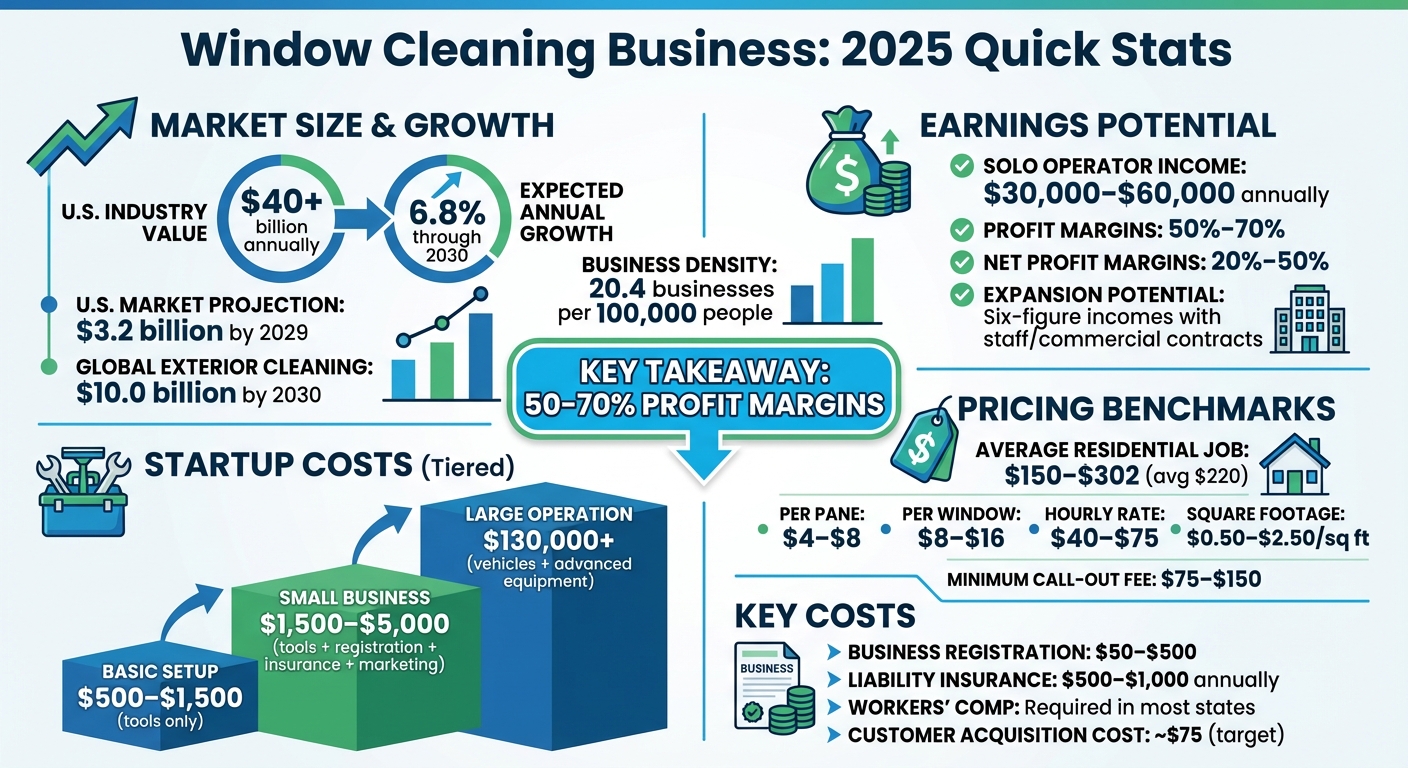
- Profit Potential: Solo operators can earn $30,000–$60,000 annually, with margins of 50%–70%. Expanding with staff or commercial contracts can lead to six-figure incomes.
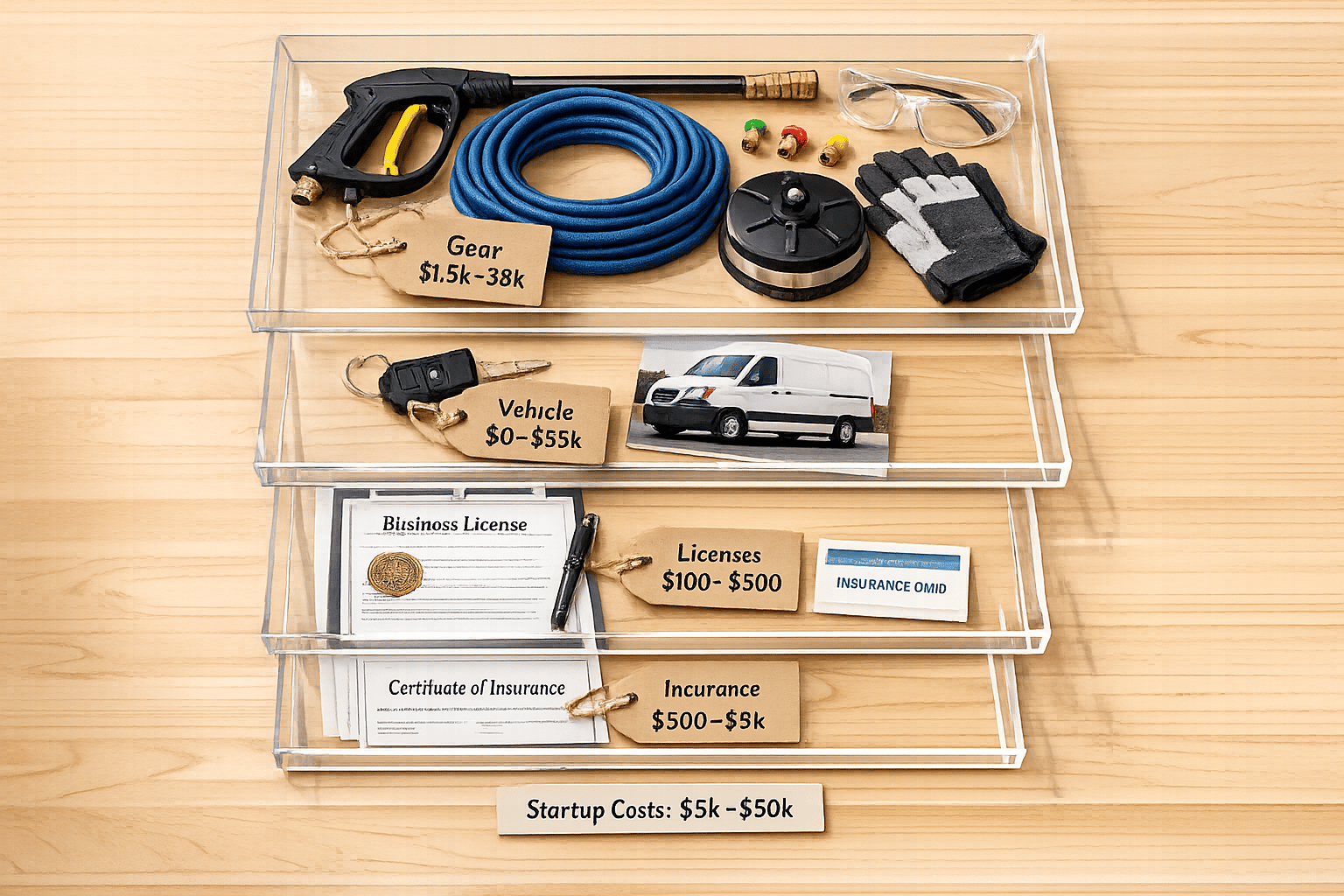
- Startup Costs: Basic equipment and registration fees range from $1,500 to $5,000. Larger setups may exceed $130,000.
- Recurring Revenue: Monthly or seasonal contracts with residential and commercial clients provide steady income.
- Key Tools: Start with squeegees, scrubbers, and ladders. Water-fed poles (WFPs) improve safety and efficiency for exterior work.
- Marketing: Use Google Business Profiles, local SEO, vehicle branding, and referral programs to attract clients.
- Pricing: Average residential jobs cost $150–$302. Charge $4–$8 per pane or $40–$75 per hour for custom jobs.
- Growth: Add services like gutter cleaning, expand into commercial accounts, and use software for scheduling and invoicing.
With the industry expected to grow 6.8% annually through 2030, this is a promising time to start. Focus on market research, legal setup, and delivering quality service to build a thriving business.
Window Cleaning Business Startup Costs, Earnings & Market Statistics 2025
How to Start a Window Cleaning Business - Equipment and Truck set up
sbb-itb-08dd11e
Researching the Window Cleaning Market
Before diving into equipment purchases, it’s crucial to get a clear picture of your local market. Skipping this step can lead to unexpected challenges. Market research helps you pinpoint areas where demand is strong, identify competitors, and discover which neighborhoods are willing to pay for quality service.
On average, the U.S. window cleaning industry has 20.4 businesses per 100,000 people. If your area has fewer businesses per capita, you might be looking at an underserved market. On the flip side, if there’s a crowd of competitors, you’ll need to stand out - whether through excellent service, quick responses, or unique offerings others might miss.
"Your competition isn't your real competitor. The real competitor is you and the customers who don't know they want their windows cleaned." - Chris Lambrinides, Author
Researching also means spotting weaknesses in the market. Check reviews on platforms like Google Maps and Yelp to uncover common complaints, such as slow callbacks or missed appointments. These pain points are opportunities for you to shine.
From here, you’ll want to measure local demand, define your ideal customers, and keep an eye on emerging trends.
Measuring Local Demand
Start by mapping out your service area. Tools like freemaptools.com can help you outline all zip codes within a 20-mile radius of your base. This gives you a clear idea of your primary service zone, balancing proximity with customer potential.
Next, dive into census data for those zip codes. Focus on three key factors: median household income, homeownership rates, and education levels - these often correlate with disposable income. Rank neighborhoods by income and prioritize areas where at least 60% of residents own their homes. These are likely your best prospects.
To gauge search demand, look at terms like "window cleaning near me", which sees an average of 33.5K monthly searches nationwide. Tools like Semrush or Ahrefs can provide localized data, helping you identify areas with high interest but fewer competitors.
Finally, talk to locals - neighbors, friends, or shop owners - about how often they hire window cleaners and what additional services they’d like to see. These conversations can uncover needs that online data might not, like requests for screen repair or post-construction cleanup.
Defining Your Target Customers
Window cleaning customers generally fall into two categories: residential and commercial. Residential clients include homeowners, property managers, and real estate agents prepping homes for sale. Commercial clients range from office buildings and retail stores to hospitals and hotels.
Research shows that women aged 40 to 55 are often the decision-makers for residential cleaning services. When marketing to this group, highlight convenience, safety, and how your service boosts curb appeal. For commercial clients, focus on professionalism, reliability, and the value of recurring maintenance contracts.
Building customer profiles can help you fine-tune your approach. Tools like Nielsen's Segment Explorer provide insights into the lifestyles and values of your potential customers. This information will guide your marketing and service offerings.
Don’t forget niche opportunities. High-rise buildings may require specialized cleaning techniques, new construction sites often need post-build cleanup, and eco-conscious customers are looking for green-certified services with biodegradable products.
Market Trends and Opportunities in 2025
With your customer profiles in hand, it’s time to consider the broader trends shaping the industry in 2025.
Recurring revenue models are becoming the standard. Monthly or quarterly contracts - especially with commercial clients - provide consistent cash flow and help balance out seasonal slowdowns.
Sustainability is also taking center stage. Many customers now expect water-efficient systems, biodegradable detergents, and non-toxic solutions. Highlighting your eco-friendly practices can give you an edge over competitors who still use harsh chemicals.
Technology is another game-changer. Automation tools and digital platforms are helping businesses streamline operations and improve customer experiences.
Expanding into complementary services like solar panel cleaning, gutter cleaning, or holiday light installation can also boost your profits. These services often require the same equipment and can strengthen relationships with your existing customers.
Finally, look for gaps in your local market. About 34.4% of window cleaning businesses don’t have websites, and 64% are closed on Sundays. By building a strong online presence and offering weekend availability, you can attract customers your competitors might miss.
These insights will directly influence your pricing and marketing strategies, which we’ll explore in the next sections.
Legal and Financial Setup
Before diving into operations, it's crucial to establish a solid legal and financial foundation for your business. This ensures your personal assets are protected and your finances are set up to handle challenges like slow periods or scaling up.
Selecting a Business Structure
The structure you choose for your business impacts everything from taxes to liability. Many window cleaning entrepreneurs start as sole proprietors because it’s simple and doesn’t require formal registration. However, this structure doesn’t separate your personal and business assets, meaning your personal finances are at risk if the business incurs debt or legal trouble.
For most window cleaning businesses, forming an LLC (Limited Liability Company) is a better option. An LLC protects your personal assets from business liabilities while offering "pass-through" taxation, where profits go directly to your personal tax return, avoiding double taxation. Filing fees for an LLC vary by state, typically ranging from $50 to $500.
"Opening a window cleaning venture without the protective shield of an LLC is possible. However, it's similar to cleaning skyscraper windows without safety equipment." - ZenBusiness
If your business becomes highly profitable, you might consider electing S Corporation status. This allows you to pay yourself a reasonable salary (subject to payroll taxes) while taking additional profits as distributions, which aren’t subject to the 15.3% self-employment tax. On the other hand, C Corporations face a flat 21% federal tax rate plus taxes on dividends, making them less practical for small businesses. Similarly, general partnerships expose all partners to unlimited personal liability.
To maintain legal protections, open a separate business bank account. This helps preserve the "corporate veil" and simplifies tax filings. Even single-member LLCs should create an operating agreement to reinforce the distinction between personal and business assets. Additionally, apply for a free Employer Identification Number (EIN) from the IRS, which you’ll need to hire employees or open business accounts.
Once your structure is set, ensure you comply with all local, state, and federal regulations to operate legally.
Licenses, Permits, and Insurance Requirements
Your business will need to meet requirements at federal, state, and local levels.
Start by obtaining a general business license from your city or county, which usually costs $50 to $500. If you plan to work from home, check local zoning laws to ensure you can store equipment on-site. Some areas may require a separate "home occupation" permit.
An EIN is mandatory if you form an LLC, incorporate, or hire employees. If your state taxes services or you sell cleaning products, you’ll also need a sales tax permit. For specialized services like high-rise cleaning or using specific chemicals, you might need additional permits, typically costing $100 to $300. While not always required, OSHA certifications and IWCA credentials can help you secure commercial contracts.
General liability insurance is essential for protecting your business against property damage or third-party injuries. Annual premiums generally range from $500 to $1,000. Many commercial clients will require proof of at least $1 million in coverage before hiring you.
"Insurance protects your business when something goes wrong, whether that's a customer slipping on a wet floor, a ladder damaging siding, or an employee getting hurt on the job." - Housecall Pro
If you plan to hire employees, workers' compensation insurance is mandatory in most states and covers medical expenses for work-related injuries. You’ll also need commercial auto insurance since personal policies usually exclude business use.
Creating Your Budget and Financial Plan
A strong financial plan includes three key documents: an Income Statement (Profit & Loss), Balance Sheet, and Cash Flow Statement. For long-term planning, project these out over five years. Start by calculating your breakeven point. For businesses with significant investments in vehicles or specialized equipment, this could take up to 22 months.
Startup costs vary depending on the scale of your operation. A basic setup with essential tools might cost between $500 and $1,500. Adding business registration fees ($50 to $500), liability insurance ($400 to $1,500 annually), and initial marketing ($500 to $2,500) can bring total costs to $1,500 to $5,000. For larger operations with vehicles and advanced equipment, costs can exceed $130,000.
"Basic cleaning tools such as squeegees, scrapers, buckets and safety equipment will cost approximately $500 to $1,500. The larger setups with water-fed poles, ladders and transportation will increase startup costs above $5,000 often." - Scott Schrader, CMO of CottageCare
Keep an eye on unit economics to ensure profitability. For healthy margins, variable costs like labor, supplies, and fuel should stay between 20% and 29% of revenue. Window cleaning businesses typically achieve net profit margins of 20% to 50%. Also, track your Customer Acquisition Cost (aim for around $75) and compare it to Customer Lifetime Value.
Recurring revenue is key to stabilizing cash flow. Aim for monthly or quarterly contracts - businesses with 75% recurring revenue are better equipped to handle seasonal slowdowns. While residential clients make up about 60% of demand, commercial accounts offer higher value and longer retention rates.
Finally, set aside funds for quarterly estimated taxes to avoid penalties. Taking these steps not only safeguards your business but also sets the stage for long-term growth. Next, we’ll cover the tools and equipment you’ll need to succeed.
Tools and Equipment You'll Need
The tools you use directly influence the quality of your work and how efficiently you can operate. By 2025, the industry has embraced a hybrid method - traditional tools for interiors and lower-level tasks, paired with Water Fed Pole (WFP) systems for exterior and high-altitude work. This combo improves both productivity and safety.
Basic Tools and Equipment
A solid starting point is a traditional cleaning kit. This includes professional-grade squeegees (12″–18″), strip washers (T-bars), rectangular buckets, extension poles (8′–16′), and microfiber towels for detailing. These essentials typically cost between $150 and $200. Sticking to trusted brands like Ettore, Unger, or Moerman ensures streak-free results.
"Basic cleaning tools such as squeegees, scrapers, buckets and safety equipment are the foundation of professional service quality."
– Scott Schrader, Chief Marketing Officer, CottageCare
Add specialized tools like #0000 steel wool for removing hard water spots and a bucket-on-a-belt (BOAB) for convenience. Scrapers are great for debris but should never be used on tempered glass. For safety, invest in ladder stabilizers to protect gutters, along with non-slip boots and harnesses for multi-story jobs.
WFP systems have become essential for exterior work up to 60 feet. These systems use carbon fiber poles and deionized (DI) water filtration to clean windows without leaving spots. Entry-level WFP systems start at around $800, while high-end setups can exceed $2,500. For solo operators, portable backpack filtration systems are a cost-effective alternative to full van conversions.
"WFPs aren't just a trend - they're the new standard for both safety and speed. If you're investing in longevity, this is where to start."
– Pivotal Window Cleaning
Keeping your tools in good condition is crucial. Replace squeegee rubbers every 1–2 weeks, and wash microfiber cloths after every job to avoid streaks. Store all equipment in a dry, shaded area to prevent rubber degradation and mold growth on washer sleeves.
Transportation and Branding
Your vehicle plays a dual role: it’s both a practical tool and a powerful marketing asset. Urban solo operators often use hatchbacks or compact cars, while suburban teams benefit from vans equipped with mounted WFP systems and onboard water tanks for higher-volume jobs.
Professional branding enhances trust. Wear clean, branded polos or performance shirts - avoid gym shorts or worn-out t-shirts. For vehicle branding, magnetic signs (costing $30–$50) are a budget-friendly option, while full vinyl wraps range from $500 to $2,000. Include your company name, logo, contact info, and services on your vehicle graphics.
"Your window cleaning van is not just a means of transportation but also a moving billboard for your business."
– Streamline Systems
Inside your van, use pole holders and shelf racks to organize tools and protect expensive carbon fiber poles. A bedliner like Protecta-Kote can prevent floor corrosion from resin leaks or water spills. If you’re using a van-mounted WFP system, baffled tanks help stabilize water during transit, and securing heavy equipment like pumps and reels ensures safety. An electric hose reel can save 10–15 minutes per job.
Where to Buy Equipment
Once you know what tools you need, sourcing them from reliable suppliers is essential. In the U.S., top suppliers include Window Cleaning Resource (WCR), abc Window Cleaning Supply, and Detroit Sponge. WCR, often rated as the top supplier, offers perks like free shipping on orders over $49 and a 90-day return policy. They also host a forum where professionals share tips on tool setups and pricing strategies.
"WCR is honestly a grown man's toy store when it comes to window cleaning. They have everything you need and everything you didn't know you needed."
– Aaron Mendoza
Amazon can work for basic supplies, but quality varies - always check brands and reviews before buying. Avoid starter kits from non-specialist retailers, as these often include low-quality tools that wear out quickly. Instead, buy individual items from trusted brands. Many pros also recommend Dawn dish soap as an affordable cleaning solution - mix about 20 ml per gallon of water.
"Price to stay in business, not just to get the job. Let your equipment and results do the convincing."
– Pivotal Window Cleaning
Setting Prices That Work
Pricing decisions can make or break your window cleaning business. To stay competitive and profitable, you need rates that not only cover your costs but also reflect your expertise and the value of your service.
How to Calculate Service Prices
Here’s a basic formula to calculate your service pricing:
Total Price = (Labor Cost + Material Cost + Overhead Cost) + (Profit Margin % x Total Costs).
One common mistake? Independent cleaners often underestimate hourly costs by 30–40% because they forget to account for non-billable time like travel, admin tasks, and setup.
Most window cleaning businesses use one of these pricing models:
- Per pane pricing: About $4–$8 per pane.
- Per window pricing: Typically $8–$16 per window.
- Hourly rates: Between $40–$75 per hour, often used for unpredictable jobs like post-construction cleanups.
- Square footage pricing: Around $0.50–$2.50 per square foot, common for commercial projects.
To gauge whether your pricing is effective, track your bid win rate. Winning nearly all bids (90% or more) could mean your prices are too low. On the flip side, losing most bids might indicate your rates are too high.
"The customer isn't paying for the 20 minutes it takes you to clean the windows - they're paying for the 5 years you spent getting fast, efficient, and thorough."
– Pivotal Window Cleaning
Set a minimum call-out fee - usually $75–$150 - to account for travel, setup, and admin costs. For first-time jobs, consider charging 1.5×–2× your base rate to handle extra grime or unexpected challenges. Adjust rates for difficult access: add $3–$5 for second-story windows, $5–$10 for third-story, and $10–$30 for hard water stain removal.
On average, residential window cleaning jobs in the U.S. cost about $220, with most falling between $150 and $302. Successful businesses often aim for net profit margins of 20% to 35%. Using AI-based pricing tools can help you account for hidden costs and adapt to market trends more effectively.
These rates also lay the groundwork for designing service packages, which we’ll discuss next.
Creating Service Packages
Offering tiered service packages can increase your average ticket size while giving customers clear choices. A typical structure might look like this:
- Basic: Exterior cleaning only.
- Standard: Includes interior and exterior cleaning, plus screens.
- Premium: Adds interior/exterior cleaning, tracks, sills, and mineral removal.
You can also boost revenue with add-on services, such as:
- Screen cleaning: $0.50–$8.00 per screen.
- Track detailing: $2–$6 per window.
- Skylight cleaning: $10–$35 per unit.
Bundling services like gutter cleaning or pressure washing with window cleaning - offered at a 10–20% discount - can help fill your schedule during slower months.
"A single $200/month storefront contract generates $2,400/year – stack 20 accounts and you have $48,000 in stable annual revenue."
– Jeel Patel, CEO, FieldCamp
Recurring maintenance plans, such as monthly or bi-weekly schedules for commercial properties, or discounted options for residential customers, can further stabilize your cash flow by reducing the time and effort needed for each visit.
When and How to Adjust Prices
It’s a good idea to review your prices annually and check competitor rates every 6–12 months. You might consider raising prices if:
- Your bid win rate is consistently 90% or higher.
- Your schedule is booked out more than two weeks in advance.
- Operational costs, like fuel or labor, have increased.
When increasing prices, give existing customers at least 30 days' notice. Limit the hike to 5–10%, and consider offering long-term clients a six-month grace period before the new rates apply. New customers should be quoted the updated rates immediately.
Be transparent when communicating price changes. Explain the reasons - like rising fuel or insurance costs - to maintain trust with your clients. With the U.S. window cleaning market expected to hit $3.2 billion by 2029 and the global exterior cleaning segment projected to grow to $10.0 billion by 2030 at a 6.8% annual rate, aligning your prices with market trends and your service value is essential for long-term growth.
Marketing and Growing Your Business
To grow a successful window cleaning business, you need a mix of cost-effective strategies and a strong online presence. Combining grassroots methods with digital marketing can help you build momentum while keeping expenses manageable. In 2025, the most successful businesses are blending these approaches to achieve steady growth.
Low-Budget Marketing Methods
Sometimes, the best marketing tools are right in front of you. Take vehicle graphics and yard signs, for example - these turn your work vehicle and job sites into constant advertisements for your services, generating leads passively in the neighborhoods you serve.
Another effective tactic is the "5-around" strategy. After completing a job, distribute flyers to five nearby homes: the two on either side and the three directly across the street. This hyperlocal approach not only builds trust through visibility but also helps you create efficient service routes.
"One clean house on a street is a calling card for five others. Don't let that visibility go to waste."
– Mark Barry, Pivotal Window Cleaning
Referral programs are another powerful tool. Offering customers a $20–$30 credit for each new client they refer can turn happy customers into your best salespeople. And since 75% of consumers regularly read online reviews for local businesses, make it a priority to collect glowing testimonials from satisfied clients.
Strategic partnerships can also open doors to pre-qualified leads. Collaborate with real estate agents, property managers, and other contractors like painters or landscapers to expand your reach without cold calling.
For a more targeted approach, consider direct mail campaigns, especially through Every Door Direct Mail (EDDM). These campaigns focus on high-value neighborhoods and can deliver returns as high as 161%.
While these traditional methods work well, combining them with digital marketing can amplify your efforts.
Online Marketing Strategies
Your Google Business Profile (GBP) is your most powerful free tool. With 72% of U.S. consumers using Google to research local businesses, your GBP listing ensures you appear in search and map results. Claim and verify your profile, then optimize it by uploading service photos weekly, keeping contact details consistent, and securing at least 10 reviews within your first month.
A mobile-friendly website is also essential. With over half of all web traffic coming from mobile devices, your site should load quickly and make it easy for visitors to book services. Include features like before-and-after photos, clear service areas, online booking options, and prominent contact buttons.
For paid advertising, Google Local Services Ads (LSAs) are a smart investment. These ads appear at the top of search results and work on a pay-per-lead model, costing $20–$50 per lead. In one example, a 2025 Google Ads campaign targeting a 10-mile radius boosted calls and bookings by 25% in just two weeks.
Short-form videos on platforms like TikTok and Instagram Reels are another trend to embrace. Post 15–30 second "oddly satisfying" clips of before-and-after transformations to engage viewers authentically. With 63% of consumers trusting content from "real people" over polished ads, this strategy can help you connect with your audience.
Finally, optimize your website for local SEO by targeting specific neighborhoods. Use phrases like "window cleaning near me" and include local zip codes in your metadata to attract relevant search traffic.
These strategies tie into the recurring revenue models and trends discussed earlier, positioning your business for long-term growth.
Scaling Your Operations
Before scaling, make sure your business runs efficiently without your constant involvement. Document your processes in Standard Operating Procedures (SOPs) to ensure consistent quality as you expand.
Invest in field service management software like Jobber or Housecall Pro to automate time-consuming tasks such as scheduling, invoicing, and route optimization. Automating review requests via SMS after each job can help you build social proof at scale.
When hiring, focus on attitude over experience. Train new employees on your SOPs, and consider a tiered structure that includes team leaders and regional managers as your business grows. Uniforms and branded vehicles reinforce your company's professionalism.
"Hire for attitude, train for skill. A positive, reliable employee who's eager to learn is far more valuable than an experienced but unreliable one."
– Carlos Ruiz, HR Consultant
Expanding your services can also boost revenue. Add options like gutter cleaning, pressure washing, or solar panel cleaning to attract more customers. Offering tiered packages - basic, standard, and premium - can make it easier for customers to choose while increasing your average ticket size.
Allocate 10–15% of your revenue to high-intent marketing channels. Track metrics like customer retention and quote-to-conversion ratios to maintain quality while growing. Since 80% of leads go to the first company that responds, use CRM automation to send instant confirmations when new inquiries come in.
| Marketing Channel | Budget Allocation | Primary Goal |
|---|---|---|
| Google Ads (LSAs/Search) | 40% | Attract ready-to-book leads |
| Facebook/Instagram Ads | 25% | Build awareness among potential customers |
| Direct Mail (Postcards) | 15% | Target high-value neighborhoods |
| Email & CRM Automation | 10% | Nurture leads and retain customers |
| SEO & Content Creation | 10% | Build long-term organic traffic |
With the window cleaning industry valued at over $40 billion annually and profit margins reaching 50%–70%, strategic marketing and efficient operations can turn a small business into a multi-crew powerhouse.
Conclusion
Starting a window cleaning business in 2025 requires more than just basic tools - it demands careful planning and strategic decisions. Begin by researching your local market to identify gaps or underserved areas. Choose the proper legal structure, such as an LLC, to protect yourself from liability, and make sure to secure the right insurance before taking on clients. Once you're set up, invest in high-quality equipment to deliver excellent service and develop a pricing strategy that reflects the value you bring, not just your expenses.
Marketing doesn’t need to drain your finances. Simple yet effective methods like distributing flyers or optimizing your Google Business Profile can help you attract steady leads without overspending. As your business grows, focus on building recurring revenue streams by securing commercial contracts. Tools like field service software can simplify scheduling and invoicing, saving time and reducing errors. With the U.S. window cleaning industry valued at over $40 billion annually and expected to grow through 2030, the potential is significant.
"Your business plan should be a living document. Revisit and update it quarterly as you gain real-world experience and data."
– Michael Chen, Small Business Advisor
To ensure long-term success, combine market research, sound legal and financial planning, and effective marketing with top-notch service. Regularly review your pricing, track which services drive the most profit, and stay informed about safety standards through organizations like the International Window Cleaning Association (IWCA). If your bid win rate consistently exceeds 90%, it may be time to raise your prices. Each job is an opportunity to improve your systems and strengthen your reputation.
With relatively low startup costs, the window cleaning industry offers a clear path to profitability. Success comes down to smart planning, consistent effort, and the ability to adapt. By refining your strategies and applying proven practices, you can build a thriving business that’s ready for 2025 and beyond.
FAQs
How do I find clients fast in my area?
To connect with clients nearby, start by refining your Google Business profile. Include accurate details about your services, and encourage satisfied customers to leave reviews - this can significantly improve your visibility.
Next, build a professional website that’s easy to navigate and features clear action prompts like “Request a Free Estimate” to guide potential clients. Pair this with targeted online advertising on platforms like Google Ads or Facebook to reach the right audience.
Don’t overlook offline methods either. Hand out flyers, place yard signs in strategic locations, and collaborate with local businesses to drum up immediate interest. These combined efforts can help you generate leads quickly and effectively.
What insurance do I need to start?
To launch a window cleaning business, securing general liability insurance is a must. This type of coverage protects you against property damage, bodily injury, and potential legal claims. If you plan to hire employees, you'll also need workers’ compensation insurance to cover expenses like medical bills and lost wages in case of workplace injuries. Depending on your operations, you might also consider adding coverage like tools and equipment insurance, commercial auto insurance, or even a business owner’s policy to address specific needs and risks.
When should I buy a water-fed pole?
The ideal moment to purchase a water-fed pole is when you're prepared to expand or enhance your window cleaning business. These tools are a game-changer for cleaning exteriors efficiently and safely, particularly for taller buildings or commercial projects. Adding one to your toolkit during a growth phase can help you meet rising demand, deliver better service, and take on larger jobs - all without relying on ladders.
Related Blog Posts
 Report an issue
Get the newest tips and tricks of starting your business!