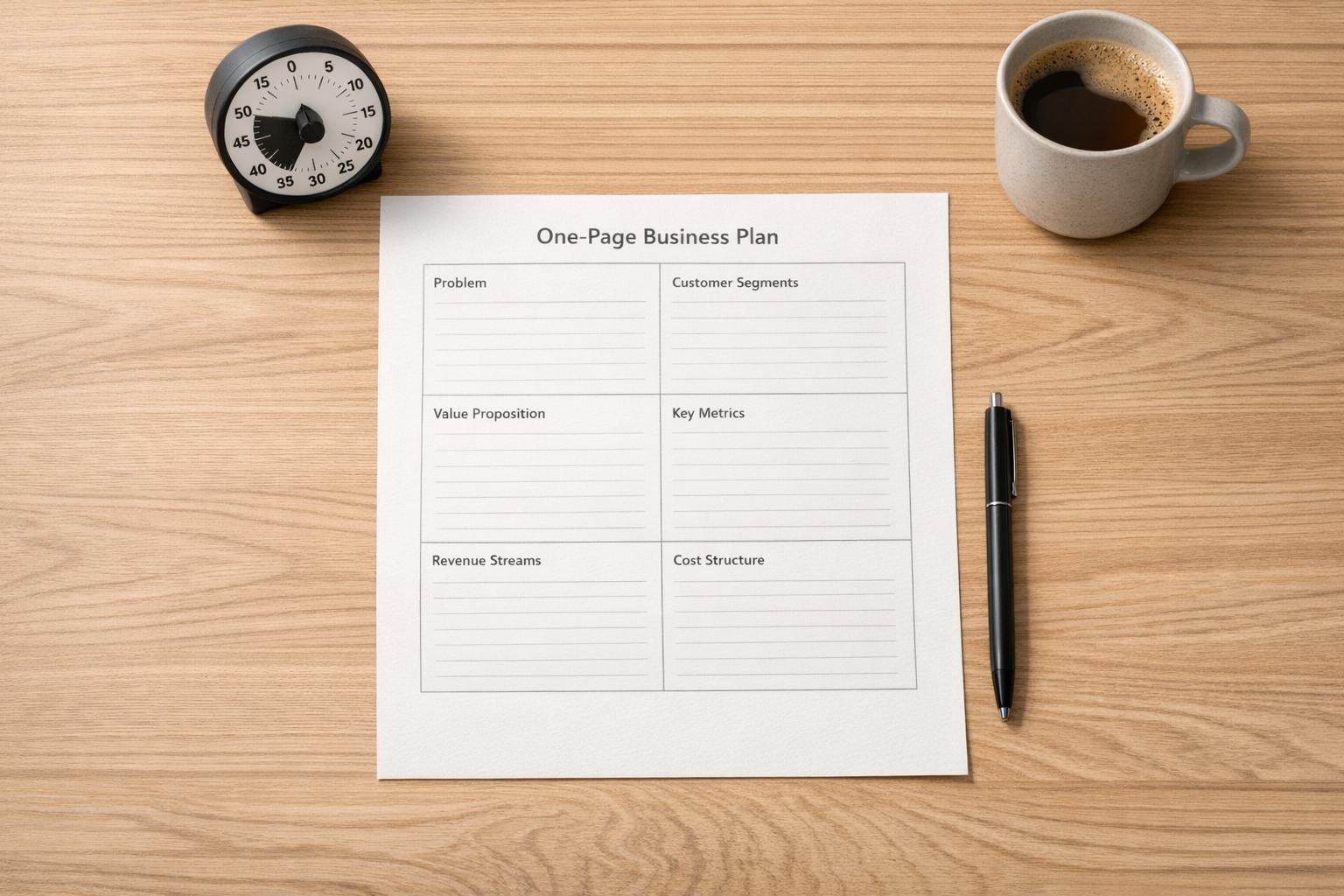
Creating a business plan doesn’t have to be overwhelming. In just 20 minutes, you can outline a concise, 1-page plan that covers the essentials:
- What you’re selling
- Who your customers are
- How you’ll make money
- What gives you an edge over competitors
This approach, based on the Lean Canvas model, focuses on simplicity and action. By zeroing in on nine key sections - like problem, solution, customer segments, and revenue streams - you can quickly test your business idea without wasting time. Research shows businesses that plan and track grow 30% faster, and 78% of startups using this method generate revenue within 90 days.
Here’s the process:
- Outline the problem and target audience.
- Define your solution and unique value proposition.
- Detail your channels, revenue streams, and costs.
- Wrap up with key metrics and your competitive edge.
Use this framework as a starting point, then refine it as you learn from customers and the market. Tools like IdeaFloat can help validate your plan and create investor-ready documents.
The key is to act fast - set a timer for 20 minutes and get started now.
the 1-page business plan that made me $200K+ in 2024
sbb-itb-08dd11e
The 1-Page Business Plan Template
This template is based on the Lean Canvas model, a framework created by Ash Maurya specifically for startups and entrepreneurs. Unlike traditional, lengthy business plans filled with assumptions, this single-page approach zeroes in on nine key elements to help you systematically test and refine your idea. With over 1 million entrepreneurs worldwide using this model, it has become a popular tool for quickly validating business concepts.
The Lean Canvas model emphasizes problem-solution fit over guesswork. As Ash Maurya famously states:
Life's too short to build something nobody wants.
This approach tackles a major challenge in the startup world: 42% of startups fail because they create products or services that the market doesn’t need. By condensing your assumptions into a single page, you can test them rapidly and avoid wasting months on ideas that won’t work. Entrepreneurs using this method report that 78% of startups achieve revenue within 90 days, compared to the average of over 8 months.
Here’s a breakdown of the nine essential elements that make up this streamlined plan.
Template Structure and Components
The Lean Canvas template includes nine core sections, each designed to address a critical aspect of your business model. Problem focuses on the primary pain points your customers face - essentially, the reason your business exists. Solution highlights the core features of your product or service that directly address those issues. Customer Segments outlines your ideal audience, detailing demographics like age, income, location, and their specific challenges.
Your Unique Value Proposition is a concise statement that explains why your offering stands out and is worth choosing. Unfair Advantage identifies what sets you apart in a way that competitors can’t easily replicate, such as proprietary technology or specialized expertise. Channels lists your methods for reaching customers, whether through social media, SEO, or word-of-mouth referrals. Revenue Streams explains how your business generates income, including pricing models and the frequency of purchases. Cost Structure breaks down your major fixed and variable expenses, while Key Metrics pinpoints the specific data you’ll track to measure progress and success.
Here’s a quick look at how each section functions:
| Component | What It Does | Key Question |
|---|---|---|
| Problem | Validates market need | What are the top 3 problems your customers face? |
| Solution | Defines your MVP development | What's the smallest product that solves these problems? |
| Unique Value Proposition | States your core benefit | Why are you different and worth buying? |
| Customer Segments | Identifies your audience | Who are your ideal customers and early adopters? |
| Channels | Maps customer acquisition | How will you reach your audience? |
| Revenue Streams | Shows path to profit | How will you charge customers? |
| Cost Structure | Identifies expenses | What are your fixed and variable costs? |
| Key Metrics | Measures success | What numbers indicate business health? |
| Unfair Advantage | Protects from competition | What can't be easily copied? |
How to Download and Use the Template
This template is meant to be a living document, evolving as you gather more insights about your market. You can fill it out digitally or print it as a one-page PDF. Some entrepreneurs even use sticky notes or specialized digital tools to keep their plans flexible.
Keep each section brief - 1 to 2 sentences per section is ideal for clarity and focus. The goal isn’t to create a perfect plan but to outline your key assumptions so you can test them quickly. As Harry Alford, Co-founder of Humble Ventures, puts it:
The Lean Canvas is a framework so startups can spend more time building versus planning the business.
Start by completing the Problem and Customer Segments sections to establish a solid foundation. Then, move through the other sections, focusing on capturing the essentials rather than getting bogged down in unnecessary details. The entire process typically takes about 20 minutes.
How to Complete Your Business Plan in 20 Minutes
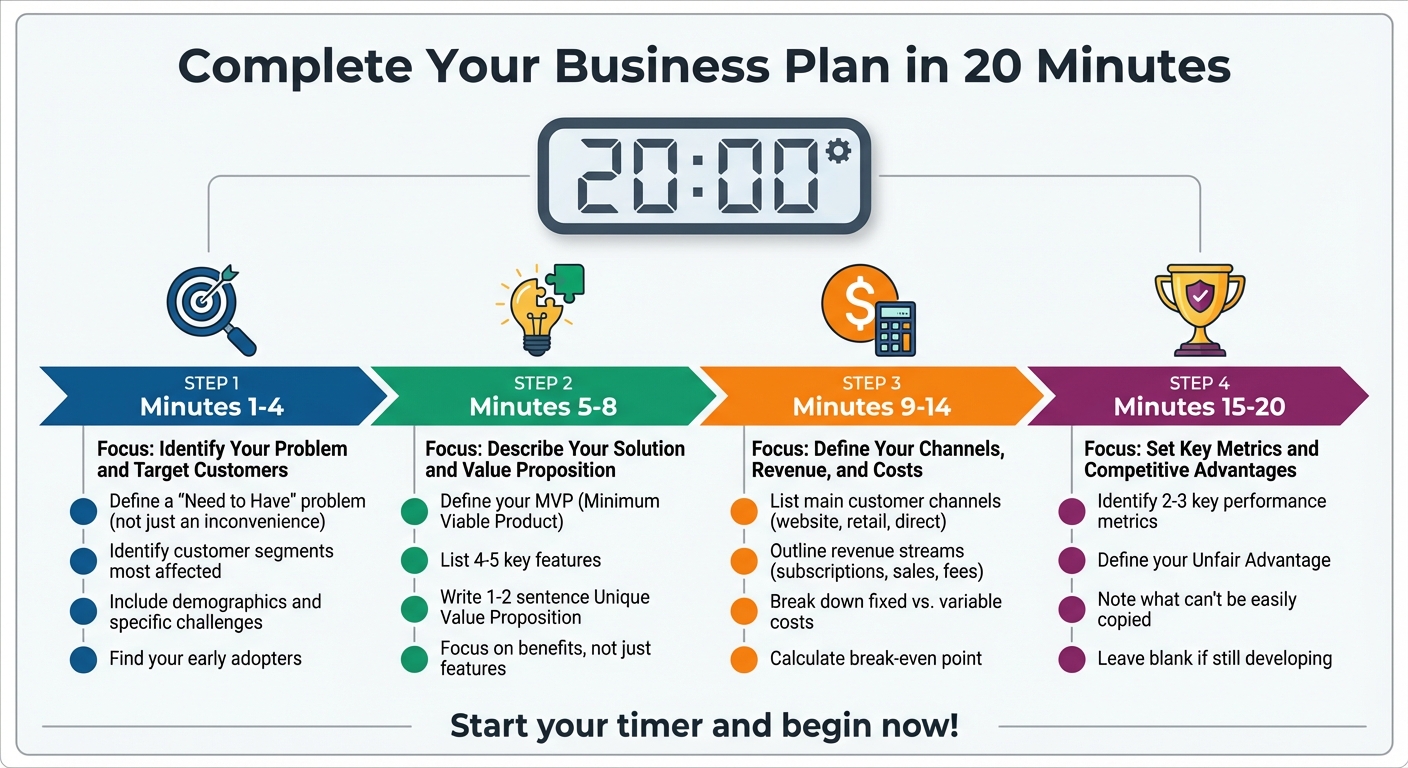
Complete Your 1-Page Business Plan in 20 Minutes: Step-by-Step Guide
Get your business plan done quickly by focusing on the essentials. Break the process into four timed sections, each targeting specific areas of the canvas. This approach helps you stay on track and make steady progress. Start by defining your problem and identifying your target customers.
Minutes 1-4: Identify Your Problem and Target Customers
Begin with the Problem and Customer Segments sections - these are the backbone of your plan. The key is to focus on a "Need to Have" problem, not just a minor inconvenience. Customers are only willing to pay for solutions to pressing, measurable issues, not small annoyances.
For example, consider a landscaping business. Instead of framing the problem as "saving time on yard work", a stronger problem statement could be "avoiding HOA conflicts and maintaining property value" - issues that homeowners feel more urgently.
In the Customer Segments section, identify the group most affected by the problem. Include details like demographics and specific challenges to pinpoint your early adopters - those who will be the first to invest in your solution.
Once you've outlined the problem and audience, move on to your solution and value proposition.
Minutes 5-8: Describe Your Solution and Value Proposition
In the Solution section, define your MVP (Minimum Viable Product) - the simplest version of your product or service that effectively solves the core problem. Focus on 4–5 key features that deliver the most value, avoiding unnecessary complexity that could overwhelm customers.
Your Unique Value Proposition (UVP) is a concise 1–2 sentence explanation of why customers should choose your solution over others. Highlight the benefits rather than just listing features. For example, Leonid, an enterprise software company, initially thought their value was "cost savings." However, customer research revealed their real strength was reducing "time and risk to get new services to market", which completely shifted how they positioned their product. As marketing expert Perry Marshall explains:
A USP is not merely a slogan - it is your company's DNA and reason for being. If you cannot summarize exactly what sets you apart in one or two sentences, you are not unique enough within your marketplace.
Take Perfect Lawns, a landscaping company, as an example. They differentiate themselves with weekly maintenance, photo updates, and a "curb appeal guarantee" that ensures lawns meet HOA standards. This specific promise directly addresses their customers' concern about property value.
Minutes 9-14: Define Your Channels, Revenue, and Costs
Next, tackle the Channels section by listing the main ways you'll reach customers. Whether it’s through your website, Amazon, retail locations, or direct outreach, focus on the strategies you'll implement in the first 90 days.
For Revenue Streams, outline how you’ll earn income - subscriptions, direct sales, hourly fees, or service contracts. For instance, in 2025, Perfect Lawns structured their revenue model around 50 clients with annual service contracts at $200 per month, generating $10,000 in monthly revenue.
In the Cost Structure section, break down your expenses. Separate fixed costs (like rent, salaries, and software) from variable costs (such as materials, marketing, and labor). Perfect Lawns, for example, detailed monthly expenses of $4,000 for labor, $1,000 for equipment, $500 for marketing, and $1,500 for insurance and overhead, totaling $7,000. This left them with a $3,000 monthly profit and a 60% gross margin. Calculating your break-even point is critical to ensure your business can sustain itself financially.
Minutes 15-20: Set Key Metrics and Competitive Advantages
Wrap up your plan with the Key Metrics and Unfair Advantage sections. Identify 2–3 metrics that best reflect your business's performance, such as monthly recurring revenue, customer acquisition cost, or conversion rate. These numbers should show whether your solution is solving the problem and generating revenue.
Your Unfair Advantage is what sets you apart and can’t be easily copied by competitors. This could be proprietary technology, specialized expertise, exclusive partnerships, or a strong network effect. If you don’t have one yet, note what you’re working on and leave the section blank for now.
How IdeaFloat Helps You Validate and Export Your Plan
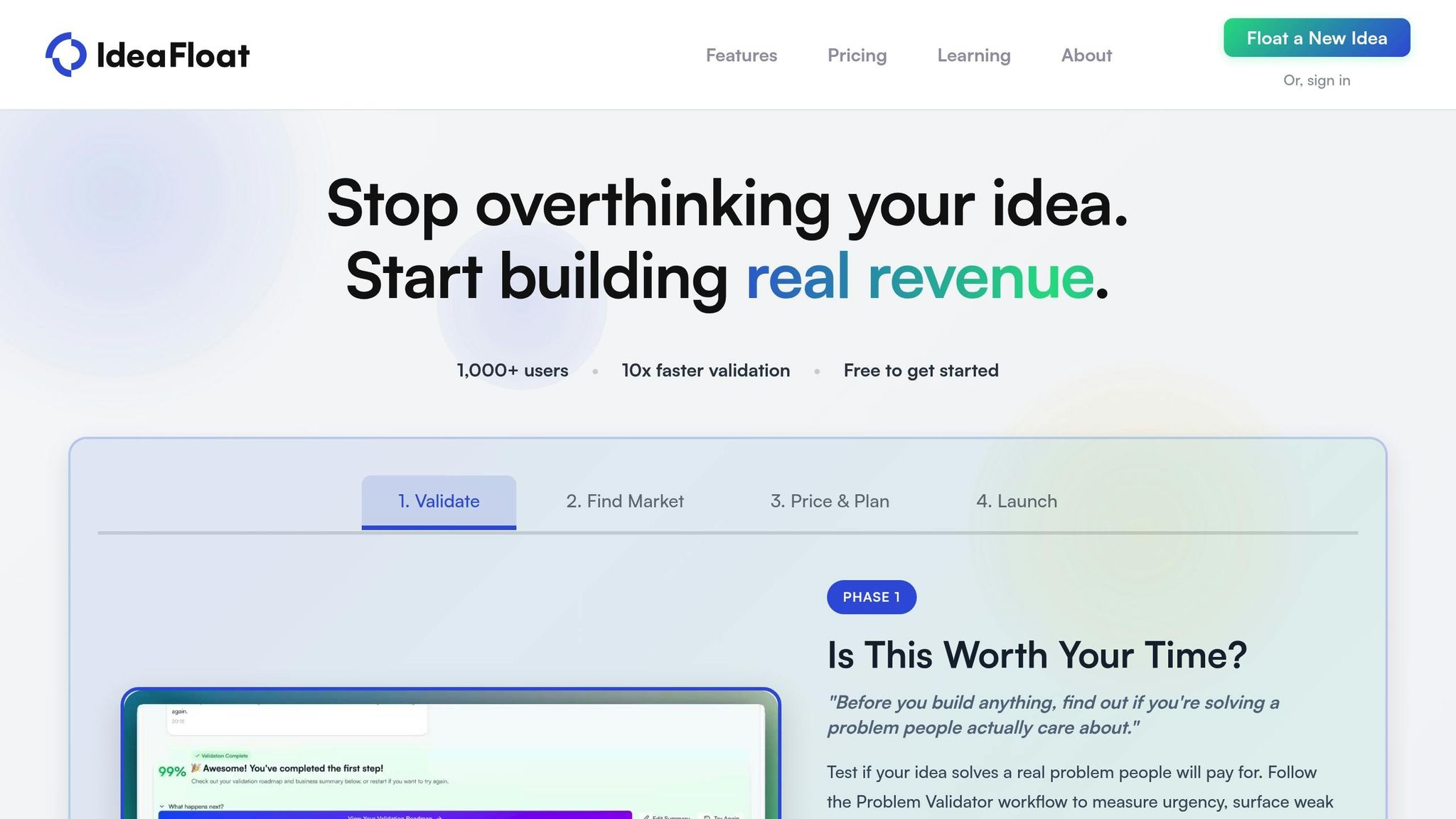
Once you've crafted your 1-page plan, IdeaFloat takes it to the next level. By incorporating market research, customer insights, and polished formatting, it transforms your initial draft into a document that's ready to impress investors.
Validate Your Plan with Data-Driven Insights
With IdeaFloat's Problem Validator, you can analyze market data and competitor insights using AI, giving you a clear success probability for your idea. This tool moves beyond guesswork by identifying urgency, spotting weak signals, and turning vague pain points into specific, actionable challenges. Instead of broadly stating that your service "saves time", the validator helps you zero in on pressing issues like "avoiding HOA fines" or "maintaining property value" - problems that customers are eager to solve.
The Consumer Insights feature dives into online communities to uncover real customer conversations, while Smart Market Sizing provides accurate estimates of your market potential. These tools work together to deliver actionable insights in just 15 minutes - up to 10 times faster than traditional research methods. Jennifer L., a SaaS founder, shared her experience:
IdeaFloat found 23 communities I never would've discovered. Got my first 50 signups in 2 weeks. Other tools just gave me a plan. IdeaFloat got me customers.
Once your idea is validated, you're ready to turn it into professional presentations.
Export Your Plan in Investor-Ready Formats
After validation, the Business Plan Generator lets you export your plan in formats designed to impress. You can download it as a PDF, Word document, or PowerPoint presentation. The platform also automatically generates a Lean Canvas based on your workspace. Need more? You can even create a Branding Guide that outlines your brand's voice, visuals, and messaging.
IdeaFloat goes beyond static plans. Tools like the Community Launch Map and Waitlist Landing Page help you connect with new customers and build momentum. Nick Sherwing, founder of woohoPets, highlighted its impact:
IdeaFloat saved us weeks of work by helping us explore demand for new products across different regions and took the guesswork out of finding gaps in the market.
Getting started is free, with paid plans available at $20/month for Standard and $40/month for Pro, offering access to advanced features.
Conclusion
You don’t need weeks to put together a business plan that works. A one-page template completed in just 20 minutes can cover everything you need - your problem, solution, target audience, and revenue model - without the unnecessary details that slow down traditional plans. Businesses that plan and track their progress grow 30% faster than those that don’t. The key is focusing on what truly matters.
But here’s the thing: the real value lies beyond just filling out the template. It’s in testing your assumptions before committing serious time and money. Talk to potential customers, run small experiments, and confirm that people are actually willing to pay for what you’re offering. Think of your one-page plan as a business GPS, helping you spot potential challenges before they derail your progress.
Platforms like IdeaFloat take this process even further by turning your quick plan into actionable insights powered by real data. From tools like the Problem Validator to creating investor-ready PDFs, IdeaFloat does the heavy lifting so you can focus on building your business. You can start for free, with paid plans available at $20/month for Standard and $40/month for Pro.
The difference between a simple idea and a thriving business is action. Download the template, set a timer for 20 minutes, and get your plan down on paper. Then, validate it, test it with real customers, and refine it based on what you learn. Your business doesn’t need to be perfect - it just needs forward momentum.
FAQs
How can I use the 1-page business plan to validate my idea quickly?
A 1-page business plan is a great way to quickly map out and evaluate your business idea. By zeroing in on the essentials - like the problem you're solving, your target audience, the solution you’re offering, and your business model - you can create a clear snapshot of your concept and its potential.
This format pushes you to determine if your idea solves a real problem and if there’s a market that would pay for it. It also prompts you to think about what sets your business apart, anticipate challenges, and sketch out basic financial estimates. This way, you can identify weak spots early on.
The beauty of this approach? It lets you gather feedback, tweak your plan, and decide if your idea is worth pursuing - all without sinking too much time or money into it upfront.
What are the main advantages of using the Lean Canvas model for startups?
The Lean Canvas model provides startups with a straightforward, one-page tool to map out their business idea. It highlights key components such as the value proposition, customer segments, revenue streams, and cost structure. Its streamlined design makes it perfect for sharing your vision with investors, team members, or other stakeholders - no lengthy business plans required.
What sets this model apart is its focus on quick iteration and validation. It encourages entrepreneurs to pinpoint potential challenges early on and adapt their strategies as they go. By prioritizing testing and refining assumptions, the Lean Canvas helps startups remain flexible and efficient, which is essential in fast-moving markets.
How does IdeaFloat make business planning easier?
IdeaFloat makes business planning quick and straightforward with its 1-page business plan template, designed to be completed in just 20 minutes. It zeroes in on the essentials - like identifying your problem, crafting a solution, understanding your target audience, and outlining financial projections. This approach helps you validate your idea fast without getting bogged down in lengthy paperwork.
By prioritizing simplicity and efficiency, IdeaFloat encourages entrepreneurs to think strategically and take immediate action. It’s a time-saver that keeps your focus on the core elements needed for success, making it an excellent fit for small businesses, startups, and side hustles.
Related Blog Posts
 Report an issue
Get the newest tips and tricks of starting your business!