
Starting an agency? Here’s what you need to know about costs:
- Team Costs: Payroll is your biggest expense - expect to allocate 40–50% of your budget here. Hiring a small leadership team can cost $26,250/month, and full-time employees cost 1.25–1.4× their salary when factoring in benefits and taxes. Freelancers can offer flexibility, with rates from $50–$200/hour.
- Tools and Software: Agencies spend $4,000–$15,000 upfront on tech, with monthly software costs between $150–$500 per user. Start small with free or basic tools and scale as revenue grows.
- Client Retainers: Retainers stabilize cash flow, with rates ranging from $2,500–$15,000/month per client. Use a 3× multiplier on costs to set profitable rates and aim for 60–70% delivery margins.
Key Tip: Plan for 12–18 months of runway to cover expenses during the initial growth phase. Most agencies take 8–17 months to break even.
Budget Breakdown:
- Lean Agencies: $45,000–$107,000/year
- Mid-Level Agencies: $150,000–$250,000/year
- High-End Agencies: $650,000–$1,050,000/year
To succeed, focus on hiring strategically, using cost-effective tools, and structuring retainers wisely. Keep cash flow steady with upfront client payments and quarterly reviews.
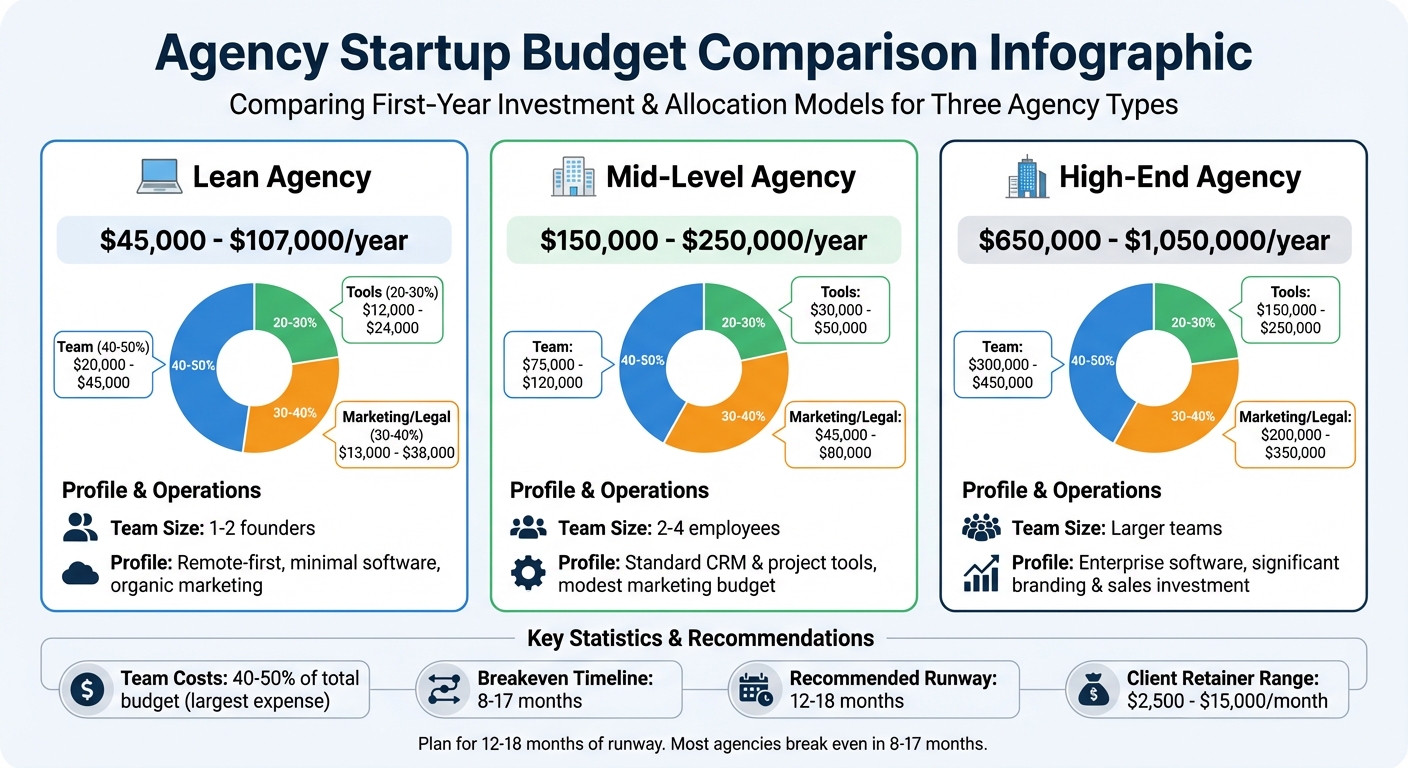
Agency Startup Budget Breakdown by Agency Type
Startup Cost and Financial Projections | SBEP Startup Class
sbb-itb-08dd11e
Team Building Costs
Building your agency team will likely be your biggest expense - typically accounting for 40–50% of your total annual budget. Hiring full-time employees involves more than just their base salary. When you add in benefits, taxes, equipment, and overhead, the total cost is about 1.25–1.4 times their salary. For example, a developer with a $100,000 salary actually costs your agency between $125,000 and $140,000 annually.
Core Roles and Salary Estimates
Most agencies start with a leadership-focused team, including roles like CEO or Creative Director, Lead Strategist, Senior Designer, Account Manager, and Sales Executive. Here’s a breakdown of typical salaries and freelance rates for these positions in the U.S.:
| Role | Annual Salary | Hourly Rate (Freelance) |
|---|---|---|
| Mid-Level Digital Marketer | $75,000–$150,000 | $75–$150 |
| Marketing Director | $180,000–$250,000 | $175–$300 |
| SEO Specialist / Account Manager | $50,000–$70,000 | $50–$100 |
| CEO / Creative Director | $100,000–$150,000+ | $300–$500+ |
| Senior Designer | $80,000–$120,000 | $85–$200 |
Recruiting talent is another expense to consider. It often costs 15–25% of the annual salary for the role. For instance, hiring a $150,000 Marketing Director could set you back as much as $37,500 just in recruitment fees.
Freelancing and Outsourcing Options
Freelancers can provide flexibility, especially if you're not ready for long-term commitments. Rates for specialists range from $50–$150 per hour, while top-tier developers or AI experts charge $75–$200 per hour. Project costs vary widely depending on who you hire:
- Freelancers: MVP builds cost $15,000–$50,000
- Offshore agencies: Expect $30,000–$75,000
- U.S.-based agencies: Budgets range from $75,000–$200,000
Geographic arbitrage is another way to save. Hiring talent from Eastern Europe can reduce costs by 30–50%, while teams in India or the Philippines can offer 60–70% savings compared to U.S. rates. However, managing freelancers from these regions often requires 20–30% more time to ensure quality and alignment with your strategy.
Starting with a Small Team
Instead of hiring a full team upfront, consider a phased approach tied to key milestones. Early-stage agencies often succeed with a "leadership-first" hybrid model: hire 1–2 core strategic roles in-house and rely on freelancers for execution. This approach is favored by 73% of companies as a competitive strategy.
AI tools are also reshaping how teams operate. AI coding assistants, for example, can boost developer productivity by 55%, enabling mid-level developers to deliver work comparable to senior-level talent. Tools like IdeaFloat can handle routine tasks like market research and documentation, freeing up your team to focus on high-impact client projects.
Another cost-saving option is fractional leadership. Hiring a Fractional CMO, for instance, gives you access to executive-level strategy at 20–30% of the cost of a full-time hire. Combining fractional leadership with AI tools allows you to streamline operations while keeping expenses manageable.
Tools and Software Expenses
After personnel, managing software expenses is a key step toward maintaining growth for your agency. On average, new agencies spend $4,000 to $15,000 upfront on technology, with monthly software costs ranging from $150 to $500 per user. Starting with free-tier tools and upgrading as revenue grows is a smart approach, especially since these expenses follow significant personnel investments.
Project Management and Collaboration Tools
Project management software is essential for keeping teams organized and clients informed. For example, Asana provides a free plan, with advanced options costing $24.99 per user monthly. Monday.com offers plans ranging from $10 to $25 per user monthly, while Trello’s options start free and go up to $17.50 per user per month for enterprise features. For resource management, Float costs between $7 and $12 per person monthly. Switching to Float saved Flight Story 2 hours daily and improved efficiency by 50%, compared to manual spreadsheet management.
Communication and collaboration tools like Slack and Miro also offer free tiers, with premium plans priced at $12.50 and $16 per user monthly, respectively. Miro, rated 4.7 out of 5 on G2 and Capterra, has become a favorite for visual planning. Japie Stoppelenburg, Founder of Truus, emphasized the importance of such tools:
"There was no way for us to do this company with this amount of clients... and deliver all this work without the system. There are so many projects happening at the same time that for a small agency like us, there is no way to handle that amount of little projects without having a visual planning tool."
Beyond managing projects, technology plays a growing role in strategic decision-making, especially with AI-powered tools.
AI-Powered Business Validation Tools
AI tools simplify tasks like research, validation, and financial modeling. IdeaFloat, for instance, helps agencies validate client ideas and analyze data, which is especially helpful during discovery phases that can cost $5,000 to $15,000 when done manually.
AI tools for SEO and content creation come with a price tag of $1,500 to $5,000 monthly, while customer engagement systems range from $2,000 to $8,000 monthly. However, the risks are high - unsuccessful AI projects can cost up to $400,000, and 95% of generative AI pilots fail to generate revenue.
In addition to collaboration and AI tools, managing client relationships effectively requires solid CRM and marketing platforms.
CRM and Marketing Platforms
A dependable CRM system is critical for tracking sales and nurturing client relationships. HubSpot offers a free plan, with paid options starting at $150+ per user monthly. Salesforce plans begin at $25 per user, and GoHighLevel provides broader services for $300 to $500 monthly. For eligible startups, HubSpot offers 90% discounts in the first year.
Marketing tools are another necessary expense. Email platforms like Mailchimp range from $20 to $300 monthly, depending on subscriber counts. SEO platforms like SEMrush and Ahrefs are priced between $200 and $500 per month. As Jay Kang from Swydo pointed out:
"software costs alone have become a significant factor. The tools you need to deliver good work cost significantly more than they did two years ago."
SaaS prices have risen by 11.4% year-over-year in 2026, far outpacing general inflation of 2.7%. To manage these rising costs, consider negotiating annual plans for 10–20% discounts and auditing subscriptions quarterly to cut out unused tools.
Retainer Pricing and Revenue Planning
Retainers are a smart way to create steady, predictable income for agencies. Unlike the ups and downs of one-off projects, retainer agreements provide consistent monthly revenue. This is a big deal, especially when 63% of agencies struggle with unpredictable cash flow and 97% face late payments. Retainers not only stabilize cash flow but also help reduce delays in payments, making them a reliable addition to your revenue strategy.
Think of retainers as an investment in your agency's growth - just like your investment in your team and tools.
Setting Up Retainer Structures
On average, agencies charge $2,500 to $15,000 per month per client, depending on the complexity of services and the size of the client. Many agencies also include a one-time setup fee, which is often equivalent to one month's retainer. For larger, more complex enterprise projects, onboarding fees can range from $50,000 to over $500,000, covering initial strategy, development, and custom work.
To price retainers effectively, use the industry-standard "3× multiplier." This means charging three times your team's cost to cover profit, overhead, and non-billable time. For example, if a team member's hourly cost (including overhead) is $50, your retainer rate should be at least $150 per hour. Jay Kang from Swydo explains:
"The 3× multiplier is the industry standard for mid-market agencies and covers profit, overhead, and non-billable time."
To avoid scope creep, set a fixed hourly cap - usually 20 to 40 hours per month - and charge 1.25 to 1.5× your base rate for overtime. Amanda Walls, Director at Cedarwood Digital, emphasizes the importance of tracking hours:
"We utilize time tracking software to ensure that the team doesn't go over hours... this is especially valuable for clients who spend a lot of time on communication and don't realize it's eating into their delivery budget."
This structured approach helps balance your team's workload while maintaining profitability.
Revenue Projections and Breakeven Points
Once your retainer model is in place, it's essential to map out revenue projections to hit financial goals. Start by calculating your breakeven point: divide total monthly fixed costs by your gross margin per client. For instance, if your fixed costs are $20,000 per month and your average gross margin per client is $4,000, you'll break even with 5 clients. Most agencies reach profitability with 3 to 10 retainer clients, depending on pricing and overhead.
Aim for a 60% to 70% delivery margin on direct costs to achieve a net profit margin of 25% to 35%. Specialist agencies often achieve higher margins (25% to 40%) compared to generalist agencies (15% to 20%). Keep an eye on your Effective Hourly Rate (EHR) by dividing total retainer revenue by actual hours worked. If the EHR dips too low, it's time to reevaluate rates or scope.
Trial retainers lasting 3 months can help prove your value to new clients before transitioning to 6- or 12-month agreements. Agencies offering three tiered pricing options see conversion rates above 60% twice as often as those that don't. Plus, increasing client retention by just 5% can boost profits by 25% to 95%.
Tiered Retainer Plans
Tiered retainers allow agencies to cater to different client needs while optimizing profitability. Here's how the most common tiers compare:
| Tier | Monthly Revenue | Client Volume (Target) | Typical Profit Margin | Best For |
|---|---|---|---|---|
| Basic | $2,500 – $5,000 | 8 – 10 Clients | 15% – 20% | SMBs needing simple, pre-defined services |
| Intermediate | $5,000 – $15,000 | 5 – 7 Clients | 20% – 30% | Mid-market clients with some customization |
| Enterprise | $15,000 – $100,000+ | 2 – 3 Clients | 30% – 40%+ | Large corporations needing high-touch services |
Basic retainers are ideal for small businesses that need straightforward services like social media management or local SEO. Intermediate retainers strike a balance, offering tiered packages with some customization for mid-market clients. Enterprise retainers, on the other hand, are tailored for large corporations and come with dedicated teams, custom strategies, and the highest margins.
To maintain financial health, ensure no single client accounts for more than 15–20% of your total revenue. Use automated invoicing tools with recurring billing to streamline payments. Conduct quarterly reviews to track KPIs, refine scope, and identify upsell opportunities. These upsells can increase account value by 20% to 40% annually.
Total Startup Budget Breakdown
Financial planning is crucial - 67% of SaaS startups fail, and 73% of those cite lack of funding as the main reason. By carefully allocating your budget, you can build a solid foundation and aim to achieve profitability within 18 to 24 months.
Budget Allocation by Category
For the first year, distribute your budget across key categories: team (40–50%), tools (20–30%), and marketing/legal (30–40%). Personnel costs often dominate, taking up 40–50% of the annual budget. These expenses include salaries, benefits, and payroll taxes, which rose from 13.8% to 15% in 2025.
Here’s a breakdown of budget allocations based on different agency models:
| Budget Category | Low Estimate (Lean/SaaS) | Mid Estimate (Web/Recruitment) | High Estimate (Creative/Full-Service) |
|---|---|---|---|
| Team (40–50%) | $20,000 - $45,000 | $75,000 - $120,000 | $300,000 - $450,000 |
| Tools (20–30%) | $12,000 - $24,000 | $30,000 - $50,000 | $150,000 - $250,000 |
| Marketing/Legal (30–40%) | $13,000 - $38,000 | $45,000 - $80,000 | $200,000 - $350,000 |
| Total First Year Budget | $45,000 - $107,000 | $150,000 - $250,000 | $650,000 - $1,050,000 |
To safeguard your business, include a working capital reserve and set aside 10–20% of your budget for unexpected costs like regulatory changes, client defaults, or emergency technology failures.
Cost-Saving Strategies for Growth
Once your budget framework is in place, focus on strategies to optimize spending and stretch your resources further.
- Hire Gradually: Add staff only as revenue milestones are met. This keeps cash flow steady.
- Leverage AI Tools: AI-powered solutions can reduce staffing needs. For example, developers using GitHub Copilot are 55% more productive. AI tools can also streamline content creation, SEO, and business validation, delaying the need for specialized hires. Platforms like IdeaFloat can help refine your agency’s positioning and pricing before making major investments.
- Lease Instead of Buying: Convert large capital expenses into manageable operational costs by leasing equipment and furniture.
- Negotiate Software Costs: Opt for annual payment plans to save around 15%, and start with free or basic tiers for software tools, upgrading only when necessary.
- Use Freelancers: For non-core tasks, hire freelancers or contractors instead of full-time employees. About 73% of companies now rely on flexible talent as part of their strategy. Test freelancers with small, paid projects ($1,000–$2,000) to ensure quality before committing to long-term contracts. Many agencies adopt a hybrid model: a small in-house team supported by specialized freelancers.
- Secure Upfront Payments: Require 50% deposits from clients to maintain cash flow.
These measures can help you balance growth with financial stability.
Budget Comparison Table
Your agency model significantly affects your budget. A lean, remote-first agency might launch for under $50,000, while a full-service creative agency could need over $1 million. The main differences lie in team size, office space, and the complexity of tools.
- Lean Agencies: Typically run by 1–2 founders, these agencies rely on minimal software and focus on organic marketing channels.
- Mid-Level Agencies: With 2–4 employees, they invest in standard tools like CRM and project management software, plus a modest marketing budget.
- High-End Agencies: Larger teams, enterprise software licenses, and significant spending on branding and outbound sales set these agencies apart.
Hidden costs can catch you off guard. For example, budget for CRM implementation ($10,000–$15,000), legal setup ($3,000–$8,000), and annual liability insurance ($1,500–$5,000). Don’t forget about payroll taxes and performance bonuses, which typically kick in 6–9 months after launch.
First-year revenue expectations vary widely, from $50,000 to $250,000, depending on pricing and how quickly you acquire clients. Planning for 18–24 months of expenses gives you the breathing room to validate your market and grow your customer base without the immediate pressure of turning a profit. With thoughtful budgeting and smart cost-saving measures, you’ll set your agency up for long-term success.
Conclusion
Success in running an agency boils down to three essential investments: building the right team, selecting tools that enhance productivity, and structuring retainers that ensure steady cash flow. Agencies that excel don’t just manage these elements - they fine-tune them from the outset. For instance, healthy agencies typically aim for gross margins of 50–70%, while AI-driven agencies can push those margins to 65–80% by automating 70% or more of service delivery tasks. This level of efficiency transforms profitability.
Specializing in a niche, backed by thorough market research, plays a key role in justifying premium pricing. Agencies offering generic services often struggle to charge more than $2,000 per month for retainers. However, niche-focused agencies can charge 20–50% more if they’ve validated demand beforehand. Tools like IdeaFloat simplify this process by helping you test market demand, refine your messaging, and build effective customer acquisition strategies - eliminating guesswork during launch.
Managing cash flow effectively is another cornerstone of agency success. Acquiring a new client costs 5–10 times more than retaining an existing one, which is why productized retainers are so impactful. By focusing on outcomes instead of hours, they protect margins and simplify service delivery. A solid approach is to set a $2,000–$3,000 monthly minimum, implement a three-tier pricing model, and collect 25–50% upfront to stabilize cash flow.
No matter the agency's size, the core principles remain consistent: hire at a measured pace, use AI to delay the need for specialized hires, and avoid scope creep. Agencies that validate their niche quickly, automate intelligently, and deliver value far exceeding their fees are the ones poised to thrive in today’s competitive environment. By focusing on these strategies, agencies can streamline operations, protect margins, and achieve lasting growth.
FAQs
How much runway do I really need to start an agency?
The runway your business requires hinges on factors like your budget, monthly expenses, and growth strategy. Many startups target 12–18 months of runway to establish a solid foundation and work toward scaling. For instance, if you have $500,000 in reserves and a monthly burn rate of $35,000, that gives you roughly 14 months of runway. Major expenses typically include hiring, software tools, and client retainers. To maintain financial health, it's crucial to plan these costs thoughtfully.
When should I hire full-time vs use freelancers?
When you need help with short-term, specialized, or project-based tasks, freelancers are often the best choice. They’re perfect for situations where flexibility and cost-effectiveness are priorities. Plus, freelancers can be onboarded quickly and bring in temporary expertise without long-term commitments.
On the other hand, full-time employees are better suited for roles that are ongoing, strategic, or central to your business. These positions often require consistency, deep institutional knowledge, and alignment with your company’s values and goals. While hiring full-time staff can be more expensive, they provide greater stability and give you more control over operations.
Many businesses find success using a hybrid model, combining freelancers for flexibility and specialized tasks with full-time employees to manage core functions. This approach allows companies to adapt to changing needs while maintaining a solid foundation.
How do I prevent scope creep on a retainer?
To keep scope creep in check, start by setting clear boundaries and expectations in the retainer agreement. Be specific about the scope of work - list the services and deliverables included upfront. Using time tracking tools can help you monitor progress and ensure that tasks stay within the agreed-upon scope. Stay in touch with clients regularly to review the work and address any potential changes. If additional work arises, handle it through a formal approval process to maintain clarity and protect your profit margins.
Related Blog Posts
 Report an issue
Get the newest tips and tricks of starting your business!