Managing Airbnb properties in Australia without owning them is a smart way to earn income without heavy upfront costs. Strategies like rental arbitrage, co-hosting, and master leasing let you profit from short-term rentals by leveraging existing properties. Here’s a quick breakdown:
- Rental Arbitrage: Lease a property long-term, rent it short-term, and earn from the price difference. Example: Properties in the Whitsunday Islands can generate 738% more income compared to traditional leases.
- Co-Hosting: Manage someone else’s Airbnb listing and earn 10%–30% of booking revenue. No upfront costs, but income depends on bookings.
- Master Leasing: Manage multiple units under fixed agreements for higher control and profit, though it requires more capital and carries higher risk.
Key Points:
- High-demand areas like Sydney, Perth, and Brisbane have occupancy rates over 70%. Top hosts earn upwards of $7,200/month in Sydney.
- Regulations vary by state. NSW, WA, and VIC have specific caps, levies, and registration rules. Always secure landlord approval and comply with local laws.
- Tools like property management software and dynamic pricing systems can streamline operations and boost revenue.
This guide walks you through earning potential, legal requirements, and operational tips to build a thriving Airbnb management business without owning property.
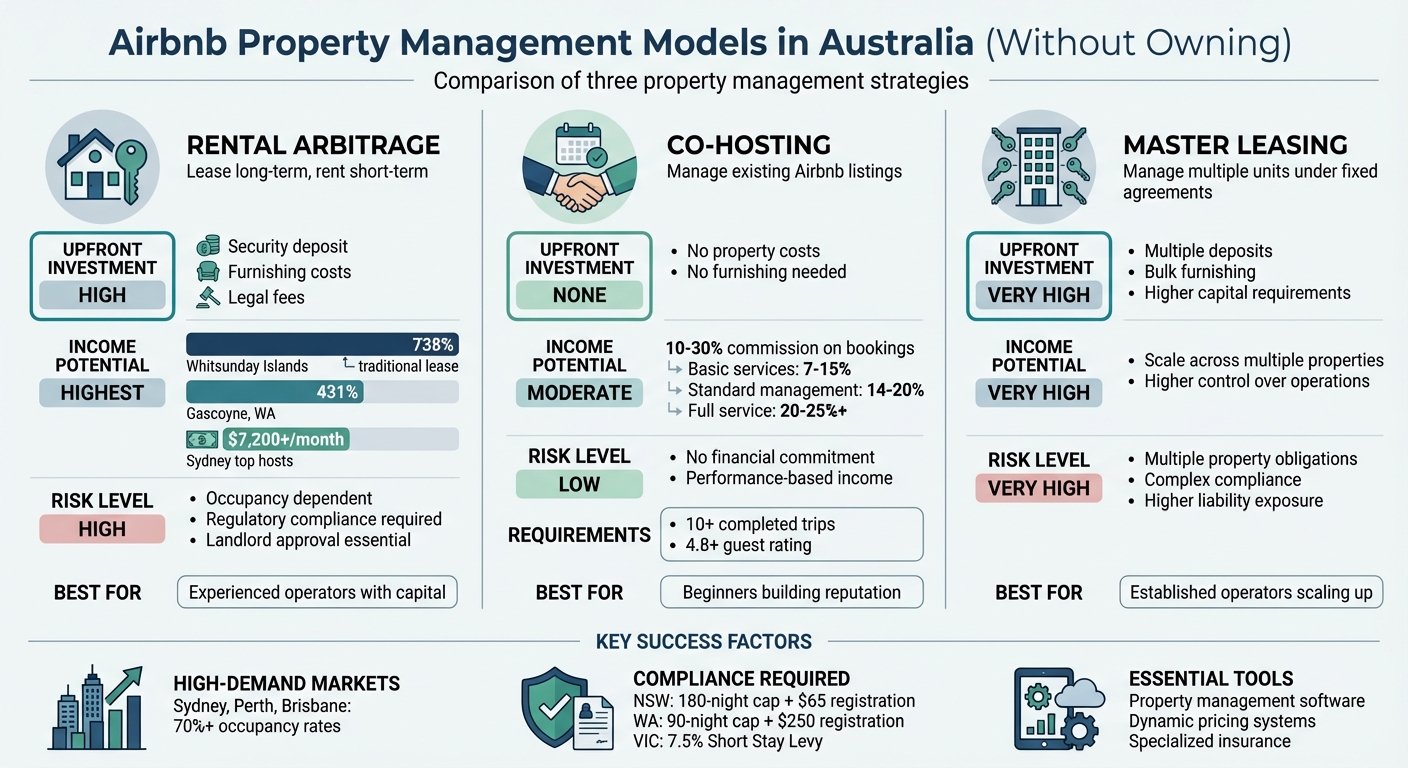
Airbnb Property Management Models Comparison: Rental Arbitrage vs Co-Hosting vs Master Leasing
How To Make $10k/mo Airbnb Co-Hosting (WITHOUT Renting or Owning!)
sbb-itb-08dd11e
Rental Arbitrage in Australia
Rental arbitrage is all about leasing a property and profiting from the difference between short-term rental income and fixed costs. The trick lies in identifying areas where short-term rental income significantly outpaces long-term rental costs - often referred to as the "rent gap."
Australia stands out for its high rent gaps. Take the Whitsunday Islands, for instance: a 2-bedroom property that might bring in $24,620 annually as a long-term rental can generate an estimated $206,560 through short-term bookings - a staggering 738% difference. Similarly, in Gascoyne, Western Australia, short-term rental income averages $82,860 annually, compared to $15,600 from long-term leasing, reflecting a 431% gap.
Navigating Australian Regulations
Rental rules in Australia differ by state. In New South Wales (NSW), hosts must register with the STRA register, which costs $65 initially and $25 annually, and there’s a 180-night limit in Greater Sydney. Western Australia requires state-wide registration, with a 90-night cap in Perth. Victoria applies a 7.5% Short Stay Levy on bookings shorter than 28 nights.
"Property Managers of short-term rentals (usually less than 60 days) are now also required to be licensed in some States, particularly if they do not own the properties."
– Vanessa Emilio, Founder and CEO, Legal123.com.au
Key Factors for Success
To succeed in rental arbitrage, focus on three main areas: securing landlord approval, furnishing the property to attract guests, and calculating profit margins accurately. Always account for both regulatory requirements and operational costs when estimating profits.
Getting Landlord Approval and Setting Up Lease Agreements
Australian leases often prohibit subletting without written permission. Before approaching a landlord, confirm that local council zoning and strata by-laws allow short-term rentals for the property. Some apartment buildings have strict body corporate rules banning holiday rentals, even with landlord approval.
When proposing your business model to landlords, transparency is critical. Highlight benefits like guaranteed monthly rent, professional cleaning after every guest, and potentially better property upkeep compared to traditional tenants. Address liability concerns by explaining that specialized Holiday Rental Property Insurance covers short-term rental activities, unlike standard landlord insurance.
A lease addendum is essential. This document should explicitly permit short-term subletting and outline responsibilities, liability limits, dispute resolution processes, and termination conditions. Offering a 24/7 emergency contact can also reassure landlords, as it shows you're prepared to handle guest or neighbor issues promptly. In some cases, offering slightly higher rent or a revenue-sharing arrangement might help seal the deal.
For properties in NSW, ensure compliance with fire safety standards, such as interconnected smoke alarms (AS 3786), and secure liability insurance that covers third-party injuries or deaths.
Furnishing and Creating Listings That Convert
Furnishing is one of your biggest upfront costs. Focus on durable essentials like beds, linens, and kitchenware that meet guest expectations. Australian travelers value high-speed Wi-Fi, access to streaming services, and fully equipped kitchens.
Choose sturdy furniture that can withstand frequent use but still looks appealing in photos. Neutral color schemes work well for a broad audience, but adding subtle local touches - like coastal decor for beach properties or city-inspired art for urban rentals - can make your listing stand out. Items like quality mattresses and blackout curtains not only improve guest reviews but can also justify slightly higher nightly rates.
When creating your listing, invest in professional photos that highlight natural light and include wide-angle shots. Be specific about the location, mentioning nearby attractions like beaches, restaurants, or public transit. Listings that clearly communicate these details tend to attract more bookings and improve occupancy rates.
Start with competitive pricing to build up positive reviews, then gradually adjust your rates. Use seasonal pricing strategies to capitalize on peak travel periods, such as summer (December–February), Easter, and school holidays. Listing on multiple platforms like Vrbo and Booking.com can also help maximize occupancy.
Calculating Profit Margins and Costs
Accurate financial planning is essential for rental arbitrage. Start by calculating all initial expenses, including application fees, security deposits, legal fees for lease agreements, and furnishing costs. Spread these over the expected duration of your business to estimate monthly costs.
Fixed monthly expenses include rent, internet, insurance, and subscriptions. Variable costs - such as utilities, cleaning services, restocking supplies, and occasional repairs - depend on occupancy. Airbnb charges a 3% host fee per booking, which also needs to be factored in.
Regulatory costs, like Victoria's 7.5% Short Stay Levy or the ACT's 5% STRA levy, directly affect your profits. Don’t overlook income tax on profits or potential GST obligations if the property is classified as commercial-residential.
Plan conservatively with a 70–80% occupancy rate to cover fixed expenses. Calculate your break-even occupancy rate - the minimum percentage of nights booked required to cover all costs. If this rate exceeds 75%, the property may be too risky for rental arbitrage.
Here’s an example:
- Monthly rent: $2,000
- Utilities: $300
- Cleaning: $1,200 (15 bookings at $80 each)
- Other costs: $500
- Total expenses: $4,000
With an average nightly rate of $180 and a 70% occupancy rate (21 nights booked), gross monthly revenue would be $3,780 - leaving a shortfall even before platform fees and levies. Adjusting rates or improving occupancy would be necessary to achieve profitability.
Once you've nailed down these calculations, you can explore co-hosting opportunities in the next section.
Co-Hosting for Property Owners
Co-hosting offers a way to earn income by managing existing Airbnb listings without the upfront costs tied to rental arbitrage. Typically, co-hosts earn a commission of 10%–30% of booking revenue, avoiding expenses like furnishing or leasing properties.
Your responsibilities as a co-host will vary based on your agreement with the property owner. Common tasks include managing guest communication, optimizing listings, coordinating cleaning, and setting dynamic pricing. Some owners may want full-service management, including property inspections and maintenance scheduling, while others may only need help with messaging and calendar updates. Generally, the more responsibilities you take on, the higher your commission rate.
"For me, you really need to be available. Some guests' questions can't wait, and you never know when they're going to drop!"
– Laura Fernandes, Experienced Airbnb Co-Host
To join Airbnb's official Co-Host Network in Australia, you’ll need at least 10 completed trips and a guest rating of 4.8 or higher. This network connects you with property owners looking for local support, making it easier to find clients without relying on cold outreach.
To protect your interests, create a co-hosting agreement that outlines your commission structure, expense reimbursements, and termination terms. Make sure commissions are calculated on net revenue (after Airbnb's 3% host fee) to avoid losing earnings to platform fees. Airbnb’s automated payout splitting feature simplifies the process, ensuring you’re paid directly after each guest checks in.
Finding Property Owners to Work With
The Airbnb Co-Host Network is a straightforward way to connect with property owners in Australia. Through this platform, you can browse listings, review property details, and pitch your services - especially if you have a strong hosting record with positive reviews.
Offline networking can also be effective. Build relationships with local contractors, cleaners, and handymen who regularly work with rental property owners. These professionals often hear about owners struggling with guest communication or maintenance. Offer a referral fee to encourage them to connect you with potential clients.
Your personal network is another great starting point. Friends, family, or colleagues who own or are considering investment properties may be hesitant to list on Airbnb due to the perceived effort involved. Position yourself as the solution by showing how you can handle everything from setup to guest reviews.
When pitching your services, focus on key benefits like fast response times, professional cleaning coordination, and revenue optimization through dynamic pricing. Owners value peace of mind and income maximization. Offering 24/7 guest support and thorough pre- and post-stay inspections can make your services stand out.
Services and Commission Rates
Once you’ve identified potential clients, it’s essential to define the scope of your services and your fees. Most co-hosting services fall into three categories:
- Basic Co-hosting (7%–15%): Covers guest communication, calendar management, and listing optimization.
- Standard Management (14%–20%): Includes basic tasks plus occupancy strategies and performance reporting.
- Full End-to-End Management (20%–25%+): Adds cleaning coordination, maintenance scheduling, and property inspections to the mix.
In Australia, co-hosts typically charge between 10% and 25% for standard services. If you provide comprehensive management, including everything from listing setup to guest messaging and maintenance, you can justify rates closer to 25%–30%. Some co-hosts also offer fixed fees or hourly rates for specific tasks like property setup, but commission-based models tend to align your earnings with the owner’s revenue.
| Service Level | Commission Rate | Key Responsibilities |
|---|---|---|
| Basic Co-hosting | 7%–15% | Guest communication, calendar management, listing optimization |
| Standard Management | 14%–20% | Basic tasks plus occupancy strategies and performance reporting |
| Full End-to-End | 20%–25%+ | All the above plus cleaning/linen coordination and inspections |
Be clear about who handles tasks like cleaning, restocking, and maintenance. Airbnb’s Resolution Center can help maintain transparency. Also, agree on response time expectations upfront - owners will expect prompt replies to guest inquiries, not next-day responses.
Airbnb’s permission settings let you customize access levels based on your responsibilities. Options include Full access (manage everything), Calendar and messaging access (handle guest communication and availability), or Calendar-only access (view bookings without messaging). Align the access level with your agreed duties to avoid confusion.
Growing from One Property to Multiple Listings
To expand your co-hosting business, focus on maintaining a 4.8+ guest rating and maximizing occupancy with dynamic pricing and fast response times. Positive reviews from both guests and property owners will be your most effective marketing tool. By consistently delivering excellent service, you can grow from managing a single property to overseeing multiple listings.
Ask happy property owners for referrals. Many property investors know other landlords who could benefit from co-hosting services. Offering a referral incentive, like a discounted commission for the first month, can encourage owners to recommend you.
As your portfolio grows, automation becomes essential. Use property management software to streamline guest messaging, automate check-in instructions, and sync calendars across platforms. Smart locks can simplify key exchanges, giving guests more flexibility with arrivals. You can also create digital guidebooks with local tips to enhance guest experiences without adding to your workload.
Managing multiple properties may require building a team. Hire reliable cleaners and maintenance staff, and use standardized checklists to maintain quality. Once you manage five or more listings, consider hiring a virtual assistant to handle routine guest inquiries, freeing you to focus on client relationships and business growth.
Australian Legal and Regulatory Requirements
Managing Airbnb properties in Australia without owning them means navigating a maze of state and local regulations. There’s no unified national framework - each state has its own approach to short-term rental rules. For instance, New South Wales (NSW) and Western Australia (WA) require mandatory property registration, while Victoria (VIC) and the Australian Capital Territory (ACT) impose booking levies instead of maintaining statewide registers. In other states like Queensland, Tasmania, South Australia, and the Northern Territory, regulations fall under the jurisdiction of local councils.
If you're using rental arbitrage, securing written consent from the landlord is non-negotiable. Courts have ruled that short-term stays are legally considered sub-leases, not just guest arrangements. Take the Victoria Supreme Court case of Swan v Uecker, where a lease was terminated after a tenant sublet their apartment on Airbnb without permission. Unauthorized subletting can lead to eviction and legal consequences.
Co-hosting comes with its own set of challenges. In some states, property managers who collect rent or handle bookings for properties they don’t own must hold a real estate or property management license. In NSW, co-hosts and property managers are also held accountable under the mandatory Code of Conduct for guest behavior. This means you could face penalties for issues like guest misconduct, even if you don’t own the property.
Strata by-laws can present another hurdle. In states like NSW and VIC, owners corporations can ban short-term rentals in apartment buildings if 75% of the owners vote in favor. This applies regardless of your lease terms or landlord approval. Before committing to a property, it’s crucial to review the building’s by-laws.
Failing to comply with regulations can be costly. In WA, operating without proper registration can result in fines of up to $20,000, while in NSW, penalties can reach $11,000, along with a potential five-year ban from hosting platforms. Staying compliant is not just a legal obligation - it’s essential for keeping your business running smoothly.
State-Specific Rules and Restrictions
NSW has a statewide Short-Term Rental Accommodation (STRA) Register. For unhosted properties, Greater Sydney enforces a 180-day annual cap, while Byron Shire limits stays to 60 days per year. Bookings of 21 consecutive days or more are exempt from the cap. Registration costs $65 for the first year and $25 annually thereafter, with fines of $1,100 for failing to register.
In WA, registration for short-term rentals becomes mandatory starting January 1, 2025. Unhosted properties in the Perth metro area are capped at 90 nights annually unless you secure development approval, which costs between $500 and $2,000. Registration fees are $250 initially, with a $100 annual renewal fee. Missing the 28-day renewal grace period adds another $250 penalty.
VIC introduced a 7.5% levy on short stays under 28 days, effective January 1, 2025. Unlike NSW and WA, VIC doesn’t require statewide registration, but local councils manage short-term rental rules. Owners corporations can ban short-term rentals with a 75% majority vote, though this doesn’t apply to hosts renting out their primary residence.
In the ACT, a 5% levy on short-term rentals began on July 1, 2025. This levy applies to the total guest payment, including cleaning and platform fees. Meanwhile, in Queensland, Tasmania, South Australia, and the Northern Territory, local councils regulate short-term rental rules, so it’s essential to check specific zoning and planning requirements for each property.
| State | Registration Requirement | Night Cap (Unhosted) | Levies/Taxes |
|---|---|---|---|
| NSW | Mandatory (Statewide) | 180 days (Greater Sydney); 60 days (Byron Shire) | - |
| VIC | Local Council Level | Varies by Council | 7.5% Short-Stay Levy |
| WA | Mandatory (Statewide) | 90 days (Perth Metro) without DA | - |
| ACT | Not applicable | - | 5% STRA Levy |
| QLD | Local Council Level | Varies by Council | - |
Permits, Registration, and Insurance
In NSW and WA, you must register a property before listing it on any platform. This involves submitting property details and proof of ownership or lease agreements. Once registered, your unique property ID must be displayed in all online listings.
Standard home or landlord insurance often doesn’t cover short-term rental activities, so you’ll need specialized short-term rental insurance. This should include coverage for public liability, property damage, and loss of income. In NSW, the Code of Conduct mandates that hosts carry insurance for third-party injuries and death during guest stays.
"The host must hold insurance that covers their liability for third-party injuries and death on the premises and it must be valid for the occupancy period." – NSW Government
Nationwide, fire safety compliance is a must. Properties must adhere to the National Construction Code (AS 3786) for smoke alarm installation and interconnection. NSW and WA have additional fire safety requirements, like emergency evacuation maps and interconnected smoke alarms. In WA, where bushfire risks are high, specific emergency plans are also required.
If you plan to exceed day limits, development approval is necessary. In WA, this applies to properties in the Perth area operating more than 90 nights annually. In NSW, properties in Greater Sydney exceeding the 180-day cap must apply through the Planning Portal, with fees ranging from $500 to $2,000. Processing times can vary, so plan ahead.
Strata by-laws can override landlord consent and registration. Owners corporations in NSW and VIC have the authority to ban short-term rentals outright. Always review recent by-law amendments and meeting minutes before taking on a property to avoid unexpected restrictions.
Tenancy Laws and Subletting Rules
Short-term rental stays are legally treated as subleases, not temporary guest arrangements. Unauthorized subletting violates your lease and can lead to eviction.
Your lease agreement must explicitly allow short-term subletting. A general clause like "subletting allowed with consent" isn’t sufficient. The agreement should specify details like the maximum number of nights, guest limits, and any usage restrictions. Without these terms in writing, you risk legal action and losing your security deposit.
Co-hosts face additional licensing requirements. If you’re managing bookings or collecting rent for properties you don’t own, you’ll need a real estate or property management license in many states. Failure to comply can result in fines or legal repercussions.
In NSW, the mandatory Code of Conduct holds both hosts and co-hosts accountable for guest behavior, including noise complaints and property damage. Hosts and managers must also be reachable for neighborhood complaints between 8:00 AM and 5:00 PM and available 24/7 for emergencies.
Tools and Methods for Managing Operations
Managing multiple Airbnb properties without owning them involves juggling guest communication, cleaning schedules, pricing strategies, and compliance requirements. The right tools can simplify these tasks, giving you more time to focus on growing your business.
Property Management Software (PMS)
A Property Management Software (PMS) is essential for streamlining operations. Platforms like Hostaway help manage multiple channels, automate guest communication, and generate financial reports. If you're budget-conscious, Property Pilot offers features like automated messaging and revenue optimization for just $15 per month per property. For co-hosts handling funds for property owners, Rental Fox stands out with trust accounting tools and an owners' portal.
"Rental Fox has simplified our business. With the team at Rental Fox taking care of the bulk of our daily tasks, we have much more time to focus on the stuff that's key to our future growth."
– Shannon O'Connell, Away Stay Play
When selecting a PMS, look for API-based syncing to ensure real-time updates across platforms. This feature prevents double bookings and ensures compliance by automatically syncing NSW STRA registration IDs and monitoring night caps. Most PMS software costs between $30 and $80 per property per month, covering essential features like pricing tools and automated messaging.
Dynamic Pricing Tools
Dynamic pricing tools automatically adjust rates based on factors like location, amenities, booking history, and demand. These tools can boost revenue by 15% to 30%. For example, Property Pilot users have reported revenue increases of up to 23% through automation. To maximize profits, set rate floors for high-demand periods, such as Australia’s summer months (January and February). Regional variations also matter - November is often the peak month for Perth properties.
Performance Tracking
Tracking performance metrics is key to staying profitable. Use professional dashboards to monitor real-time data like occupancy rates, search conversions, and average nightly revenue. In major Australian markets, well-run 1–3 bedroom homes typically achieve occupancy rates between 59% and 75%. If your numbers fall short, it might be time to tweak your pricing strategy or improve your listing’s appeal.
Property Management Software and Automation
Automation takes care of repetitive tasks, freeing you to focus on growth. For instance, guest messaging systems can send check-in instructions, house rules, and checkout reminders automatically. When a booking is made, the system notifies your cleaning team, updates calendars across platforms, and sends a welcome message to the guest - all within minutes.
Multi-channel distribution is another way to boost occupancy. Listing your properties on platforms like Airbnb, Vrbo, and Booking.com increases exposure, but only if your software ensures real-time calendar syncing. Look for PMS options with "Airbnb Preferred" or "Preferred Plus" status for reliable syncing.
For co-hosts managing properties for others, trust accounting features are a must. Your PMS should integrate with tools like Xero to generate audit-ready reports, ensuring transparency and legal compliance. Additionally, noise monitoring integration is becoming more relevant, especially in areas like Queensland where councils may require noise sensors. Integrating this data into your PMS can help address issues proactively and even protect your property insurance.
Before committing to any software, take advantage of free trials (usually 14–30 days) to ensure the platform meets your needs. Verify that features like messaging, tax calculations, and payouts work seamlessly. For Australian managers, AEST-based customer support is crucial for handling urgent issues.
| Feature | Channel Manager | Property Management System (PMS) | Full-Service Manager |
|---|---|---|---|
| Best For | Hands-on hosts with 1 property | Managers with 3–10 properties | Portfolios of 10+ properties |
| Core Function | Syncs calendars and rates | Operations (cleaning, accounting) | End-to-end management |
| Compliance | Manual STRA ID entry | Automated compliance tracking | Full regulatory management |
| Cost | Low (software fees) | Moderate ($30–$80/property) | High (15–25% of revenue) |
Dynamic Pricing and Performance Tracking
To protect your profits during high-demand periods, set rate floors for key dates like New Year’s Eve, Australia Day, or local events. Use rule-sets to enforce minimum stays (typically 3–5 nights) during peak months like January and February.
Track these key metrics weekly:
- Occupancy rate: Aim for 59%–75%, which is standard in major Australian markets.
- Average daily rate (ADR): Monitor how pricing adjustments affect this figure.
- Search conversion: Check how often your listing appears on the first page of search results.
- Revenue per available night (RevPAN): Combine occupancy and pricing data to measure earning potential.
Optimized strategies can lead to a 5% occupancy increase, translating to an extra $400–$500 in monthly revenue for properties with daily rates of $250–$350.
Testing Your Business Idea with IdeaFloat

To validate your Airbnb management business, IdeaFloat offers tools to test demand, analyze competition, and build a financial model.
Start with the Problem Validator to confirm that property owners in your area need management services. Then, use Consumer Insights to explore online discussions about short-term rental management. This research helps you understand how property owners describe their needs, which can guide your marketing.
The Competitor Analysis tool maps out local management services, revealing potential gaps in the market. For instance, you might discover an oversupply of luxury management services but a lack of options for mid-range properties.
Smart Market Sizing quantifies your opportunity by outlining your total addressable market (TAM), serviceable available market (SAM), and serviceable obtainable market (SOM). For example, Brisbane's experience economy is expected to grow significantly ahead of the 2032 Olympics, creating new opportunities.
Finally, the Financial Model tool calculates your profitability based on expected costs like software subscriptions, cleaning, and insurance. You can also use Advanced Pricing Research to refine your pricing strategy and maximize margins.
Once your business model is validated, the Go-to-Market Strategy tool helps you launch. It identifies where property owners are active, estimates customer acquisition costs, and provides outreach scripts. The Community Launch Map even suggests specific forums and communities to engage with potential clients effectively.
Conclusion
Managing Airbnb properties without owning them can be a lucrative venture, especially when you tap into the potential of rental arbitrage and co-hosting. Rental arbitrage benefits from the gap between rental costs and Airbnb income, while co-hosting offers a low-risk way to earn commissions - typically ranging from 10% to 30% - as you build your reputation and experience. Many operators start with co-hosting to prove their ability to deliver excellent guest experiences before scaling into rental arbitrage for higher earnings.
Staying on the right side of the law is non-negotiable. For example, in New South Wales, you must register with the state's STRA system and comply with the 180-night cap for unhosted properties. In Western Australia, unhosted rentals in Perth are capped at 90 nights unless you obtain development approval. Additionally, always secure written consent from landlords before subletting, use formal contracts to outline responsibilities, and invest in holiday rental insurance since standard home policies often don’t cover short-term rental activities. Once these legal steps are in place, you can focus on optimizing your operations.
Technology plays a huge role in streamlining property management. Tools like property management software automate guest communication, sync calendars across platforms, and help you stay compliant. Dynamic pricing tools can increase revenue by 15%–30%, while performance tracking tools help you refine your approach for better profitability. Before diving in, validate your business model with tools like IdeaFloat to ensure there’s demand, address property owner concerns, and calculate profitability by factoring in costs like cleaning, insurance, and software subscriptions.
Combining co-hosting and rental arbitrage is a smart way to diversify your income. Co-hosting ensures steady, commission-based earnings without financial risk, while rental arbitrage can deliver higher returns in markets with strong demand. With the right mix of strategy, tools, and legal compliance, you can confidently establish a thriving Airbnb management business in Australia - without owning a single property. This blend of approaches sets the foundation for long-term success in the short-term rental industry.
FAQs
Which model fits me best: arbitrage, co-hosting, or master leasing?
The ideal approach depends on your resources, goals, and how much involvement you’re ready for. Rental arbitrage can bring in high earnings but comes with upfront expenses and the need for landlord approval. Co-hosting is a safer option, where you assist property owners in exchange for a share of the income. Master leasing lets you expand quickly but involves navigating legal complexities. Your choice should align with your budget, comfort with risk, and readiness to handle day-to-day operations.
Do I need a real estate license to manage Airbnb listings in Australia?
In Australia, managing Airbnb listings without owning property generally doesn’t require a real estate license, provided you follow local laws and regulations. However, licensing rules can differ depending on the state and may apply to specific activities. It’s crucial to stay aligned with local council requirements, adhere to safety standards, and follow Airbnb’s hosting policies. To avoid any legal issues, always review the regulations specific to your state to determine if a license is necessary for your role.
How do I estimate break-even occupancy before signing a lease?
To figure out your break-even occupancy, you’ll need to calculate the minimum occupancy rate needed to cover key expenses like rent, operating costs, and management fees. Tools like Airbnb calculators or profit estimators can be incredibly helpful here, as they take into account local market rates and expenses. By doing this upfront, you can ensure your property has the potential to stay financially stable before signing a lease.
Related Blog Posts
 Report an issue
Get the newest tips and tricks of starting your business!