
Want to sell your business in two years? Here's how.
This 24-month plan helps you create a business that's ready to sell by focusing on four key phases: preparation, optimization, go-to-market strategy, and execution. Most small businesses fail to sell because of poor financial records, overdependence on the owner, or lack of buyer appeal. This guide addresses those issues step by step.
Key Takeaways:
- Months 1-6: Validate your business idea and confirm demand.
- Months 7-12: Build scalable operations and document processes.
- Months 13-18: Optimize revenue and attract buyers with clean financials.
- Months 19-24: Prepare for sale, negotiate terms, and finalize the deal.
By the end of this process, your business will be positioned as a valuable asset with steady revenue, strong systems, and minimal reliance on you. Whether you're starting from scratch or growing an existing business, this plan provides a clear path to a successful sale.
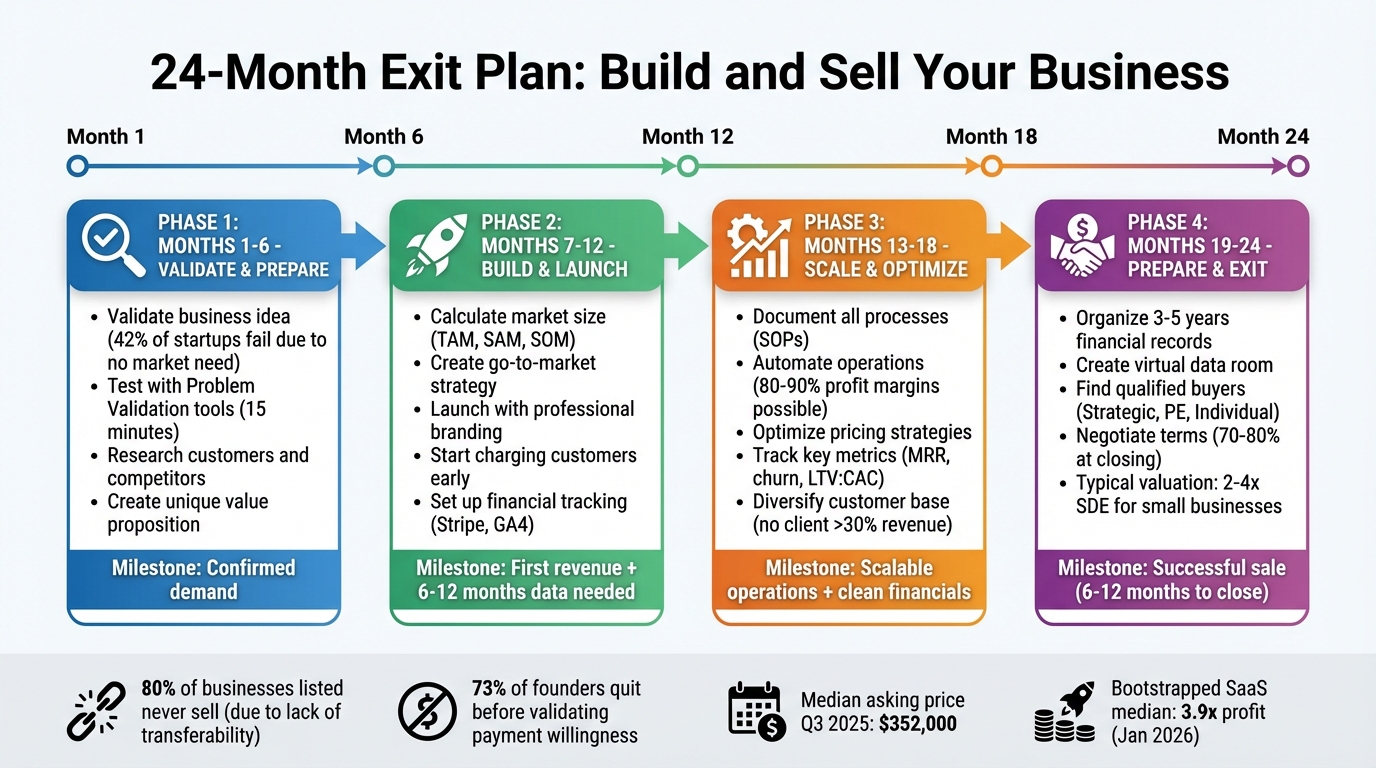
24-Month Business Exit Plan: Timeline from Validation to Sale
How To Start And Sell A Business For Big Money!
sbb-itb-08dd11e
Months 1-3: Validate Your Business Idea
The first three months are critical - they determine whether you're building something customers actually want or heading toward a dead end. Did you know that 42% of startups fail because there's no real market need for their product? Your mission during this phase is simple: prove that people are willing to pay for your solution before you pour significant resources into it. This means finding solid evidence that customers are already spending money, time, or effort trying to solve the problem you've identified. Once you've confirmed there's a real need, you can move forward with testing your idea using tools designed for validation.
Test Your Idea with Problem Validation Tools
Start by using tools like IdeaFloat's Problem Validator to see if your idea solves a problem urgent enough for customers to invest in. The process is quick - just 15 minutes - and can save you months of wasted effort on a solution nobody wants. Instead of asking, "Do people like this idea?" focus on finding proof that customers are already paying for similar solutions or creating their own workarounds.
"Killing a bad idea in 24 hours is infinitely better than killing it after 6 months of building." - AI Shortcut Lab Editorial Team
"IdeaFloat saved us weeks of work by helping us explore demand for new products across different regions and took the guesswork out of finding gaps in the market." - Nick Sherwing, founder of woohoPets
Take David L., a serial entrepreneur, as an example. He used this rapid validation method to test five different ideas in just one week. After identifying a winning concept, he launched and gained 30 paying customers in his first month. This kind of speed and data-driven decision-making lays the groundwork for a business that's both low-risk and attractive to potential buyers.
Research Customers and Competitors
Once you've confirmed initial demand, it's time to dig deeper. Start by researching customer conversations and identifying competitor weaknesses. Tools like Consumer Insights can help you uncover real customer discussions on platforms like Reddit, LinkedIn, and other online communities. Understanding how customers talk about their problems will not only improve your future marketing but also show potential buyers that your business is built on real-world insights.
Next, conduct a Competitor Analysis to get a clear picture of the players in your space. Focus on their weak spots by combing through 1-3 star reviews on platforms like G2 or Capterra. These reviews often highlight feature gaps or underserved needs. Use this information to shape your strategy and carve out a unique position in the market - something that will make your business stand out to acquirers.
Take Marcus T., an e-commerce entrepreneur, for example. He completed this type of research in just two hours, a process that usually takes months. The result? He launched his side hustle and hit $5,000 in revenue in his first month.
Create Your Value Proposition
Armed with insights from your customer research and competitor analysis, it's time to craft a Unique Value Proposition that sets you apart. This isn't just a catchy tagline - it’s a detailed messaging framework that includes your one-liner pitch, brand positioning, and differentiation strategies.
Your value proposition should directly address the weaknesses you've found in competitor offerings, using customer language to make it resonate. For example, if customers complain about "clunky interfaces" or "hidden fees" in competitor products, your messaging should focus on ease of use and transparent pricing. This clarity not only attracts customers but also signals to potential buyers that your business has a strong, defensible position in the market.
Months 4-9: Build and Launch Your Business
Once you've confirmed demand for your idea, it's time to transform that validation into a real, functioning business. This phase is about laying the groundwork - defining your market, crafting a strategy to reach it, and launching with a polished, professional presence. Keep in mind, buyers typically want to see 6–12 months of consistent revenue history before considering an acquisition.
Calculate Your Market Size: TAM, SAM, and SOM
Sizing your market is a crucial step, and it involves understanding three key metrics:
- TAM (Total Addressable Market): This is the total revenue potential if you captured 100% of the global market without any competition.
- SAM (Serviceable Addressable Market): This represents the portion of the TAM you can realistically target, factoring in your business model, location, and distribution channels.
- SOM (Serviceable Obtainable Market): This is the share of the SAM you aim to capture within the next one to three years, based on your resources and competition.
The bottom-up approach is a reliable way to calculate these figures. For example, you multiply the number of potential customers by your average revenue per customer. Slack did this in 2014, estimating a SAM of 15 million knowledge workers with an average revenue per user of $100, resulting in a $1.5 billion SAM. They projected capturing 3.3% of that SAM (500,000 paid users) within five years, translating to $50 million in revenue.
Tools like IdeaFloat's Smart Market Sizing tool can simplify this process. It uses AI to analyze search engine data and keyword volumes to estimate market size, backing its findings with verifiable sources. Be cautious of the "1% trap" - claiming you'll capture a small slice of a massive market without a clear strategy is a red flag for investors.
For institutional Series A funding, investors typically expect a TAM of at least $1 billion. Realistically, startups should aim to capture 3% to 5% of their SAM within three to five years. Thorough research can also improve your chances of securing funding, as startups that neglect market demands are among the 70% that fail.
Once you’ve defined your market, the next step is creating a strategy to reach it.
Create Your Go-to-Market Strategy
With your market size in hand, focus on building a go-to-market (GTM) strategy that converts interest into revenue. Start by defining your target audience with detailed buyer personas. Identify their job roles, company types, and the specific problems your product solves.
Next, select the channels where your audience spends their time. IdeaFloat's Customer Profiler can help by generating detailed personas and identifying the most effective channels. Focus on your strengths and apply the "Rule of Three" by prioritizing up to three marketing channels to avoid spreading yourself too thin.
Your sales model should complement your pricing strategy. For instance:
- Products with an annual contract value (ACV) under $500 often work best with a self-serve model (e.g., Notion or Canva).
- Products priced between $500 and $25,000 might benefit from a sales-assisted approach (e.g., Slack or mid-tier HubSpot).
- Products with an ACV above $25,000 usually require a direct sales team (e.g., Salesforce).
"Your first 90 days post-launch are about learning, not scaling."
- Foundra Editorial Team
Before launching, identify key metrics like Customer Acquisition Cost (CAC), conversion rates, and activation rates. Regularly review your top three KPIs - weekly check-ins can help you spot and fix issues quickly while creating a data trail that future buyers will value.
Launch Your Business
With your market analysis and GTM strategy ready, it’s time to launch. Start by building a professional brand identity. Tools like IdeaFloat's Logo Generator and Branding Guide can help you establish credibility from the outset.
Create buzz with a Waitlist Landing Page before your official launch. In 2025, SaaS founder Sarah K. used IdeaFloat's waitlist tool to secure 50 signups by week two and landed three paying beta customers by week three. Similarly, e-commerce entrepreneur Marcus T. combined AI-generated content with validation tools to generate $5,000 in revenue within his first month.
Leverage the Community Launch Map to find 23+ online communities where your target audience gathers. This tool can also help you craft tailored posts for each platform, saving you time and effort.
Start charging customers early, even if it’s a modest fee like $9 per month. This not only validates your product's value but also sets a foundation for predictable revenue. Approximately 73% of founders quit before they determine if customers are willing to pay, so this step is crucial. Even modest, consistent revenue - say $500 to $1,500 per month - can make your business appealing to buyers if it demonstrates stability.
Set up your financial systems with tools like Stripe and Google Analytics (GA4) to track revenue and traffic. Buyers often look for at least 6–12 months of verified data.
Lastly, document your processes using tools like Notion or Loom to create clear standard operating procedures (SOPs). Well-documented systems make it easier for buyers to take over without relying heavily on you. By 2026, businesses with strong operational foundations will have a distinct edge in the acquisition market.
Months 10-18: Scale Operations and Increase Revenue
At this stage, the focus is on controlled growth. After laying the groundwork during your launch phase, it's time to scale operations and improve profitability. The goal? To demonstrate that your business can grow without excessive costs and function independently of you - key factors that make it more appealing to buyers.
"Scaling a SaaS business is not just 'getting more customers.' It means growing revenue faster than costs, improving retention, and building systems that can handle more volume with roughly the same or fewer resources." - Burkhard Berger, Founder of awesomex™
Before diving into scaling, ensure you're ready. Your product-market fit should be solid, customer retention stable, and unit economics healthy. Specifically, your customer lifetime value (LTV) should be at least three times your customer acquisition cost (CAC). With these in place, you can scale confidently without unnecessary cash burn.
Document Processes and Streamline Operations
Creating a self-sustaining business starts with documenting your processes. Use tools like Notion or Loom to outline repeatable workflows, and delegate these tasks to a manager at least 6 to 12 months before selling. Focus on areas like customer onboarding, sales outreach, marketing campaigns, product development, and financial reporting. This not only proves the business can run without you but also boosts its value. In 2026, businesses with strong systems and minimal owner dependency are commanding higher valuations.
Automation is equally important. Tools like Zapier and AI chatbots can streamline customer onboarding and support, maintaining lean operations with profit margins as high as 80%–90%. Consider examples like Cleanvoice, an AI tool that automates podcast editing, which reached $20,000 per month in MRR, or Bank Statement Converter, a micro-SaaS that generates $40,000 per month by automating a niche task.
Boost Profits with Smarter Financial Practices
Profitability is a key driver of valuation. Instead of solely chasing new customers, focus on pricing strategies that maximize earnings. Tiered or usage-based pricing can significantly increase customer lifetime value. Even a small 5% improvement in customer retention can have a noticeable impact on profits.
Financial tools can also provide valuable insights. For example, IdeaFloat's Advanced Pricing Research and Financial Projections tools help simulate how pricing changes affect your bottom line. If your business generates under $50,000 in MRR, platforms like Paddle or LemonSqueezy can handle global tax compliance, saving time and reducing administrative burdens.
Accurate financial records are non-negotiable. Maintain three to four years of clean, consistent financial statements - income statements, balance sheets, and cash flow reports - that reconcile with your bank accounts. Separate personal and business expenses, and align your owner salary with industry norms. These steps not only improve profitability but also make your business a low-risk, attractive asset for buyers. By Q3 2025, the median asking price for U.S. small businesses reached $352,000, with valuations typically ranging from 2x to 4x Seller's Discretionary Earnings (SDE). Bootstrapped micro-SaaS businesses, as of January 2026, sell for a median of 3.9 times profit.
For added credibility, consider a sell-side Quality of Earnings (QoE) report before listing your business. Though it may cost $35,000 to $150,000 depending on your revenue, this report identifies and resolves accounting issues that could otherwise lower your sale price.
Keep an Eye on Key Metrics
Effective scaling requires tracking the right metrics. Set up a dashboard to monitor Monthly Recurring Revenue (MRR), customer churn rate, LTV, CAC, and CAC payback period. These numbers reveal whether your business is growing sustainably or burning cash too quickly.
Here’s a quick look at healthy benchmarks for scalable businesses:
| Metric | Survival Zone | Strong | Elite |
|---|---|---|---|
| Monthly Churn | Below 5% | Below 3% | Below 1% |
| LTV:CAC Ratio | 3:1 | 5:1 | 7:1+ |
| CAC Payback | Under 6 months | Under 3 months | Under 1 month |
| Gross Margin | Above 60% | Above 75% | Above 85% |
Source: AwesomeAgents.ai
Break down your MRR into new, expansion, and churned revenue. This helps you see whether growth is driven by new customers or increased spending from existing ones. For businesses earning $50,000 to $200,000 in MRR, focus on pricing optimization, upselling, and automation to drive growth.
Use tools like Google Analytics (GA4) and Stripe to track revenue and traffic. Ensure you have 6 to 12 months of verified data before approaching buyers. Consistent, predictable performance builds trust and makes your business a more attractive investment.
Lastly, avoid over-reliance on a single customer. If one client accounts for more than 30% of your revenue, it could deter buyers. Diversify your customer base and consider subscription models or monthly retainers to create steady, predictable cash flow.
Months 19-24: Prepare for Sale and Exit
Your business is now equipped with proven metrics and scalable operations. At this stage, the focus shifts from growth to getting buyer-ready. The objective? Minimize buyer uncertainty and maximize your sale price. Buyers need to envision owning your business without your involvement.
"Buyers pay for certainty - reduce surprises and you increase the value of your company; increase ambiguity and buyers discount value or walk away." - Ascent CFO
The process of reducing buyer uncertainty is crucial. Successful business sales often involve 12 to 24 months of preparation. This section will walk you through organizing your records, finding qualified buyers, and negotiating terms that protect your interests.
Organize Your Financial Records
Accurate and organized financial records are a must. Buyers typically want to see 3–5 years of tax returns, profit and loss (P&L) statements, balance sheets, and cash flow reports. If your financials are unclear or incomplete, buyers may back out or lower their offers due to perceived risk.
Start by separating personal and business expenses immediately. Close your monthly books within five business days to show financial discipline. This practice reassures buyers that your operations are well-managed. Recasting your financials to highlight Seller’s Discretionary Earnings (SDE) or Adjusted EBITDA can further showcase your business's value. Keep detailed records of adjustments with receipts, as buyers will scrutinize every entry during due diligence.
Consider investing in a sell-side Quality of Earnings (QoE) report. While it may cost $35,000 to $150,000 depending on your revenue, this report validates your adjusted EBITDA and flags accounting issues before buyers do. This proactive step can prevent last-minute price renegotiations and build trust with buyers.
Create a virtual data room (VDR) to organize all relevant documents. Categorize them into financial, legal, HR, tax, and technology sections. Include accounts receivable and payable aging schedules, revenue breakdowns by customer and product, and debt or lease schedules. Streamlined access to this information makes the sale process smoother.
For example, in 2016, Dollar Shave Club leveraged a professional valuation and well-organized financials to secure a $1 billion cash acquisition by Unilever. Similarly, Jim Smith, an auto repair chain owner, spent six months with a CPA cleaning up his financials, which led to a sale price 15% higher than projected.
Find Potential Buyers
Finding the right buyer is just as critical as having clean financials. Buyers fall into four main categories, each with unique motivations and valuation methods:
| Buyer Type | Primary Motivation | Typical Valuation | Post-Sale Involvement |
|---|---|---|---|
| Strategic | Synergies, market share | Highest (Premium) | Full integration; owner exits |
| Financial (Private Equity) | ROI, performance growth | Multiple of EBITDA | Management often stays 5–8 years |
| Individual | Lifestyle change, self-employment | 2–4x SDE | Owner-operator role |
| Family Offices | Long-term wealth preservation | Varies | Flexible, case-by-case |
Strategic buyers, such as companies in related markets, often pay the highest premiums. They value synergies like cost savings or market expansion. Start building relationships with these buyers 2 to 3 years before your planned exit. Attend industry events, network with business owners in related sectors, and use cold outreach to connect with decision-makers.
For smaller businesses (under $5 million), working with a business broker might be a good option. Brokers typically charge 5% to 10% of the sale price and can provide access to buyer databases while handling the screening process. For larger deals or strategic sales, consider working directly with buyers or hiring an M&A advisor.
Prepare two key marketing documents: a "teaser" (a one-page summary) for initial outreach and a Confidential Information Memorandum (CIM) for serious buyers who sign a Non-Disclosure Agreement (NDA). Never share sensitive information - like financials or customer lists - without an NDA that includes non-solicitation and non-circumvention clauses.
Qualify buyers early. Require proof of funds or a financing pre-approval letter before sharing sensitive data. This ensures you're engaging only with serious prospects. In Q3 2025, the median asking price for U.S. small businesses reached $352,000, with transaction volumes up 8% year-over-year.
Once you’ve identified potential buyers, the next step is negotiating terms that safeguard your interests.
Negotiate the Sale Terms
With your records in order and buyers identified, it’s time to focus on favorable deal terms. The Letter of Intent (LOI) lays the groundwork for the entire deal. Don’t wait for the final purchase agreement to address critical terms - negotiate them upfront in the LOI. Concentrate on three key aspects: purchase price, deal structure, and legal protections.
Aim to receive 70% to 80% of the total value at closing, with the remainder held in escrow or structured as short-term notes rather than long-term earn-outs. Earn-outs, which typically account for 10% to 25% of middle-market purchase prices, can be risky. Once buyers gain control, they might adjust expenses to meet targets. If an earn-out is unavoidable, negotiate operating covenants requiring the buyer to maintain consistent post-closing operations. Push for revenue-based metrics instead of profit-based ones to minimize manipulation risks.
Work with both a broker and an attorney to protect your interests. Negotiate indemnification caps (usually 10% to 15% of the purchase price) and establish baskets or deductibles (typically 0.5% to 1%) to avoid small claims. General representations and warranties should expire after 12 to 18 months, though key items - like title and taxes - may have longer durations.
Limit the buyer’s exclusivity period to 45–60 days instead of the typical 90–120 days. This ensures your business isn’t sidelined for too long if the deal falls through.
Small businesses often sell for 2 to 4 times SDE, while larger businesses command 3 to 6 times EBITDA. High-growth SaaS companies can fetch 4 to 8 times revenue. For instance, Disney’s 2009 acquisition of Marvel for $4 billion included carefully negotiated IP rights and earn-out provisions. By 2017, the deal had generated over $18 billion in value for Disney.
The average time from listing to closing is 6 to 12 months. Ultimately, the difference between a 3× and a 6× multiple often depends on how well you demonstrate that your business can thrive without you. These negotiations mark the final step in your 24-month journey, transforming your business into a buyer-ready asset.
Conclusion: Complete Your 24-Month Exit
Review of the 24-Month Plan
This 24-month exit plan offers a clear roadmap for first-time entrepreneurs aiming to build and sell a buyer-ready business. Each phase - from initial validation to launch - focuses on creating a solid foundation of demand, operational independence, and financial transparency. The goal? To ensure your business can run without you, maintain clean financial records, generate steady revenue, and have well-documented processes that lower risks for potential buyers.
Successful businesses share key characteristics: they operate without heavy founder involvement, have organized financials, generate consistent income, and follow structured processes that minimize buyer concerns.
Main Lessons for First-Time Entrepreneurs
Here’s the big takeaway: a business that relies too much on its founder isn’t scalable - or sellable.
A staggering 80% of businesses listed for sale never find a buyer. The primary reason? Lack of transferability. To increase your chances of a successful exit, focus on building a business that can thrive without you. Start by implementing standard operating procedures (SOPs), separating personal and business finances early, and hiring an operations manager 6–12 months before your planned sale to prove the business can run independently.
Financial organization is equally critical. Buyers will closely examine every detail during due diligence, and disorganized finances can raise red flags that kill deals. Recurring revenue streams, like subscriptions or retainers, are particularly appealing to buyers and often lead to higher valuations.
In short: SOPs, clean financial records, and diversified income streams reduce buyer risks. And don’t forget to prepare for unexpected situations - like the "Five D's" (Death, Divorce, Disability, Disagreement, or Distress) - by having an exit plan in place.
With these lessons in mind, it’s time to move forward. Start by validating your idea and using available tools to guide you step by step.
How to Get Started
Using the outlined phases, you can jumpstart your plan with the help of IdeaFloat tools. Instead of rushing into building, begin with thorough validation. IdeaFloat’s Problem Validator is an excellent starting point - it helps you quickly determine if your idea solves a real problem that customers are willing to pay for. This tool can shrink the validation process from months to just 15 minutes by identifying weak points and gauging market demand.
Once validated, use the Smart Market Sizing tool to calculate TAM, SAM, and SOM with reliable data. As you move through Months 4–18, tools like the Financial Model and Advanced Pricing Research will help you fine-tune profit margins and predict break-even points. When you reach the exit phase (Months 19–24), the Business Plan Generator creates professional, investor-ready documents in multiple formats, streamlining the due diligence process.
Start today with IdeaFloat’s Problem Validator and follow the AI-powered roadmap to your exit. Remember, 73% of founders quit before confirming if customers will pay for their product. Don’t let that be you - take the first step toward building a business that’s ready to sell.
FAQs
What business types are easiest to sell within 24 months?
Businesses operating with recurring revenue models - like SaaS companies or subscription-based services - are often the simplest to sell within a 24-month timeframe. Why? Their steady, predictable income streams and appeal to buyers make them especially attractive for acquisitions.
How much monthly revenue do I need before buyers take me seriously?
To draw the attention of serious buyers, your business should aim to generate consistent monthly revenue in the range of $10,000 to $20,000. Businesses with steady income and strong profitability tend to be more attractive, boosting their appeal and perceived value in the eyes of potential buyers.
What should I prepare for due diligence before listing my business?
Start getting ready for due diligence 12 to 24 months before putting your business on the market. Use this time to tidy up your financial records, address any legal concerns, and work on minimizing the business's reliance on you as the owner. Make sure all legal and contractual documents are well-organized and up-to-date. Knowing your business's worth early on can make the sale process smoother and help you get the best possible value.
Related Blog Posts
 Report an issue
Get the newest tips and tricks of starting your business!