
A service business plan outlines how your business will deliver its services, achieve profitability, and meet customer needs. Unlike product-based businesses, service businesses rely on expertise and time rather than inventory. A strong plan ensures you define your audience, validate your service's demand, and create a scalable delivery model. Here's what you need to know:
- Why You Need a Plan: Avoid overcommitment, scope creep, and financial mismanagement. A clear plan helps secure funding and ensures you deliver quality services consistently.
- Key Components:
- Executive Summary: A concise overview of your mission, target market, services, and financial projections.
- Service Offerings: Define services with clear outcomes, pricing tiers, and deliverables.
- Market Analysis: Identify your target audience and competitors using data-driven insights.
- Operational Plan: Outline roles, processes, and tools for smooth service delivery.
- Financial Planning: Calculate costs, forecast revenue, and establish profitability goals.
- Marketing Strategy: Use targeted channels to attract and convert clients effectively.
This guide provides actionable steps, templates, and examples to help you create a structured, realistic plan for your service business.
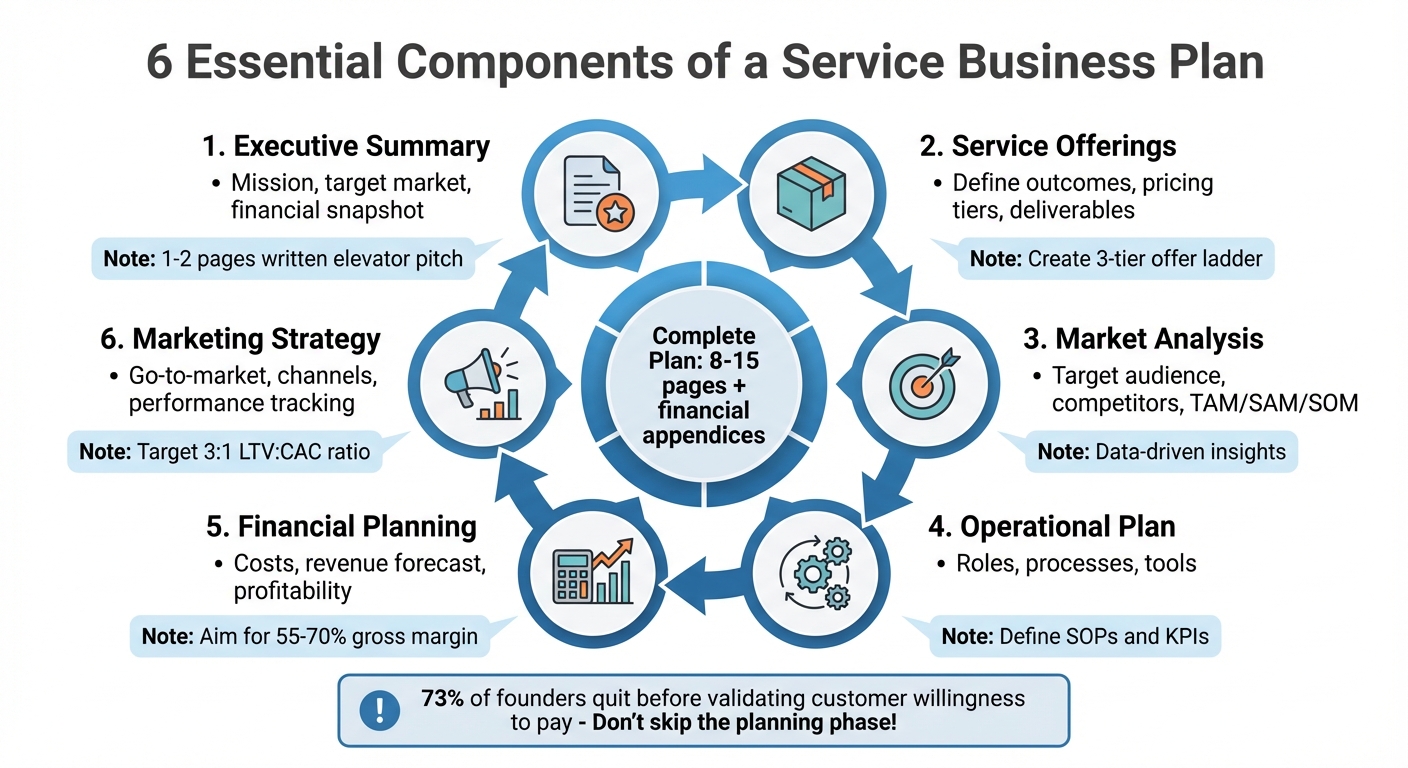
6 Essential Components of a Service Business Plan
Executive Summary: Writing a Clear Overview
What to Include in Your Executive Summary
The executive summary is the first impression your business makes on investors, lenders, or partners. Think of it as your written elevator pitch - it should grab attention and summarize your business clearly in just 1–2 pages. Start with a strong hook, like a surprising statistic, a bold mission statement, or a clear problem that your business addresses. For instance, if you're starting a consulting firm aimed at helping startups validate their ideas, you could open with something like: "Approximately 73% of founders quit their ventures before determining if customers are actually willing to pay for their solution".
Next, outline your mission, vision, and value proposition. Explain what your business does, where it's headed, and the specific benefits it offers. Define your target market as precisely as possible. Instead of a broad term like "small businesses", focus on a niche, such as "30-200 employee SaaS firms in the healthcare sector." This shows you understand your Ideal Customer Profile (ICP).
Include a snapshot of your financials, such as projected revenue, profit margins, break-even points, and funding needs. If you're running a service-based business, also touch on operational details like billable hours, utilization goals, and plans for scaling - whether through hiring or outsourcing. Wrap up with a strong call to action, encouraging readers to take the next step, such as scheduling a meeting or requesting the full business plan.
Below is an example of a well-crafted executive summary for a consulting firm.
Example: Consulting Firm Executive Summary
Mission:
We empower early-stage founders to validate their business ideas with confidence, minimizing investment risks through AI-driven market research and financial modeling.
Problem & Solution:
Most startups fail not due to poor execution but because they create solutions no one wants to pay for. Our consulting firm uses IdeaFloat's AI-powered validation tools to help founders test demand, analyze market size, and build financial models - turning guesswork into data-driven decisions.
Target Market:
We focus on pre-seed and seed-stage founders in the United States, particularly in tech, SaaS, and professional services. Our clients typically have budgets ranging from $5,000 to $25,000 for validation and planning services.
Services & Pricing:
Our offerings include three key packages:
- Problem Validator ($5,000): Evaluates willingness-to-pay and competitive positioning.
- Market Sizing & Strategy ($12,000): Delivers market analysis (TAM/SAM/SOM) and go-to-market strategies.
- Full Launch Blueprint ($25,000): Combines validation, financial modeling, and investor-ready documentation.
Competitive Advantage:
Unlike traditional consultants who rely on static templates, we use IdeaFloat's real-time market data and AI-driven insights to provide measurable validation metrics. As Robert Bates, Partner at McFillin Accounting, shared:
"IdeaFloat will save me and my team countless hours of work, as we help clients articulate their business ideas".
Financial Highlights:
We forecast $135,000 in revenue for Year 1, scaling to $810,000 by Year 3, with gross margins of 60% and profitability by Month 18. We're seeking $50,000 in seed funding to cover initial operations, marketing, and hiring our first associate consultant.
Next Steps:
Schedule a 30-minute demo with us to see how our validation process works and explore partnership opportunities.
sbb-itb-08dd11e
Service Offerings: What You'll Provide to Customers
How to Define Your Services
Start by identifying your core services and the outcomes they deliver. Craft a "Service Thesis" - a concise statement that outlines who you serve, the problem you solve, and what success looks like for your clients. This clarity ensures your offerings align with client expectations.
Make your services outcome-focused. For instance, instead of vague promises, emphasize measurable results like reducing churn, accelerating sales cycles, or increasing conversion rates. This approach highlights the tangible value you bring.
Each service package should include specific deliverables, timelines, and acceptance criteria. For example, if you provide market research, detail that clients will receive a report with competitor analysis, customer insights, and actionable recommendations within a set timeframe. This level of detail avoids misunderstandings and scope creep.
Consider creating a three-tier Offer Ladder: entry, core, and premium services. This structure allows you to cater to a range of client needs without overwhelming them, making it easier for customers to choose a package that fits their goals and budget.
Example: AI-Powered Business Validation Services
IdeaFloat offers a great example of structuring services around customer needs. Many entrepreneurs struggle to validate whether their business idea meets a genuine market demand before committing significant resources.
- Problem Validator: Evaluates whether an idea addresses a real need by measuring urgency and identifying early market signals.
- Competitor Analysis: Maps the competitive landscape, highlighting strengths, weaknesses, and gaps in the market.
- Go-to-Market Strategy: Delivers a customer acquisition plan with actionable recommendations for channels and outreach strategies.
These services are tailored to help founders make informed decisions and avoid costly missteps.
Setting Prices for Your Services
Once your services are clearly defined, it’s time to set pricing that ensures both profitability and competitiveness. Start by calculating your total costs - including fixed expenses (like rent, insurance, and software) and variable costs (like contractor fees and direct labor). Add a margin of 20–40% to support sustainable growth. This margin not only helps with unforeseen challenges but also prevents underpricing, a common pitfall for service businesses.
To maximize profitability, aim for high utilization rates - above 85% for technical roles - while accounting for non-billable administrative time. Research competitor pricing to understand the market range, but base your rates on your specific costs and the value you deliver. Businesses that back their pricing with thorough research often justify rates 20–40% higher than those that rely on guesswork.
Explore different pricing models based on your services:
- Hourly Rates: Ideal for consulting or coaching, typically ranging from $150 to $350 per hour depending on expertise.
- Project-Based Pricing: Encourages efficiency by rewarding faster completion, effectively increasing your hourly rate.
- Tiered Packages: Offer entry-level, core, and premium options to attract a broader client base.
For services priced above $2,000, consider offering payment plans. Breaking larger fees into monthly installments can make your services more accessible. Before implementing new pricing, test it with 5–10 potential clients to gather feedback and refine your approach.
Market Analysis: Who Your Customers Are
Researching Industry Trends
To understand your market's direction, start by tapping into federal databases. The U.S. Census Bureau offers detailed demographic data by location, the Bureau of Labor Statistics tracks employment and wage trends, and the Bureau of Economic Analysis provides insights into GDP and other economic indicators. These resources are free and can help you build a solid understanding of industry movements.
Look for measurable growth patterns in your sector. For instance, the renewable energy market in the U.S. grew by 7% in 2025, while demand for plant-based foods surged by 20%. These trends highlight opportunities for businesses that align with evolving customer priorities. Keep an eye on regulatory changes, too. For example, new carbon emission limits introduced in 2025 created opportunities for eco-friendly service providers while increasing costs for others.
Pay attention to shifts in customer behavior. The rise of mobile shopping and social commerce is changing how businesses connect with their audiences. Similarly, the growing use of AI in customer service is improving efficiency and user experience across industries. Tracking these changes can help you position your services in line with where demand is headed.
Finding Your Target Market
Defining your target market starts with segmentation. Break your audience into groups based on demographics like age, income, and location, as well as behavior such as purchasing habits, brand loyalty, and usage frequency. This helps pinpoint the groups most likely to engage with and pay for your services.
When evaluating potential segments, consider three key factors:
- Size: Is the segment large enough to meet your revenue goals?
- Accessibility: Can you reach them effectively through your marketing and sales efforts?
- Fit: Does this group align with your business strengths?
A segment might seem appealing on paper, but if reaching them is too costly or serving them is impractical, it’s not the right choice.
Use the TAM/SAM/SOM framework to quantify market potential. This involves estimating the Total Addressable Market (overall demand), the Serviceable Addressable Market (realistic demand you can serve), and the Serviceable Obtainable Market (the portion you can capture immediately). This structured approach not only provides reliable data for investors but also helps set realistic revenue goals. As Nick Sherwing, Founder of woohoPets, shared:
"IdeaFloat saved us weeks of work by helping us explore demand for new products across different regions and took the guesswork out of finding gaps in the market".
Combine indirect research, such as Census data and industry reports, with direct methods like surveys, focus groups, and customer interviews. This mix gives you both a broad overview and specific insights into how customers might respond to your services. This dual approach ensures your value proposition is well-informed and sets the stage for a thorough competitive analysis.
Analyzing Your Competition
A clear understanding of your competitors helps sharpen your positioning. Competitors fall into three categories:
- Direct competitors: Those offering the same service to the same audience.
- Indirect competitors: Businesses solving the same problem in a different way.
- Substitutes: Alternatives that achieve the same outcome through different means.
For example, if you run a consulting firm, direct competitors might include other consultants in your niche. Indirect competitors could be online courses or software tools, while substitutes might be in-house teams handling similar tasks.
"Market research helps you find customers for your business. Competitive analysis helps you make your business unique." - U.S. Small Business Administration
Identify recurring customer pain points by reviewing platforms like Google, Yelp, and social media. Common issues such as slow response times, unclear pricing, or poor communication can reveal opportunities to set your business apart. Searching for "alternative to [Competitor Name]" on Google or Reddit can also uncover specific frustrations driving customers away from established players.
Create a comparison matrix to evaluate 3-5 key competitors on factors like implementation time, support quality, and pricing transparency. Recognizing competitor strengths and weaknesses enhances your analysis. Update this matrix every 90 days to keep up with changes in the competitive landscape, such as new product launches or funding rounds.
For high-end service firms, customer acquisition costs (CAC) often average around $4,500. This expense is sustainable if your project value justifies it. Understanding competitor pricing strategies can help you position your services effectively without undervaluing what you offer.
Operational Plan: How Your Business Will Run
Defining Roles and Responsibilities
A solid operational plan starts with clearly defined roles. Here are five key positions to consider:
- Delivery Lead: Oversees project outcomes, approves scope, and escalates risks.
- Project Manager: Handles scheduling, stakeholder communication, and RAID logs.
- Specialists: Focus on execution, documentation, and client demos.
- QA Lead: Ensures quality through test plans, data checks, and KPI dashboards.
- Customer Success Manager (CS Manager): Manages client reviews, health scores, and drives revenue retention.
As your business grows, you may also need part-time or fractional support for finance tasks like billing and cash forecasting, as well as legal needs such as contracts and compliance. This approach keeps operational costs lean while ensuring smooth workflows.
Defining responsibilities for each role ensures consistency in delivering services and achieving business goals. To measure effectiveness, set specific performance targets:
| Role | Key Responsibilities | Performance Targets |
|---|---|---|
| Delivery Lead | Outcome ownership, risk escalation, scope approval | 70–80% Utilization |
| Project Manager | Scheduling, stakeholder communications, RAID logs | ≥95% on-time delivery |
| Specialists | Execution, documentation, demos | <3% Rework |
| QA Lead | Test plans, data checks, KPI dashboards | <2% Defect escape rate |
| CS Manager | Health scores, QBRs, expansion plays | ≥95–110% Net revenue retention |
Once roles are defined, focus on streamlining operations with tools and processes that enhance efficiency.
Tools and Processes for Running Your Business
With roles in place, the next step is to create clear procedures that tie together your sales, capacity planning, and administrative tasks. Start by developing Standard Operating Procedures (SOPs) for every service you offer. These SOPs should include step-by-step checklists and clear acceptance criteria for deliverables. For every service package, define what "done" looks like, including timelines, deliverables, and assigned responsibilities.
To prevent over-promising to clients, integrate your sales pipeline with a capacity model that tracks available hours and the ramp-up time for new hires. For instance, in April 2026, a 6-person operations consultancy stabilized their margins by adopting outcome-based service packages. They set clear hour budgets and internal checklists, which boosted close rates and stabilized cash flow within just one quarter.
Leverage tools like IdeaFloat's Launch Checklist to manage go-to-market tasks during client onboarding. Additionally, the Cost Analysis tool can help you model pricing scenarios and understand how changes in utilization or wages affect profitability. Automating repetitive tasks - like scheduling, appointment reminders, and e-signatures - can also reduce the administrative burden on your team.
Finally, establish a governance rhythm to keep your team aligned. This could include:
- Weekly delivery reviews: Monitor project progress.
- Fortnightly pipeline reviews: Align sales efforts with capacity.
- Monthly financial reviews: Keep tabs on cash flow and margins.
This structured cadence helps you stay proactive, addressing potential issues before they become major problems.
Financial Planning: Numbers and Funding
Calculating Startup Costs and Monthly Expenses
To build a solid foundation for your business, start by breaking down your costs into two categories: one-time startup expenses and recurring monthly costs. One-time costs typically include incorporation fees, equipment, branding, professional services, and deposits, which can range from $9,500 to $50,000. On the other hand, monthly recurring expenses - like rent, software subscriptions, insurance, payroll, and telecommunications - usually fall between $750 and $3,700 or more.
Launching most service businesses at a professional level generally requires between $20,000 and $50,000. Essential tools, such as CRM, project management, and accounting software, often cost $50–$300 per user per month. Additionally, you should allocate $5,000–$50,000 for marketing and client acquisition during your first year.
To stay financially prepared, plan for 12–24 months to achieve cash-flow positivity. This means budgeting for 12–18 months of operating expenses. An emergency fund equivalent to 3–6 months of operating costs - around 10% of your projected annual revenue - is also recommended. To save on early-stage costs, consider hiring contractors or part-time employees, which can reduce benefit expenses by 20–30%. Improving cash flow can also be achieved by asking for upfront deposits, such as 50% for projects or monthly prepayments for retainer work.
Projecting Revenue and Profitability
Once your costs are mapped out, focus on converting your capacity into revenue projections. For service businesses, tie revenue to your team’s capacity rather than vague goals like "getting more leads". For instance, if a specialist works 160 hours per month at a 75% utilization rate, that translates to 120 billable hours. Multiply those hours by your hourly rate to estimate monthly revenue per employee.
"Service margins are won (or lost) in utilisation, scope control, and repeatability, not just 'getting more leads.'"
Aim for a blended gross margin of 55–70% and a contribution margin of 35–50% by the end of your first year. A key metric to track is your variable cost ratio, calculated as total variable costs divided by total sales revenue. This ratio shows how much of each dollar earned goes toward variable expenses like contractor fees and transaction costs, which typically range from 2.5–3.5%.
Your breakeven point is where your contribution margin covers all fixed costs. For example, a cleaning service might take 31 months to break even, while a proofreading service could reach profitability in about 7 months. Over time, aim to shift your revenue mix from lower-margin services to higher-margin specialized contracts. Including best, base, and worst-case scenarios in your financial projections - while accounting for factors like deposits, payment terms, and seasonal fluctuations - will ensure your plan reflects your business’s true financial position.
For detailed tracking, tools like IdeaFloat’s Financial Model can help you monitor cash flow, create monthly forecasts, and visualize your profitability path.
Determining Funding Requirements
With a clear revenue plan in place, the next step is identifying how much funding you need to achieve your goals. Funding typically includes two parts: initial capital expenditures (CAPEX) and operational cash runway to cover deficits until you’re cash-flow positive. Early-stage businesses often face variable costs that exceed revenue - for instance, a cleaning startup might see variable costs at 225% of revenue initially due to travel and supplies.
To mitigate risks like delayed customer onboarding or inefficient marketing, secure enough funding to cover at least 18 months of operations. Depending on your business type, capital requirements can vary widely - for example, $336,000 for a cleaning service and over $833,000 for specialized tech projects.
When pitching to investors, break down your funding request into specific categories. For instance, a $50,000 request might allocate $15,000 for equipment, $10,000 for website and CRM setup, $15,000 for marketing, and $10,000 for three months of operational costs. Highlighting your LTV:CAC ratio (aim for 3:1 or higher) can demonstrate strong unit economics and strengthen your pitch. Potential funding sources include seed investors, bank loans, and strategic partners with market expertise.
To refine your investor pitch, use IdeaFloat’s Smart Market Sizing tool to generate data-backed TAM/SAM/SOM calculations, and create polished visuals and forecasts for your plan.
Marketing and Sales Strategy: Getting Customers
Planning Your Go-to-Market Strategy
Test your approach with a 30-day pilot across three channels: outbound, inbound/content, and partner referrals. This lets you identify the most effective strategy without wasting months on a single channel that might not deliver results.
Define a specific Ideal Customer Profile (ICP) that aligns with the problem you solve. For instance, instead of targeting "tech startups", focus on something like "Series A SaaS companies burning cash". Use tools like intent data, technographics, and headcount filters to create tightly targeted outbound lists.
Tools like IdeaFloat's Go-to-Market Strategy tool can simplify this process. It helps pinpoint where your audience spends their time, calculates acquisition costs, and even prepares outreach scripts. Additionally, its Community Launch Map identifies over 23 online communities where your target audience is active and provides custom posts to engage them.
To measure success, calculate your pipeline velocity using this formula:
(Opportunities × Deal Size × Win Rate) ÷ Sales Cycle Length.
This ensures your marketing translates into revenue, not just traffic. Content marketing is another key channel - companies with blogs generate 67% more leads than those without.
Once your outreach strategy is set, make sure your online presence reinforces your message and converts interest into action.
Building Your Online Presence
Your website should focus on results, such as "increase efficiency by 20%", rather than listing services. Simplify the buying process by offering fixed-scope, fixed-price packages (e.g., Starter, Professional, Enterprise) to eliminate the need for custom proposals.
Before launching, consider creating a waitlist landing page. This allows you to gauge interest and capture leads early. Tools like IdeaFloat's Waitlist Landing Page can help you design a high-conversion page that builds excitement and collects emails.
Be strategic about social media. For instance, LinkedIn is ideal for B2B services, while Instagram works better for creative industries. Focus on storytelling and sharing your expertise rather than direct selling. Consistently engaging in communities where your audience spends time helps build trust over time.
It's worth noting that 73% of founders give up before confirming if customers are willing to pay for their service. A strong online presence - with clear pricing and proof of expertise - can help you attract leads who already understand your value.
Tracking Marketing Performance
Keep a close eye on Customer Acquisition Cost (CAC) and Lifetime Value (LTV) to ensure your marketing spend is sustainable. Aim for an LTV:CAC ratio of 3:1 or better. For professional services, typical CAC ranges from $120 to $450 for smaller deals and up to $2,500 for high-value B2B services.
Another key metric is the CAC payback period - the time it takes to recoup your acquisition costs. Ideally, this should be 4 to 6 months or less. For example, if your CAC is $2,500 and your average monthly revenue per client is $3,225, you’d recover your costs in just 0.77 months.
Evaluate channel performance monthly to ensure you're not overspending on low-margin customers. Allocate more budget to channels that attract higher-tier clients, such as Professional or Enterprise packages. Hold weekly go-to-market meetings to review KPIs and cut underperforming channels.
Keep tabs on your lead-to-client conversion rate (targeting 8% to 15%) and monthly churn (aiming for 2% to 4% or lower). If onboarding takes longer than 14 days, churn risk increases, which can hurt your marketing ROI. Tools like IdeaFloat's Financial Model can help you track these metrics alongside cash flow and revenue, giving you a clear picture of your marketing's profitability.
Conclusion: Putting Your Plan Together
Review of Main Sections
Your service business plan brings together six key components that work in harmony. The executive summary captures your value proposition and financial highlights, making it easier for stakeholders to understand and support your vision. The service offerings section defines exactly what you provide, setting clear boundaries, timelines, and criteria to avoid scope creep. A thorough market analysis pinpoints your ideal clients and identifies gaps in the competition, while the operational plan lays out workflows, roles, and the tools needed for consistent, scalable delivery.
In the financial planning section, you'll connect revenue forecasts with delivery capacity, keeping an eye on metrics like utilization, gross margin, and cash flow over a 12- to 24-month period. Lastly, the marketing and sales strategy details how you’ll attract customers through targeted channels and measure success with key performance indicators. Together, these sections create a blueprint to validate your business model and guide decisions. Typically, a complete service business plan ranges from 8 to 15 pages, with additional financial appendices for deeper insights.
"If you can't schedule it, staff it, and forecast it, it's not a plan." - Model Reef
Service margins hinge on efficient resource use and managing scope effectively. Including an assumptions register in your plan is critical - it tracks factors like conversion rates, deal sizes, and retention goals, while a sensitivity analysis shows how shifts in these metrics could impact your business.
This comprehensive framework sets the stage for actionable next steps as you begin implementing your plan.
Getting Started with Your Business Plan
Now that you’ve got a solid grasp of the main components, it’s time to move into action. Begin with a one-page summary that outlines your offer, target audience, delivery model, and financial goals.
Platforms like IdeaFloat can help you transition from planning to validation. With tools like AI-powered community finders, waitlist landing pages, and financial modeling, IdeaFloat has assisted in validating over 1,247 business ideas and offers a free plan to get you started. Considering that 73% of founders quit before confirming if customers will actually pay, early demand testing is essential.
Document each step of your service delivery process to ensure new team members maintain quality as you grow. Use a driver-based financial model that adjusts forecasts automatically when pricing, volume, or capacity changes. Monitor key operating metrics - such as utilization rates, backlog, cycle times, and Net Promoter Score (NPS) - to catch potential problems before they affect profitability. Ultimately, your business plan should serve as a practical tool, helping you make informed decisions on a weekly basis.
How to Write a GREAT Consulting Business Plan [Free Template Download]
FAQs
How do I turn billable hours into a realistic revenue forecast?
To estimate revenue from billable hours, start by figuring out the total hours you have available to work. Then, apply your target utilization rate - the percentage of those hours you expect to bill clients - to calculate your billable hours. Finally, multiply the billable hours by your hourly billing rate to get a realistic revenue projection.
Don’t forget to factor in non-billable time, such as administrative tasks or training, to make your forecast more precise.
Key Steps:
- Calculate total available hours: Determine how many hours you can work in a given period.
- Apply the utilization rate: Use a percentage to estimate the hours you’ll spend on billable work.
- Multiply by your billing rate: This gives you an estimated revenue figure.
What should I include in a scope to prevent scope creep?
To keep scope creep at bay, it's essential to define a clear and detailed project scope in your documentation. This means spelling out specific deliverables, objectives, and boundaries right from the start. By doing so, you set clear expectations and limit the possibility of unnecessary or unplanned changes.
Make sure to include details like the services being offered, the target audience or clients, and any operational limits. This ensures that everyone involved - whether they're stakeholders, team members, or clients - understands exactly what's part of the project and what isn't. A well-defined scope keeps everyone on the same page, maintains focus, and minimizes the risk of the project expanding beyond its original intent.
How do I figure out how much funding runway I need?
To figure out your funding runway, you need to divide your total cash reserves by your net burn rate. This calculation shows how many months your business can keep running before requiring more funds.
Here’s how you can do it:
- Step 1: Subtract your monthly revenue from your monthly expenses. This gives you your net burn rate.
- Step 2: Take your total cash reserves and divide them by the net burn rate.
This simple formula can help you plan ahead and make informed decisions about your business's financial future.
Related Blog Posts
- Business Plan Template (2025)
- Coffee Shop - Business Plan Template (2025)
- Build Your Business Plan in 20 Minutes with IdeaFloat
- I Analyzed 1,000 Business Plans - Here's What The Successful Ones Had