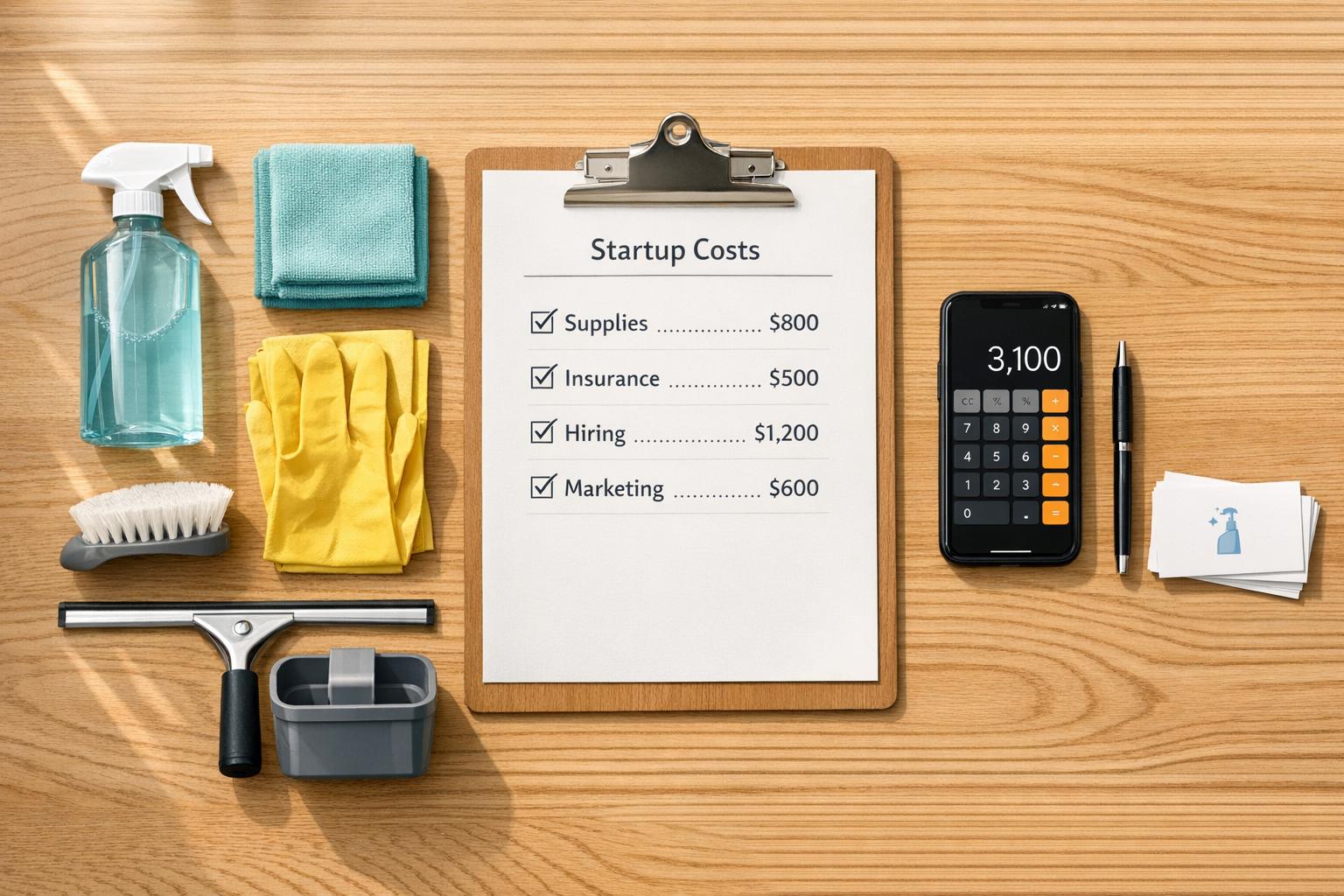
Starting a cleaning business is affordable, with initial costs ranging from $500 to $2,000 for solo operators. Most businesses recover their investment after 5–15 cleaning jobs. Here's a breakdown of key expenses:
- Supplies & Equipment: Basic kits cost $300–$600 (add $350–$750 if you need a vacuum). For commercial setups, expect $2,000–$5,000.
- Insurance: General liability insurance costs $30–$60/month. Workers' compensation is $800–$3,000 annually for small teams.
- Hiring & Training: Wages average $20/hour. Training costs $1,000 per employee, plus $280–$640 for supplies and uniforms.
- Marketing: Start with free tools like social media and Google Business. Paid ads or websites cost $200–$1,000/month.
Plan carefully to avoid overspending. Supplies make up about 5–10% of revenue, and insurance protects against unexpected financial risks. With proper budgeting, most cleaning businesses achieve positive cash flow in 30–60 days.
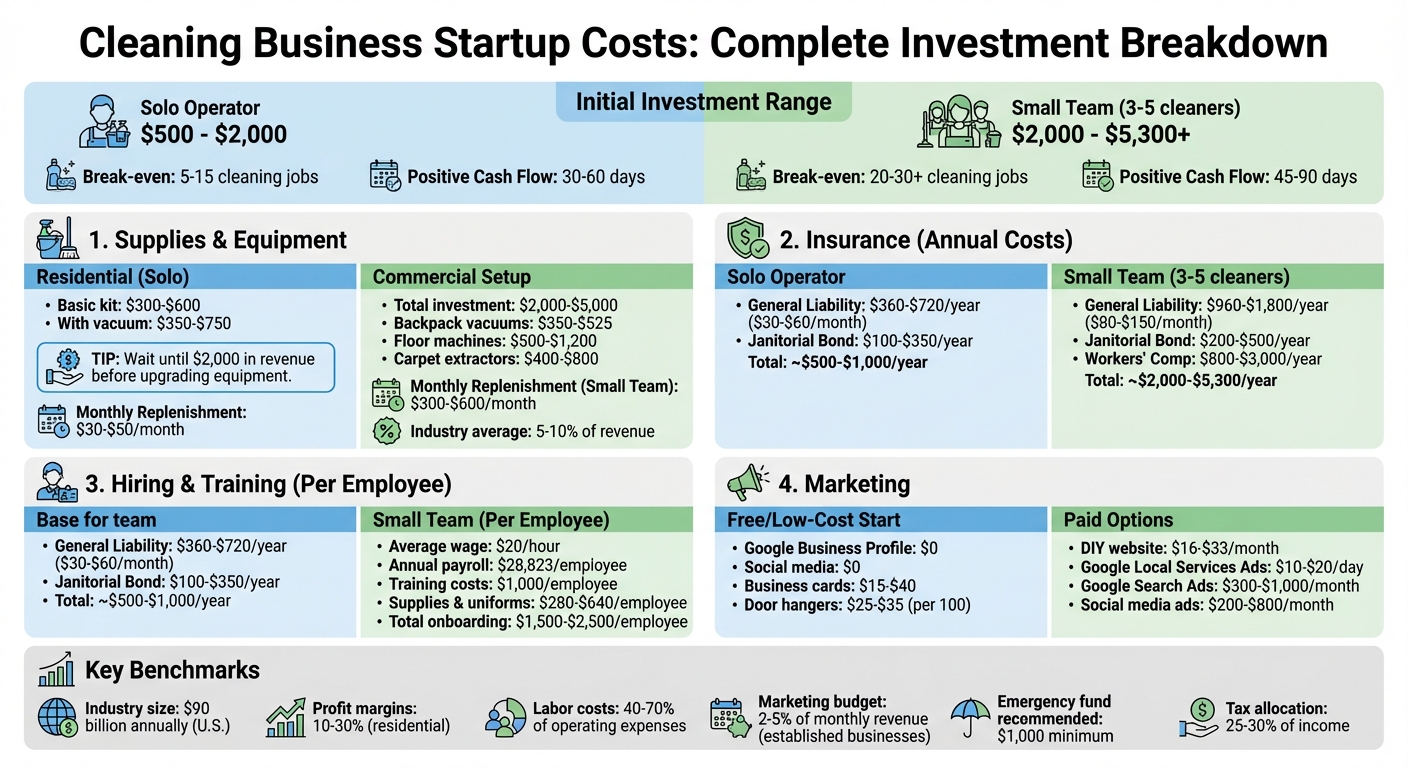
Cleaning Business Startup Costs Breakdown: Solo vs Small Team Investment Comparison
How Much Does It REALLY Cost to Start a Cleaning Business?
sbb-itb-08dd11e
Cleaning Supplies and Equipment Costs
Getting a handle on supply costs is essential for planning your startup budget. For residential cleaning, a basic kit typically costs between $300 and $600 - assuming you already own a vacuum. If you don’t, expect to spend $350 to $750 to cover everything. This range includes essentials like a mop system, microfiber cloths, cleaning solutions, a caddy, and safety gear.
Investing in a reliable vacuum is also a smart move. Budget models can wear out quickly with daily use, leading to higher replacement costs. For residential cleaning, lightweight uprights such as the Shark Navigator (priced at $160–$220) are a good fit. If you’re working with a commercial team, backpack vacuums are worth considering - they can cut vacuuming time by 30–40% compared to standard models.
Basic Cleaning Supplies
To keep costs manageable, prioritize multi-purpose cleaning products. A flat microfiber mop system, like the O-Cedar Spin Mop ($35–$45), offers both efficiency and hygiene. A 24-pack of microfiber cloths - priced at $16–$28 - can last through more than 200 washes as long as you avoid fabric softeners when laundering. Stick to a few core cleaning chemicals, such as:
- All-purpose cleaner
- Glass cleaner
- Bathroom disinfectant
- Degreaser
These should cost around $40 to $60 in total.
"Your first cleaning kit should cost $200-$400. Add a vacuum if you don't already own one, and you're looking at $350-$750 total." - CleaningBizHub
You can also save by purchasing concentrated cleaning solutions. For example, a $20 bottle of concentrate can yield over 30 bottles of ready-to-use cleaner. Additionally, organizing your cleaning caddies with color-coded systems (e.g., one for bathrooms, another for kitchens) can help avoid cross-contamination while giving off a professional vibe.
Commercial Cleaning Equipment
If you’re planning to take on commercial jobs, be prepared for higher upfront costs. Industrial-grade tools can add $2,000 to $5,000 to your startup expenses. Some of the key equipment includes:
- Commercial backpack vacuums: $350–$525
- Floor machines or burnishers: $500–$1,200
- Portable carpet extractors: $400–$800
- Restroom cleaning carts: $150–$300
However, it’s best to hold off on buying this specialized equipment until you’ve secured commercial contracts. Starting with residential cleaning can help you build cash flow before making larger investments. Here’s a quick comparison of costs for residential versus commercial setups:
| Equipment Type | Residential Cost | Commercial Cost |
|---|---|---|
| Vacuums | $150–$250 | $250–$525 |
| Mops & Buckets | $35–$50 | $50–$150 |
| Cleaning Chemicals | $40–$60 | $150–$250 |
| Small Tools & PPE | $50–$100 | $100–$200 |
| Specialty Equipment | Skip initially | $500–$2,000 |
Experts often advise waiting until you’ve generated $2,000 in revenue before upgrading to professional-grade tools. As your business expands, you’ll also need to account for regular supply restocking.
Monthly Supply Replenishment Costs
Plan to spend $10–$20 per job on replenishing items like cleaning solutions, trash bags, and microfiber cloths. For a solo operator, this might mean $30 to $50 per month, while a small team of 3–5 cleaners could face monthly supply costs of $300 to $600. On average, supplies will make up about 5% to 10% of your total revenue.
Keeping detailed purchase records is crucial for both budgeting and tax purposes. Once your business is established, consider switching to commercial concentrates from janitorial suppliers - they’re often about 50% cheaper than retail options.
"The biggest waste of money for new cleaners isn't a specific purchase. It's buying things before you need them. Every dollar spent before you have paying clients is a dollar of pure risk." - CleanKitHQ
Insurance Costs for Cleaning Businesses
As mentioned earlier, creating a proper budget is essential to safeguarding your assets, and insurance plays a key role in this. It not only protects your personal property but also boosts your credibility with clients by showing proof of coverage. Interestingly, cleaning businesses are considered one of the simpler industries to insure. Below, we break down the main insurance types to help you stay protected from day one.
General Liability Insurance
General liability (GL) insurance is the cornerstone of coverage for any cleaning business. It safeguards against property damage (like scratching a hardwood floor or breaking an item), bodily injury (such as a client slipping on a wet floor), and claims that might arise after you've completed a job. Most policies offer limits of $1 million per incident and $2 million in total coverage.
For solo cleaners, GL insurance typically costs between $30 and $60 per month ($360–$720 annually). If you have a small team of 3–5 cleaners, the range increases to $80–$150 per month ($960–$1,800 annually). Based on 2026 data, over half of cleaning business owners (54%) report paying between $40 and $50 monthly.
Your premium is influenced by factors such as your claims history, the size of your team, annual revenue, and your location. Opting for a Business Owner’s Policy (BOP), which combines GL with commercial property insurance, can cost between $500 and $1,500 annually and often provides cost savings compared to purchasing separate policies.
Workers' Compensation and Bonding
Workers' compensation insurance is a legal requirement in most states once you hire employees. It covers expenses like medical bills, lost wages, and rehabilitation costs for work-related injuries - common in cleaning jobs due to risks like chemical exposure, slips, or repetitive motions. For a small team, this insurance typically costs $800 to $3,000 annually, or about $40–$100 per month per employee. Rates generally fall between $1.50 and $4.00 per $100 of payroll.
A janitorial bond, on the other hand, protects your clients from theft by employees. If a claim is made, the bonding company reimburses the client, and your business repays the company. These bonds cost between $100 and $500 per year, with coverage limits ranging from $5,000 to $25,000.
"A surety bond is not the same thing as insurance. A bond is a theft guarantee. It protects your client if something goes missing from their home while you're there. It does not protect you - it protects them." - CleaningBizHub
Many commercial contracts demand both workers' compensation and bonding. Even for residential clients, advertising your business as "Bonded and Insured" builds trust and acts as an important selling point.
How to Compare Insurance Packages
Lining up your insurance options side by side makes it easier to decide what works best for your business. Focus on what each policy covers and how it aligns with your operations. Solo cleaners often manage with GL insurance and a bond for under $1,000 annually. However, hiring employees adds workers' comp, which becomes one of the largest expenses.
| Policy Type | What It Covers | Solo | Small Team (3–5) |
|---|---|---|---|
| General Liability | Property damage, bodily injury, advertising injury | $360–$720/year | $960–$1,800/year |
| Janitorial Bond | Employee theft of client property | $100–$350/year | $200–$500/year |
| Workers' Comp | Employee medical bills and lost wages | Not required | $800–$3,000+/year |
| Commercial Auto | Accidents involving business vehicles | $1,200–$2,400/vehicle | $1,200–$2,400/vehicle |
Combining your GL insurance and bond with the same provider can lead to discounts and simplify your policy management. Keep a digital Certificate of Insurance (COI) on hand to quickly provide proof of coverage when requested by clients. If your business operates part-time or seasonally, consider pay-as-you-go plans to avoid long-term commitments.
Hiring and Training Costs
Managing labor effectively, from offering fair wages to providing targeted training, plays a major role in maintaining financial stability. Labor costs typically make up 40%–70% of operating expenses. In the U.S., house cleaners earn an average of $20.72 per hour, while janitors and maids/housekeeping cleaners earn slightly less, with median wages of $17.27 and $16.66 respectively as of May 2024. When planning your labor budget, remember to include payroll taxes and benefits. Breaking down direct labor expenses and training investments is crucial for long-term success.
Employee Wages and Benefits
On average, the annual payroll per employee in the cleaning industry is $28,823. Initial costs for workers' compensation, bonding, training, and supplies range between $1,500 and $2,500 per employee. Before expanding your team, ensure your business operates at 80% capacity for at least four consecutive weeks. Companies that manage to keep employee turnover low often enjoy profit margins that are 5% to 10% higher than their competitors.
Training and Certifications
Beyond wages, investing in proper training is essential for maintaining quality and safety. Training a new hire costs around $1,000. Basic training typically includes sanitation, dusting, disinfecting, and the correct use of cleaning chemicals. For their first 3–5 jobs, new employees should work alongside experienced staff before handling tasks independently. OSHA requires Bloodborne Pathogen training for relevant employees, with non-compliance fines reaching up to $70,000. Free training materials, such as "Cleaning 101" from the Cleaning Management Institute, can help reduce onboarding costs. For specialized skills like medical cleaning, biohazard cleanup, or eco-friendly cleaning, certifications cost between $100 and $500 per employee.
Uniforms and Employee Supplies
Plan to spend $50 to $100 per employee on a basic branded uniform, usually a polo shirt and black pants. Branded polos range from $10 to $20 each. Safety gear, such as knee pads ($15–$25) and back braces ($15–$20), is also essential to minimize workplace injuries. Since uniforms are required work attire, they are considered tax-deductible expenses. Many uniform suppliers offer free setup for custom embroidery on bulk orders of 12 pieces or more. Outfitting a new cleaner with a starter kit - complete with cleaning chemicals, mops, and a commercial-grade vacuum - typically costs between $280 and $640.
Marketing and Advertising Expenses
Once you've tackled labor and training costs, the next step is bringing in clients. This means focusing on marketing strategies that are both effective and budget-friendly.
Most solo cleaning businesses can start with a marketing budget of just $0–$200 by using free tools and affordable materials [5,10]. The trick is to focus on strategies that deliver quick results before diving into paid advertising.
One of the best places to start? Your Google Business Profile. It's free and can account for up to 50% of new leads. Plus, reviews on your profile are a game-changer - over 70% of new residential clients come from positive Google reviews. Make it a habit to ask happy customers for a review right after their first cleaning.
"The single best marketing move for a new cleaner? Post in 5 local Facebook groups this week... That's a $0 marketing campaign that can book 3–5 clients in a week." - CleanKitHQ
Low-Cost Marketing Methods
Social media platforms are a goldmine for free advertising. Posting in local Facebook groups - like neighborhood pages or parent communities - and offering a 20% discount on first cleans can quickly fill your schedule. Another great platform is Nextdoor, where locals actively look for service recommendations [6,27].
Physical marketing still works wonders for targeting your local area. Here are some affordable options:
- Business cards: $15–$40 for 250–500 cards [5,10].
- Door hangers: $25–$35 for 100. Distribute these in high-value neighborhoods on Saturday mornings for maximum exposure.
- DIY flyers: Use free tools like Canva to design your own flyers and avoid hefty design fees [5,6].
- Vehicle branding: Magnetic signs or decals cost $100–$500, turning your car into a mobile ad [6,7].
These strategies combine affordability with visibility, helping you reach potential clients without breaking the bank.
Website Development and Online Ads
A simple, mobile-friendly website is all you need to start. Prioritize functionality over flashy design - a clear "Book Now" button is essential. DIY website builders cost about $16–$33 per month, while hosted options range from $29–$49 per month, including a $179 setup fee. A custom domain name will add $12–$20 per year.
Hold off on paid ads until you have steady bookings or recurring revenue [5,6]. When you're ready, Google Local Services Ads are a smart choice. These operate on a pay-per-lead model, costing around $10–$20 per day - you only pay when customers contact you. Other options include:
- Google Search Ads: $300–$1,000 per month.
- Facebook and Instagram Ads: $200–$800 per month [28,6].
Established cleaning businesses typically dedicate 2% to 5% of their monthly revenue to marketing efforts.
Tracking Marketing ROI
To avoid wasting money, it's vital to track the success of your marketing channels. Tools like IdeaFloat can help you calculate and analyze your return on investment (ROI), ensuring your budget goes toward strategies that deliver results.
For basic tracking, add UTM parameters to all your campaign links. This allows Google Analytics 4 to show which sources are driving traffic and conversions. You can also use tools like OpenPhone (around $15 per month) to assign unique phone numbers to different campaigns, making it easy to track offline leads from flyers or vehicle signage.
Aim for a 5:1 revenue-to-spend ratio (400% ROI). Instead of focusing solely on first-time cleaning fees, consider the lifetime value of a customer - especially if you're building a subscription-based service.
"The biggest threat to your marketing ROI isn't a bad campaign - it's a good campaign you can't prove worked, which gets its budget cut in the next review cycle." - The Seo Engine
Conclusion: Planning Your Cleaning Business Budget
Starting a cleaning business can be surprisingly affordable, with first-year costs ranging from $300 for a basic solo operation to over $5,000 for a more professional setup. On average, the national startup cost hovers around $23,900, but this varies significantly by location - $19,843 in Oklahoma City compared to $44,699 in New York City.
The key to success lies in planning wisely, not just spending more. Tools like IdeaFloat can simplify this process by consolidating your supply, insurance, and labor costs into actionable financial insights. With IdeaFloat, you can calculate customer acquisition costs, set optimal pricing, and evaluate whether your business idea will generate steady revenue or risk becoming an expensive venture. With over 1,247 validated business ideas and results in as little as 15 minutes, it’s a time-saving solution for turning guesswork into clarity.
To stay financially secure, allocate 25–30% of your income for self-employment taxes and maintain a contingency fund of at least $1,000 for unexpected expenses, such as equipment repairs or client-related damages. These proactive steps, combined with earlier cost estimates, help ensure every dollar you spend supports your business's growth.
Residential cleaning services often achieve net profit margins of 10–30%. By carefully analyzing your costs and tracking your break-even point, you can make sure each expense moves you closer to profitability.
With the U.S. cleaning services industry generating over $90 billion annually, there’s ample opportunity for growth. By budgeting wisely and leveraging financial tools, you can set your business on a path to sustainable success without draining your resources before profits start rolling in.
FAQs
What should I buy first if I’m starting with a tight budget?
If you're launching a cleaning business and funds are tight, prioritize the essentials. Begin with supplies like disinfectants, all-purpose cleaners, microfiber cloths, and a dependable vacuum cleaner. With an initial investment of about $300–$500, you can cover these basics. As your business grows and your budget expands, you can take steps to officially register your business and obtain insurance.
What insurance do I need before landing my first client?
Before you can secure your first client, it's essential to have insurance in place. This coverage safeguards your cleaning business against risks like property damage, lawsuits, or employee injuries. Plus, many clients and landlords won't even consider working with you unless you can provide proof of insurance. Having this sorted ensures your business is ready to operate smoothly and meets all necessary requirements.
When should I start hiring instead of staying solo?
When should you think about hiring? It's time to consider bringing someone on board when your workload becomes too much to manage on your own or if you're looking to grow your services. Many solo cleaners start out with a modest budget (around $300–$500) and manage clients solo. However, as demand increases or you aim to scale your business for better efficiency and higher revenue, hiring becomes a logical next step. Just make sure your finances are in a good place before taking that leap.
Related Blog Posts
 Report an issue
Get the newest tips and tricks of starting your business!