
Want to beat your competitors without wasting hours? Here's how to analyze their strategies in just 30 minutes. This method focuses on identifying what works, spotting weaknesses, and turning insights into actionable steps.
Key Takeaways:
- Find Competitors (5 min): Use AI tools like IdeaFloat to quickly identify direct and indirect competitors based on real-time data.
- Analyze Strengths (10 min): Look for clear messaging, traffic strategies, and pricing models that you can refine for your business.
- Spot Weaknesses (10 min): Use customer reviews and data to uncover gaps, like poor service or unclear positioning.
- Action Plan (5 min): Decide where to compete, differentiate, and avoid. Prioritize improvements using the RICE framework.
Why It Matters:
- 44% of companies lack competitor visibility.
- AI tools can deliver 80% of key insights in 15 minutes, saving up to 30 hours a month.
- Structured analysis helps uncover untapped opportunities and market gaps.
This approach is about working smarter - not harder. Let’s dive into the details.
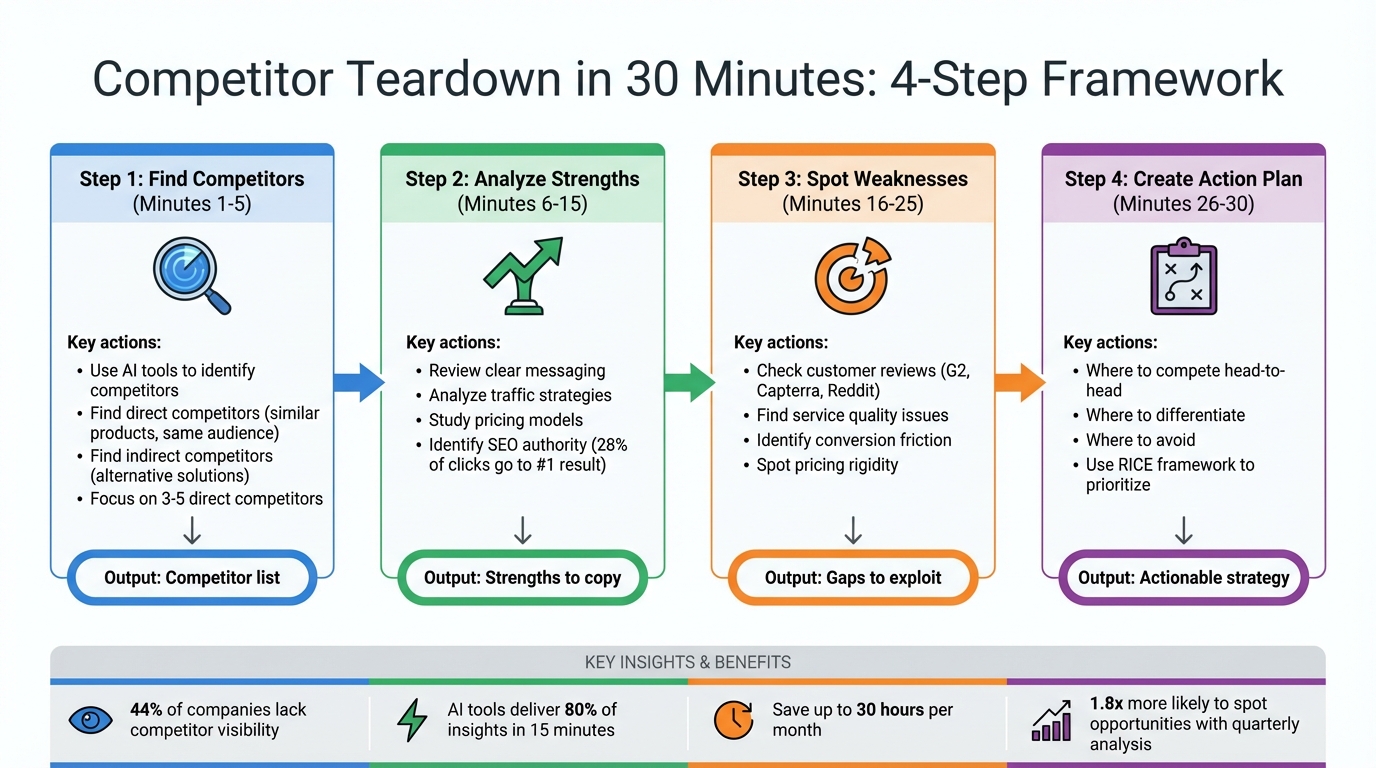
30-Minute Competitor Analysis Framework: 4-Step Process
Step 1: Start Your Competitor Scan (Minutes 1-5)
Finding Your Competitors
With IdeaFloat's tool, mapping out your competitors becomes quick and efficient. Instead of manually combing through search results, the tool gathers data from websites, social media, reviews, and even job listings to pinpoint your competition.
It identifies two types of competitors: direct competitors (businesses offering similar products to the same audience) and indirect competitors (those providing alternative solutions to the same problem). For instance, if you're creating a project management app, your direct competitors would be other SaaS tools, while indirect competitors could include physical planners or even Excel templates.
"AI doesn't have your biases. It doesn't know which competitors you fear or respect. It just processes patterns." - Rodney Warner, Blog Author
This bias-free analysis can reveal emerging competitors that might otherwise go unnoticed. The tool doesn’t favor established brands; it simply highlights anyone vying for your audience's attention. To keep your findings manageable, focus on 3-5 direct competitors. This narrow scope ensures you're collecting insights you can act on right away.
Once your competitors are identified, the next step is to figure out which metrics will give you the clearest picture of their market position.
Choose Your Analysis Metrics
Focus on key metrics like pricing, product features, customer sentiment, and digital presence.
IdeaFloat simplifies this process by analyzing homepage content, service descriptions, recent social media activity, and customer feedback from platforms like G2 or Google. It synthesizes this data into actionable insights. For example, the tool might uncover that a competitor markets itself to enterprises but primarily receives reviews from small businesses - a potential strategic mismatch you could leverage.
Also, pay attention to where competitors are allocating their resources. Job postings, for instance, can reveal priorities - if they're hiring more sales reps than developers, their focus might be on scaling their sales efforts. Additionally, note what competitors don’t promote in their messaging. These omissions can signal untapped opportunities or weaknesses you could exploit.
sbb-itb-08dd11e
Step 2: Find Strengths to Copy (Minutes 6-15)
Spot What's Working for Competitors
Now that you've identified your competitors and metrics, it's time to figure out what makes them tick. IdeaFloat's analysis highlights three key areas where successful competitors often excel: clear messaging, traffic mix, and pricing strategy.
Start by reviewing their homepage. The best competitors can sum up their audience, the problem they solve, and the outcome they deliver - all in one sentence. This kind of clear value proposition can significantly boost conversion rates, even if the design stays the same. A strong hero section that immediately communicates these points is a proven strength worth taking note of.
Next, dive into their traffic mix. High direct traffic points to strong brand loyalty, a heavy reliance on organic traffic suggests SEO expertise, and significant paid traffic hints at aggressive customer acquisition strategies. For example, if a competitor is dominating the #1 organic search result (which grabs around 28% of all clicks), look into the "intent clusters" they target. Are they excelling in problem-aware searches, or are they winning over high-intent evaluation-stage queries? Knowing this can help you refine your own approach.
Then, take a close look at their pricing strategy. Models that frame pricing around outcomes often encourage customers to pay more. Examples like Stripe's usage-based pricing or Basecamp's flat-rate structure illustrate how different approaches can tap into customer psychology. Pay attention to which model fits your audience best.
Interestingly, the messaging trends for 2025–2026 show a shift from "visionary transformation" to measurable ROI and efficiency. In tighter financial climates, competitors focusing on cost savings and automation are thriving. If this resonates with your market, it’s a direction worth considering.
Once you've noted these strengths, the next step is figuring out which ones align with your business goals.
Pick Which Strengths to Use
Not every competitor strength will suit your business. The key is to focus on those that align with your goals and resources. Ask yourself: Does this strength match what we can realistically achieve?
Start by separating baseline features from true differentiators. Baseline features are standard across the industry, while differentiators are what set a competitor apart. Prioritize differentiators that complement your strategy.
Also, consider the moat factor. Some strengths, like network effects or proprietary data, are tough to replicate. If a competitor's edge depends on years of user data, you may need to find a different way to deliver similar value.
Finally, align these strengths with your strategic position. If you're competing directly, focus on one decisive advantage that matters, like Figma’s real-time collaboration against Adobe. If you're taking a different approach, serve the same market with a unique philosophy, such as Linear's speed-focused design versus Jira's complexity. And if you're targeting a niche, choose strengths that let you dominate a specific segment.
These insights will help shape your action plan in Step 4. Below is a summary of actionable competitor strengths you can adapt.
Comparison Table: Top Competitor Strengths
| Strength Description | Evidence from Data | Copy Strategy |
|---|---|---|
| Outcome-Framed Pricing | Pricing tiers based on ROI or usage units, boosting willingness to pay | Rename pricing tiers to reflect customer outcomes (e.g., "Starter Growth" instead of "Basic Plan"). |
| High-Clarity Hero Section | Homepage clearly states audience, problem, and outcome; lowers bounce rates | Rewrite your headline to highlight who you serve and the problem you solve. Test outcome-focused variations. |
| Vertical Specialization | Industry-specific landing pages and case studies | Identify a niche market and create tailored landing pages with language that resonates with their needs. |
| SEO Authority on Keywords | Leads in high-intent search results, capturing 28% of clicks | Target high-intent keywords. Develop comparison content to position your solution as the better choice. |
| Minimalist Onboarding | Simplified signup process reduces friction | Streamline your signup by cutting unnecessary fields. Move qualification questions post-signup. |
Step 3: Find Weaknesses to Avoid (Minutes 16-25)
Identify Common Mistakes
While it's important to mimic a competitor's strengths, steering clear of their flaws is just as critical. The next step is to uncover where competitors fall short. Although competitor websites often present polished surfaces, platforms like G2, Reddit, and Capterra can reveal the raw, unfiltered truth about customer experiences.
Focus on low-rated reviews from sources like G2, Capterra, Trustpilot, and forums such as Reddit or Twitter. These reviews often highlight recurring complaints and major pain points - issues that can drive customers to cancel. Common weaknesses include inconsistent messaging (e.g., branding as "enterprise-grade" but primarily serving small businesses), declining service quality, or frustrating conversion processes like slow-loading pages or overly complicated forms.
Pay attention to patterns in who’s complaining. Are certain roles or company sizes more vocal? These trends can point to underserved segments. Even competitor job postings can offer clues - multiple openings for customer success managers may hint at internal struggles like retention issues.
"Competitor analysis isn't about documenting what competitors do. It's about finding strategic opportunities they've missed." – NxCode Team
AI tools can speed up the process by identifying recurring phrases or themes in reviews. Look for messaging gaps - competitors who fail to emphasize ROI, efficiency, or measurable outcomes are leaving room for others to step in. In fact, 40% of companies using generative AI for analysis say it has shortened deal cycles by 30–50%.
These insights provide the foundation for turning competitor weaknesses into opportunities for your business.
Turn Weaknesses into Your Advantage
Once you've pinpointed competitor vulnerabilities, the next move is turning them into advantages. Address the exact problems their customers are complaining about and position your business as the solution.
Start with structural weaknesses - those deeply rooted in a competitor's strategy or design that aren't easy to fix. For example, if a competitor targets enterprise clients but their reviews reveal frustration from small businesses, focus on dominating the SMB market with simpler pricing and faster onboarding. This approach has more staying power than chasing quick fixes.
If competitors are struggling with feature overload or declining service, position yourself as the streamlined alternative. For example, if they rely on outdated messaging and chatbot-only support, differentiate by offering dedicated account managers or superior customer service. With 63% of buyers checking online reviews before making a purchase, fixing these service gaps can create clear opportunities to win over their customers.
Also, look for overlooked distribution channels. If competitors aren't using AI-powered search tools like ChatGPT or niche forums, dive into those spaces. Similarly, if they’re wasting budget on irrelevant PPC keywords or have poor backlink strategies, outmaneuver them by being smarter and more targeted.
Tackle pricing inflexibility by offering clear and adaptable models. Consider a positioning statement like: "For [target customer], [Your Product] is the [category] that [unique value prop], unlike [competitor] which [their limitation]".
Comparison Table: Key Competitor Weaknesses
| Weakness Description | Customer Impact Evidence | Avoidance Tactic for Your Business |
|---|---|---|
| Strategic Confusion | Mismatch between "enterprise-grade" marketing and SMB-focused case studies. | Commit to one segment and align messaging, pricing, and features. |
| Service Decline | Reviews mention product "used to be great" and point to chatbot-only support. | Offer dedicated account managers or enhanced human support. |
| Conversion Friction | High abandonment rates due to multi-field forms or page loads over 100ms. | Streamline signups to 2–3 fields and optimize for sub-100ms responsiveness. |
| Pricing Rigidity | Complaints about expensive, complex solutions or lack of flexible tiers. | Implement usage-based or flat-rate models with clear, outcome-focused tiers. |
| Content Gaps | Thin, rapid-fire product posts leading to weak organic traffic. | Invest in detailed guides targeting high-intent keywords competitors miss. |
Step 4: Create Your Action Plan (Minutes 26-30)
List What to Copy and What to Avoid
In these final five minutes, turn your insights into actionable decisions.
Break your findings into three categories:
- "Where to Compete Head-to-Head": These are areas where your strengths give you a realistic shot at winning.
- "Where to Differentiate": This includes gaps in the market where competitors are weak and customer needs remain unfulfilled.
- "Where to Avoid": These are territories where competitors hold an overwhelming advantage, making it impractical to challenge them.
Data shows that product teams conducting structured competitive analysis every quarter are 1.8x more likely to spot market opportunities ahead of competitors.
To prioritize your next steps, consider using the RICE framework - Reach, Impact, Confidence, Effort. This method helps you focus on the feature gaps that matter most. Resist the urge to copy every feature your competitors offer. Instead, concentrate on creating solutions that align with your vision and address underserved customer needs.
"The business that wins isn't the one with the most features or the lowest price. It's the one that finds and owns the position competitors can't or won't take." – Rodney Warner, Strategist
With your priorities set, the next step is weaving these insights into your overall strategy.
Apply Insights to Your Business
Now, use these insights to refine your market approach and strengthen your business strategy. Tools like IdeaFloat can help you integrate these findings effectively.
Start with your Unique Value Proposition (UVP). Use this positioning formula:
"For [target customer], [Your Product] is the [category] that [unique value prop], unlike [main competitor] which [their limitation]".
For example, if competitors rely heavily on chatbots and struggle with declining service quality, you could position yourself as the alternative offering personalized support through dedicated account managers.
Next, validate your opportunity with Market Sizing. Create a 2x2 positioning map - like Ease of Use versus Feature Depth - to identify untapped customer segments. If competitors are clustered in a high-price, high-complexity quadrant, this could signal a demand for simpler, cost-effective solutions.
Use competitor pricing data to refine your Financial Models. Identify the "floor price" (lowest viable price), "ceiling price" (highest price charged), and the "sweet spot" (where most competitors land). If competitors struggle with rigid pricing, consider flexible options like usage-based or flat-rate models to stand out.
Finally, translate these insights into your Go-to-Market Strategy. If competitors are ignoring specific distribution channels - like AI-powered search tools or niche forums - make these a priority. Equip your sales team with battle cards that address common objections and even acknowledge when a competitor might be a better fit. This transparency can build trust with prospects.
To ensure follow-through, assign clear owners and deadlines to each action item. Companies leveraging AI for strategic analysis report deal cycles that are 30% to 50% shorter. Without accountability, even the best analysis risks becoming just another unused dataset.
Conclusion
Key Takeaways
A 30-minute competitor analysis isn't about creating an overwhelming report. Instead, it focuses on condensing 15–30 hours of research into a streamlined process that delivers about 80% of the critical insights.
Here’s the framework: spend 5 minutes identifying competitors, 10 minutes pinpointing strengths, 10 minutes identifying weaknesses, and 5 minutes crafting your action plan. AI tools play a big role here, automating data collection and spotting patterns, which can save a lot of time compared to doing everything manually.
The real game-changer? Making this a regular habit, not a one-off task. Teams that perform structured competitive analysis every quarter are 1.8x more likely to identify market opportunities before their competitors. Focus on uncovering deeper structural weaknesses - like a product designed for enterprise users that struggles to serve small businesses - rather than chasing temporary feature gaps that competitors can easily replicate.
"The goal of competitive analysis is not to find a market where you have no competition. That market doesn't have customers either." - AI Shortcut Lab Editorial Team
Use these insights to sharpen your strategy and stay ahead of the competition.
Next Steps with IdeaFloat
IdeaFloat’s Competitor Analysis tool simplifies your 30-minute competitor analysis. It maps out competitors, evaluates strengths and weaknesses through reviews and messaging trends, and highlights clear positioning gaps.
Rather than manually sifting through websites, review platforms, or social media, IdeaFloat delivers a structured competitive intelligence report with reliable sources. From there, its Unique Value Proposition tool helps you craft a positioning statement that resonates with customers, while the Go-to-Market Strategy feature translates insights into actionable acquisition plans and tactics.
Start your analysis today and replace guesswork with a market position built on solid data.
How To Do Marketing Competitor Analysis (& What To AVOID)
FAQs
Which 3–5 competitors should I analyze first?
Start by identifying competitors that have a direct influence on your market and impact how your brand is positioned. Pay close attention to those with a strong presence, standout products, or high visibility within your industry. Focusing on 3–5 major players is usually enough to gather meaningful insights without becoming overwhelming.
What data sources should I trust most for strengths vs. weaknesses?
To craft a strong strategy, use data sources that offer quantifiable insights into how your competitors are performing. Pay attention to key metrics like traffic trends, demand distribution, and audience demographics. Also, keep an eye on major market signals - things like funding announcements, new product launches, or pricing adjustments. These indicators can help you pinpoint both strengths and gaps in your competitors' approaches, giving you the edge you need to fine-tune your own strategy.
How do I turn findings into a prioritized action plan with RICE?
To build an action plan using the RICE method, here’s how you can approach it:
- Categorize insights: Start by identifying the most meaningful findings, such as shifts in strategy or updates in marketing approaches. These are the areas that can drive the most change.
- Score insights with RICE: Use the four RICE factors - Reach, Impact, Confidence, and Effort - to evaluate each insight. This scoring helps you objectively assess their potential value and feasibility.
- Prioritize and act: Once scored, rank the insights based on their RICE scores. Begin tackling the tasks with the highest scores first to ensure your efforts lead to the greatest results.
Related Blog Posts
 Report an issue
Get the newest tips and tricks of starting your business!