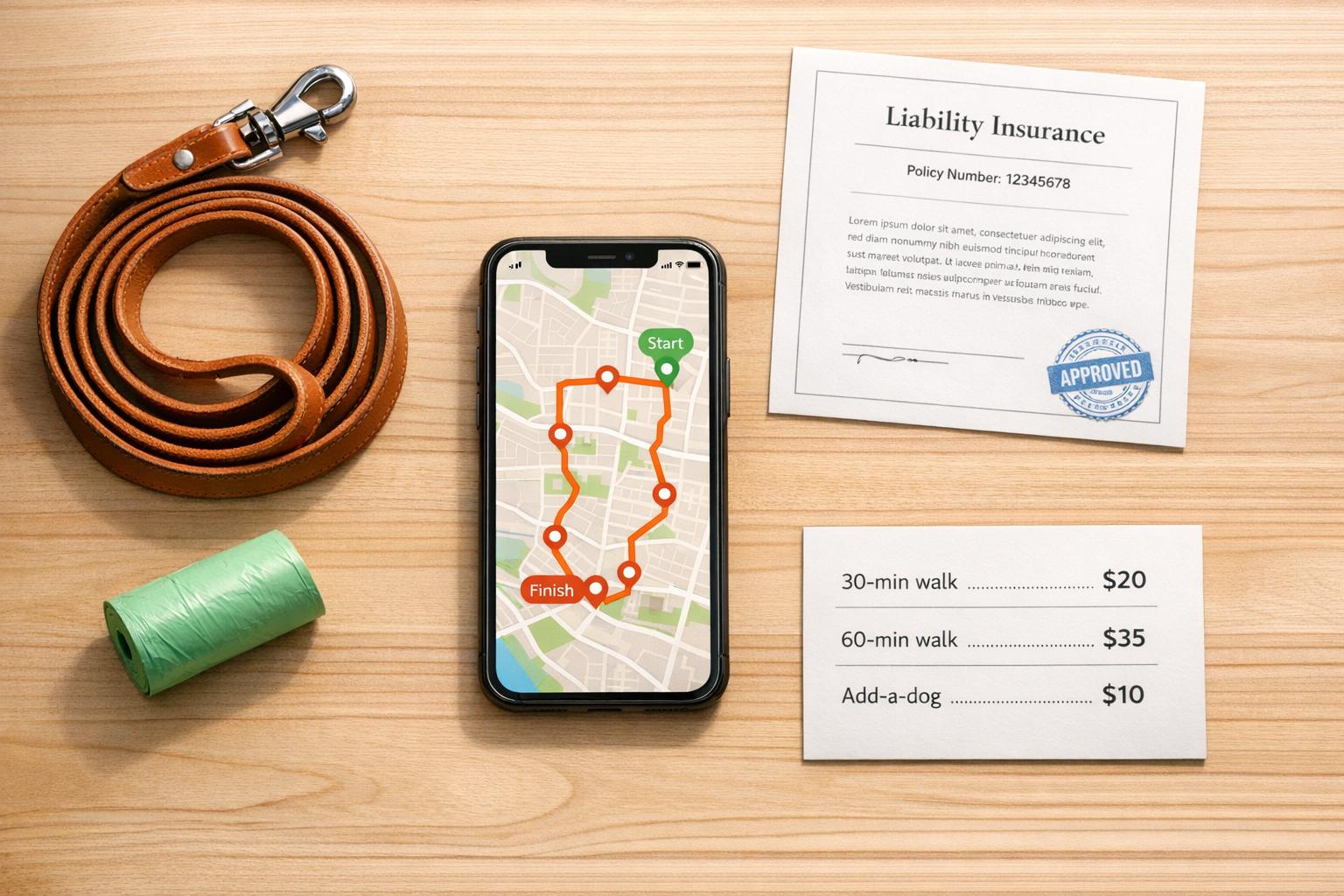
If you're thinking about starting a dog walking business, here's what you need to know upfront:
- Startup Costs: Expect to spend $500–$2,000 for essentials like insurance, equipment, and certifications. Scaling with employees or apps? Costs can jump to $5,000+.
- Insurance: Protect yourself with general liability ($15–$42/month), animal bailee coverage ($35/month), and bonding ($5–$15/month). Add workers' comp and commercial auto insurance if needed.
- Pricing: Average rates for a 30-minute walk are $24–$34. Use models like cost-plus or package pricing to ensure profitability. Add surcharges for extra dogs or holidays.
- Route Planning: Group walks geographically to save time and fuel. Tools like Google Maps or scheduling software can help streamline operations.
- Certifications: First aid and CPR training ($25–$75) boost credibility and client trust. Joining professional groups can also help.
How to Start a 6-Figure Dog-Walking Business (COMPLETE GUIDE)
sbb-itb-08dd11e
Insurance Requirements for Dog Walking Businesses
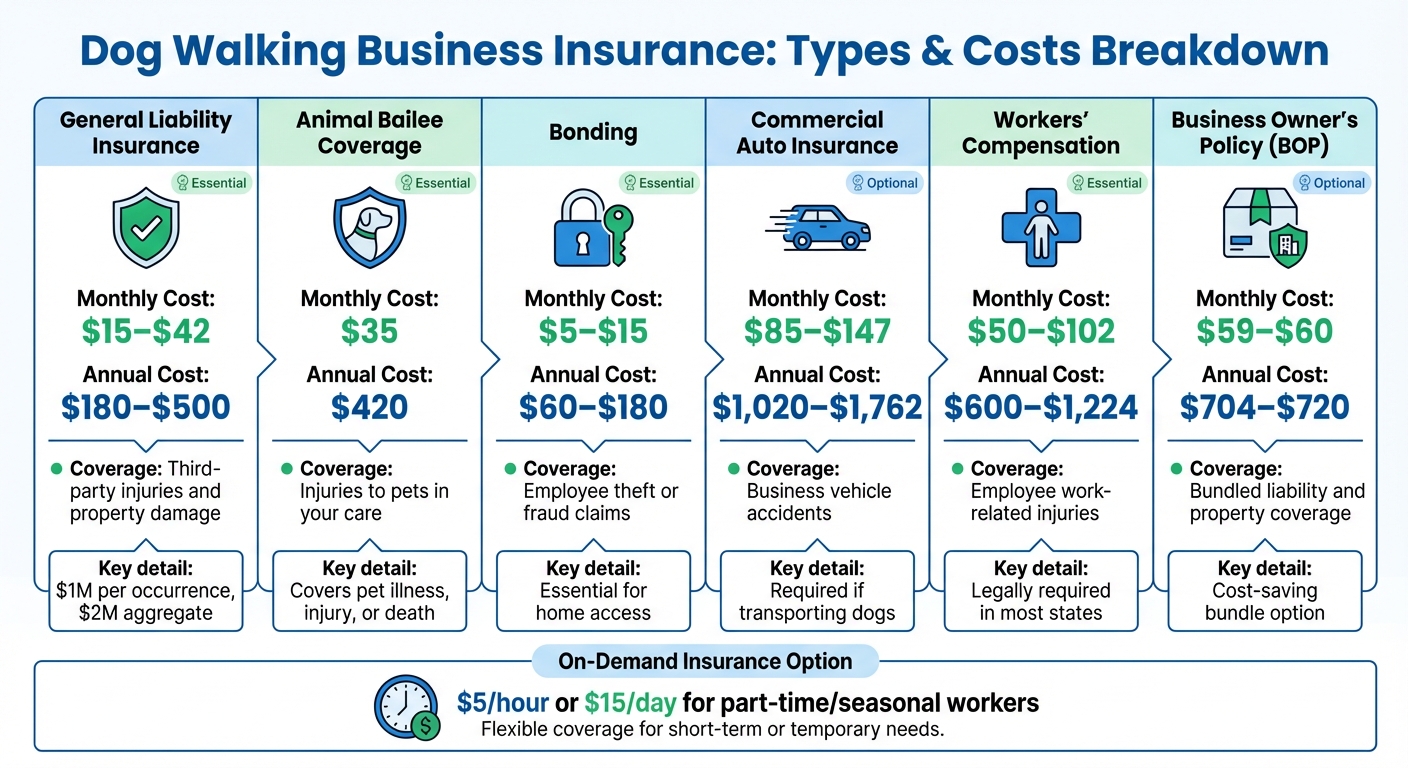
Dog Walking Business Insurance Types and Costs Comparison
Insurance is a key safeguard for dog walking businesses, offering protection against lawsuits, medical expenses, and property damage claims. Without it, a single incident could drain your finances or even shut down your business. Plus, many pet owners prefer hiring insured walkers, and some service platforms require independent coverage.
Types of Insurance and Their Costs
General Liability Insurance is essential for covering third-party injuries and property damage. For example, if a dog you're walking bites someone or damages a client's furniture, this policy can help cover legal fees and settlements. Monthly premiums range from $15 to $42 (or $180 to $500 annually), with coverage limits typically set at $1 million per occurrence and $2 million in aggregate.
However, general liability policies often exclude claims related to the animals in your care. That’s where Animal Bailee Coverage (also called Pet Protection) comes in. This policy covers injuries, illnesses, or even the death of pets under your care. It usually costs around $35 per month (or $420 per year).
Bonding is another layer of protection, particularly if you or your employees have access to clients' homes. It covers allegations of theft and typically costs between $5 and $15 per month. Diana Ludwiczak, CEO of Wolfie's Place, emphasizes its importance:
I would suggest getting pet insurance and bonding. Having this will let your clients know that you take the safety of their dog very seriously.
If you transport dogs as part of your business, your personal auto insurance likely won’t cover incidents. In this case, you’ll need Commercial Auto Insurance, which costs between $85 and $147 per month (or $1,020 to $1,762 annually).
For businesses with employees, Workers’ Compensation is legally required in most states. It covers medical bills and other costs if an employee is injured on the job. Monthly costs typically range from $50 to $102.
Many dog walkers opt for a Business Owner’s Policy (BOP) to save money. This bundles general liability and property insurance into a single package, costing about $59 to $60 per month (or $704 to $720 annually).
If you work part-time or seasonally, on-demand insurance offers a flexible option, with rates starting at approximately $5 per hour or $15 per day.
| Insurance Type | Monthly Cost | Annual Cost | What It Covers |
|---|---|---|---|
| General Liability | $15–$42 | $180–$500 | Third-party injuries and property damage |
| Animal Bailee | $35 | $420 | Injuries to pets in your care |
| Bonding | $5–$15 | $60–$180 | Employee theft or fraud claims |
| Commercial Auto | $85–$147 | $1,020–$1,762 | Business vehicle accidents |
| Workers' Compensation | $50–$102 | $600–$1,224 | Employee work-related injuries |
| Business Owner’s Policy | $59–$60 | $704–$720 | Bundled liability and property coverage |
Why Dog Walkers Need Insurance
Dog walking comes with risks, from dog bites to property damage. These incidents can result in steep legal fees and unexpected costs. Insurance helps cover attorney fees, court costs, and settlements, protecting your financial stability in the event of a mishap.
Beyond financial security, insurance is often a client expectation. While some service platforms offer coverage for the pet or owner, they may leave you liable for certain risks. Common issues include dog bites, property damage caused by pets, pet health emergencies, and even lost keys. Without proper coverage, you could be personally responsible for these expenses.
Certifications and Their Benefits
Though not legally required, certifications like Pet First Aid and CPR can enhance your credibility. Colby Lehew, Owner of Dogletics, underscores their value:
The canine first aid is a must. Most customers will not use you without it.
These certifications generally cost between $25 and $75, depending on whether you choose online or in-person training. They equip you to handle emergencies like choking, heatstroke, or administering CPR. Plus, being certified can sometimes lead to insurance discounts and boost client confidence - especially if you join professional organizations like the National Association of Professional Pet Sitters (NAPPS) or Pet Sitters International (PSI).
In addition, adopting safety measures - like using non-slip flooring during pickups, practicing safe animal handling, and utilizing GPS tracking software - can reduce risks and strengthen your business reputation. These proactive steps demonstrate your commitment to safety and reliability in every aspect of your work.
How to Price Your Dog Walking Services
When setting your dog walking rates, make sure they cover all your expenses - like insurance, fuel, supplies, and taxes - while staying competitive in your area. In 2024, the average cost for a 30-minute dog walk in the U.S. was $29.50, with rates typically ranging from $24 to $34 depending on factors like location and experience. From there, consider different pricing strategies to find the best fit for your business needs.
5 Pricing Models for Dog Walking
Different pricing models work better at various stages of your business. For instance, cost-plus pricing ensures profitability by adding a profit margin to your total expenses (think labor, fuel, and overhead). This approach makes sure every walk earns you more than it costs to provide.
If you're just starting out in a crowded market, competitive pricing might be a better fit. By matching the average rates of local competitors - often found on platforms like Rover - you can attract clients without pricing yourself out of the market.
For those offering premium services like GPS tracking, photo updates, or professional certifications, value-based pricing allows you to charge higher rates, often $35 or more per walk. Penetration pricing, on the other hand, focuses on rapid growth, using tactics like "First Walk Free" to quickly build a client base. Lastly, package pricing bundles multiple walks at a discount or offers flat monthly rates, encouraging long-term loyalty and steady income.
Here’s a quick overview:
| Pricing Model | Best For | Example |
|---|---|---|
| Cost-Plus | Ensuring every walk is profitable | $20 base + $9 overhead = $29/walk |
| Competitive | New businesses in crowded markets | Match local average of $30/walk |
| Value-Based | Premium services with added features | $40/walk with GPS tracking & updates |
| Penetration | Attracting new clients quickly | First week free or 50% off first month |
| Package/Subscription | Encouraging long-term client retention | $400/month for 20 walks |
Setting Rates That Cover Your Costs
Start by calculating your target hourly earnings. For example, if a 30-minute walk plus 15 minutes of travel time equals $40 per hour, you’ll need to charge at least $30 per walk before factoring in overhead costs. Make sure to include both fixed costs (like insurance and software) and variable costs (fuel, supplies, and payment processing fees).
Don’t forget to account for travel, administrative work, and scheduling time in your calculations. Reducing travel time by grouping walks in the same neighborhood can significantly increase your hourly earnings. Additionally, set aside about 15% of your gross income for self-employment taxes.
Michael Grenier from Time To Pet highlights why proper pricing is vital:
Ensuring you are charging the correct amount for your services has become even more critical over the past few years. The global economy, inflation, the threat of recession, and various other factors have significantly impacted pet care professionals.
To boost profitability without increasing your base rates, consider adding surcharges. For example, charge $2–$10 for each additional dog in the same household or $5–$10 for holiday or weekend walks. Keep pricing straightforward by including small tasks - like watering plants or collecting mail - within your standard fee rather than itemizing them.
After determining your base rates, compare them to local market prices to ensure they’re competitive.
Researching Local Market Prices
Take the time to research your competitors' rates. Visit their websites and save screenshots of their pricing pages. Be aware that many use vague language like "starting at…" to mask actual costs. To make accurate comparisons, categorize competitors by type, such as solo operators versus businesses with employees.
Jason Hofmann, owner of 203 Pet Service, describes the challenge:
Shopping for a dog walker feels like buying a car. Everyone has different pricing structures, hidden fees, and vague "starting at…" language.
You can also use free tools like Time To Pet's Dog Walking Rate Calculator, which provides state and national averages based on your zip code. Social media groups for pet owners in your neighborhood are another great resource for understanding what services people value and what they’re willing to pay.
Update your research quarterly to stay aligned with market trends. Pay attention to whether competitors employ W-2 workers or 1099 contractors, as businesses with W-2 staff often charge higher rates to cover extra costs like workers' compensation and training. Look for opportunities to offer additional services, such as administering medication or providing behavioral training, which can bring in around $10 for a 20-minute session.
Planning Efficient Walking Routes
Planning your walking routes carefully can save on fuel costs and allow you to complete more walks each day. Much like having the right insurance and pricing strategies, efficient routing is key to managing expenses and boosting profits. By grouping clients within the same neighborhood - a technique known as "clustering" - you can cut down on unnecessary driving. As John Reh from Pet Business Masters points out:
Going back and forth between homes unnecessarily is a time killer and money waster.
When you organize your routes geographically, you reduce gas expenses, limit wear and tear on your vehicle, and increase the number of appointments you can handle in a single shift. This approach to routing is as critical to your bottom line as managing your insurance and pricing strategies.
Fuel and Vehicle Maintenance Costs
The cost of fuel and vehicle upkeep depends on how far you drive, with local travel reimbursements ranging from $600 to $4,500 depending on the density of your service area. Keeping track of metrics like "walks per mile" can help you pinpoint areas where excessive driving is eating into your profits.
Tools for Route Optimization
If you’re looking for tools to streamline your routes, Google Maps is a free and simple option for mapping client locations and comparing drive times. For more advanced needs, platforms like Time To Pet offer features such as GPS tracking, automated visit reports, and mobile staff management, starting at $20 per month. Jobber, another option, provides route optimization during its 14-day free trial, helping you fit more visits into your day. Amanda Jensen, owner of Golden Hour Designs, shares her experience with scheduling software:
I love the ease of making my team's schedule every week! I can do it from my phone wherever I'm at and that's a game changer for someone who's always on the move like myself!.
Once you have more than three clients, using scheduling software can also help you sidestep the hassle of double bookings.
Permits for Group Dog Walks
Efficient routing isn’t the only thing to consider - following local regulations for group dog walks is equally important. Many cities require permits if you’re walking four or more dogs at once. For instance, in San Francisco, dog walkers need $1 million in general liability insurance and a commercial dog walker permit, which costs $333 initially and $133 annually to renew. In Massachusetts state parks, the permit fee is $100 annually for groups of up to eight dogs. Most areas limit group sizes to six to eight dogs and enforce leash length restrictions, typically no longer than 8 feet . Operating without the proper permits can result in fines: $50 for the first offense, $100 for the second, and up to $500 for further violations within a year. Since some permits may require training hours or vehicle inspections, it’s a good idea to check with your local animal control office early in the process.
Total Startup Costs and Financial Planning
Complete Cost Breakdown
When planning your dog walking business, understanding your initial investment is crucial. For lean operations, startup costs can range between $500 and $2,000, covering essentials like business registration fees ($35–$300), liability insurance (about $15 per month), basic walking equipment (usually under $100), and pet first-aid certification ($25–$100). On the other hand, professional setups with premium branding, advanced equipment, and specialized software may require $2,000 to $5,000 or more.
If you're launching a tech-enabled startup, costs can skyrocket. Developing a custom mobile app, for instance, could cost anywhere from $100,551 to over $244,000, with app development alone averaging around $40,000. These figures highlight the importance of tailoring your budget to your business model and growth goals.
Financial Forecasting Tools
To ensure long-term success, it's essential to plan for ongoing expenses and determine your break-even point. Tools like IdeaFloat's Financial Model can help you create detailed 5-year projections by tracking critical metrics such as your monthly burn rate, contribution margins, and profitability timeline. For example, if your monthly overhead is approximately $15,000 and your contribution margin is 70.5%, you'll need to generate about $21,826 in monthly revenue to break even.
Additionally, the amount of cash cushion you'll need depends on your scaling strategy. An aggressive growth plan might require reserves of around $855,000, while a leaner approach could get by with a much smaller buffer. These financial insights are invaluable for setting up a sustainable operation and preparing for the challenges ahead.
Key Takeaways for New Dog Walking Businesses
Success in the dog walking industry hinges on smart planning and efficient operations. Start with robust insurance to protect your business, and implement strategic pricing models - whether subscriptions, packages, or hourly rates - to stay competitive while covering your costs. Efficient route planning, such as grouping clients in the same area, can save on fuel and maximize the number of walks you can handle daily. Earning proper certifications and prioritizing safety measures not only enhance professionalism but also build trust with your clients. Begin with a lean setup, monitor your finances closely, and expand as your client base grows.
FAQs
How much cash should I save before I start?
It's suggested to have approximately $855,000 set aside as a cash reserve before starting a dog walking business. This amount is based on common startup costs and is intended to cover initial expenses while you get your business up and running.
What insurance do I need first?
To kick off a dog walking business, the first thing you'll need is general liability insurance. This typically runs about $42 per month and provides protection in case of accidents or claims that might happen while you're out walking dogs. It's a crucial step to protect your business and establish trust with your clients.
How many clients do I need to break even?
The number of clients you’ll need to break even hinges on a few key factors: your fixed costs, variable costs, and how much you charge for your services. For example, starting a dog walking business often involves initial costs averaging around $12,887. With a focused and determined approach to gaining customers, it’s possible to recoup those costs and break even in as little as 5 months.
Related Blog Posts
 Report an issue
Get the newest tips and tricks of starting your business!