
When starting a business, aiming for perfection can lead to delays, confusion, and wasted resources. Instead, focus on an "ugly" business model - one that's simple, practical, and revenue-focused. Here's why this approach works:
- Speed to market: Launch quickly to test your idea with real customers.
- Profit-first mindset: Prioritize covering costs and generating income over unnecessary features or branding.
- Simplicity wins: Avoid overcomplicating with excessive features, branding, or pricing models.
- Market feedback: Learn what customers actually want by starting small and iterating based on their input.
An "ugly" business model isn’t unprofessional - it’s about focusing on essentials like solving one clear problem, offering a single product or service, and keeping costs low. This approach minimizes risk, maximizes learning, and ensures you’re building a business that works.
Key takeaway: Start with a lean, functional model that prioritizes profit and customer needs over perfection. Launch, learn, and refine as you grow.
Everything About Lean Startup in 12 Minutes
What Is an 'Ugly' but Profitable Business Model?
An "ugly" business model is all about keeping things simple and focusing on making money while minimizing costs. It's not about creating something flashy or overloaded with unnecessary extras. Instead, it’s about understanding the basics: how revenue comes in, what it costs to operate, and how much profit is left over. In short, it’s a straightforward equation: revenue minus costs equals profit.
The idea here is to solve a real problem for customers and charge for the solution. Before adding bells and whistles, the priority is to validate that your concept works and, more importantly, that it generates income. Only after proving the model's potential should you think about expanding or refining it.
What Makes a Business Model 'Ugly'
An "ugly" business model thrives on efficiency and simplicity. It boils down to four key features:
- Basic Offer: Focus on one main product or service.
- Minimal Branding: Use a simple logo and a clear name that tells people exactly what you do.
- Straightforward Delivery: Make it easy and direct for customers to get your product or service.
- Lean Cost Structure: Spend only on what directly drives sales.
This stripped-down approach allows you to test your assumptions and get real feedback from the market quickly. Instead of guessing what customers might want, you're putting your solution out there and learning from their reactions. As Martin Zwilling, Founder and CEO of Startup Professionals, aptly says:
"A reasonable profit will make your idea a reality for all, rather than a dream".
The focus on minimalism isn’t about cutting corners. It’s about being intentional - keeping things simple without sacrificing quality or professionalism.
'Ugly' vs. Unprofessional
It’s important to distinguish between being "ugly" and being unpolished. An "ugly" business model is deliberately simple but still professional. Essential components like secure payment systems, reliable customer communication, and consistent delivery are non-negotiable. Even if your website is just a single landing page, it should load quickly and clearly explain what you’re offering. Minimal branding doesn’t mean neglecting customer service - it’s about doing a few things exceptionally well.
What Profitability Means for New Businesses
An "ugly" business model prioritizes profitability by cutting out the fluff and focusing on what truly matters. For a new business, profitability isn’t about having huge profit margins right away. It’s about covering your costs and generating enough revenue to grow. This requires a solid understanding of your unit economics - how much it costs to deliver your product or service versus what you’re charging.
Achieving a positive contribution margin and breaking even as soon as possible is critical. Early profitability gives you control and flexibility. With a steady revenue stream, you’re less reliant on outside funding and can make decisions that align with your customers' needs. Tools like IdeaFloat’s Financial Model and Financial Projections & Breakeven Analysis can help you track your progress, showing you where your dollars are going and when you’ll hit profitability.
Why Your First Business Model Should Be 'Ugly'
Starting with something simple can make the difference between survival and failure. Nine out of ten startups fail because they wait too long to launch. This isn’t just a statistic - it’s a wake-up call for anyone starting a business. Your first business model doesn’t need to be perfect; it needs to get you out the door and into the market.
Speed to Revenue vs. Perfection
Every day you delay launching is a day you lose potential revenue and critical insights. 42% of startups fail due to lack of product-market fit, and 36% because they miss the right market timing. These aren't abstract numbers - they reflect the real dangers of waiting too long to test your ideas in the market.
Take Instagram, for example. It began as Burbn, a check-in app with several features. But when the founders noticed users were mostly engaging with the photo-sharing tool, they didn’t waste time trying to perfect an all-encompassing platform. They quickly pivoted, stripped away other features, and focused solely on photo sharing. The result? 1 million users within two months and a $1 billion acquisition by Facebook. This story underscores a key lesson: market feedback is far more valuable than launching with a flawless product.
The goal is simple: launch with a basic solution that solves a problem, charge for it, and use the revenue and feedback to improve. As Investopedia puts it, "A company has to keep the business running until its revenues exceed its expenses". The faster you generate income, the faster you can reinvest in growth - without draining your savings or taking on debt.
The Problems with Over-Complexity
Keeping things simple not only speeds up your launch but also helps you avoid the traps of overcomplication.
Adding unnecessary features or polish doesn’t just delay your launch - it adds costs and confuses both customers and investors. Complicated business models can scare off investors and slow down growth. If you’re pitching a product with a dozen features or a pricing structure that feels like a math problem, you’re making it harder for people to buy in. Complexity creates confusion, drives up expenses, and delays your entry to the market.
Even big companies fall into this trap. 75% of large organizations admit their AI projects stall because they get bogged down by concerns over regulations, ethics, and imperfect data. If companies with deep pockets can get paralyzed by perfection, imagine how much more damaging it is for a startup with limited resources.
Common Perfection Traps to Avoid
To stay competitive, you need to sidestep common pitfalls that can derail your progress.
Here are three traps that frequently sink first-time businesses:
- Over-designed branding: You don’t need an expensive logo, a detailed brand guide, or a perfectly curated social media presence to make your first sale. Colonel Sanders started KFC by selling his chicken recipe to local restaurants - not by waiting to launch a polished franchise. Branding can evolve as your business grows. What matters now is that your customers understand what you’re offering and trust you to deliver.
- Feature-heavy products: Dropbox’s Drew Houston didn’t wait for a fully developed product before testing the waters. Instead, he released a simple video demo to gauge interest and secure funding. The takeaway? Your first offering should solve one problem really well - not ten problems poorly.
- Complicated pricing: Fancy pricing models with multiple tiers, add-ons, and usage-based fees might seem impressive, but they often confuse customers. Start with one clear price that delivers one clear outcome. You can always refine your pricing later as you learn more about what customers value. Tools like IdeaFloat’s Advanced Pricing Research can help you set that initial price based on competitor data and proven strategies.
The message is clear: action trumps perfection. Airbnb’s founders, Brian Chesky and Joe Gebbia, didn’t wait to perfect their hospitality concept. They started with a simple website offering air mattresses in their living room to conference attendees. That scrappy first step eventually grew into a multi-billion-dollar company. Your first business model doesn’t need to be pretty - it just needs to be fast, simple, and focused on generating revenue while you learn.
Key Parts of an 'Ugly' but Profitable Business Model
When it comes to building a business quickly, a no-frills, revenue-first approach can help you validate your idea without unnecessary complications.
Core Building Blocks
To get started and begin generating revenue, your business model only needs four key components. First, a clear value proposition - this is the promise you’re making to customers, showing how your product or service solves their problem directly. Second, a specific customer segment - identify the exact group you’re serving and the problem you’re solving for them. Third, a basic pricing strategy - set straightforward pricing from day one to start bringing in revenue. Finally, a simple delivery mechanism - focus on getting your product or service to customers without overcomplicating the process; manual delivery methods often work fine in the beginning.
"The two levers of a business model are pricing and costs." – Investopedia
Stick to these four essentials. Test your idea in the real world to gather feedback and refine as you go. Instead of aiming for perfection, focus on building something functional and learn from the market. To streamline this process, you can use IdeaFloat to validate and improve each element.
Using IdeaFloat to Build Your Model
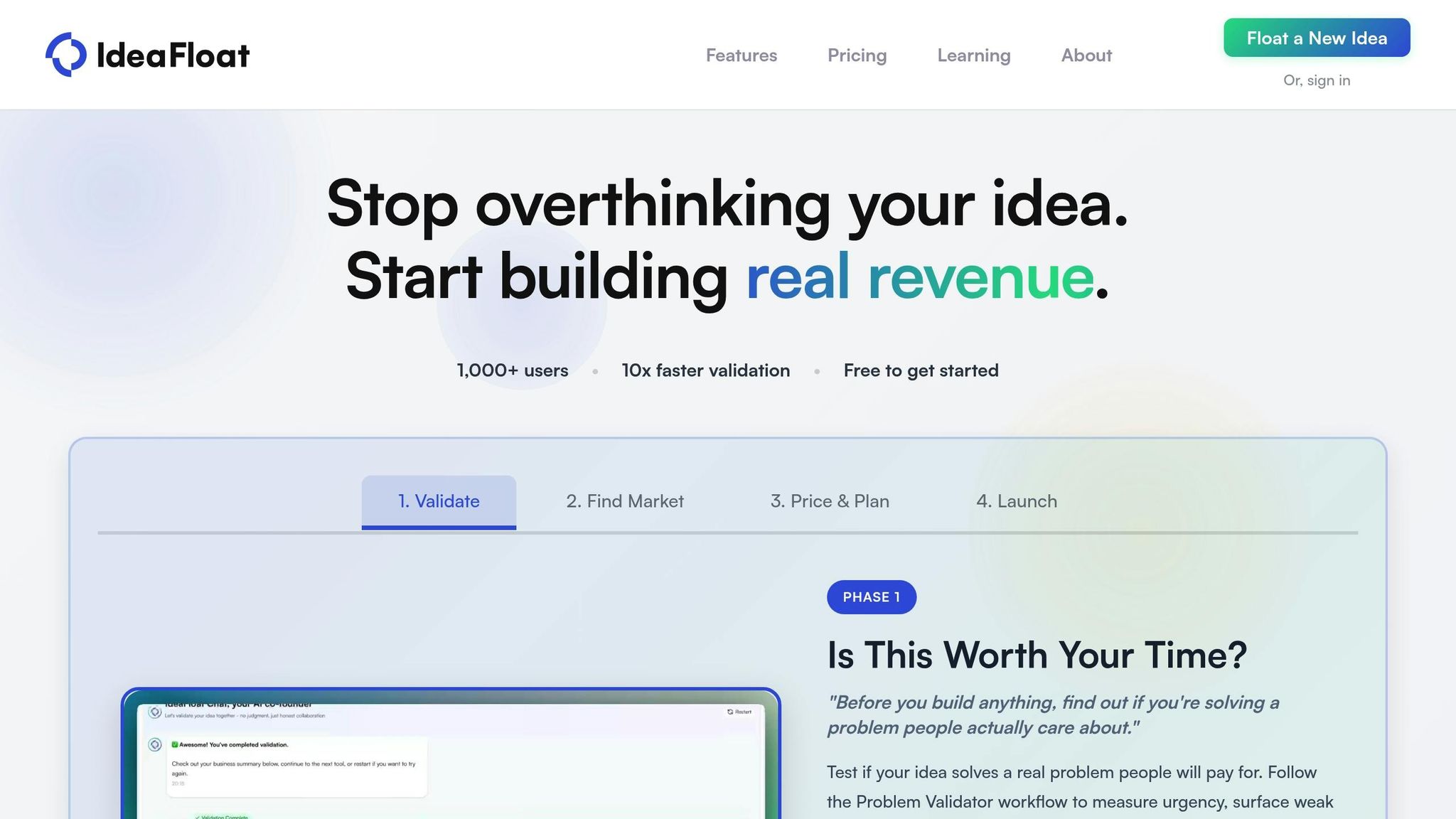
IdeaFloat provides tools to help you validate and refine your business model without getting stuck in endless analysis. The Problem Validator ensures your idea addresses a real, urgent problem people are willing to pay to solve. It helps you recognize weak signals early, saving you time and money. Meanwhile, Smart Market Sizing calculates your total addressable market (TAM), serviceable addressable market (SAM), and serviceable obtainable market (SOM), giving you a realistic picture of your market opportunity in the first year.
The platform also offers a Financial Model to track cash flow and a Cost Analysis tool to estimate both startup and operational expenses. Using the Advanced Pricing Research feature, you can analyze competitor data and apply proven pricing strategies to set prices that balance profitability with market competitiveness.
Once your model is outlined, you can identify which areas demand immediate attention and which can be refined later.
What to Focus on Now vs. Later
Focusing on the essentials first helps you save time and resources. Start with the elements that drive revenue and defer non-critical features for later.
| Component | What 'Ugly' Looks Like | What Can Wait Until Later |
|---|---|---|
| Offer | A single, clear product/service | Additional variations or bundles |
| Branding | Basic logo and name | Detailed brand guidelines |
| Delivery Mechanism | Simple or manual delivery | Fully automated systems |
| Pricing | Basic pricing | Advanced tiered pricing models |
An "ugly" model focuses on outcome metrics that show real results - like customer acquisition rate, conversion rate, and average revenue per user - rather than output metrics like the number of emails sent or features developed. By keeping your attention on these key performance indicators, you can prioritize launching quickly and refining later, rather than getting bogged down in unnecessary details.
sbb-itb-08dd11e
How to Build Your First 'Ugly' Business Model
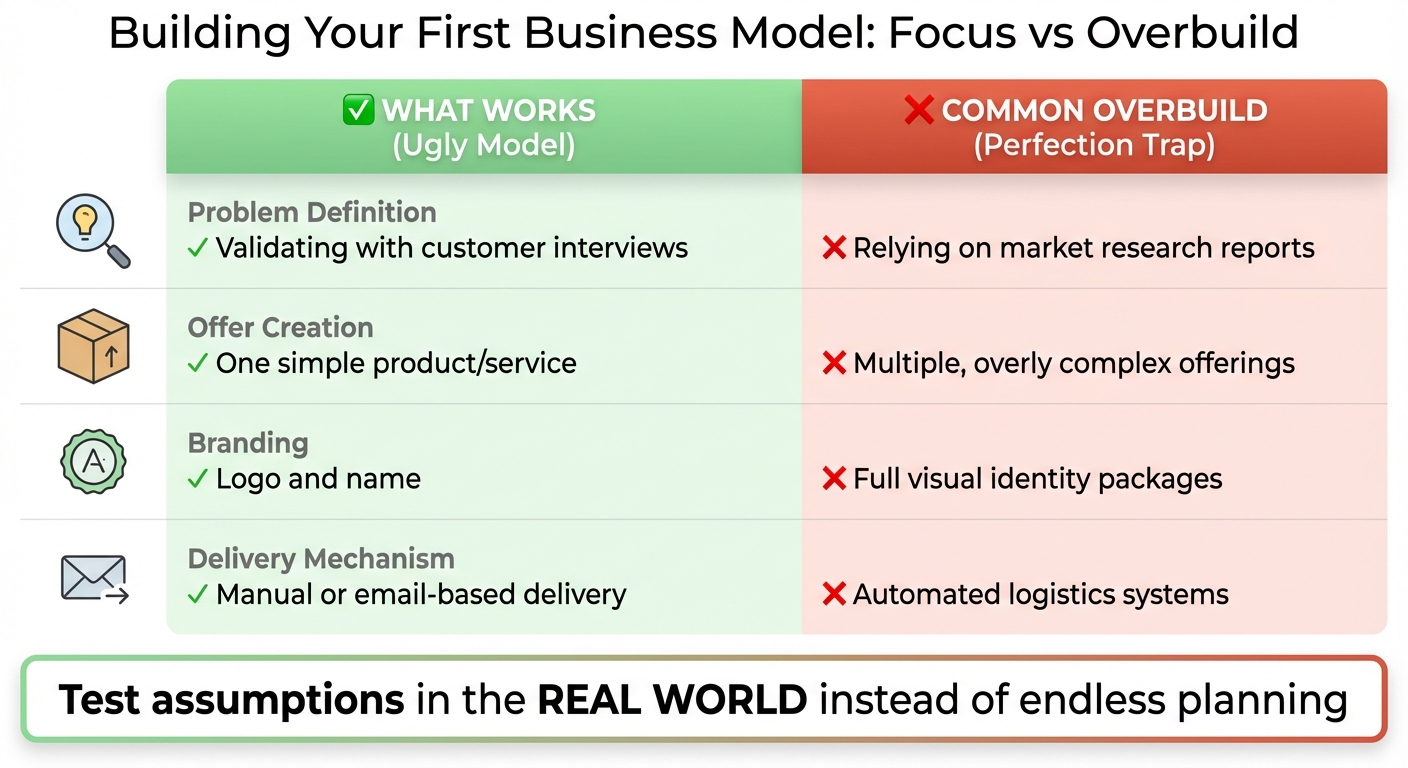
Ugly vs Overbuild Business Model: What to Focus On First
When starting out, your goal should be to create a simple, testable, and revenue-generating business model as quickly as possible. A one-page business model works great for early-stage startups - it helps you understand how your business might work and whether it has the potential to succeed. Think of your business model as a working hypothesis - something that needs to be tested and validated to ensure it solves real problems for your target audience.
Step-by-Step Process
The first step is to identify the problem you're solving. Tools like IdeaFloat can help you validate the problem, estimate startup and operational costs (which typically range between $500 and $5,000 for many ideas), and establish clear pricing. Be specific when defining your customer segment - ask yourself who has this problem and how urgent it is for them. Then, focus on developing a single product or service that directly addresses the issue.
Understanding unit economics is crucial. This means calculating the direct revenues and costs associated with selling one unit of your product or service to a customer. A quick financial check can help you determine if your idea is viable.
Once you’ve validated your basic model, it’s time to align it with a simple branding and marketing strategy.
Basic Branding and Market Strategy
Your branding doesn’t need to be perfect - it just needs to be professional enough to launch. Use tools like IdeaFloat’s Logo Generator to create a polished logo and basic brand identity so you appear credible from the start. Next, set up a Waitlist Landing Page with compelling copy to capture emails and build interest before you officially launch.
For your go-to-market strategy, focus on one or two channels where your target audience already spends time. IdeaFloat’s Go-to-Market Strategy tool can help you identify these channels, calculate customer acquisition costs, and even provide ready-to-use outreach scripts. The Community Launch Map is another helpful resource, offering a customized list of online communities along with prewritten posts to generate buzz and drive traffic. Start with manual outreach - via email, phone, or in-person - before diving into complex automation systems.
Steps vs. Common Mistakes
Many founders lose time and money by overcomplicating things before proving their concept. Here’s a breakdown of what works versus common pitfalls:
| Step | What Works | Common Overbuild |
|---|---|---|
| Problem Definition | Validating with interviews | Relying on market research reports |
| Offer Creation | One simple product/service | Multiple, overly complex offerings |
| Branding | Logo and name | Full visual identity packages |
| Delivery Mechanism | Manual or email-based delivery | Automated logistics systems |
The key is to test your assumptions in the real world instead of getting stuck in endless planning. Many founders underestimate the time and money required to become profitable. Keeping things simple allows you to learn faster, make adjustments, and avoid sinking resources into unproven ideas. Focus on building something functional, test it with real customers, and use their feedback to refine and improve - not chase theoretical perfection.
Tracking Progress and Making Improvements
Once your "ugly" business model is up and running, the real challenge begins: tracking its performance and making changes as needed. The idea isn’t to obsess over every single metric but to focus on a few critical ones that determine whether your business can survive and grow. As Investopedia explains, "Analysts and investors often look at a company's gross profit to evaluate the success of a business model".
Key Metrics to Track
Zero in on a handful of metrics that are essential for keeping your business model sustainable. These include:
- Gross margin: This shows how much profit you keep after covering direct costs.
- Customer acquisition cost (CAC): The cost of gaining a new customer.
- Customer lifetime value (CLTV): How much revenue a customer generates over their relationship with your business.
- Churn rate: The percentage of customers who stop using your product or service.
- Cash flow or net income: A measure of your actual profitability.
By focusing on these metrics, you can assess the efficiency and profitability of your operations without drowning in unnecessary data. Use them to guide decisions and refine your business model.
How to Improve Based on Results
The numbers tell a story - use them to decide whether to optimize, pivot, or even stop. For example:
- If your gross margin is lower than expected, revisit your pricing strategy or look for ways to reduce costs.
- If your CAC is too high compared to your CLTV, explore more affordable marketing options or fine-tune your messaging.
- A high churn rate might indicate dissatisfaction with your product or service, signaling the need for improvements.
- Keep an eye on cash flow or net income to ensure your business is generating real profits.
Tools like IdeaFloat’s Advanced Pricing Research can provide insights to help you adjust pricing based on market trends. Similarly, their Financial Projections tool allows you to model various scenarios before making changes. Remember, a business model is essentially a working hypothesis - it should adapt as you gather real-world feedback.
Take Lego as an example. In the 1990s, the company over-diversified and lost focus on its core strengths. By listening to customer feedback and refocusing, Lego managed a stunning turnaround. By 2009, its net profits had jumped by 63%, and its pre-tax margin rose to 24%.
This kind of continuous feedback loop highlights the strength of an "ugly" business model - it’s designed to evolve with real market data. As Andrew Stotz wisely points out, "Without profit any business will eventually die". The flexibility of this approach allows your model to grow and adapt based on ongoing results and customer feedback.
Conclusion: Start Simple to Build Profitably
Success doesn’t come from chasing perfection - it comes from focusing on what truly matters: profitability and simplicity. An "ugly" business model cuts through unnecessary complexity, zeroing in on generating revenue and validating your idea. As Stotz puts it, profit is the lifeblood of any business. Your initial model should be a flexible framework that grows and adapts with feedback, not a flawless plan set in stone.
By starting with the basics, you’re forced to prioritize speed over polish. This means you can test your idea through soft launches, gather real-world feedback, and fine-tune without wasting time or resources on features you don’t need. A simpler model is not only easier to explain to investors and your team, but it also allows you to pivot quickly when the market demands change.
IdeaFloat’s integrated tools - like the Problem Validator and Smart Market Sizing - help you skip the overthinking stage and move straight to testing and earning. These tools are designed to help you experiment with scenarios and connect with paying customers faster than more traditional approaches.
This approach isn’t static - it’s constantly evolving. A business model should be a living, breathing document, updated regularly to reflect market shifts, customer feedback, and new opportunities. Think of companies like Netflix, Amazon, and Apple. They didn’t succeed by getting everything perfect from the start. Instead, they thrived by staying adaptable, listening to customers, and tweaking their models as they grew.
Start simple. Test your ideas with real customers. Refine based on measurable results. That "ugly" business model? It’s not a compromise - it’s your edge. It gets you into the market faster, helps you learn what works, and sets the foundation for building something profitable over time.
FAQs
What are the advantages of starting with a simple, imperfect business model?
Starting with a straightforward, even rough-around-the-edges business model comes with some clear benefits. It lets you zero in on tackling real customer needs without getting sidetracked by overcomplicating things or chasing perfection. By keeping the focus on functionality and profitability, you can bring your idea to market quicker, cut down on initial expenses, and adapt based on actual customer feedback.
This method also strengthens customer trust by offering practical solutions that deliver results. Rather than striving for perfection right out of the gate, you can channel your energy into creating value and driving revenue - both critical for building long-term success.
How can I keep my simple business model professional and credible?
To keep things professional while maintaining a straightforward business model, focus on three key areas: clear communication, consistent branding, and reliable service. Every interaction with your customers should be handled thoughtfully, ensuring their needs are met and their expectations are respected.
Take time to regularly review your operations to spot opportunities for improvement and make adjustments where necessary. By emphasizing practicality and dependability, you can earn your customers' trust and strengthen your reputation - all without adding unnecessary complexity to your approach.
When is the right time to improve or grow your first business model?
When your business is consistently turning a profit, receiving positive feedback from customers, and running smoothly, it might be time to fine-tune or broaden your initial business model. These are clear signals that your foundation is solid enough to support growth or changes.
Refining your model could mean streamlining operations, upgrading your product or service, or finding additional ways to generate income. On the other hand, expansion might involve tapping into new markets, increasing production capacity, or offering a wider range of products or services. The key is to strike a balance - grow while staying profitable and flexible to keep your business on the right path.
Related Blog Posts
 Report an issue
Get the newest tips and tricks of starting your business!