Want to turn your business idea into paying customers in just 30 days? This step-by-step guide breaks down how to validate your idea, calculate market potential, and secure your first sale - all without overthinking or overplanning. Here’s the plan:
- Week 1 (Days 1–7): Validate your idea by testing if it solves a real problem. Use tools to analyze customer pain points, conduct interviews, and research competitors.
- Week 2 (Days 8–14): Calculate your market size (TAM, SAM, SOM) and outline a clear customer acquisition strategy. Build a landing page to collect leads.
- Week 3 (Days 15–21): Confirm your business can make money. Set prices, calculate costs, and create a simple financial model to ensure profitability.
- Week 4 (Days 22–30): Launch your product, drive traffic to your landing page, and secure your first paying customers.
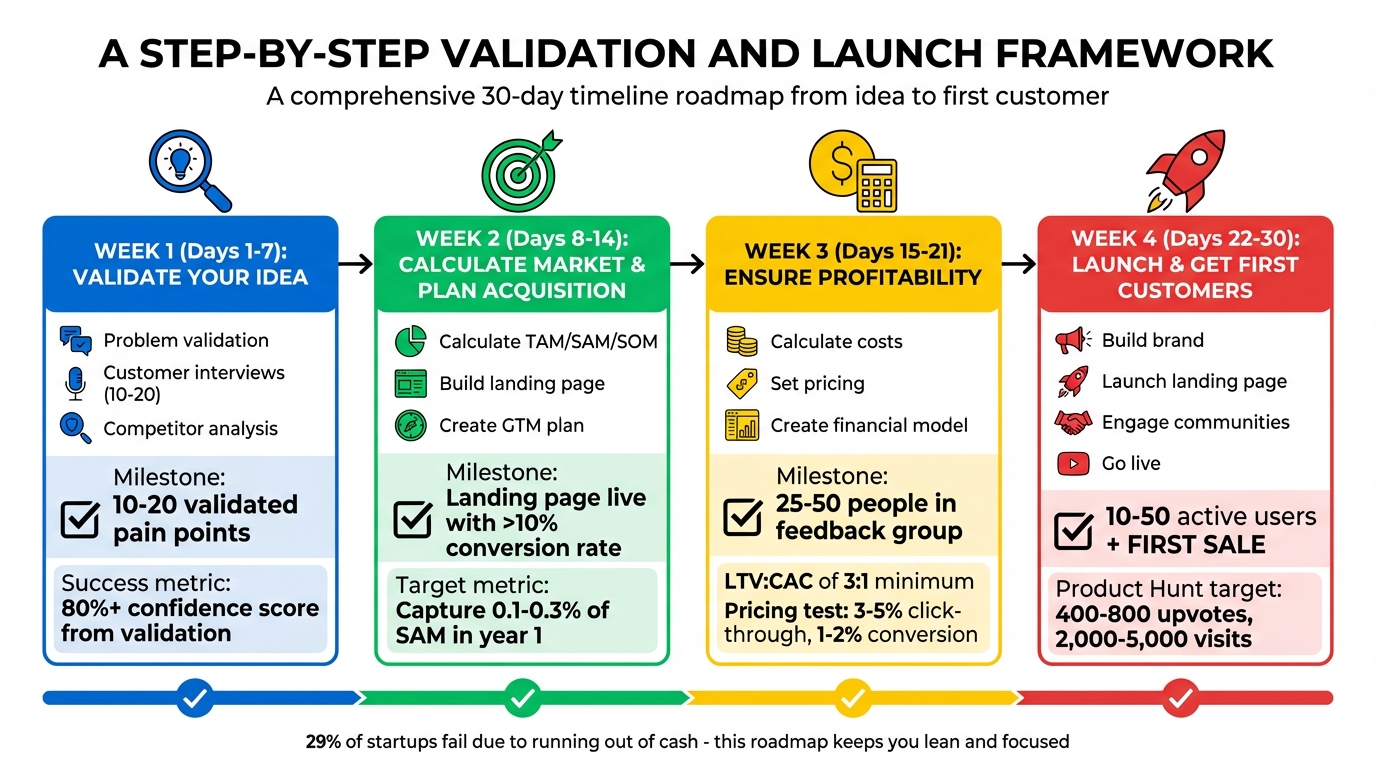
30-Day Startup Launch Roadmap: From Idea Validation to First Customer
How to Get Your First Customers | Startup School
Days 1-7: Test If Your Idea Solves a Real Problem
The first week is all about proving your idea has potential. Instead of chasing perfection, focus on validating whether your target audience truly faces the problem you’re trying to solve - and whether they’re willing to pay for a solution. Thanks to AI tools, this process, which used to take upwards of 40 hours, can now be done in just about an hour. Use this time to gather evidence that will help you decide whether to move forward or pivot.
Test the Problem with the Problem Validator
Start by using IdeaFloat's Problem Validator to gauge how pressing your problem is for potential customers. This tool helps clarify the specific outcome your audience is seeking (often called the "job to be done") and identifies the triggers that push them to search for solutions. To stay focused, write a hypothesis you can test. Use this format:
"We believe [niche] with [pain] will do [action] within [timeframe] because [value]. Success equals [metric threshold]."
Here’s an example: "We believe freelance designers struggling with client contracts will sign up for a template library within 7 days because it saves 3+ hours per project. Success equals 15 email sign-ups."
AI validation platforms can help by analyzing large datasets - like social media trends and customer reviews - and delivering a confidence score. A score of 80% or higher is a good sign. But even if the results show weak signals, such as low urgency or vague pain points, that’s valuable feedback. As Ryan Glasgow explains:
"A great outcome for any startup... is that you determine in the very beginning, or as soon as possible, that it's not worth spending time on".
Once you’ve tested your hypothesis, take the next step: dive into customer conversations to deepen your understanding.
Research Customer Conversations Online
Dig into how your audience talks about their challenges by joining online communities where they gather. Look for Slack groups, Discord servers, Reddit threads, or Facebook Groups that match your target audience. A 2025 survey of 317 founders revealed that 34% struggled with "access to target users" during validation.
AI tools can make this easier by scanning thousands of customer reviews, support tickets, and social media discussions to identify common pain points and overlooked opportunities. You can also use IdeaFloat’s Consumer Insights to analyze these conversations and confirm whether there’s real demand for your idea.
Engage directly by posting open-ended questions like: "I’m thinking of starting a project around [topic]. What’s the biggest problem you face with it?". In addition, aim to conduct 10–20 discovery interviews this week. Send personalized emails or direct messages - about 20 per day - to potential users, requesting brief 15-minute calls. During these conversations, ask questions like:
- "How do you currently handle [problem]?"
- "What’s the most frustrating part of your current process?"
Pay attention to recurring patterns. Are multiple people mentioning the same issue? Are they actively seeking solutions, or are they just tolerating the problem? As Webb Brown and Ajay Tripathy of Kubecost point out:
"When talking to potential customers, their eyes should light up. They should be engaged in the conversation and ready to pull out their wallets on the spot to pay for your solution".
Analyze Your Competition
Wrap up the week by identifying who else is addressing the problem you want to solve - and where they might be falling short. IdeaFloat’s Competitor Analysis can help you uncover competitors, evaluate their strengths and weaknesses, and identify underserved areas. With AI-powered tools, you can even track real-time changes in pricing, product updates, and market positioning.
The goal isn’t to copy what’s already out there. Instead, focus on spotting gaps where your solution can stand out and offer something distinct.
Days 8-14: Calculate Market Size and Plan Customer Acquisition
With your idea validated, it's time to dive into the numbers and outline your strategy for finding customers. This week is all about answering two key questions: How big is the opportunity? and Where will you find your first customers? Getting these answers right will not only help you decide whether to move forward but also provide a clear path to your first sale. These insights will set the tone for a focused and effective launch in the coming weeks.
Calculate Your Market Size (TAM, SAM, SOM)
To understand the potential of your idea, you’ll need to calculate three metrics: TAM (Total Addressable Market), SAM (Serviceable Available Market), and SOM (Serviceable Obtainable Market). These figures will help you gauge the size of the opportunity and the portion you can realistically capture, especially in the short term.
- TAM is the total revenue opportunity available if you could capture 100% of the market, assuming no competition. This is expressed as annual revenue.
- SAM refines TAM into the portion of the market you can realistically reach, factoring in your business model, pricing, and geography.
- SOM is the slice of SAM you can actually capture in the short term, usually within two to five years, considering your resources and competition.
The most reliable way to calculate these is by using a bottom-up approach, which starts with defining your specific customer profile. Instead of something broad like "small businesses", get precise: for instance, "independent restaurants with 10 to 50 employees in the United States." Use real data sources like the U.S. Census Bureau, Bureau of Labor Statistics, or LinkedIn Sales Navigator to determine how many potential customers fit this profile. Then, multiply that number by your estimated average annual revenue per customer.
For realistic targets, aim to capture 0.1%–0.3% of your SAM in the first year and 2%–5% by year five. Focus on the customers you can genuinely reach and convert with your current resources. As one expert explains:
"TAM is not a number of customers but rather dollars per year. Willingness to pay is key."
- LeanB2B
You can also validate your market size using search data. Tools like Google Keyword Planner can reveal how many people are actively searching for solutions like yours, which can signal real demand.
Build Your Go-to-Market Plan
Once you've nailed down your market size, the next step is to create a Go-to-Market (GTM) plan. This tactical roadmap focuses on acquiring your first paying customers and building traction before achieving product-market fit.
Start by identifying the top 3–5 online spaces where your target audience is most active. These could include industry webinars, specific newsletters, or niche platforms. For example, if you’re targeting freelance designers, you might find them in design-focused subreddits, Dribbble communities, or LinkedIn groups. Estimate how much it will cost to reach them and decide between organic outreach (free but time-consuming) or paid ads (faster but requires a budget).
Next, craft your positioning statement to guide your messaging. Use this format:
"For [target customers], [your company] is the [market definition] that delivers [brand promise] because only [your company] is [reason to believe]."
This statement should focus on solving your customer’s pain points rather than highlighting technical features. For instance, instead of saying, "Our AI-powered platform uses machine learning", say, "Save 3+ hours per project with ready-to-use contract templates."
Decide whether to use a product-led approach (where the product itself drives adoption, common in SaaS and B2C) or a sales-led approach (where direct outreach and relationship-building drive conversions, common in complex B2B solutions). For many entrepreneurs launching in 30 days, a hybrid approach works best: use a simple landing page to generate interest (product-led), then follow up personally with each lead (sales-led).
Finally, prepare your outreach messages. Write three variations of a short, personal email or direct message to send to potential customers. Keep the tone conversational and problem-focused:
"Hi [Name], I noticed you’re dealing with [specific problem] in [community]. I’m working on a solution that [specific benefit]. Would you be open to a 10-minute chat?"
Test these messages with 20 people this week and track your response rate. Aim for a reply rate of at least 20%. If your response rate is lower, tweak your messaging and try again.
Days 15-21: Make Sure the Numbers Work
You've validated your idea and figured out how to reach your customers. Now it's time to answer the big question: Can this business actually make money? This week is all about laying down a solid financial foundation. You'll calculate your costs, set prices that people are willing to pay, and build a simple financial model to determine when you'll break even. Get these numbers right, and you'll launch with confidence rather than guesswork.
Add Up Your Costs
Start by listing all your expenses, dividing them into fixed costs and variable costs. Fixed costs stay constant no matter how much you sell - things like rent, software subscriptions, insurance, and salaries. Variable costs, on the other hand, change based on sales volume. These might include raw materials, packaging, shipping, or transaction fees.
"Fixed costs are the expenses that stay the same, regardless of how much you sell or don't sell. For example, expenses such as rent, wages, and accounting fees are typically fixed. Variable costs are the expenses that change in accordance with production or sales volume."
- Ahmet Yüzbaşıoğlu, Co-founder of Peak Plans
Don’t overlook less obvious expenses like office maintenance, equipment repairs, or professional services.
If you're launching a startup within 30 days, expect to spend:
- $50–$500 on setting up an LLC
- $100–$500 per month on no-code tools like Bubble or Webflow
- At least $5,000 if you're hiring freelancers or an agency to build your MVP
One critical step: open a dedicated business checking account. Mixing personal and business finances can lead to tax headaches and make it harder to track spending accurately. To stay on the safe side, aim to have enough cash to cover three to six months of expenses. This buffer is crucial since 29% of startups fail because they run out of money.
Once you've outlined your costs, the next step is to determine pricing that reflects demand and ensures profitability.
Set Your Prices
Pricing isn't just about covering costs - it’s a tool to gauge demand. Don’t wait until your product is finished to test pricing. Use a simple landing page with pricing tiers or a "buy" button to see how many people are willing to pay. A good benchmark: 3–5% of qualified traffic clicking through to pricing, and a 1–2% conversion rate if you're asking for a small deposit (like $5 for a "charter plan").
When deciding on pricing, look at what competitors charge and pay attention to customer feedback. If you hear phrases like "I desperately need this" or "I’d pay anything for this," you might be able to charge 1.8x to 2x more than you initially thought. For B2B products, consider a manual concierge service to test willingness to pay. For example, a data cleanup service charged $299 per CSV repair to five Shopify merchants before automating the process.
"Price is the fastest path to real signal. I use Buy buttons, paywalls or concierge quotes to learn willingness to pay and positioning in one move."
- Alex Robb, Founder, Launching Next
Once you’ve tested pricing, incorporate these insights into a financial model to project your profitability.
Create Your Financial Model
Use a free Google Sheets or Excel template to map out your revenue, expenses, and profit over the first six months. Start with these steps:
- Estimate monthly unit sales
- Multiply by your selling price
- Subtract fixed and variable costs
- Calculate your gross margin (selling price minus variable costs)
- Determine your break-even revenue using this formula:
Break-Even Revenue = Fixed Costs ÷ Gross Margin Percentage
For example, if your fixed costs are $2,000 per month and your gross margin is 50%, you’ll need $4,000 in monthly revenue to break even.
Pay close attention to your unit economics. Understand your Customer Acquisition Cost (CAC) and compare it to the revenue each customer brings in. A healthy Lifetime Value (LTV) to CAC ratio is at least 3:1. If your CAC is higher than the revenue you expect from a customer over 12 months, it’s time to revisit your model.
Review your financial model monthly, updating it with real data from your first customers.
"Creating a financial plan will show you if your business ideas are sustainable... It will also help you plan growth, survive cash flow shortages, and pitch to investors."
- Craig Hewitt, Founder of Castos
sbb-itb-08dd11e
Days 22-30: Launch and Get Your First Customers
You’ve validated demand, tested your pricing, and built a financial model. Now it’s time to launch your product and start acquiring customers. This is where all your preparation comes together. The focus now is on building momentum, not chasing perfection.
Quickly Design a Memorable Logo and Brand Identity
A strong logo and consistent branding can make your business look polished, even if you’re just starting out. But don’t overthink it - speed matters when you're on a short timeline. A good logo should be simple, recognizable, and timeless. Overly complicated designs often dilute the core message of your brand.
Consider using IdeaFloat's Logo Generator to create multiple logo options and brand guidelines in minutes. This tool helps you establish a professional identity without hiring a designer. Plus, it provides a Branding Guide to ensure your colors, fonts, and messaging stay consistent across every channel. From day one, your brand will look cohesive and credible, even if you’re a solo founder.
"Done is better than perfect when it comes to MVPs."
- shipai.dev
Build a Landing Page to Capture Leads
Your landing page is your first impression - it needs to grab attention, collect emails, and build excitement. Start by addressing the exact problem your product solves and use your customers’ own language in the copy. This approach makes your message more relatable and effective.
With IdeaFloat's Waitlist Landing Page tool, you can quickly create a responsive page featuring an email signup form, countdown timer, and customer testimonials. These elements create urgency and build trust. To track performance, set up tools like Google Tag Manager, GA4, and ad pixels (Meta, LinkedIn) right away. Retargeting ads can boost conversion rates by up to 70% compared to standard display ads.
Don’t rely solely on organic traffic. Combine manual outreach with digital campaigns to grow your audience quickly. Personal emails and text messages to your network can help secure your first 25-50 subscribers.
Share Your Launch in Online Communities
Once your landing page is live, it’s time to drive traffic. Start by engaging with targeted online communities where your potential customers hang out. Use IdeaFloat's Community Launch Map to identify these spaces and craft posts that spark interest and conversations.
For startup and developer audiences, focus on platforms like Product Hunt, Hacker News ("Show HN"), and Indie Hackers ("Show IH"). If your product is B2B, LinkedIn and X (formerly Twitter) are key. For consumer-facing products, prioritize Instagram, TikTok, or X. The key is to add value to these communities - engage weeks ahead of your launch and contribute meaningfully before mentioning your product.
"Provide value in every post, not just 'check out my product.' Be authentic about being the founder."
If you’re launching on Product Hunt, timing is critical. Go live at 12:01 AM PST to maximize visibility during the 24-hour voting window. Respond to comments quickly - ideally within 30 minutes during the first two hours. Products in the top 5 on Product Hunt typically receive 400-800 upvotes and generate 2,000-5,000 site visits.
Finalize Your Launch Checklist
To keep everything on track, use IdeaFloat's Launch Checklist. This tool organizes all the tasks you’ve worked on - like setting up automated email sequences and preparing customer support (FAQ, email, or live chat) - into one clear plan.
"Having too many customers can be just as damaging as having none at all... you should always have plans for growth and best-case scenarios in place."
- Elle Kaplan, CEO, LexION Capital
Make sure every link you share includes UTM parameters so you can track which platforms are driving the most conversions. Set up a 5-email automated sequence to nurture new sign-ups, reinforce your product’s value, and start building relationships right away. This checklist ties everything together, ensuring a smooth transition from launch to growth.
30-Day Roadmap: Daily Tasks and Milestones
Here’s a detailed, step-by-step roadmap to help you tackle every essential task over the next 30 days. This plan breaks down daily actions and milestones, ensuring you stay on track to build momentum and achieve measurable results.
By the end of Day 7, you should have conducted 10–20 customer interviews. By Day 14, aim for a landing page conversion rate above 10%. By Day 21, establish a feedback group of 25–50 members. Finally, by Day 30, hit the milestone of 10–50 active users and secure your first sale.
| Day | Action | Milestone |
|---|---|---|
| 1 | Write a one-sentence idea description, define your target customer, and secure a domain name | Clear problem statement and domain registered |
| 2 | Research 5–10 competitors, join 3 relevant communities, and identify a copywriter | Competitive landscape mapped out |
| 3 | Reach out to 20 potential interviewees and choose an email service (e.g., Mailchimp) | Outreach list and email tool set up |
| 4 | Conduct 3–4 customer interviews and create a pre-launch page with a countdown timer | Initial interview insights collected |
| 5 | Complete the remaining interviews, analyze patterns, and set up an email autoresponder | 10+ interviews completed |
| 6 | Categorize features into Must/Should/Could and create a 4-email lead-up sequence | MVP feature list finalized |
| 7 | Write MVP user stories or wireframes and set up social accounts (Facebook, Twitter, LinkedIn) | Week 1 Milestone: 10–20 validated pain points |
| 8 | Decide between no-code tools and a developer; start scheduling social posts using tools like Buffer or Hootsuite | Development path chosen |
| 9 | Sign up for tools or contact developers; engage with niche communities | Development tools or contracts ready |
| 10 | Review developer portfolios or build the first no-code data model; create a product video | Technical foundation initiated |
| 11 | Finalize contracts or build the first no-code workflow; complete your landing page design | Development officially underway |
| 12 | Finalize technical specs and set up ad accounts (Google Ads/Bing Ads) | Ads ready to launch |
| 13 | Set up project management tools (Slack, Trello) and configure Facebook Ads | Team communication tools live |
| 14 | Create hosting/domain accounts and finalize wireframes | Week 2 Milestone: Landing page live with >10% opt-in rate |
| 15 | Begin core MVP development and gather feedback from early beta testers | Initial features built |
| 16 | Build your marketing website (WordPress/Squarespace) and draft user-facing copy | Marketing site structure complete |
| 17 | Set up a professional business email and finalize the onboarding process | Email and onboarding flow ready |
| 18 | Prepare a press kit (bio, logos, images) and plan the launch day schedule | Press materials finalized |
| 19 | Set up analytics tools (Google Analytics/Mixpanel) and find 25 guest posting opportunities | Analytics tracking live |
| 20 | Create a customer support system (email/Intercom) and set up a referral program | Support and referral systems operational |
| 21 | Set up Stripe or another payment processor and launch a promotional contest | Week 3 Milestone: 25–50 people in feedback group |
| 22 | Soft launch to interview participants and explore PR opportunities (e.g., HARO) | First real users onboarded |
| 23 | Gather soft launch feedback, fix critical bugs, and draft a press release | Bug fixes completed |
| 24 | Launch to your personal network (friends and family) and reach out to influencers | Inner circle activated |
| 25 | Launch publicly on social media, post on LinkedIn and Twitter, and conduct website user tests | Public visibility established |
| 26 | Email all interviewees and leads, and directly reach out to potential customers | Email list activated |
| 27 | Engage with startup communities (Reddit, Indie Hackers) and test the ordering process | Community engagement underway |
| 28 | Submit your product to platforms like Product Hunt or Betalist and track signups | Launch platforms submitted |
| 29 | Analyze user engagement and feedback, and update the site with a "contest ended" page | Data analysis completed |
| 30 | Official launch day! Review metrics and plan the next 90-day iteration | Week 4 Milestone: 10–50 active users + first sale |
This roadmap is based on strategies used by successful early-stage founders to validate ideas quickly and on a budget.
Stick to this checklist to keep momentum high and avoid overplanning. If needed, reduce the scope of your project rather than extending the timeline. By following this plan, you’ll turn a validated idea into a functional, revenue-generating business in just 30 days.
Conclusion
You now have a clear, actionable game plan built on three essential pillars: validation (ensuring your problem resonates with real people before you build), financial planning (making sure the numbers add up), and customer acquisition (focusing on attracting actual buyers, not just gathering feedback). These steps have already shown success in early trials.
Speed is your advantage. While others may spend months stuck in planning mode, you’ll be out there learning directly from customers and refining your approach. Historical data highlights the dangers of overplanning. The 30-day timeline forces you to stop overthinking and test your assumptions with real people - not just friends or family. This approach sets you up for fast, focused progress.
IdeaFloat equips you with tools designed for quick validation and launch. From the Problem Validator and Consumer Insights to Smart Market Sizing and Financial Model, every tool is crafted to help you move swiftly from concept to customer. You can even generate your Logo, create a Waitlist Landing Page, and build a Community Launch Map to streamline the entire process.
The daily checklist breaks everything into bite-sized tasks. Stick to it. If you fall behind, scale back the scope instead of extending the timeline. By Day 7, aim to identify 10–20 validated pain points. By Day 14, you should have a landing page with a conversion rate above 10%. By Day 30, your goal is to secure your first sale and attract 10–50 active users. This plan helps you move quickly from validating your idea to acquiring real customers.
Don’t wait. Define your problem in one sentence, register your domain, and start talking to potential customers. Act fast, learn as you go, and build a business that works.
FAQs
How can I validate my business idea in just one week?
Validating your business idea in just a week means figuring out quickly if it solves a real problem that people are willing to pay for. By combining research, feedback, and a simple prototype, you can decide whether to move forward, make adjustments, or hit pause - without wasting time or money.
Start by pinpointing the problem you’re addressing and defining your target audience. Use AI-powered tools to gauge market demand and spot opportunities. Then, connect with potential customers through quick interviews or surveys to better understand their needs and how they talk about the problem. Create a basic prototype - this could be as simple as a landing page or a demo - to present your idea. To test it, use affordable ads to drive traffic to your prototype and monitor key metrics like sign-ups, pre-orders, or other signs of interest.
If the feedback and data show strong interest, you’ll know you’re on the right track. If not, use what you’ve learned to tweak your idea or consider a different approach. This method helps you validate your concept quickly and affordably - often for under $50 and just a few hours of effort each day.
How can I accurately calculate the size of my market?
To figure out your market size accurately, start by defining your Total Addressable Market (TAM) - this is the total demand for your product or service. Next, refine it to your Serviceable Available Market (SAM), which reflects the segment you can realistically target within your first month. Finally, focus on your Serviceable Obtainable Market (SOM) - the portion you aim to capture during your initial outreach efforts.
You can approach this in two ways:
- Top-down approach: Look at industry-wide revenue data from trusted sources and estimate your potential market share based on your specific niche.
- Bottom-up approach: Identify the number of prospects you can reach through channels like email lists, LinkedIn, or niche forums, and multiply that by your anticipated price point.
AI-powered tools can simplify the process, offering real-time data and insights to fine-tune your estimates.
To ensure your numbers are solid, validate them through surveys or interviews to gauge willingness-to-pay and overall demand. Compare your findings with competitor benchmarks and adjust for variables like market saturation or broader economic trends. This way, your projections will be grounded in reality and ready to guide your 30-day launch strategy.
How can I confirm my business idea will make money before launching?
To make sure your business can stand on solid financial ground, start by crunching the numbers on your costs and break-even point. Add up all your expenses - both one-time and recurring - like software subscriptions, marketing efforts, and prototype development. Tally them in U.S. dollars (for example, $12,500). Once you have that figure, figure out how many customers you’d need to break even by dividing your total costs by the price you plan to charge per customer. For instance, if your total costs are $12,500 and your price per customer is $49, you’d need 255 customers to cover expenses ($12,500 ÷ $49 = 255).
After that, it’s time to test your assumptions against real-world data. Start talking to potential customers to understand if they’d actually pay for your product or service. You can also use surveys or even pre-sales to confirm there’s demand. Crowdfunding campaigns or early pre-order offers can be great tools - not just for validation but also as a way to generate some early revenue.
Lastly, assess whether your customer acquisition cost (CAC) is manageable compared to the lifetime value (LTV) of a customer. A good benchmark for most businesses is a CAC-to-LTV ratio of at least 1:3. By combining a clear cost breakdown, realistic projections, and direct feedback from potential customers, you’ll have a much clearer picture of whether your business is financially sustainable before you officially launch.
Related Blog Posts
 Report an issue
Get the newest tips and tricks of starting your business!