
If you're starting a business in Australia, government grants can help reduce costs like R&D, marketing, or commercialization. As of March 9, 2026, over 300 grant programs are available across federal, state, and territory levels. However, competition is tough - only about 7% of applications get funded. Here’s a quick breakdown of active programs:
- Federal Grants:
- Industry Growth Program: Matched funding from $50,000 to $5,000,000 for innovative projects.
- Export Market Development Grants (EMDG): Reimburses 50% of export expenses, offering $20,000–$80,000 annually.
- CSIRO Kick-Start: Matched funding between $10,000 and $50,000 for R&D with CSIRO.
- State Programs:
- NSW MVP Ventures: Grants up to $75,000 for small businesses, with co-contribution requirements.
- Queensland Ignite Ideas Fund: Offers up to $200,000 for scaling businesses.
- WA Wind Energy Manufacturing Grant: Funding up to $300,000 for innovation projects.
Most grants require matched funding and preparation (6–12 months). Deadlines are strict, so plan ahead. Platforms like business.gov.au and GrantConnect can help you find and apply for the right opportunities.
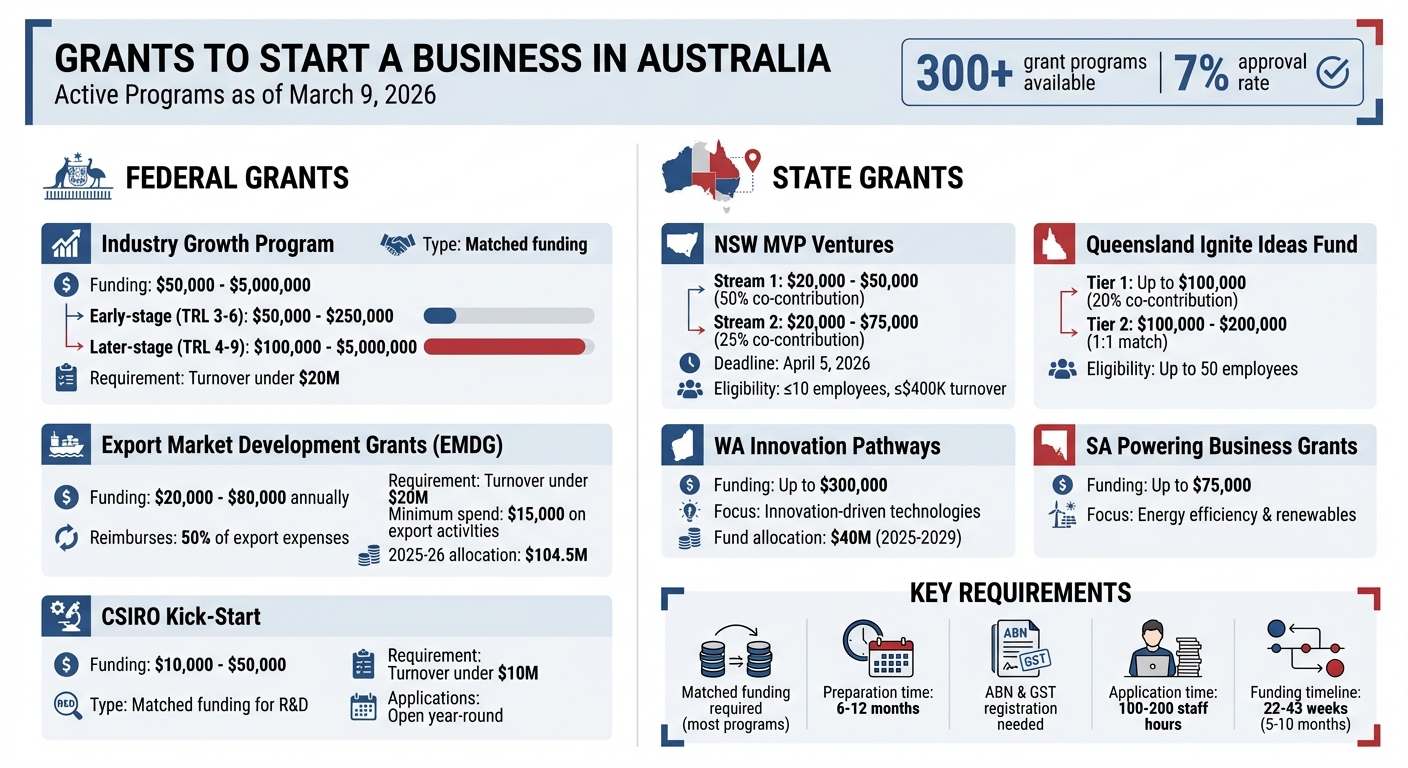
Australian Business Grants Comparison: Federal and State Funding Amounts 2026
Federal Government Grants Currently Accepting Applications
Three federal programs are currently open for matched funding applications. These programs require a dollar-for-dollar cash contribution and cater to businesses at various growth stages.
Industry Growth Program
This program provides matched funding between $50,000 and $5,000,000, depending on the project's development stage. For early-stage commercialization projects (Technology Readiness Level 3–6), funding ranges from $50,000 to $250,000. Later-stage projects (TRL 4–9) can receive between $100,000 and $5,000,000.
Eligibility requirements include:
- Annual turnover under $20 million for the past three fiscal years.
- A valid ABN and GST registration.
- Completion of an Advisory Service through the business.gov.au portal.
Applicants must work with an assigned adviser to receive a tailored report, including an advisory service number, before submitting their grant application. Projects must demonstrate innovation and align with the National Reconstruction Fund priorities, such as renewable energy, medical science, transport, and defense.
For instance, in 2024, Lenexa Medical advanced its AI-based sensor software to help prevent pressure injuries in patients, showcasing the kind of innovation this program supports.
Once commercialization efforts are underway, businesses can explore export opportunities through the next program.
Export Market Development Grants (EMDG)
The EMDG program reimburses 50% of eligible export expenses, offering annual funding between $20,000 and $80,000 for export promotional activities.
Eligibility criteria include:
- An annual turnover of less than $20 million.
- A minimum of $15,000 spent on qualifying export-related activities.
The program operates across three tiers, tailored to a business's export readiness and market expansion goals. Applicants must submit a marketing plan to Austrade during the designated submission period (typically April or May). Missing this window means businesses cannot claim expenses for that financial year. For the 2025–26 financial year, up to $104.5 million is allocated for this program.
CSIRO Kick-Start Program
The CSIRO Kick-Start Program offers matched funding between $10,000 and $50,000 to startups collaborating with CSIRO on research and development projects.
To qualify, businesses must:
- Have an annual turnover under $10 million for the current and previous two financial years, or
- Be operating for less than three years.
Applicants must also have an Australian Company Number (ACN), be GST-registered, and have their main business operations in Australia. Applications are open year-round, starting with an Expression of Interest. Once approved, businesses are paired with a CSIRO researcher to define project objectives. Funding contributions must be in cash, as in-kind support is not eligible.
Businesses can also apply for additional projects, provided the total funding remains under $50,000 and the initial project is complete.
For further funding opportunities, consider exploring state and territory grant programs.
sbb-itb-08dd11e
State and Territory Grant Programs
Australia's states and territories each manage their own grant initiatives, offering varying levels of funding, eligibility requirements, and deadlines. These programs often address specific business needs or demographics, making it crucial to align your business profile with the right opportunity. Like federal programs, these initiatives aim to provide tailored support to meet diverse business demands.
New South Wales: MVP Ventures Program
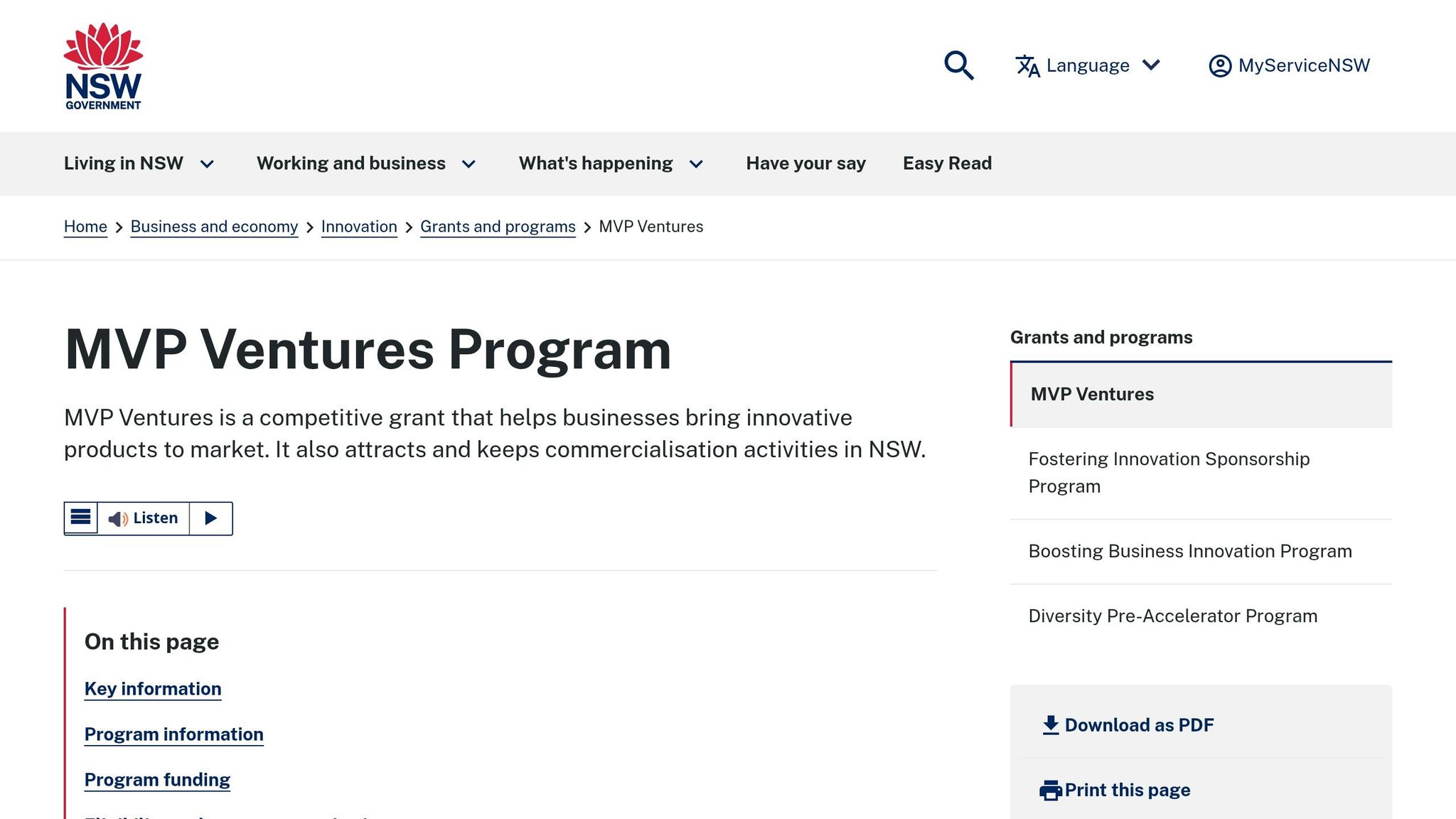
Round 3 of the MVP Ventures Program launched on March 9, 2026, with applications closing on April 5, 2026. The NSW Government allocated $3 million for the 2025–26 fiscal year to help startups and small businesses commercialize innovative products.
The program features two funding streams. Stream 1 offers between $20,000 and $50,000, requiring a 50% co-contribution, while Stream 2 provides $20,000 to $75,000 with a reduced 25% co-contribution for women-owned, regional, or Indigenous businesses. To qualify, businesses must have an active ABN, be based in NSW, employ 10 or fewer full-time staff, and report an aggregated turnover of $400,000 or less over the past three years. Eligible products must fall within Technology Readiness Levels 3 to 9, and at least 80% of the project’s spending must occur within NSW.
Certain expenses face limits: wages and contractor fees can each account for no more than 50% of the grant, and costs for intellectual property or regulatory compliance are capped at $7,500. For example, in Round 1 of 2025–26, 309 applications were submitted, with 28% progressing to competitive assessment. Among the recipients, Affectable Pty Ltd from Waverley received $49,799 for commercialization efforts, and RoboMotion Pty Limited (trading as Verbotics) in Wollongong secured $29,200 to advance its innovative product.
Queensland: Ignite Ideas Fund
The Ignite Ideas Fund in Queensland provides two tiers of funding based on business maturity and needs. Tier 1 offers up to $100,000 with a 20% co-contribution for early-stage businesses, while Tier 2 awards between $100,000 and $200,000, requiring a 1:1 funding match for high-growth businesses ready to scale. Eligible businesses can employ up to 50 full-time staff and must submit letters of intent from potential customers or partners, along with proof of the required co-contribution.
In 2025, Ignite Ideas funding helped Thermal Armour commercialize its Evertec® wearable warming technology, designed to prevent surgical hypothermia, while Brisbane-based Cub Care expanded its pediatric healthcare model with government support. Queensland also offers other programs, including the Business Growth Fund (Round 7, $50,000 to $75,000 for specialized equipment), the Female Founders Co-Investment Fund ($50,000 to $200,000 for women-led startups), and the First Nations Innovation Acceleration Program (up to $100,000 for established First Nations businesses).
Western Australia: Wind Energy Manufacturing Grant
Western Australia’s New Industries and Innovation Fund has allocated $40 million for 2025–2029 to support innovation-driven technologies. Within this, the Innovation Pathways stream provides up to $300,000 to fund accelerator and investor-readiness programs for businesses working on new technologies. Additionally, the state offers Small Business Growth Grants of up to $10,000, requiring 50% matched funding, to support general business expansion projects.
South Australia and Australian Capital Territory Programs
South Australia’s Powering Business Grants for 2025–26 provide up to $75,000 to help SMEs improve energy efficiency or adopt renewable solutions. Meanwhile, in the Australian Capital Territory, Innovation Connect (ICON) Grants focus on fostering partnerships between businesses and research institutions. These grants require businesses to have established research partnerships and clear paths for commercialization. Tasmania also supports businesses through its Business Growth Loan Scheme, offering concessional loans to help established businesses expand or diversify.
"Funding is increasingly concentrated into fewer, larger programs. Collaboration, co-investment, and national impact are being prioritised over standalone or reactive grant programs." - Steve Dowling, Founder, GrantHelper
Next, we’ll look at practical tips for finding and applying to these grants.
How to Search for and Apply to Business Grants
Start with federal search platforms. Begin your search using two key tools. The business.gov.au Grants and Programs Finder is a free resource that helps you filter opportunities based on industry, location, business size, and how long your business has been operating. For a broader federal perspective, check out GrantConnect (grants.gov.au). This platform lists all Australian Government grant opportunities and includes a "Forecast Opportunities" feature, allowing you to plan 6–12 months ahead. By registering on GrantConnect, you can receive automated alerts tailored to your criteria. Once you’ve reviewed federal options, shift your attention to grants available at the regional level.
Explore your state or territory’s portal. Each state and territory has its own designated portal for business grants. As of late 2022, the business.gov.au finder tool listed around 555 government grants, funding opportunities, and support programs across all levels of government.
Check your eligibility carefully. Download and read the official guidelines for each grant to ensure your business qualifies. Key requirements often include having an active ABN, GST registration, meeting turnover thresholds, and adhering to employee headcount limits. Common disqualifiers include insolvency, bankruptcy, or having previously received funding from the same program. If you’re uncertain about your eligibility after reviewing the guidelines, reach out to the grant administrators for clarification.
Prepare your documentation early. Most grant applications require substantial supporting materials, such as letters of support, market research, growth forecasts, feasibility studies, resumes of key staff, and financial statements. Preparing these documents can take significant time - applications often require 100–200 staff hours to complete. Since financial audits and partner agreements can also take weeks to finalize, it’s best to start gathering everything as soon as you identify a grant opportunity.
Submit ahead of the deadline. Many grant systems strictly enforce deadlines, and late submissions are typically not accepted - even if technical issues arise. To avoid last-minute problems, aim to submit your application 48–72 hours before the deadline. Platforms like GrantConnect or SmartyGrants can experience technical hiccups, so planning ahead is crucial. Keep in mind that the entire process - from identifying a grant to receiving funds - can take anywhere from 22 to 43 weeks (roughly 5–10 months). Proper planning is essential to ensure success.
These steps will help you navigate the process and position your business for securing grant funding.
Next Steps for Accessing Grant Funding
Now that you understand the application process, here’s how to move forward and secure funding effectively.
Start with currently open programs.
Focus on active opportunities like NSW's MVP Ventures, which closes on April 5, 2026, and defense grants with deadlines ranging from March 31 to May 31, 2026. Don’t procrastinate - popular programs like MVP Ventures might shut down early if they hit their application cap.
Register on business.gov.au and SmartyGrants, and get your documents ready.
Federal grants are managed via business.gov.au, while New South Wales grants use SmartyGrants. Create your accounts as soon as possible to avoid last-minute technical issues. Gather essential documents, including your ABN, GST registration, and an accountant's declaration confirming your financial ability to fund your portion of the project. If you're applying for the Industry Growth Program, complete the Advisory Service and obtain the required report before pursuing commercialization grants.
Submit your application early - ideally 48–72 hours before the deadline.
Late submissions won’t be accepted. As Janine Owen, Founder and CEO of Grant’d, emphasizes:
"The strongest outcomes typically come from businesses that embed grants into their broader growth and innovation strategy, rather than treating them as last-minute opportunities".
Keep an eye on future opportunities through GrantConnect.
Use the "Forecast Opportunities" feature on grants.gov.au to monitor upcoming funding rounds that align with your objectives.
FAQs
Which open grant best fits my startup stage?
The ideal grant for your startup depends on what stage you're at and what your business needs. For early-stage startups with strong growth potential, the MVP Ventures Program in New South Wales is worth exploring. This program provides funding ranging from $20,000 to $75,000, giving businesses a financial boost to develop their ideas.
Mark your calendar: applications open on March 9, 2026, and close on April 5, 2026.
How much matched funding do I need to apply?
To qualify for the MVP Ventures Program in NSW, applicants are required to contribute at least 50% of the project cost through matched funding. The program offers funding between $20,000 and $75,000, with the exact amount varying based on the specific stream selected.
What documents should I prepare before applying?
Before you apply for a grant, make sure you have these essential documents ready:
- Proof of eligibility: This could include business registration details, like an Australian Business Number (ABN), if relevant.
- Supporting documents: Some grants may require items like a certified statutory declaration.
- Evidence of business growth or financial performance: This is often necessary for grants focused on business development.
Double-check the specific grant guidelines to ensure you’ve gathered everything needed before submitting your application.
Related Blog Posts
 Report an issue
Get the newest tips and tricks of starting your business!