If I want a one-person business with strong profit, I’d start with one of four paths: digital products, expert services, recurring content, or fixed-scope services. In this article, the main takeaway is simple: the best solo businesses usually have low overhead, clear demand, high pricing power, and a delivery model one person can run without payroll, rent, or stock.
Here’s the short version:
- Digital products can reach some of the best margins because I build once and sell many times.
- Expert services can bring in cash in 2–6 weeks if I already have a skill people pay for.
- Recurring content can turn one topic into monthly revenue, but it often takes longer to build.
- Standardized delivery gives me service income without making every project custom.
A few numbers matter right away:
- Many solo digital-first models can reach 70% to 80%+ gross margins
- Many solopreneurs start with under $5,000
- 84% self-fund
- 117,060 U.S. no-employee businesses made $1 million+ in revenue in 2023
What I’d look for before picking any idea:
- People are already searching for the problem
- People are already paying to fix it
- The offer has a fixed scope
- Support stays light
- The work can grow without hiring fast
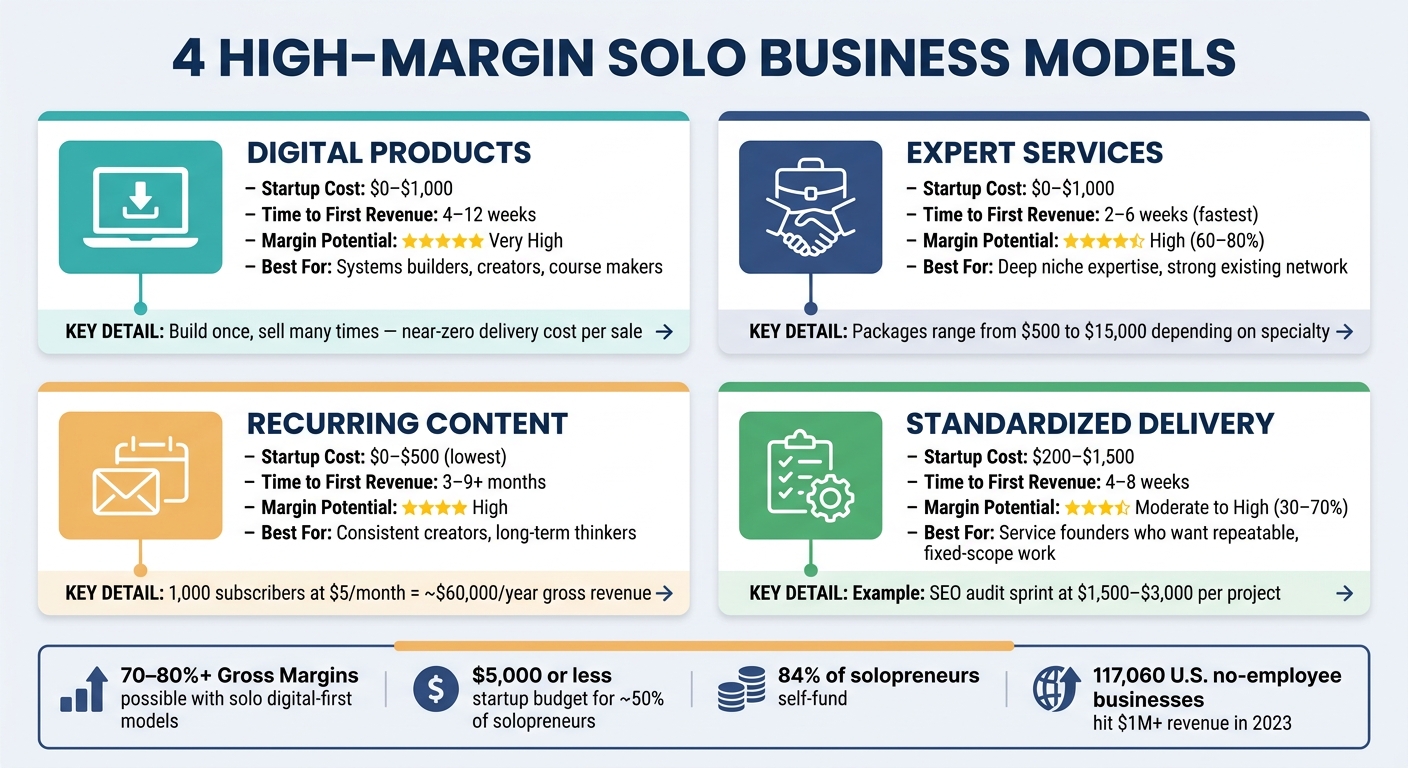
4 High-Margin Solo Business Models Compared
7 Simple One-Person Businesses That Make $100K+/Year
sbb-itb-08dd11e
Quick Comparison
| Model | Startup Cost | Time to First Revenue | Margin Potential | Best Fit |
|---|---|---|---|---|
| Digital products | $0–$1,000 | 4–12 weeks | Very high | I like systems, files, tools, or courses |
| Expert services | $0–$1,000 | 2–6 weeks | High | I have a skill and can sell it now |
| Recurring content | $0–$500 | 3–9+ months | High | I can publish on a set schedule |
| Standardized delivery | $200–$1,500 | 4–8 weeks | Moderate to high | I want service revenue with a fixed process |
The core idea: I don’t need a team to build a strong business. I need one focused offer, a market that pays, and a simple way to deliver it again and again.
What Makes a One-Person Business Profitable and Manageable
These filters help you tell the difference between a solo-friendly idea and one that quietly demands a team.
The best one-person businesses usually share a few traits: clear demand, low startup cost, simple delivery, strong pricing, room to grow without hiring, and a light support load. If an idea misses several of those marks, it’s often a bad fit for a solo founder. This applies whether you’re looking at digital products, consulting, newsletters, or productized services.
A solo founder usually doesn’t have the time to teach a market why the problem matters. The easier route is to solve something people are already searching for and already paying to fix. That matters even more when money is tight. Nearly half of solopreneurs start with under $5,000, and 84% self-fund. So the model needs to get to profit fast, without inventory, equipment, or office space dragging things down.
Things also fall apart when the scope is fuzzy. If every client project looks different, the business gets harder to run. That’s why fixed deliverables, repeatable steps, and standardized outputs matter so much. They make the work easier to deliver and easier to price. They also cut support load. Clear instructions and set response windows - like email-only replies within 24–48 hours - help one person stay in control.
At the center of all this is leverage. Put simply: are you trading hours for money, or are you building something that keeps earning after the work is done? The strongest solo models tend to do one of two things:
- Use value-based pricing tied to outcomes instead of hours
- Sell something once that can keep bringing in revenue, like a digital product or a paid newsletter
A lot of founders begin with services because they’re the fastest way to get cash flow. Then, once demand is clear, they add digital products or subscriptions. That mix is often what makes a one-person business both high-margin and manageable.
Once an idea clears these filters, don’t just guess. Validate demand before launch. After you narrow your list, check the strongest option with an AI-powered market review. Use IdeaFloat to test demand, pricing, and margins before you build. The point is simple: prove people will pay before you spend time or money.
1. Digital products
Among the solo-friendly models above, digital products are the easiest to scale without hiring more people. You make them once, then sell them again and again with almost no delivery cost. Each extra sale costs next to nothing - no inventory, no shipping, no fulfillment. That’s why this model can produce some of the highest margins for a solo business.
These products tend to work best when they fix a problem people already spend money to solve. The three formats below work well for a simple reason: delivery is easy, and support usually stays light.
- Niche online course Pick one clear problem your audience already pays to fix. Then build 5–8 focused lessons around that single issue and put them behind a sales page with an email follow-up sequence. A short course that solves one problem well can often justify premium pricing.
- Templates and toolkits Templates and printables are some of the fastest digital products to launch. Think about one specific workflow - like financial modeling for real estate investors or client onboarding for freelance designers. Then build a ready-to-use file, add a short guide, and sell it through a digital storefront. Buyers can use it right away, and you don’t have to deal with fulfillment.
- Micro-SaaS tool If you want recurring revenue instead of one-time sales, software is the next step. A micro-SaaS is a small web app built for one problem and one audience. It can charge a monthly fee and still stay manageable if you keep the scope tight. Out of these three options, it asks the most from you day to day - but it can still work as a solo business if you resist the urge to keep adding features beyond that narrow use case.
2. Expert services
Selling specialized knowledge is one of the most reliable ways to build a high-margin solo business. You’re getting paid for what you know, not just for time on the clock. Solo consultants, coaches, and advisors often hit 60–80% margins. In many cases, the main costs come down to software and marketing.
The simplest way to make this model work is to narrow your focus hard. Instead of calling yourself a general marketing consultant, you become an email and funnel strategist for solo service providers. That kind of focus makes it easier to charge more, bring in clients who fit, and cut down on scope creep. Fixed-scope packages and retainers also make the work easier to repeat.
Three expert service ideas tend to work well for a solo founder:
- Niche business or marketing consultant: Choose one client type and one problem to solve, like lead generation for local service businesses. Strategy sessions, audits, and multi-month retainers often land between $2,000 and $15,000.
- Specialized financial or tax advisor: Focus on a specific group - freelancers, creators, or small online sellers - and offer tax planning reviews plus ongoing planning. Packages often run from $500 to $3,000.
- Career or executive coach: Work with mid-career professionals or executives who want help with promotions or job changes. These offers are often sold as 3–6 month packages priced from $1,500 to $10,000.
Why do these models work so well? Because the buyer is paying for an outcome, not for hours one by one. If you want income that comes in on a repeat basis, the next move is recurring content.
3. Recurring content
If you can turn your know-how into steady updates, recurring content can turn that into subscription income. It helps break the link between earnings and hours worked. And the math is appealing: one issue can go out to many subscribers with little added cost, which keeps margins high.
This setup works best in a tight niche where people need updates on a regular basis. In other words, they’re not paying just to read. They’re paying for help with decisions.
The easiest solo models usually stick to a repeatable format:
- Paid newsletter: Send subscriber-only emails on a set schedule. 1,000 subscribers at $5/month can bring in about $60,000 per year in gross revenue. Business newsletters often charge more, around $10–$15/month or $100–$150/year.
- Niche membership community: Pair written content with a private forum, monthly Q&A calls, or a resource library. About 32.9% of communities charge $26–$50/month. That higher price point comes from access, discussion, and tools - not only the posts themselves.
- Subscription research brief: Publish a short report for people in a specific field, like a monthly competitive intelligence brief for SaaS founders or a deal-flow summary for angel investors. These briefs can charge more because they help readers make choices.
A fixed format makes this model much easier to run alone. Batch the research, automate onboarding and renewals, and keep delivery consistent. That repeatable setup is what lets one person serve a lot of subscribers without turning the work into chaos.
4. Standardized delivery
Package your know-how into a fixed-scope service with a clear deliverable, timeline, and flat price. It sits between custom consulting and digital products.
Here’s what that looks like in practice: a solo founder offering an SEO audit sprint might charge $1,500–$3,000 per project, review 10–20 pages, and hand over a prioritized action plan within two weeks.
The big upside is repeatable delivery. You create checklists, intake forms, and report templates once, then use them again for every client. That’s how one person can keep quality steady without hiring a team. Over time, each project takes less effort, while your price stays flat or even goes up as demand grows. Productized services like this often fall in the 30–70% profit margin range, especially when the scope stays tight.
Automation helps keep the day-to-day simple. You can:
- collect onboarding details with a form
- send contracts and payment links through tools like Stripe
- book calls with Calendly
To protect margins, standardize 80%–90% of the service. That’s not just about process. It also helps you keep overhead low while holding firm on pricing. For founders who want service revenue without doing custom work every time, this model makes a lot of sense.
How to Choose the Right Model for Your Skills and Goals
Use this filter to pick the model that fits your time, budget, and comfort level with client work. The best choice usually comes down to six practical factors: expertise, network, startup budget, speed to revenue, recurring-income goals, and how much weekly client interaction you can handle.
What matters most for many people? Speed to first dollar. Expert services and standardized delivery can start paying in 2–6 weeks. Digital products and recurring content often take 4–12 weeks or longer because you usually need an audience before the sales start coming in. If cash is tight and you need money soon, client-based models tend to be the safer bet.
Your skill set also points you in a certain direction. High-trust skills like marketing, software, law, finance, and design usually fit consulting or productized services. Creative skills work well for digital products and recurring content. Operational skills line up well with standardized delivery.
Use the comparison below to match each model to your limits and goals.
| Model | Startup Cost | Time to First Revenue | Margin Potential | Best For |
|---|---|---|---|---|
| Expert services | $0–$1,000 | 2–6 weeks | High | Deep niche expertise, strong network |
| Digital products | $0–$1,000 | 4–12 weeks | Very high | Creators, systems builders, content-first |
| Recurring content | $0–$500 | 3–9+ months | High | Consistent creators, long-term thinkers |
| Standardized delivery | $200–$1,500 | 4–8 weeks | Moderate to high | Service founders who want repeatable work |
Before you launch, run the math. At realistic U.S. pricing - say, $3,000 per project or $150/hour - figure out how many clients or customers you need each month to hit your target.
Conclusion
The best high-margin solo business usually isn't the flashiest one. It's the one that hits four things at the same time: clear demand, strong pricing power, low delivery friction, and a scope one person can handle without chaos. When those line up, a solo operator can build a profitable business with low overhead.
And this isn't just a nice idea on paper. Forbes reported that 117,060 U.S. no-employee businesses generated $1 million or more in revenue in 2023, which shows that solo businesses can scale when the model matches the market.
The next move is simple: pick one focused offer. Get clear on the audience, the outcome, and the price. Then test it with a landing page, a few sales conversations, or a small beta group. Paid demand is what proves an offer. Free interest doesn't.
Once people start buying, tighten up delivery. Systematize before you scale. Write down your process, automate invoicing and scheduling, and use templates so each client job follows the same path. High margin comes from repeatable delivery, not from adding more people.
Start narrow. Validate fast. Systematize early.
FAQs
Which solo business model is best for beginners?
For beginners, the easiest solo business models to start are usually the ones that are cheap to launch and simple to repeat as a service.
That includes:
- residential cleaning
- virtual assistance
- niche online education
You can often start one of these with $500 to $3,000. That keeps the risk low, which matters when you're just getting going.
They can also bring in cash flow fast. And over time, they can grow into something bigger if you narrow your focus to a specific niche and document your workflows early.
Put simply: start simple, pick a clear lane, and write down how the work gets done from day one.
How do I validate demand before I build anything?
Validate demand before you build anything. That helps you avoid solving a problem people simply don't care enough about.
One of the clearest signs of demand is simple: people already pay to deal with the issue. They might hire consultants, patch things together with spreadsheets, or lean on clunky manual workarounds. If money is already changing hands, that's a good signal.
You can check demand a few practical ways:
- Talk to people on discovery calls and listen for repeated pain points
- Scan Reddit or LinkedIn for the words customers use and the problems that keep coming up
- Test a landing page with a $50 to $100 ad budget and see if people bite
That kind of early feedback gives you something far better than a guess. It gives you signs from the market before you spend months building.
When should I choose services over digital products?
Choose services over digital products when you want to offer high-touch, custom help that can earn premium fees based on your skill and the results you get for clients.
Services make the most sense when your specialized skills solve problems that off-the-shelf digital products just can't fix. They can also bring in income faster and with more predictability, while helping you build stronger client relationships.
And if you can systematize the work with clear processes and templates, services become a lot easier to deliver without reinventing the wheel every time.
Related Blog Posts
- Which Small Business Is Most Profitable? Real Margins by Niche
- High-Margin Small Business Ideas in Australia for One-Person Teams
- 21 Australian Business Ideas That Work Even in a Slow Economy
- Business Ideas With Low Competition and Low Startup Cost