Starting a home-based business in Australia can be rewarding, but it requires following specific rules to stay compliant. Here's what you need to know:
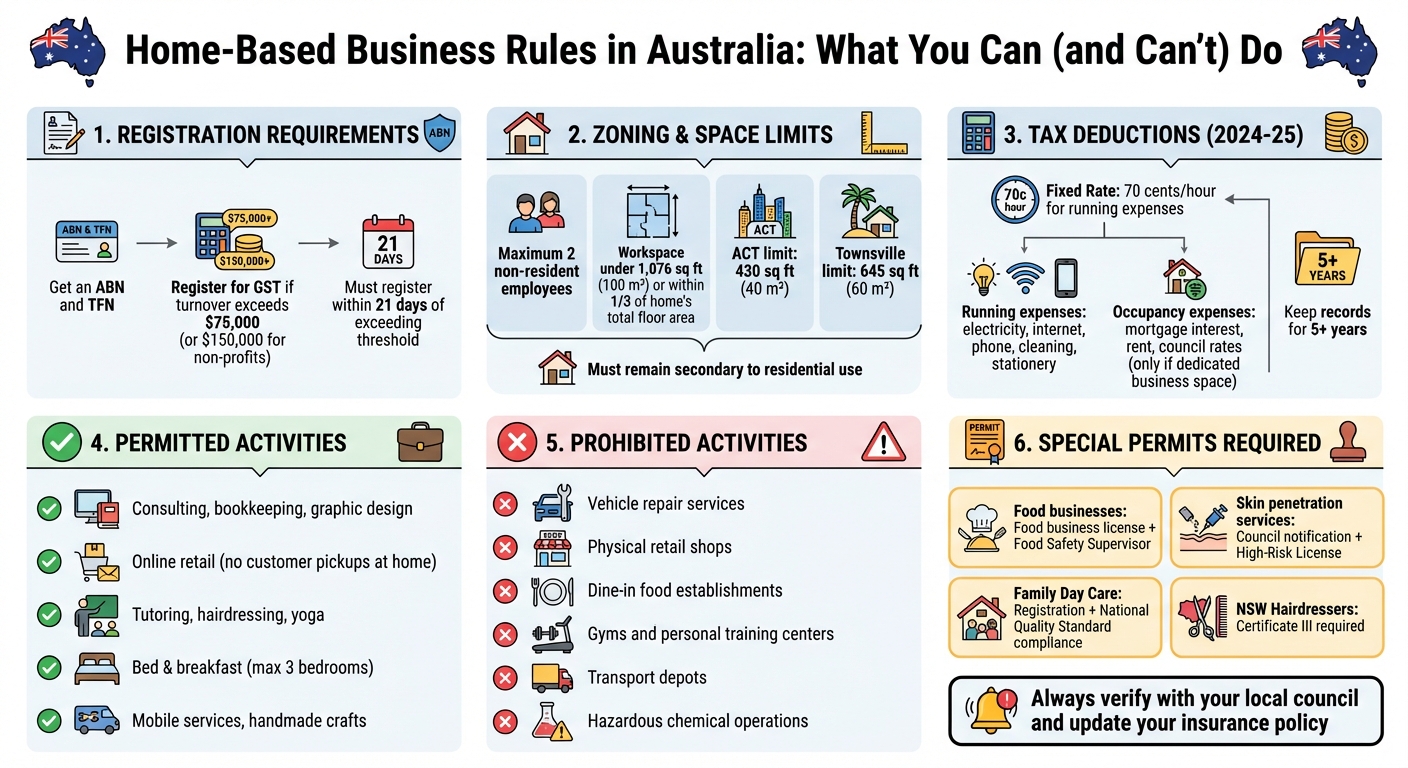
- Registration: Get an ABN and TFN, and register for GST if turnover exceeds $75,000.
- Zoning Laws: Check local council zoning rules. Many home businesses are allowed without approval if they meet conditions (e.g., no more than two non-resident employees, minimal noise, etc.).
- Permits: Some industries (food, childcare, beauty) require special permits or licenses.
- Tax Deductions: Claim home office expenses (e.g., 70 cents/hour for running costs) but note restrictions on occupancy expenses.
- Insurance: Standard home insurance won’t cover business activities. Update your policy and, if renting, get landlord approval.
- Prohibited Activities: Avoid businesses like vehicle repair, gyms, or hazardous operations that disrupt residential areas.
Always verify rules with your local council and ensure your business aligns with zoning, permits, and tax requirements.
Home-Based Business Rules in Australia: Compliance Checklist
Zoning Regulations for Home Businesses
What Zoning Laws Are and How They Affect Home Businesses
Zoning laws are rules set by local councils to separate areas for residential, commercial, and industrial use. These laws help maintain a neighborhood’s character by keeping disruptive business activities in check. For home businesses, this usually means the business must remain secondary to the primary purpose of the property - being a residence.
Many councils categorize small home businesses as "exempt" or "accepted" developments. This means that as long as your business meets specific criteria - like limits on noise, floor space, or staffing - you won’t need a formal planning permit. Councils assess factors such as traffic, parking, the number of non-resident employees, the floor area used for business, and potential environmental concerns like noise, fumes, or waste. For example, in the Australian Capital Territory, a home business can operate without development approval if it uses no more than 430 square feet (40 m²). In Townsville, the limit for accepted development is slightly larger, at 645 square feet (60 m²).
Next, we’ll look at how you can confirm these rules with your local council.
How to Check Your Local Council's Zoning Rules
Before starting your home business, it’s crucial to confirm zoning requirements to ensure compliance from the outset. Start by visiting your local council’s website and reviewing its Planning Scheme or Local Environmental Plan (LEP), which detail what activities are allowed in different zones. Many councils offer online mapping tools, such as "Find a Property", and resources like the Australian Business Licence and Information Service (ABLIS) to help you identify your zoning designation and any permits you might need.
If your business plans include hiring more than two non-resident employees or exceed other standard limits, you’ll need to contact your council’s planning officers to discuss submitting a Material Change of Use application. Also, if you’re renting your property, carefully review your lease. Many residential leases explicitly prohibit commercial activities unless you have written consent from the landlord.
sbb-itb-08dd11e
Permits, Approvals, and Licenses You Need
Council Approvals and Exempt Development
Before launching your home business, it’s essential to determine whether you need council approval. Many small-scale, low-impact businesses - like online retail, consulting, or freelance writing - fall under "exempt development." This means you can start operating without filing a formal Development Application (DA) as long as you meet certain criteria. For example, you can employ up to two non-residents, display only one sign, and ensure your business doesn’t create disruptions like noise, fumes, or increased traffic.
If your business doesn’t qualify as exempt development but still aligns with specific standards, you might be eligible for complying development. This streamlined approval process applies to operations like bed and breakfast accommodations or small-scale food manufacturing. However, if your business exceeds these thresholds - such as employing more staff, making major property modifications, or generating significant noise or waste - a full DA will be required. Keep in mind that heritage-listed properties demand a DA regardless of the business type or size.
To simplify the process, use the Australian Business Licence and Information Service (ABLIS) to generate a tailored report outlining the permits you’ll need based on your industry and location. Additionally, consult your local council’s planning department to confirm your business’s classification. Certain industries also require specialized licenses, which we’ll cover next.
Industry-Specific Licensing Requirements
Some businesses need more than council approvals - they must also meet specific legal and health regulations. For instance, food-based businesses must adhere to the Food Act 2003 and the Food Standards Code. This includes obtaining a food business license from your local council and appointing a certified Food Safety Supervisor.
If your business involves skin penetration services - such as tattooing, body piercing, acupuncture, waxing, or nail treatments - you’ll need to notify your council’s Environmental Health department before opening. Some of these services also require a High-Risk Personal Appearance Services License under the Public Health Act.
Family Day Care providers must register with a Family Day Care service and comply with the Education and Care Services National Regulations and the National Quality Standard. In New South Wales, hairdressers are required to hold a Certificate III in Hairdressing under the Hairdressers Act 2003. Additionally, health consulting rooms for doctors or allied health professionals typically require a formal DA, as they don’t qualify for exempt development status.
If you’re renting your property, don’t forget to get written approval from your landlord before starting your business. Also, notify your insurance provider, as most standard home insurance policies exclude coverage for business activities.
How to start your home business in Australia | Australia Explained
Tax Requirements for Home-Based Businesses
Managing tax responsibilities is a critical aspect of running a home-based business. Beyond securing permits and adhering to zoning laws, staying on top of tax obligations and claiming legitimate deductions is essential to remain compliant with the ATO.
How to Claim Home Office Expenses
Home office expenses generally fall into two categories: running expenses and occupancy expenses.
- Running expenses include costs like electricity and gas for heating, cooling, and lighting, internet and phone charges, cleaning supplies, stationery, computer consumables, and depreciation of office equipment such as desks or computers.
- Occupancy expenses cover costs tied to owning or renting your home, including mortgage interest, rent, council rates, land taxes, and home insurance premiums.
You can claim occupancy expenses only if a specific area of your home is set aside exclusively for business purposes. This space should be clearly designated (e.g., marked by signage), used solely for work, and regularly accessed by clients. However, claiming these expenses might have implications for capital gains tax (CGT) when selling your home, as it could reduce your main residence exemption.
The ATO offers three methods for calculating home office expenses:
- Fixed Rate Method: Claim 70 cents per hour for running expenses, with depreciation calculated separately.
- Actual Cost Method: Calculate the exact additional costs incurred from working at home.
- Floor Area Method: Allocate expenses based on the percentage of your home’s floor area used for business.
Keep detailed records for at least five years. Depending on the method you choose, this could include a full diary of hours worked (for the fixed rate method) or a sample four-week diary (for the actual cost method).
Once you’ve addressed home office expenses, the next step is to focus on GST registration and income reporting to ensure full compliance.
GST Registration and Income Reporting
GST registration is mandatory if your business’s GST turnover reaches $75,000 or more, or $150,000 for non-profit organizations. Certain professions, like taxi, limousine, and ride-sourcing drivers (e.g., Uber drivers), must register regardless of their turnover. If you exceed the threshold, you need to register within 21 days and must have an Australian Business Number (ABN) to complete the process.
Once registered, you are required to:
- Charge 10% GST on taxable sales.
- Lodge a Business Activity Statement (BAS) to report GST collected and claim credits on business purchases.
If you’re not registered for GST, you can’t include GST in your prices or claim GST credits on purchases. To monitor turnover, calculate it by excluding GST from total sales.
All business income and expenses must be reported to the ATO through an annual income tax return. If you are GST-registered, amounts should be presented as GST-exclusive. Tools like the ATO’s myDeductions app can simplify tracking income and expenses throughout the year, making tax time much easier.
What You Can and Can't Do from Home
Understanding what activities are allowed or restricted for home-based businesses is crucial to staying compliant with regulations. In Australia, these rules are designed to protect the peace and character of neighborhoods by minimizing noise, traffic, and other disruptions.
Business Types Usually Allowed
Many professional services are well-suited for operation from home and typically don’t require special permits. For example, consulting, bookkeeping, graphic design, writing, and virtual assistance are generally permitted since they have a minimal impact on the surrounding area. Similarly, online retail and e-commerce businesses are allowed as long as goods aren’t displayed at your home or picked up by customers there.
Personal services like tutoring, hairdressing, and yoga can also function as home-based businesses, provided they avoid creating excessive noise or unpleasant odors. Bed and breakfasts are another option, but most local councils limit these to three bedrooms when the owner resides on-site.
Certain trades and crafts are allowed too. For instance, mobile vehicle inspections or creating handmade crafts from home are acceptable as long as they don’t generate significant noise or increase local traffic.
Always check your local council’s specific guidelines to ensure your business aligns with the rules.
Business Activities That Are Prohibited
Some activities are explicitly banned to maintain neighborhood harmony and meet regulatory standards.
Running vehicle repair services, operating physical retail shops, or managing food establishments with dine-in options from home is not permitted. Similarly, transport depots and heavy logistics businesses are prohibited due to the traffic they generate.
Gyms and personal training centers often face restrictions because they cause excessive foot traffic and parking issues.
Additionally, businesses that deal with hazardous chemicals or gases exceeding domestic levels are not allowed. Operations that demand more water, electricity, or gas than a typical household are also prohibited.
How to Validate Your Business Idea with IdeaFloat
Before diving into your new business, it's essential to make sure everything aligns with local regulations and tax obligations. Once that's squared away, the next step is to validate your idea. This is where IdeaFloat comes in - it’s a platform designed to help you test your concept, research your market, and crunch the numbers, all while staying compliant with the law.
Test Your Idea with Problem Validator

IdeaFloat's Problem Validator is a handy tool that checks if your business idea meets Australia's exempt development standards. It ensures that your operations - like employee limits, space usage, and even noise or odor levels - don’t conflict with local regulations.
The tool also flags activities that might require stricter approvals. For example, businesses like vehicle repair, sex services, or high-risk food handling (think dairy or seafood) are often subject to rigorous council oversight. Another feature allows you to model traffic impacts by estimating daily visitor and delivery numbers. If your business exceeds local vehicle trip limits, you might need to file a full Development Application.
Once you’ve tested the feasibility of your idea, the next step is understanding your market.
Research Your Market with Consumer Insights and Competitor Analysis
Knowing your market is key to running a business that fits into its surroundings without causing disruptions. IdeaFloat's Consumer Insights and Competitor Analysis tools help you study how similar businesses operate in residential areas. You can analyze factors like parking availability, operating hours, and signage to understand what works and what doesn’t.
The platform also guides you through mandatory registrations, using resources like the Australian Business Licence and Information Service (ABLIS). This is especially useful for industries that involve high-risk activities, such as food preparation or skin penetration services. If you’re renting or living in a townhouse, you can even check if your lease agreement or strata by-laws allow for commercial activity.
Once you’ve gathered market data, it’s time to dive into the numbers.
Calculate Costs and Validate Finances
IdeaFloat’s Cost Analysis and Financial Model tools break down your expenses into two main categories: occupancy costs (like mortgage interest, rent, and council rates) and running costs (such as electricity, phone, and internet). This distinction matters because occupancy expenses can only be claimed if you have a dedicated "place of business" that’s used almost exclusively for work.
For the 2024–25 income year, the Australian Taxation Office offers a fixed rate of 70 cents per hour for home-based business running expenses. You can compare this fixed rate with the Actual Cost Method to see which one gives you the best tax advantage. IdeaFloat also considers Australian-specific costs, like public liability insurance, council permit fees, and even the potential impact of Capital Gains Tax if part of your home is used solely for business.
Additionally, eligible businesses can benefit from an instant asset write-off of $20,000 for the 2023–24 and 2024–25 income years. By calculating these costs upfront, you’ll have a clear picture of how much capital you need and whether your business idea is financially viable.
Key Points for Running a Home-Based Business in Australia
Operating a home-based business in Australia comes with specific rules and limits designed to maintain the residential nature of your property. Your home cannot be turned into a commercial facility. Most local councils allow businesses to operate without formal planning approval if they meet "accepted development" criteria. This typically includes having no more than two employees who don't live on the premises, keeping your workspace under 1,076 square feet (100 square meters) or within one-third of your home's total floor area, and ensuring your business doesn't cause extra disruption to the neighborhood.
Tax responsibilities are another key area to manage. A standard rate of 70 cents per hour can be used to claim running expenses like electricity, phone, internet, and office supplies. However, claiming occupancy expenses - such as mortgage interest or rent - requires your workspace to function as a dedicated place of business. This might include hosting client visits, displaying signage, or having a space unsuitable for regular domestic use. Keeping detailed records is essential to support any claims you make.
Before diving too deep into your business plans, make sure your idea aligns with local regulations. Confirm your council's zoning rules, review your lease agreement if you’re renting, and update your home insurance policy - standard policies typically don't cover business-related liabilities. Tools like IdeaFloat's Problem Validator can help determine if your business meets exempt development standards or if stricter approvals are needed.
FAQs
How do I know if my home business needs council approval?
Before starting, make sure to check the regulations in your area, as they can differ widely. In many cases, if your business operates on a small scale - like having no more than two employees who don’t live on the premises, avoiding excessive noise or traffic, and not displaying products outdoors - you might not need formal approval. However, activities such as food production or installing large signs often require specific permits. To be certain, reach out to your local council. Some areas may allow specific types of businesses to operate without prior approval.
What qualifies as a “dedicated place of business” for tax purposes?
A “dedicated place of business” refers to a specific area set aside mainly for generating personal services income (PSI). To meet the business premises test, this space must be:
- Exclusively used by the taxpayer for business purposes.
- Physically separate from any private living areas or client spaces.
- Not located on a client’s premises.
These criteria are crucial for ensuring the space qualifies for applicable tax deductions.
What insurance do I need for a home-based business?
When running a home-based business, having the right insurance is crucial. At a minimum, you'll need liability insurance to cover accidents or injuries related to your business. Adding property or contents insurance is also wise, as it protects your business equipment from damage or theft. Depending on your industry, you might also consider specialized business insurance tailored to the unique risks your operations face. These policies provide a safety net against potential losses, damages, or claims that could impact your business.
Related Blog Posts
 Report an issue
Get the newest tips and tricks of starting your business!