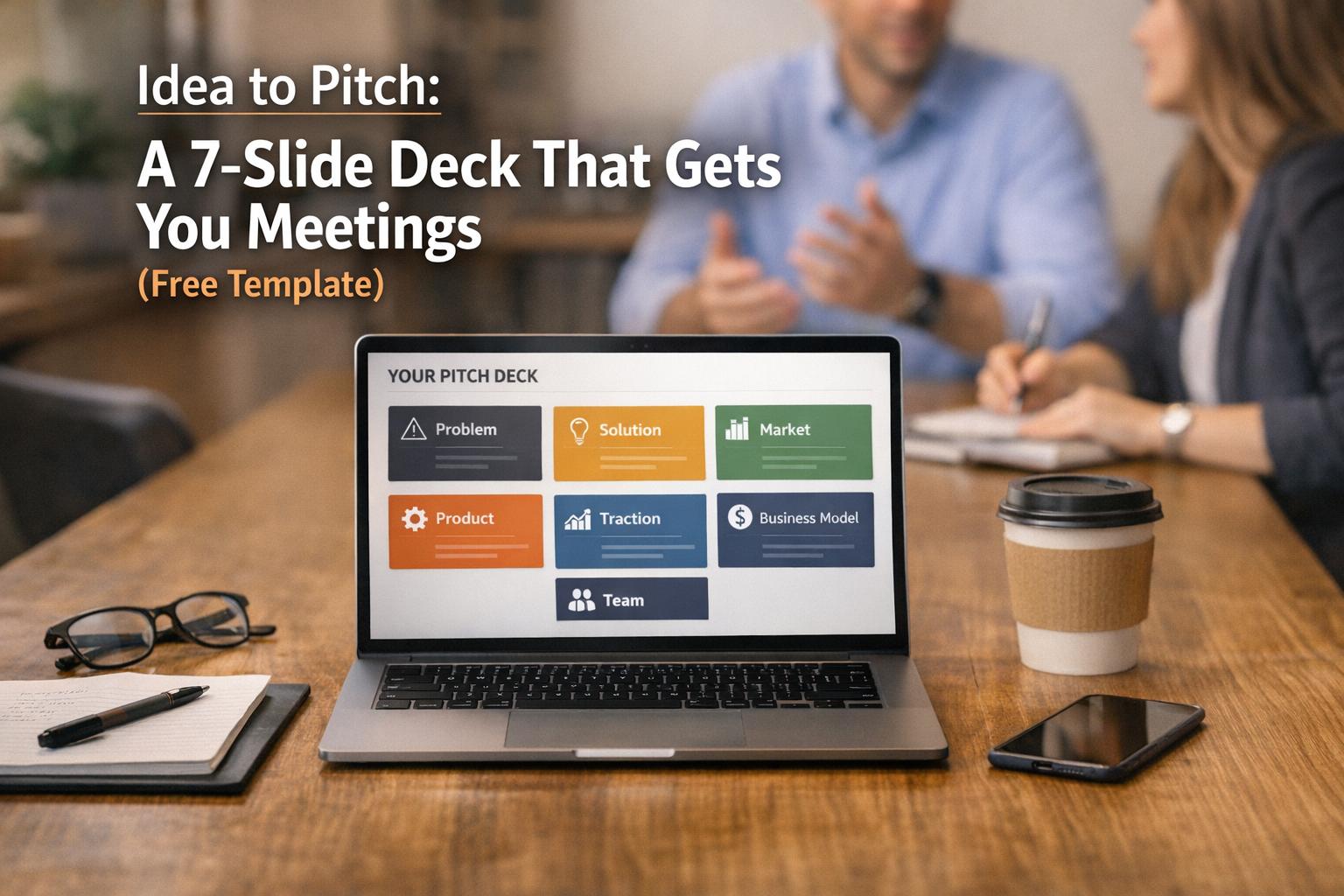
Want to grab investor attention fast? Here's your solution: a 7-slide pitch deck that gets you meetings.
This article breaks down how to create a concise, effective pitch deck that focuses on what matters most to investors. The goal? To spark enough interest to secure a meeting - not to overwhelm with information. You'll also find a free template to streamline the process.
Key Takeaways:
- Why short decks work: Investors process info quickly; a lean deck keeps them engaged.
- The 7-slide structure:
- Problem: Clearly define the issue your business solves with data.
- Solution: Present your product as the answer, focusing on benefits.
- Market Opportunity: Show growth potential with TAM, SAM, and SOM metrics.
- Product Details: Use visuals to highlight how your product works.
- Competition: Position yourself strategically in the market.
- Financials: Provide realistic 3-year projections and key metrics.
- Call to Action: Clearly state your funding request and its purpose.
- Free template: Download and customize to save time on formatting.
This streamlined approach helps you focus on delivering a clear, engaging story that resonates with investors. Ready to start? Download the free template and craft your pitch today.
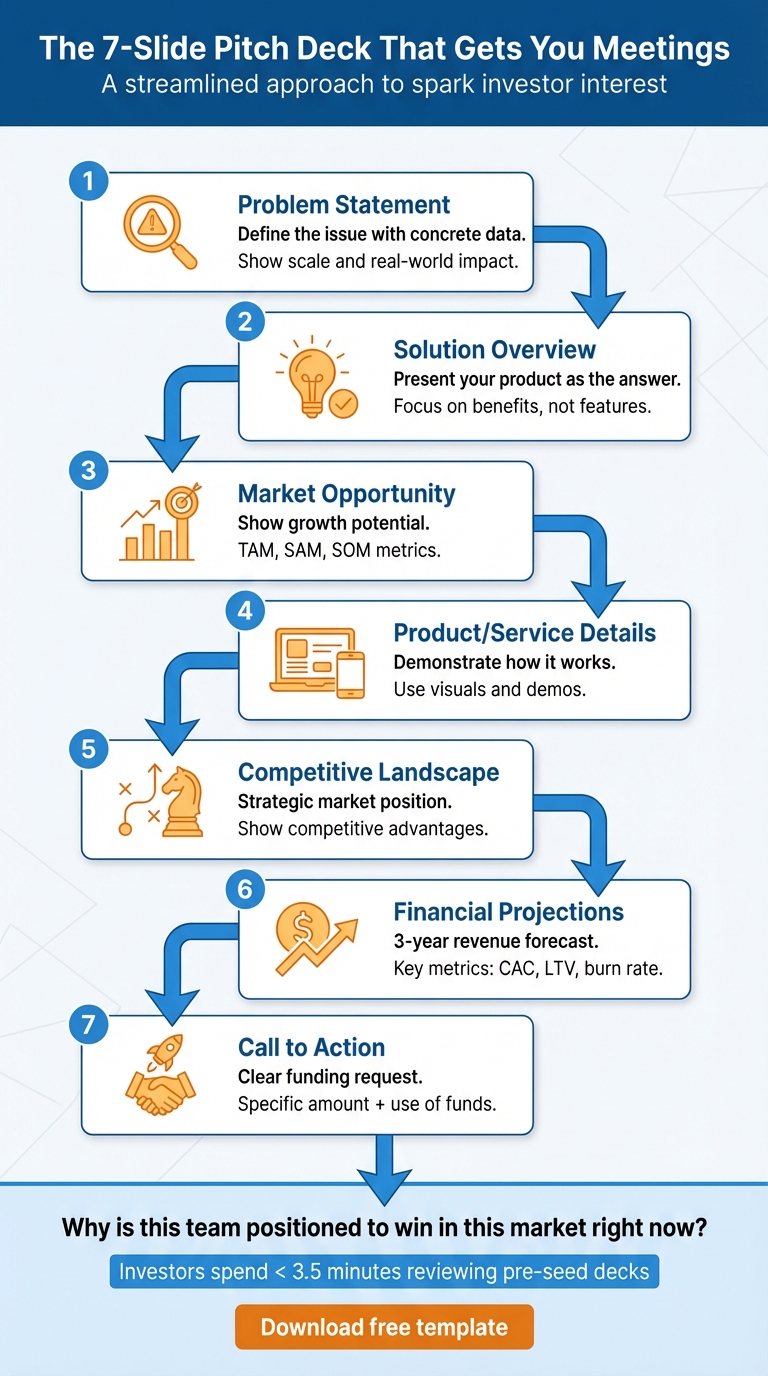
7-Slide Pitch Deck Structure for Investor Meetings
Startup investor pitch deck walkthrough + FREE template!
The 7-Slide Deck Structure
Every slide in your pitch deck has a job to do - together, they build a story that convinces investors why your team is the right one to succeed in this market, at this moment. Think of it as a journey that moves from identifying a problem to showcasing why your solution stands out. The aim isn't to overload investors with information; it's to spark enough curiosity that they want to hear more.
The seven slides are designed to answer one central question: Why is this team positioned to win in this market right now? Every detail in your deck should contribute to this narrative. Avoid unnecessary fluff or lengthy presentations. As Sandy Kory, Founder and General Partner at HorizonVC, advises:
"Don't make your deck too short or too long - 10 to 15 slides is usually a good length."
For initial outreach, a streamlined seven-slide deck can strike the right balance. Here's how each slide plays its part in crafting your pitch.
Slide 1: Problem Statement
Kick things off by clearly defining the problem your business is solving. Use concrete data to show why this issue matters. Highlight the scale of the problem - how many people it affects, or the time and money wasted because of it. Make it relatable by tying it to real-world scenarios. Farzad Rashidi, Lead Innovator at Respona, underscores this point:
"Clearly stating the problem and how your solution addresses it is essential. Y Combinator emphasizes that the specifics of how the problem impacts real-world people or businesses are valuable."
Back up your claims with evidence like survey results, customer testimonials, or industry reports to show that the problem is widespread. Avoid generic statements like "businesses face inefficiencies." Instead, use specific, measurable data to illustrate the impact.
Slide 2: Solution Overview
Now that you've laid out the problem, present your product as the solution. Focus on the benefits rather than the technical details. Investors need to see why your solution matters and how it stands out. Highlight your Unique Selling Proposition (USP) and explain what makes your approach different.
Keep it simple. For example, instead of saying, "Our AI-powered SaaS platform leverages machine learning algorithms to optimize workflow automation", say, "Our software reduces invoice processing time from 3 hours to 15 minutes by automating data entry and approval routing." Tie your solution directly back to the problem to create a clear, logical flow.
Slide 3: Market Opportunity
Investors want to know your business has room to grow. Use the TAM, SAM, and SOM framework to outline your market size:
- TAM (Total Addressable Market): The total market for your product category.
- SAM (Serviceable Available Market): The segment of the market you can realistically serve.
- SOM (Serviceable Obtainable Market): The specific portion you're targeting right now.
For example, if you're developing accounting software for small businesses, your TAM might be the $12 billion small business accounting software market. Your SAM could narrow it down to the $3 billion segment for businesses with 10–50 employees, and your SOM might focus on the $500 million market for healthcare businesses in that size range. Use bottom-up calculations to make your projections credible. For instance: "There are 150,000 healthcare practices with 10–50 employees. If we acquire 1,500 customers (1% penetration) at $5,000 annual revenue per customer, that's $7.5 million in revenue."
Also, explain why now is the right time - whether it's due to market trends or recent developments that make your solution particularly timely.
Slide 4: Product/Service Details
This slide is your chance to show how your product solves the problem you outlined in Slide 1. Use visuals like screenshots, mockups, or a short demo video to highlight the key moments when your product delivers value. A compelling visual demonstration can instantly make your solution feel real and impactful.
Focus on the core user experience. For example, if you're showcasing a mobile app, walk through 3–4 key screens that show how users move from onboarding to solving their problem. If it's a physical product, include professional images or a brief video demonstration. Don’t overwhelm with a laundry list of features - stick to the ones that matter most to your audience.
Slide 5: Competitive Landscape
Never claim you have no competition - it signals a lack of market understanding. Instead, use a competitive matrix or a quadrant chart to show where you stand. For example, you could plot your position based on price versus features or ease of use versus customization.
Identify your competitive advantages and explain how you fill gaps in the market. For instance, if competitors are expensive and require extensive technical support, emphasize how your product is more affordable or easier to use. Be honest but strategic in framing your differentiation.
Slide 6: Financial Projections
Investors need to see a clear path to growth. Provide a three-year revenue forecast that feels realistic. Highlight key metrics like gross margins, customer acquisition cost (CAC), lifetime value (LTV), and burn rate. Be transparent about your business model - whether it’s subscription-based, transaction fees, or one-time purchases.
For example, if you charge $5,000 per customer annually with a 75% gross margin, include those numbers. If you're projecting rapid growth, explain the assumptions behind it, like a marketing push or entering new markets. Early-stage startups should focus on traction metrics like month-over-month growth, pilot program results, or waitlist numbers rather than absolute revenue figures.
Slide 7: Call to Action
Wrap up with a clear funding request. Be specific - round your ask to clean numbers like $1.5M instead of $1,478,000 - and outline how you’ll use the funds. Use visuals like pie charts or bar graphs to show how the money will be allocated (e.g., hiring, R&D, marketing, operations).
For example: "$1.5M to hire 3 engineers, expand into 2 new markets, and scale customer acquisition." Tie the funding to concrete milestones you aim to achieve in the next 12–18 months, such as growing from 50 to 500 customers, reaching $2M in annual recurring revenue, or achieving profitability by a specific date. If relevant, mention the investment structure (e.g., SAFE, equity, convertible note), but save detailed terms for later discussions.
The goal here is simple: make it easy for investors to see the potential and want to continue the conversation.
Using the Free Pitch Deck Template
Our free, customizable pitch deck template is built around a simple seven-slide structure, making it easier than ever to prepare your presentation. It’s designed to save you hours of formatting headaches so you can focus on what really matters: telling your story. Forget about wrestling with layouts - this template lets you dive straight into crafting your message.
The template is fully editable, allowing you to tweak text, swap in your visuals, and incorporate your brand colors for a polished, professional finish.
How to Download the Template
To get started, head to the IdeaFloat website and click the "Download" button - no email or sign-up required. The template comes as a PowerPoint (.pptx) file, which works seamlessly with Microsoft Office. Prefer Google Slides? No problem. Upload the file to Google Drive, and it will automatically convert to the Google Slides format.
Once downloaded, open the file in your preferred software. If you’re using Google Slides, just upload the .pptx file, and you’re good to go. For a polished final product, export your presentation as a PDF to ensure consistent formatting.
Now you’re ready to customize the template to fit your brand and message.
Customizing the Template for Your Business
Start by replacing the placeholder text with your own content, following the seven-slide structure as your guide. Incorporate your brand kit - including your company’s colors, fonts, and logo - throughout the slides to create a consistent, professional appearance. Stick to 2–3 main colors and easy-to-read fonts like Montserrat or Arial for a clean design.
When crafting your message, focus on benefits, not features. For instance, instead of saying, "Our platform uses AI-powered automation", highlight the value: "Our software reduces invoice processing time from 3 hours to just 15 minutes." Keep slides simple and visually appealing by following the 5x5x5 rule: aim for no more than 5 lines of text per slide, 5 words per line, and avoid more than 5 text-heavy slides in a row. Replace filler content with real visuals like screenshots, mockups, or wireframes to make your points more impactful.
Finally, tailor your deck to your audience. If you’re pitching to venture capitalists, focus on scalability and market potential. For strategic partners, highlight how your solution aligns with their existing offerings. Avoid confusing jargon or acronyms - test your pitch with someone outside your industry to identify anything that needs simplifying.
sbb-itb-08dd11e
How to Present Your Pitch Deck
Every slide in your pitch deck is designed to deliver a clear message, and your presentation style should reflect that same clarity and focus. A strong pitch isn’t just about explaining your product - it’s about telling a story that convinces investors you’re the one to dominate the market. Your delivery needs to be dynamic and engaging to achieve this.
Keeping Your Presentation Professional
Keep your presentation concise - aim for 15 to 20 minutes. This leaves enough time for discussion and questions during a typical one-hour meeting. Start with a powerful hook to grab attention right away. Instead of beginning with, "We're a B2B SaaS platform", try something more intriguing, like, "What if you could reduce invoice processing time from 3 hours to just 15 minutes?" A strong opening sets the tone for the rest of your pitch.
Rehearse your presentation thoroughly - at least 10 times - with trusted colleagues or mentors. This will help you fine-tune your timing and delivery. When presenting, focus on showing rather than telling. Replace text-heavy slides with high-quality visuals, infographics, and screenshots. If possible, include a brief demo to make your solution feel more real, but keep it short to maintain momentum.
"Present enough to get them excited, but leave enough information off the table so that the investors will engage and ask you questions to find out more." – Oliver Kicks, Concept Ventures
Use simple and clear language throughout your pitch. Imagine explaining your business to someone unfamiliar with your industry - clarity beats jargon every time. Also, ensure your slides are visually clean by using a font size of at least 30 points to enhance readability.
Once you’ve delivered a captivating presentation, be ready to dive into the Q&A session.
Preparing for Questions
After your main presentation, transitioning smoothly into a well-prepared Q&A session is crucial. Investors will likely challenge your assumptions, projections, and understanding of the market. Be ready for questions about pricing models, unit economics, growth plans, and potential risks. To stay prepared, create an appendix with extra slides covering detailed financials, product roadmaps, and technical details. This way, you can quickly address any specific inquiries.
If you don’t know an answer, stay composed. Let the investors know you’ll follow up with a detailed response and move on to the next question. Panicking or becoming defensive can harm your credibility, so maintain your confidence even when under pressure.
"If you don't know the answer to a question, tell the viewers that you'll get a professional answer and share it with the audience in a preferred manner." – Tanya Slyvkin, Founder, Whitepage
Ensure you have a detailed financial model ready for follow-up requests. This should include at least three years of projections, covering key areas like hiring plans and R&D expenses. A well-prepared Q&A session can leave a lasting impression and show investors you’re ready for the challenges ahead.
Conclusion
Key Takeaways
A 7-slide pitch deck is your quickest ticket to securing investor meetings. The goal? Not to seal the deal right away, but to spark enough interest that investors want to meet again. By keeping your deck concise and focused, you dodge endless revisions and can dedicate more time to growing your business.
"The purpose of a pitch deck should be to articulate [execution] factors in a convincing, clear, and concise way in order to generate interest, open investor doors, and enable founders to cultivate relationships." – Jake Dluhy-Smith, CEO & Co-Founder, OAK'S LAB
This streamlined format directly tackles the key investor concerns we discussed: Market risk, Product risk, Team risk, and Execution risk. Each slide builds upon the previous one, creating a compelling story that takes investors from understanding the problem to believing your team is the one to solve it. A well-designed template ensures your deck aligns with what investors expect.
Let this approach serve as your guide for the next step in your journey.
Next Steps
Now it’s time to put these ideas into action. Download the free template based on the seven-slide structure we covered, and tailor it with your branding, visuals, and relevant data. Create two versions of your deck: a reading deck (with more details) for emailing and a presentation deck (visual-heavy and text-light) for in-person meetings.
Practice your pitch until you can deliver it smoothly without constantly checking your slides. Share it with mentors or advisors to identify any unclear terms or weak areas. When you’re ready, start reaching out to investors. Remember, investors typically spend less than 3.5 minutes reviewing a pre-seed pitch deck, so every element - words, visuals, and structure - needs to work hard to grab their attention. Your deck is your ticket into the room - make it count.
FAQs
Why is a 7-slide pitch deck more effective than a longer presentation?
A 7-slide pitch deck works wonders because it forces you to keep your message sharp, clear, and straight to the point. Investors typically spend less than two minutes skimming through a pitch deck, so a concise format ensures they catch the essentials - like the problem you’re solving, your solution, the market potential, and your team - without wading through unnecessary fluff.
By sticking to the essentials, you make it easier for investors to grasp your vision and stay interested. This focused approach not only helps you stand out but also boosts your chances of landing meetings and leaving a lasting impression - especially if you’re an early-stage startup trying to break through the noise.
How can I customize the 7-slide pitch deck template to fit my business?
To make the pitch deck template work for your business, start by focusing on what sets your company apart. Think about your business model, who your target audience is, and what gives you a competitive edge. Then, tweak the slides to make these points stand out clearly.
Take advantage of the template’s flexible features to add visuals, data, and branding that match your message. Highlight key metrics, outline your growth plans, and share any market insights that showcase your value. The goal is to make the deck align with your business objectives while connecting with your audience.
Lastly, rehearse your presentation and use feedback to fine-tune it. This will help ensure your pitch comes across as polished, engaging, and unforgettable.
What mistakes should I avoid when creating and presenting a pitch deck to investors?
If you want your pitch deck to leave a lasting impression, steer clear of these frequent missteps:
- No clear narrative: A disjointed pitch deck can leave investors puzzled. Make sure your slides follow a logical sequence, weaving a story that clearly explains your business and its potential.
- Overcrowded slides: Too much text or data on a single slide can overwhelm your audience. Keep it simple. Use concise points and visuals to emphasize the most important aspects.
- Leaving out key information: Your pitch deck should cover the essentials: the problem you're solving, your solution, the market size, your business model, and your team. Missing these can weaken your overall message.
- Ignoring your audience: Tailor your presentation to resonate with your specific audience. A generic pitch often fails to connect. Show that you understand their interests and priorities.
- Lack of preparation: Even the most visually appealing deck won't save you if your delivery is unpolished. Practice until you're confident and can deliver your pitch smoothly.
By focusing on a strong narrative, clear visuals, and thorough preparation, you'll greatly increase your chances of capturing investor interest.
Related Blog Posts
 Report an issue
Get the newest tips and tricks of starting your business!