Starting a lawn care business in Australia is affordable and scalable. With initial investments ranging from $2,000 to $50,000, you can begin with basic tools or opt for a full commercial setup. Essential equipment includes mowers, trimmers, and blowers, while operational expenses like insurance, fuel, and maintenance typically account for 45% of revenue. Residential jobs can earn you $30 to $200 per lawn, depending on size and services offered, with hourly rates averaging $70-$80.
To succeed, focus on:
- Choosing the right equipment: Commercial-grade tools last longer but cost more upfront.
- Pricing services effectively: Use per-job or hourly rates and consider seasonal adjustments.
- Building a client base: Offer tiered service packages and upsell extras like weed control or fertilizing.
- Managing expenses: Plan for insurance, marketing, and software costs.
With steady demand and potential annual revenue of $50,000 to $90,000, lawn care is a profitable venture when paired with smart planning and reinvestment.
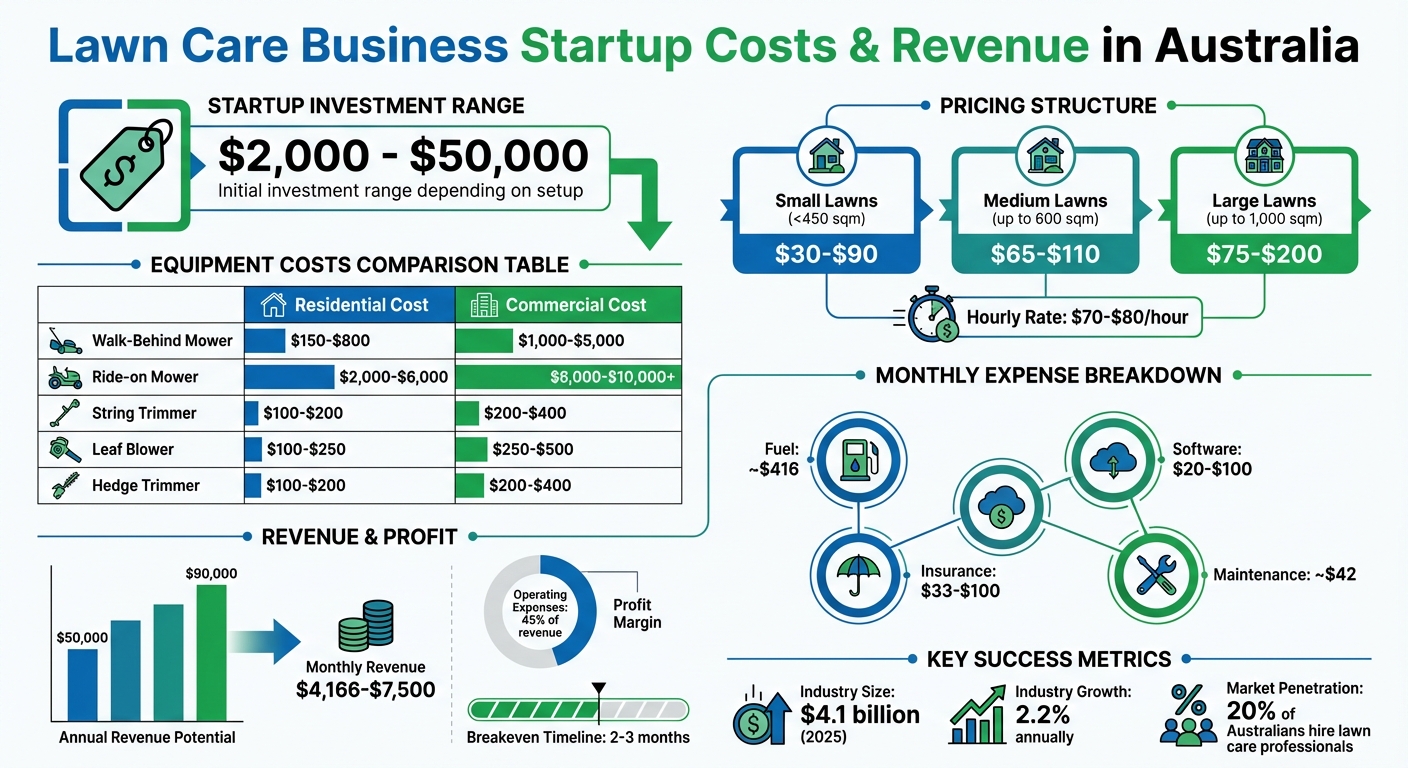
Lawn Care Business Startup Costs and Revenue in Australia 2025
How To Start A Lawn Or Garden Business with $2000, $10,000 Or $100,000
Equipment and Tools You'll Need to Start
The tools you choose will directly impact your startup costs and how much work you can take on. At a minimum, you'll need a lawn mower, a string trimmer (also called a whipper snipper), and a leaf blower to get started. Beyond these essentials, you'll also need reliable transportation and safety gear to ensure you're working efficiently and meeting safety regulations.
Starting costs for equipment usually fall between $2,000 and $15,000. While residential-grade tools might save you money upfront, commercial-grade equipment is built to handle daily wear and tear, helping you avoid costly downtime. Many dealers offer bundled packages that include everything you need - like a trailer, mower, blower, and trimmer - at a reduced price.
"Full packages including trailers, mowers, blowers, and trimmers are the most cost-effective way to start a commercial lawn care business." – LawnStarter
If you're working with a tight budget, consider reconditioned commercial equipment. This option can cut your upfront costs by up to 50%. Alternatively, hire purchase agreements allow you to spread out payments for expensive machinery, making it easier to manage cash flow. These initial choices will shape your setup and determine the specific tools you'll need.
Lawn Mowers and Core Equipment
The type of mower you need depends on the size and type of properties you'll be servicing. For smaller yards under 5,400 square feet, walk-behind mowers are a practical choice. Residential models cost between $150 and $800, while commercial versions range from $1,000 to $5,000. Walk-behind mowers are easier to transport and work well in tight spaces, making them ideal for suburban jobs.
For larger properties over 10,800 square feet, ride-on mowers are a must. These machines save time, reduce fatigue, and improve efficiency. Expect to pay $2,000 to $10,000 or more, with annual maintenance costs averaging around $500. If you're tackling steep or challenging terrain, remote-control mowers (priced between $1,000 and $5,000) can provide safer and more precise operation.
Other essential tools include a string trimmer for edging and hard-to-reach spots, which costs $100 to $400. A leaf blower for cleanup tasks will set you back $100 to $500. When deciding between petrol and electric equipment, remember that electric tools often have lower maintenance and fuel costs but may require multiple batteries to last a full workday.
| Equipment Item | Residential Cost | Commercial Cost |
|---|---|---|
| Walk-Behind Mower | $150 – $800 | $1,000 – $5,000 |
| Ride-on Mower | $2,000 – $6,000 | $6,000 – $10,000+ |
| String Trimmer | $100 – $200 | $200 – $400 |
| Leaf Blower | $100 – $250 | $250 – $500 |
| Hedge Trimmer | $100 – $200 | $200 – $400 |
Vehicles and Transportation
Transportation is a key part of running a lawn care business. You'll need a reliable vehicle, like a ute or van, and possibly a trailer to haul your equipment between job sites. Used trucks or utes can cost between $5,000 and $15,000, while new models typically range from $30,000 to $50,000.
For trailers, an open flatbed is a budget-friendly option starting at around $1,000. However, these leave your equipment exposed to weather and theft. Enclosed trailers, priced between $3,000 and $10,000, provide better security and weather protection. They can also serve as mobile storage units, which is especially useful if you don't have access to a garage.
Safety Gear and Small Tools
Personal protective equipment (PPE) is non-negotiable for safe and compliant operations. Plan to spend $200 to $500 on a complete safety gear package. This should include heavy-duty gloves, safety glasses or visors, ear protection, and steel-toe boots. Since you'll be working outdoors, sun protection like wide-brim hats and sunscreen is a must. High-visibility clothing is also essential for jobs near roads.
You'll also need basic hand tools like rakes, shovels, garden forks, manual edgers, and pruning shears, which typically cost $30 to $80 each. Additional items like fuel storage containers ($50 to $100), tie-downs for securing equipment, and loading ramps are also necessary. If you plan to offer specialized services, you may need extra licenses and equipment to get started.
Additional Startup Costs
Setting up a lawn care business involves more than just buying equipment. You’ll also need to budget for administrative and operational expenses, which can range from $1,200 to $4,000 during your first year. These costs cover things like legal registration, insurance, and marketing - essentials for running a legitimate business and attracting clients.
Business Licenses and Registration Fees
Registering your business in Australia is straightforward and relatively low-cost. While getting an Australian Business Number (ABN) is free, registering your business name with the Australian Securities and Investments Commission (ASIC) is necessary if you’re not trading under your own name. This registration typically costs between $50 and $500, depending on your business structure.
For basic lawn mowing and gardening services, no specific trade license is generally required. However, if your services include applying pesticides or herbicides, you might need additional permits or certifications. To figure out what’s required for your area, check with your local council or use the Australian Business Licence and Information Service (ABLIS) website.
Insurance Coverage
Insurance is a must-have to protect your business from unexpected financial losses. The most important type is public liability insurance, which covers you if someone is injured on a job site or if you accidentally damage property. For small lawn care businesses, public liability insurance typically costs around $50 per month.
If you plan to hire employees, you’ll also need workers’ compensation insurance, which averages about $80 per month. Additionally, many commercial clients and property managers require proof of valid insurance before they’ll hire you.
Don’t forget about equipment insurance, which protects your tools and machinery from theft or damage. This coverage usually costs between $200 and $800 annually. To save money, consider bundling your policies with a single provider - it can lower premiums and make managing your coverage easier.
Marketing and Software Costs
Marketing and business software are key to attracting clients and keeping your operations smooth. A basic marketing package - which might include a simple website, business cards, vehicle signage, and printed flyers - typically costs between $500 and $1,500. Early on, focus on local strategies like distributing door hangers in target neighborhoods, setting up a free Google Business Profile, and posting before-and-after photos of your work on social media.
As your business grows, investing in management software can make a big difference. Budget $20–$100 per month for tools like accounting and scheduling software. These systems simplify tasks like tracking expenses, sending invoices, and managing your calendar. Additionally, mobile payment processors like Square or Stripe make it easy to collect payments on-site, improving cash flow and reducing the hassle of chasing down checks.
sbb-itb-08dd11e
How to Price Your Lawn Care Services
Getting your pricing right is essential for running a successful lawn care business. You need to cover your expenses, stay competitive, and make a profit. Pricing affects more than just your bottom line - it can shape how customers perceive your services. With nearly 20% of Australians hiring professionals to mow their lawns, the demand is there. The key is setting rates that attract customers while keeping your business sustainable.
Per-Square-Foot Pricing

Many lawn care businesses use property size to determine their rates. This method keeps pricing straightforward and easy for customers to understand. For smaller lawns (under 4,800 square feet or about 450 square meters), you might charge between $30 and $90. Medium lawns (up to 6,500 square feet or roughly 600 square meters) typically range from $65 to $110, while larger lawns (up to 10,800 square feet or about 1,000 square meters) can cost $75 to $200.
Keep in mind these rates apply to flat, well-maintained lawns. If you're dealing with tall grass, steep slopes, or obstacles like trees and garden beds, it's reasonable to charge more. Overgrown lawns often require extra work, like whipper-snipping, which adds time and effort. If clients want you to collect and dispose of clippings or haul green waste, factor those disposal costs into your pricing as well.
Hourly Rates and Service Packages
Another common pricing method is charging by the hour. In Australia, about 30% of lawn care contractors set their rates between $70 and $80 per hour. For a typical two-hour residential mowing job, you’re looking at an average of around $100.
To attract more clients, consider offering tiered service packages. For instance:
- A Basic package could include mowing only.
- A Standard package might add edging and blowing clippings off pathways.
- A Premium package could bundle in extras like fertilizing, weed control, and hedge trimming.
Also, establish a minimum call-out fee to ensure even smaller jobs are worth your time, especially when factoring in travel and setup.
Seasonal Price Adjustments
Lawn care demand varies throughout the year, so adjusting your pricing seasonally can help maximize profits. During the busy spring and summer months, when grass grows quickly and demand spikes, you can charge premium rates. For example, in Sydney, hourly rates can climb to $75 in summer but might dip to $25 during the slower winter months.
"You absolutely charge differently depending on who the client is, depending on the time of the year, and the speed at which the client needs you." – Stanley Genadek, Genadek Landscaping & Excavating
To maintain steady income during the quieter winter months, consider shifting your focus to general garden maintenance tasks like pruning, soil care, and hedge trimming. You might also encourage clients to switch from weekly mowing to less frequent schedules, such as every four or five weeks, to reduce labor costs while keeping them on as regular customers. Offering seasonal contracts at slightly reduced rates can also help lock in consistent revenue, even when demand slows. These adjustments not only keep your cash flow steady but also prepare you to estimate monthly earnings and profits effectively, which we’ll explore next.
Revenue and Profit Expectations
Understanding your potential earnings is key to setting realistic goals and staying motivated. In 2025, the Australian gardening services industry is expected to generate $4.1 billion, with an annual growth rate of about 2.2% over the past five years. For entry-level lawn care businesses, yearly revenue typically ranges between $50,000 and $90,000, which breaks down to roughly $4,166 to $7,500 per month. Keep in mind that seasonal demand can lead to predictable fluctuations in revenue.
Monthly Revenue Examples
Let’s break it down: if your business earns at the lower end of the spectrum - around $50,000 annually - that’s about $4,166 per month. On the higher end, with $90,000 annually, you’d be looking at approximately $7,500 per month. Monthly income largely depends on how many jobs you handle and the average price per service. For instance:
- Completing 40 jobs a month at an average of $110 per job totals about $4,400.
- Handling 60 jobs a month at an average of $125 per job could generate close to $7,500.
Building a loyal client base - customers who book regularly, whether fortnightly or monthly - can help stabilize your income by reducing the time spent finding new clients and mitigating seasonal slowdowns. Once you have a clear picture of your revenue, the next step is understanding your monthly expenses and when you’ll break even.
Monthly Expenses and Breakeven Timeline
Your monthly operating costs will take a significant bite out of your revenue, so keeping a close eye on them is crucial. Typical monthly expenses might include:
- Fuel: Around $416
- Insurance: Between $33 and $100
- Software: Around $20 to $100
- Maintenance: Approximately $42
On average, expenses account for about 45% of your turnover. For example, if you earn $5,000 per month, you could expect about $2,250 in expenses, leaving you with $2,750 in profit before taxes. After taxes, your net profit will be lower.
If you start with an initial investment of around $5,000 and maintain a 55% net profit margin (based on Australian Taxation Office benchmarks), you could recover your startup costs within 2 to 3 months of full operation. However, financial advisors often suggest having enough funds to cover at least 6 months of operating costs to ensure the business can sustain itself. Additionally, maintaining a 3-month emergency fund can help you manage seasonal slow periods or unexpected expenses like equipment repairs.
Ways to Increase Your Profit Margins
Once you’ve got a handle on your income and expenses, it’s time to focus on boosting your profits. Here are some strategies to help:
- Invest in commercial-grade equipment: While the upfront cost is higher, faster and more efficient tools allow you to complete more jobs in less time, increasing your earning potential.
- Optimize your routes: Reducing travel time between jobs cuts fuel costs and adds more billable hours to your day.
- Upsell additional services: Offer extras like mulching, aeration, or fertilizing to increase the value of each visit. For instance, mulching clippings back into lawns can save on disposal fees while adding value for clients.
- Expand off-season services: During slower months, consider offering complementary services like gutter cleaning, pressure washing, or general garden maintenance to keep cash coming in.
Finally, reinvesting 10%-15% of your early profits into the business - whether for equipment upgrades or targeted marketing - can accelerate your journey to full-time profitability. By refining your operations and strategically reinvesting, you can maximize your earnings while building a sustainable business.
Conclusion
Starting a lawn care business in Australia is well within reach if you approach it with careful planning. Your initial investment could range from as little as $2,000 for a basic setup to over $50,000 for a more commercial operation. Operating costs typically hover around 45% of your revenue - a key figure to keep in mind as you map out your finances.
To stay competitive and profitable, consider setting rates that align with market expectations. Hourly rates often fall between $70 and $90, or you could opt for flat fees based on lawn size. Securing a steady flow of recurring clients and offering additional services like fertilizing or aeration can help balance out seasonal dips in demand. The strong market demand for lawn care services in Australia means there’s room for new businesses to thrive, provided they have a solid operational plan in place.
Before diving in, take the time to validate your financial assumptions and experiment with different pricing strategies. This groundwork can make a big difference in your profitability. Tools such as IdeaFloat can be invaluable here, helping you estimate startup costs, calculate breakeven points, and forecast seasonal revenue changes specific to the Australian market. By factoring in equipment costs, monthly expenses, and projected job volume, you can identify potential cash flow issues and refine your strategy before making significant investments.
With a well-thought-out plan and a commitment to reinvesting early profits, you can establish a lawn care business that operates successfully year-round. The gardening services industry in Australia is steadily growing, offering a promising landscape for entrepreneurs ready to seize the opportunity.
FAQs
What should I consider when choosing between residential and commercial lawn care equipment?
When choosing between residential and commercial lawn care equipment, it’s important to match the tools to the type and size of jobs you’ll be tackling. Commercial-grade equipment is built for heavy-duty use, larger properties, and demanding conditions. These machines typically come with more powerful engines, wider cutting decks, and sturdy frames, making them a go-to for professional, high-volume work. In contrast, residential-grade equipment is lighter, easier to handle, and more budget-friendly - perfect for smaller lawns and occasional use.
Here are a few key points to weigh when making your decision:
- Power and Performance: Commercial mowers pack a punch with engines ranging from 15 to 25 horsepower and cutting decks as wide as 60 inches. Residential models, on the other hand, usually offer less than 10 horsepower and decks under 30 inches - sufficient for smaller-scale tasks.
- Cost and ROI: Residential mowers are more affordable, often priced in the hundreds of dollars, while commercial-grade models can climb past $10,000. Think about your workload and how quickly the equipment will pay for itself before making a big investment.
- Durability: Commercial machines are designed for daily use, featuring reinforced components and longer warranties. This reduces maintenance costs in the long run, making them a more reliable choice for frequent, intensive use.
By evaluating factors like the scope of your work, your budget, and the level of durability you’ll need, you can find the right balance between performance and cost to suit your lawn care needs.
How can I set competitive prices for my lawn care services while staying profitable?
To set the right price for your lawn care services, start by checking out what others in your area are charging. Look at the going rates for tasks like mowing, edging, and seasonal clean-ups. This research will help you establish a competitive starting point.
Next, figure out your costs. Include everything - labor, fuel, equipment maintenance, and insurance. Once you have your expenses, add a profit margin, usually between 15-25%, to make sure your business remains profitable. A helpful guideline is to keep your total expenses within 36-54% of your revenue.
If you're just starting out, you might want to price slightly below the local average - around $35-$40 per hour - to attract initial customers. As you build your reputation and expand your services (like fertilizing or aeration), you can raise your rates over time. Offering tiered service packages or seasonal promotions is another smart way to keep customers coming back and manage cash flow during slower months. Be sure to regularly review your income and expenses to ensure your pricing strategy continues to work for your business.
How can I handle seasonal changes in demand for my lawn care business?
Seasonal demand shifts are a well-known hurdle in the lawn care business, but there are smart ways to keep your income steady throughout the year. One effective tactic is to expand your service offerings. Don’t just stick to mowing - consider adding services like landscaping, garden cleanups, fertilization, weed control, or irrigation system maintenance. These extras can help fill your calendar during slower periods when lawns don’t need as much attention.
Another key strategy is securing recurring contracts with both residential and commercial clients. Offering fixed-price maintenance agreements ensures a steady stream of work, helping you avoid the feast-or-famine cycle of relying on one-off jobs.
Finally, focus on consistent marketing efforts year-round. Use the off-season to promote services like leaf removal, gutter cleaning, or even snow removal if you’re in a colder region. Bundling services - such as combining spring cleanups with summer mowing - or offering discounts during quieter months can also encourage customers to book. By diversifying what you offer, locking in long-term agreements, and staying visible to your audience, you can navigate seasonal slowdowns and keep your business running strong.
Related Blog Posts
 Report an issue
Get the newest tips and tricks of starting your business!