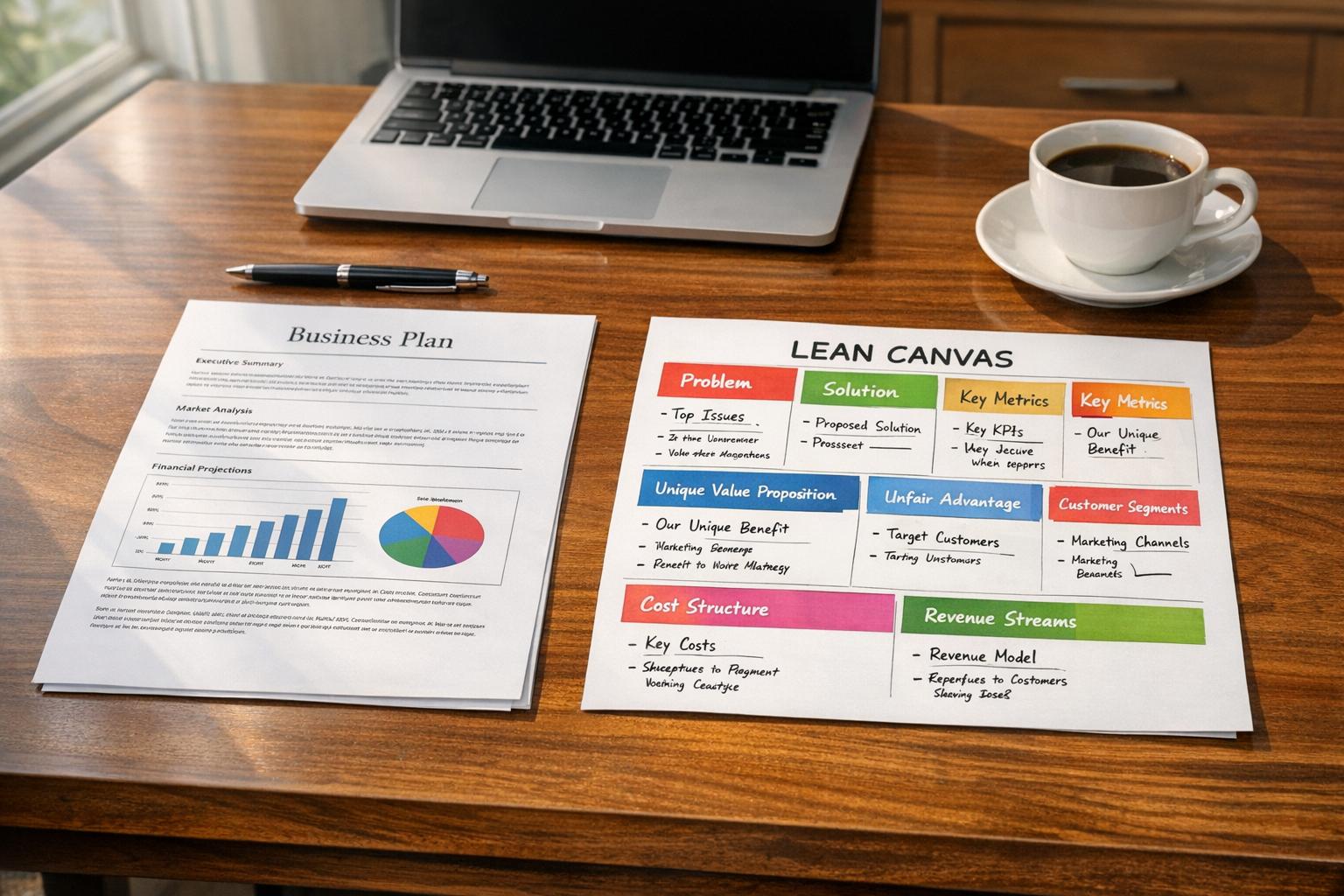
If you're trying to secure funding, the choice between a Lean Canvas and a Business Plan depends on your startup's stage and your audience. Here's what you need to know:
- Lean Canvas: A one-page, quick-to-create tool that focuses on testing your idea and addressing key assumptions. Ideal for early-stage startups and investors who value clarity and speed. It’s great for pitching angel investors or agile venture capitalists.
- Business Plan: A detailed, multi-page document that includes financial projections, market analysis, and a strategic roadmap. Essential for bank loans, grants, or investors who need extensive due diligence. Best for established businesses or those scaling up.
Quick Comparison
| Feature | Lean Canvas | Business Plan |
|---|---|---|
| Format | 1-page outline | 15–40+ pages |
| Time to Create | ~1 hour | Weeks to months |
| Focus | Testing assumptions | Long-term strategy |
| Best For | Early-stage startups | Loans, grants, scaling |
| Investor Appeal | High for quick pitches | High for detailed reviews |
Start with a Lean Canvas to validate your idea quickly. When you're ready for larger funding or need detailed financials, expand into a Business Plan. Tools like IdeaFloat can help create both efficiently.
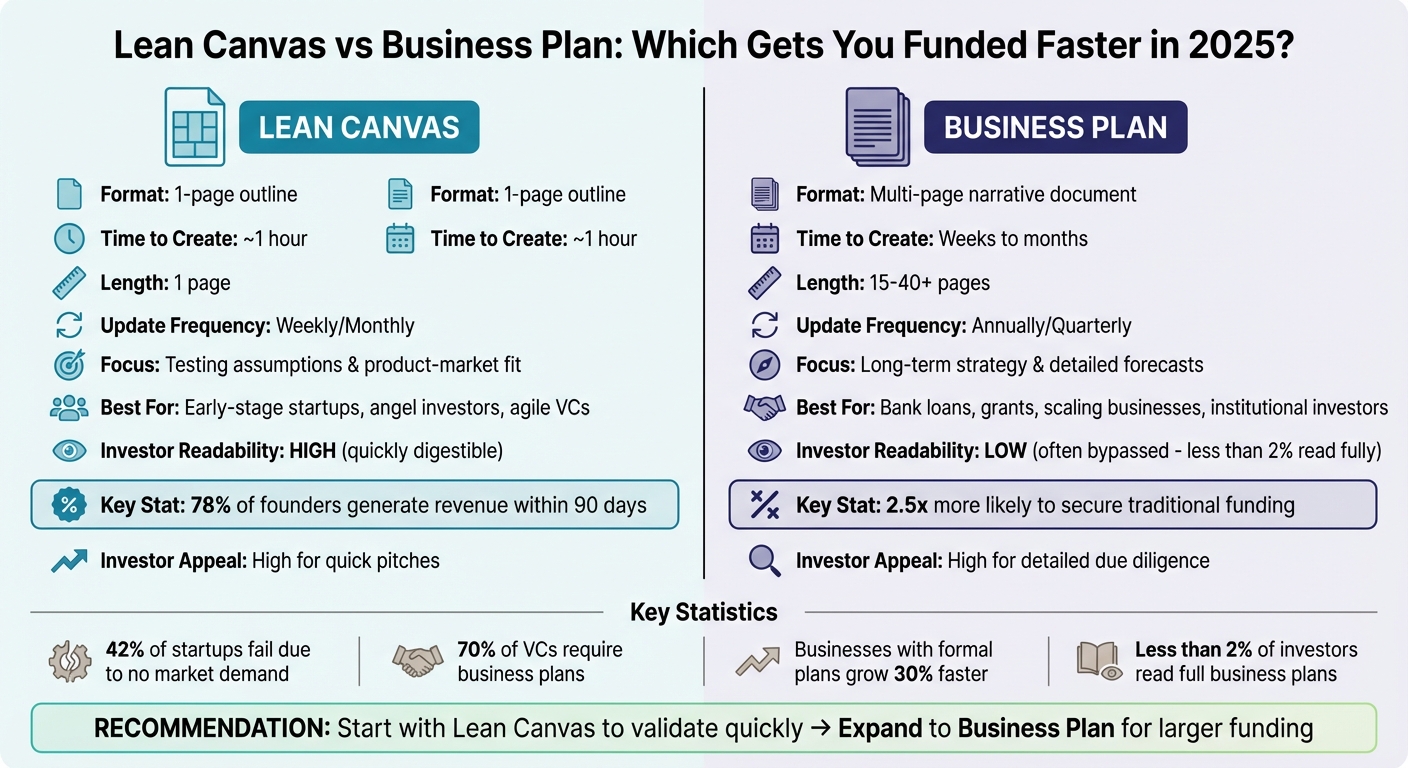
Lean Canvas vs Business Plan Comparison Chart 2025
Don’t Write a Business Plan. Create a Business Model Instead
What Is Lean Canvas?

Lean Canvas, created by Ash Maurya, is a one-page framework designed to help startups quickly map out and test their business ideas - often in as little as 15–20 minutes.
The goal? To identify and challenge your riskiest assumptions early on. It’s not about crafting a flawless execution plan but about reducing risk by determining if there’s genuine demand for what you’re building. And this is critical - 42% of startups fail because they create products for which there’s no market demand.
Here’s a compelling stat: 78% of founders using Lean Canvas generate revenue within 90 days, compared to over eight months for those who don’t. As Ash Maurya puts it:
"Your business model, not your solution, is the true product".
Lean Canvas encourages you to see your business model as a work-in-progress - something you test, refine, and evolve over time, rather than a static list of features.
Core Elements of Lean Canvas
Lean Canvas breaks your business model into nine essential blocks, each answering a key question:
- Problem: What are the top 1–3 pain points you're solving?
- Customer Segments: Who experiences these problems?
- Unique Value Proposition: Why should anyone care about your solution?
- Solution: What are the minimum viable features you’ll offer?
- Channels: How will you reach your customers?
- Revenue Streams: How will you generate income?
- Cost Structure: What are your expenses?
- Key Metrics: How will you measure success?
- Unfair Advantage: What makes you hard to replicate?
What sets Lean Canvas apart is its focus on finding a problem-solution fit. It forces you to clearly define the problems first, ensuring that the features you develop address real needs. The Unfair Advantage block challenges you to identify what gives you an edge - whether it’s exclusive knowledge, proprietary data, or endorsements that competitors can’t easily match.
Lean Canvas is designed to be a "living document" - constantly updated as you learn from your customers. Keep it concise, using bullet points and plain language. Ash Maurya refers to this as the "High-School Test", meaning anyone, even without industry knowledge, should be able to grasp your business model in minutes.
Next, let’s dive into scenarios where Lean Canvas delivers the most value for startups.
Best Use Cases for Lean Canvas
Lean Canvas is a game-changer during the early stages of a startup. If you’re still assessing whether your idea has potential, this tool is perfect. By testing key assumptions upfront, you can avoid wasting time and resources on solutions no one wants.
Investors love Lean Canvas for its clarity. It highlights your value proposition, defines the problem precisely, and demonstrates rapid validation. In fact, less than 2% of investors bother to read full business plans. They’re more interested in seeing how you adapt and learn through real-world testing than in lofty projections.
However, Lean Canvas isn’t a one-size-fits-all solution. If you’re applying for a bank loan or seeking funding from traditional institutions, you’ll likely need a detailed business plan with financial forecasts. Similarly, for scaling an established business or sharing complex operational details with stakeholders, the one-page format might feel too restrictive. But for startups aiming to validate ideas quickly and attract investor interest, Lean Canvas is a powerful tool for clarity and focus.
What Is a Business Plan?
A business plan is much more than a simple one-page outline like the Lean Canvas. It’s a detailed, long-term roadmap for your company’s future, spanning 15 to 25 pages and laying out specific goals and strategies. This document dives deep into planning, projecting growth in areas like marketing, finances, and operations over the next 3 to 5 years.
"A business plan is a living document that grows with your business, and describes your core business activities, objectives, and strategies to achieve your goals".
Interestingly, entrepreneurs who create formal business plans are 16% more likely to achieve success. For investors and lenders, business plans are essential tools for evaluating potential returns. In fact, around 70% of venture capitalists won’t invest without one.
Let’s take a closer look at what makes up a business plan and when it’s most useful.
Main Sections of a Business Plan
A well-crafted business plan is broken down into several key sections, each serving a specific purpose:
- Executive Summary: Think of this as your elevator pitch. It provides a high-level overview of your mission, leadership team, and funding needs. While it appears first, it’s usually written last.
- Market Analysis: This section showcases your research on industry trends, target customers, and competitors. Investors often expect data on TAM (Total Addressable Market), SAM (Serviceable Addressable Market), and SOM (Serviceable Obtainable Market), backed by credible industry reports.
- Financial Projections: A detailed forecast for the next 3 to 5 years, including income statements, balance sheets, and cash flow statements. These projections should rely on realistic, bottom-up assumptions, such as specific sales figures or conversion rates. Investors may scrutinize whether your growth projections align with these assumptions.
- Marketing and Sales Strategy: This outlines your approach to attracting and retaining customers, including distribution channels and customer acquisition costs.
- Operational and Management Plans: Covers your legal structure (e.g., LLC, C Corp), organizational hierarchy, and the expertise of your leadership team.
- Exit Strategy and Appendices: For funding requests over $1 million, you’ll need a clear exit strategy, such as a plan for acquisition or going public within 3 to 10 years. Supporting documents like patents, permits, resumes, or contracts should be included in an appendix.
With these components in place, it’s easier to understand how and when a business plan can be most effective.
Best Use Cases for a Business Plan
A detailed business plan is particularly important when seeking financing from traditional sources like banks or institutional lenders. These institutions rely on the plan to evaluate your loan repayment strategy and assess collateral.
It’s also the go-to format for pitching to venture capitalists who require extensive due diligence. Startups with comprehensive business plans are about 2.5 times more likely to secure funding. As the U.S. Small Business Administration puts it:
"Your business plan is the tool you'll use to convince people that working with you - or investing in your company - is a smart choice".
Beyond financing, business plans are valuable for applying for federal grants, presenting to corporate partners who need operational clarity, or scaling an established business with strategic precision. For startups experiencing rapid growth, the business plan should be treated as a living document, updated quarterly. Established businesses, on the other hand, might review it annually.
That said, if you’re in the early stages of validating your idea, a full-fledged business plan might slow you down. Over 90% of startups fail because they don’t account for the true costs of launching and running their business. As Steve Blank wisely points out:
"No business plan survives first contact with a customer".
Choosing the right planning tool depends on where you are in your business journey and what your funding needs are.
Lean Canvas vs Business Plan: Direct Comparison
The Lean Canvas and traditional business plan aren't just different in size - they reflect two distinct ways of approaching and communicating a business idea. Their core differences lie in how they prioritize speed, adaptability, and purpose.
The Lean Canvas is all about quick validation and flexibility. You can create one in about an hour by focusing on nine essential elements: the problem, solution, unique value proposition, unfair advantage, customer segments, key metrics, channels, cost structure, and revenue streams. Its simplicity makes it an ideal tool for early-stage startups, allowing frequent updates based on real-time feedback.
On the other hand, a traditional business plan is a much more detailed document. Spanning 15–40+ pages, it requires weeks or even months to complete. It covers everything from market analysis and organizational structure to 3-to-5-year financial projections. These plans are typically updated annually, making them less adaptable to sudden market changes.
Interestingly, while investors value concise and flexible tools, fewer than 2% actually read an entire business plan. This highlights a key insight: while a business plan may be essential for due diligence or securing loans, many entrepreneurs start with a Lean Canvas to validate their ideas before committing to a more comprehensive plan. Here’s a closer look at how they compare:
Comparison Table: Lean Canvas vs Business Plan
| Feature | Lean Canvas | Traditional Business Plan |
|---|---|---|
| Format | Single-page visual diagram | Multi-page narrative document |
| Length | 1 page | 15–40+ pages |
| Creation Time | ~1 hour | Weeks to months |
| Key Sections | 9 blocks (Problem, Solution, UVP, Unfair Advantage, Customer Segments, Key Metrics, Channels, Cost Structure, Revenue) | 9+ sections (e.g., Executive Summary, Market Analysis, Management, Operations, Financial Projections, Exit Strategy) |
| Update Speed | High (weekly/monthly iterations) | Low (annual or quarterly updates) |
| Investor Readability | High (quickly digestible) | Low (often bypassed due to length) |
| Risk Analysis | Identifies riskiest assumptions for early testing | Focuses on contingency plans and detailed forecasts |
| Primary Goal | Product-market fit validation | Securing funding and a strategic roadmap |
| Best For | Early-stage startups, angel investors, agile venture capitalists | Bank loans, government grants, later-stage investors |
Many entrepreneurs find success by using a hybrid approach - starting with a Lean Canvas to test their ideas before transitioning to a full business plan for traditional investors. This method helps avoid the common pitfall faced by up to 75% of startups: spending too much time planning unproven concepts. Ultimately, the choice between these tools should depend on your business stage and the expectations of your target audience.
What Investors Want in 2025
Current Investor Trends
By 2025, investors have moved away from lengthy, speculative business plans. Instead, they prioritize agility, real-world data, and a company’s ability to quickly adapt to changing markets. In today’s fast-paced and unpredictable business environment, traditional business plans are often viewed as outdated relics.
What carries weight now is traction, not projections. Investors are more interested in metrics that show real progress - customer feedback, revenue figures, and a validated product-market fit. Key indicators like Customer Lifetime Value (LTV) and Customer Acquisition Cost (CAC) have become crucial tools for evaluating a startup’s potential.
Another major focus is what’s known as the "Unfair Advantage." In an increasingly crowded market, investors need to see what makes your business hard to copy. Whether it’s proprietary technology, exclusive partnerships, or a uniquely loyal community, having a clear competitive edge often determines whether your startup stands out or blends into the crowd.
"The combination between great products and a great business model is going to keep you ahead [of] competition in the coming decade."
- Alexander Osterwalder, Business Model Expert
Beyond the numbers, investors want a compelling story. They’re drawn to narratives that outline the customer journey and show how your product or service solves a real, pressing problem. Dry executive summaries packed with market research no longer cut it - investors want to see how your solution connects with real people.
How 2025 Economic Conditions Affect Investor Decisions
These evolving preferences are deeply influenced by the economic climate of 2025. With tighter capital and rapidly shifting markets, investors are laser-focused on startups that can prove their value quickly. Founders are expected to communicate their value proposition in minutes, not hours, as investors sift through countless pitches daily.
Risk tolerance has also shifted significantly. Investors now place a premium on clear frameworks that highlight burn rate and cost structure. They want to know exactly how long your runway will last, especially during volatile times. Overly optimistic plans without evidence to back them up no longer hold water. Instead, investors expect proof that your riskiest assumptions have been tested and validated by early adopters.
This need for clarity and adaptability has given rise to a hybrid approach. A concise, one-page framework is often used to grab attention, followed by more detailed insights like traction roadmaps and customer factory blueprints during the due diligence process. This lean, flexible approach aligns with the realities of today’s investment landscape.
sbb-itb-08dd11e
Lean Canvas for Funding: Pros and Cons
Why Lean Canvas Works for Funding
Lean Canvas offers the speed and clarity that investors in 2025 demand, especially for early-stage funding. You can complete one in under an hour - far faster than drafting a traditional business plan - making it a great tool to grab investor attention quickly.
The format forces you to address your riskiest assumptions first. By focusing on "Problem" and "Customer Segments", you tackle the very issues that contribute to the 42% startup failure rate caused by poor product-market fit. This approach reassures investors that you understand your business's vulnerabilities and are prepared to address them head-on.
Lean Canvas also accelerates validation. Instead of taking six months or more with traditional methods, you can systematically test ideas in just 30 days. In fact, 78% of founders who adopted continuous innovation frameworks reported generating revenue within 90 days, compared to the average of over eight months.
Another advantage is its one-page format, which makes pivoting seamless. If customer feedback reveals a misstep, you can revise your canvas in minutes and immediately communicate the updated strategy to your team and investors. In today’s unpredictable markets, this kind of agility is invaluable. However, this speed does come with a trade-off: some essential financial details are left out.
Where Lean Canvas Falls Short
Despite its strengths, the Lean Canvas isn't always the best fit for every funding situation.
Its biggest limitation is the lack of financial depth. Traditional investors and banks often require detailed multi-year financial projections and cash flow analyses - elements that a single-page canvas simply doesn’t include. Ash Maurya, who created the Lean Canvas, even admitted:
"The lean canvas framework alone could not replace more complete business plans for stakeholders who required financial forecasts and product introduction roadmaps".
For conventional lenders, the Lean Canvas can feel incomplete. The U.S. Small Business Administration emphasizes:
"Traditional business plans... are the preferred method of many lenders and investors. While a traditional plan may take more time to write, the extra effort is worth it in the long run".
If you're applying for a bank loan or dealing with risk-averse investors, relying solely on a Lean Canvas won't suffice.
The canvas also skips operational roadmaps and long-term strategies, which are crucial when seeking substantial funding. While it excels at testing ideas and securing early-stage interest, it lacks the detailed market research and planning needed for scaling or late-stage funding rounds. This makes it a great starting point but not a standalone solution for more complex ventures.
To address these gaps, many founders now pair their Lean Canvas with tools like "customer factory blueprints" and "traction roadmaps", which provide the hard data and financial details investors expect. Use the Lean Canvas for your initial pitch, but be prepared to back it up with more comprehensive documentation when approaching serious investors.
Business Plan for Funding: Pros and Cons
While the Lean Canvas is all about speed and adaptability, traditional business plans trade agility for detailed financial insights.
Why Business Plans Work for Funding
When it comes to banks or institutional lenders, traditional business plans are the gold standard. Startups with a formal plan are 2.5 times more likely to secure funding and 16% more likely to succeed.
The biggest draw? Financial depth. These plans include multi-year projections that are crucial for calculating ROI. Banks and lenders rely on this level of detail to evaluate repayment potential and collateral.
A well-prepared plan also demonstrates thorough market research and risk management - key factors for investors. In fact, around 70% of venture capitalists review business plans before making decisions. As Investopedia highlights:
"A well-crafted business plan is essential for attracting investors and guiding a company's strategic growth. It should address market needs and investor requirements and provide clear financial projections".
Beyond funding, the act of creating a business plan can be transformative. Businesses with a formal plan tend to grow 30% faster than those without one. The process helps align teams, spotlight risks, and outline strategies for scaling. It also reassures investors that your business is built on a solid foundation, streamlining due diligence.
But while these benefits are undeniable, they come with some serious downsides.
Where Business Plans Fall Short
The most obvious drawback? Time. Crafting a traditional business plan can take weeks or even months, which is a huge disadvantage for startups trying to move quickly in competitive markets.
And here’s the kicker: most investors don’t even read them in full. In fact, fewer than 2% of investors review lengthy 40+ page plans from start to finish. As Steve Blank, a Stanford entrepreneurship professor, candidly puts it:
"Investors make you write [business plans] that they don't read".
Another issue is their rigidity. Traditional plans operate on a "Plan and Execute" model, which doesn’t mesh well with the "Search and Execute" approach needed by early-stage startups. For companies still experimenting with product-market fit, long-term forecasts can quickly become irrelevant. Extensive five-year projections and detailed marketing plans often rely more on guesswork than actual validation. As Ash Maurya, the creator of the Lean Canvas, puts it:
"Traction, not a plan for traction, is what both investors and entrepreneurs should ultimately demand".
While established businesses might update their plans annually, startups often need to pivot quarterly in fast-moving markets. This makes traditional business plans outdated almost as soon as they’re completed. So, while these plans offer valuable insights, their rigidity and time-consuming nature can slow down funding efforts in a dynamic environment.
Which Tool Gets You Funded Faster in 2025?
The right tool for securing funding in 2025 depends heavily on your startup's stage and the type of investors you're targeting. If you're an early-stage founder aiming for seed or angel funding, the Lean Canvas is your best bet for speed. Why? Because you can whip one up in about an hour. It condenses your value proposition onto a single page, which is exactly what busy investors want to see first.
That said, speed doesn’t mean skipping the deeper work. While the Lean Canvas is a great starting point, investors will eventually want more details. During due diligence, they’ll ask for financial forecasts, cash flow statements, and a strategic roadmap. That’s where a Lean Plan comes in - a concise 5 to 10-page document that sits between a one-pager and a long, traditional business plan. As Bailey Koharchick from LivePlan explains:
"The best investor-ready business plan is a Lean Plan".
If you’re going after bank loans or institutional funding, a traditional business plan is still the gold standard. Banks typically require detailed five-year projections to assess your ability to repay loans. However, for startups in fast-moving industries, writing one can feel like running a race where the finish line keeps moving - your assumptions might already be outdated by the time the plan is complete. Finding a balance is crucial.
The smartest strategy for 2025? Start lean, then build out the details as you go. Begin with a Lean Canvas to validate your business model, and when it’s time for serious investor meetings, expand it into a Lean Plan with detailed financial projections like TAM/SAM/SOM. This hybrid approach allows you to stay agile while meeting the rigorous requirements that close deals.
How IdeaFloat Helps You Create Both Tools
Crafting a Lean Canvas or a business plan can feel daunting, especially when funding is on the line. That’s where IdeaFloat steps in, simplifying the process and helping you create both tools efficiently. By using AI trained on thousands of successful business plans, the platform guides you through the key questions that matter most to investors. This seamless approach takes you from quick idea validation to producing detailed, investor-ready documentation.
AI-Powered Lean Canvas Creation
IdeaFloat’s Lean Canvas Generator walks you through the nine essential building blocks of your business. It incorporates market insights to validate your idea quickly. Along the way, you’ll receive a Validate Score and an exportable proof-of-concept report to strengthen your pitch. As IdeaFloat explains:
"We help float your best business ideas, help you articulate the market potential, and give you the tools to provide clarity on your idea, ready to share it with investors".
As your idea matures, you can transition seamlessly into creating a full business plan with integrated financial details.
Business Plan Generator for Comprehensive Planning
When it’s time to go beyond a one-page outline, the Business Plan Generator transforms your data into an investor-ready document. This includes financial projections, go-to-market strategies, and even SBA-approved formatting. The platform automates complex tasks like generating financial statements, cash flow forecasts, and balance sheets, eliminating the need for spreadsheets. You can easily export your finalized plan as a PDF, Word document, or PowerPoint presentation, making it simple to share with banks or institutional lenders.
Tailored for Modern Funding Needs
IdeaFloat equips you with both a Lean Canvas and a business plan, ensuring you’re prepared for any funding stage. Its education section helps you decide which tool is right for your current needs. Start with the Lean Canvas to validate your riskiest assumptions, then shift to a full business plan when detailed financials and due diligence are required. Features like Breakeven Analysis, Startup Cost Analyser, and Competitor Analysis Generator provide the data-driven insights investors expect. This flexible approach aligns with today’s funding realities. After all, businesses that create formal plans and track their progress grow 30% faster than those that don’t.
Conclusion: Pick the Right Tool for Your Funding Goals
The tool you choose should align with your startup's current stage and funding needs. If you're just starting out with an untested idea, the Lean Canvas is a great choice. It helps you identify and test your riskiest assumptions quickly, so you can begin engaging with potential customers right away. On the other hand, when you're ready to scale, seek a bank loan, or undergo detailed scrutiny from institutional investors, a comprehensive Business Plan - complete with five-year financial projections - becomes indispensable.
Investors' expectations often guide this decision. Early-stage funders typically prefer the concise and focused Lean Canvas, while traditional lenders and institutional investors expect detailed financials and thorough planning. Research even shows that businesses with formal plans tend to grow 30% faster.
A practical approach is to start with a Lean Canvas to validate your core assumptions. This allows you to avoid investing significant time in a lengthy document that might become irrelevant after your first customer interactions. Once you've established a solid problem–solution fit, you can transition to a full Business Plan to secure larger funding. Tools like IdeaFloat make this process smoother by enabling you to build both resources without starting from scratch, ensuring you're always ready to meet new funding opportunities head-on.
FAQs
Should I use a Lean Canvas or a Business Plan to secure funding for my startup?
When deciding between a Lean Canvas and a Business Plan, it really comes down to where your startup stands, what you need the document for, and how much time you can put into it.
A Lean Canvas works best for early-stage startups that are still ironing out their ideas or need a quick way to showcase their problem-solution fit. It’s a one-page, highly visual tool that you can pull together in just a few hours. Plus, it’s easy to revise as you gather feedback and refine your approach.
In contrast, a Business Plan is better suited for more established startups, especially those looking to raise funds, secure loans, or map out a detailed operational roadmap. These plans are thorough, covering everything from market analysis to financial projections and operational strategies. However, they take significantly more time - often weeks - to put together.
If you’re just getting started, a Lean Canvas can help you stay flexible and responsive. As your startup grows and investor expectations become more demanding, transitioning to a Business Plan makes sense.
What are the key benefits of using a Lean Canvas to secure early-stage funding?
The Lean Canvas provides a quick and focused way for early-stage founders to showcase their business ideas to potential investors. Its one-page, visual format allows entrepreneurs to put together a clear and concise presentation in just a few hours or days. By focusing on key elements like the problem, solution, unique value proposition, key metrics, and revenue model, the Lean Canvas helps investors quickly grasp the market potential of the idea.
One of its standout benefits is how easily it can be updated. Startups can revise the Lean Canvas as they test out assumptions, collect customer feedback, and fine-tune their strategies. This ability to adapt not only helps entrepreneurs avoid costly missteps but also shows investors that the team is using a thoughtful, data-driven approach. With its focus on speed, clarity, and flexibility, the Lean Canvas is especially useful for early-stage funding, where proving the concept and showing the ability to pivot often outweigh long-term forecasts.
Why do some investors prefer a traditional Business Plan over a Lean Canvas?
Many investors lean toward a traditional Business Plan because it provides detailed information and a structured framework they depend on to evaluate risks and potential returns. These plans typically include extensive market research, long-term financial projections, and a clear operational strategy. This depth allows investors to analyze critical factors like market size, cash flow potential, and growth opportunities.
Traditional Business Plans also fit seamlessly into the due diligence process that investors are familiar with. They often look for specific details, such as five-year financial forecasts or 12- to 18-month marketing plans - elements that a Lean Canvas generally lacks. This comprehensive approach gives investors confidence that the founders have a well-prepared, long-term vision for success.
Related Blog Posts
 Report an issue
Get the newest tips and tricks of starting your business!