
Low-competition businesses thrive by addressing unmet local demand with scalable models. These ventures often see higher profit margins and lower advertising costs, making them ideal for multi-location growth. Examples include AI services for small businesses, ghost kitchens, and niche vending machine networks. Success hinges on solving urgent, frequent problems, leveraging standardized processes, and validating demand before scaling. Key takeaways:
- AI Services: Help local businesses integrate automation tools. Monthly retainers range from $2,000–$10,000 with high margins.
- Ghost Kitchens: Delivery-only food operations reduce overhead and focus on efficiency. Ideal for densely populated areas.
- Niche Vending Machines: Offer specialized products in high-traffic locations. Low ongoing effort with steady revenue.
To scale effectively, document processes, tailor services to local markets, and monitor performance metrics. Focus on markets with rising demand, minimal competition, and clear profitability potential.
19 Most Profitable Niche Business Ideas With Low Competition
sbb-itb-08dd11e
What Makes a Business Low-Competition and Scalable
Not every business can grow across multiple locations, but those that do often share three important traits: they solve problems people are eager to pay for, they rely on systems that are easy to replicate, and they build dependable revenue streams early on. Picking the right market is what separates profitable ventures from those that barely break even. These traits are the backbone of scalable, low-competition opportunities.
The most promising businesses focus on "must-have" services rather than passing fads. Think about industries like janitorial services (worth $90 billion in the U.S.), pet care (a $60 billion market), or elder care, which is projected to hit $98.19 billion by 2032. These aren't just trends - they're essential services that people rely on, even during tougher economic times.
Service-based businesses tend to have higher profit margins than retail because they emphasize expertise over physical inventory. Industries like residential roofing or mobile pet grooming are great examples - they're profitable and generate steady revenue. The key is to address problems that are urgent, costly, frequent, and widespread across different markets.
Another advantage of low-competition niches is reduced advertising costs. These markets often see 50–80% lower ad expenses compared to saturated industries, resulting in a return on investment that's six times higher. Since demand exceeds supply in these areas, you don't need to be extraordinary - just good at solving a specific problem.
Automation also plays a big role in scaling. Streamlined processes make it easier and more affordable to open new locations. Standardized systems give businesses a compounding edge as they expand.
Finding Gaps in Local Markets
The first step is identifying where existing businesses fall short. Tools like Google Maps and local directories can help you spot areas with few or no providers for a particular service. If people are driving 30 minutes or more to access something, that's a strong sign of unmet demand waiting to be tapped.
Social platforms and local directories are also useful for uncovering recurring needs. Reddit threads and Facebook groups, for instance, often highlight frustrations like poor service, long wait times, or unresponsive businesses.
To evaluate a market, apply the Four Forces Framework. This involves looking at:
- Demand Level: Are search trends rising?
- Market Health: Are competitors profitable?
- Competitor Maturity: Is the market fragmented or dominated by a few players?
- Barriers to Entry: How high are advertising costs?
Markets that are fragmented, where 50% of competitors have fewer than 1,000 backlinks or operate as single-location businesses with minimal online presence, are particularly promising. Look for "green flags" like increasing search volume with limited competition, high-value keywords with low SEO challenges, and active community discussions without a dominant provider. On the flip side, avoid markets where Google search results are dominated by high-authority sites or where interest peaked a few years ago.
Before diving in, validate your assumptions by talking to local business owners. Ask them about services they wish existed or challenges they face. Focus on specific groups, like retirees who need tech support or busy families looking for meal prep services. A quick way to test demand? See if you can secure five paying customers within a week.
Business Models That Are Easy to Replicate
Once you've identified a demand gap, consider scalable models like mobile services. Businesses such as mobile pet grooming, car detailing, or equipment cleaning bring solutions directly to customers, cutting costs by eliminating the need for physical storefronts.
Recurring revenue streams add stability, making it easier to scale. For instance, weekly pet waste removal services or monthly contracts for local SEO provide consistent cash flow. Specialized medical equipment cleaning services, for example, can bring in around $73,000 in monthly revenue thanks to predictable contracts.
Service businesses often outperform retail because they charge for expertise rather than products. For example:
- A custom Notion workspace design might fetch $500–$2,500 per client.
- B2B podcast production can range from $2,000–$4,000 monthly for four episodes.
- Accessibility audits might cost $2,000–$8,000 per project.
By narrowing your focus - like offering "LinkedIn strategy for technical founders in climate tech" instead of generic marketing - you can charge higher rates and establish authority in a smaller, more targeted market.
Efficiency is key for replication. Subscription-based models and specialized software improve margins and simplify scaling. Automation and standardized processes make it easier to expand without relying heavily on labor or inventory. Setting up repeatable frameworks from the start ensures smoother growth.
Confirming Demand and Profitability
Before scaling, it's crucial to confirm that there's enough demand and that the business can be profitable. The Problem Intensity Framework can help. It evaluates whether a problem is:
- Urgent: Does it need immediate attention?
- Expensive: Does it cost the client a lot to ignore?
- Frequent: Does it happen often?
- Pervasive: Does it affect a large number of people?
If a problem doesn't meet these criteria, profitability will be harder to achieve - no matter how low the competition.
Other indicators of a healthy market include credit scores and job posting trends. For example, if 89% of local operators have low-risk credit scores and job postings in the sector are growing by 38–49% year-over-year, it's a good sign the market can support another player.
A soft launch is a smart way to test assumptions. Offer services at a discount to a small group of customers to identify operational challenges, pricing issues, and customer acquisition costs without taking on too much risk.
Google Trends can also help you spot emerging demand. Use the "Rising" feature to track related topics gaining traction over the past 30 days. This can help you identify opportunities before competitors do, especially when combined with geographic analysis to find the best areas for expansion.
"Most people start a business backward. They pick something they want to do - not something their community actually needs." – The Ruralpreneur
Finally, run the numbers. Calculate your customer acquisition cost, average transaction value, and profit margin per customer. In less crowded markets, acquisition costs can be 50–80% lower. If the financials don't show a clear path to profitability within 90 days, it might not be the right opportunity. This early validation lays the groundwork for successful multi-location growth.
3 Low-Competition Businesses You Can Expand to Multiple Locations
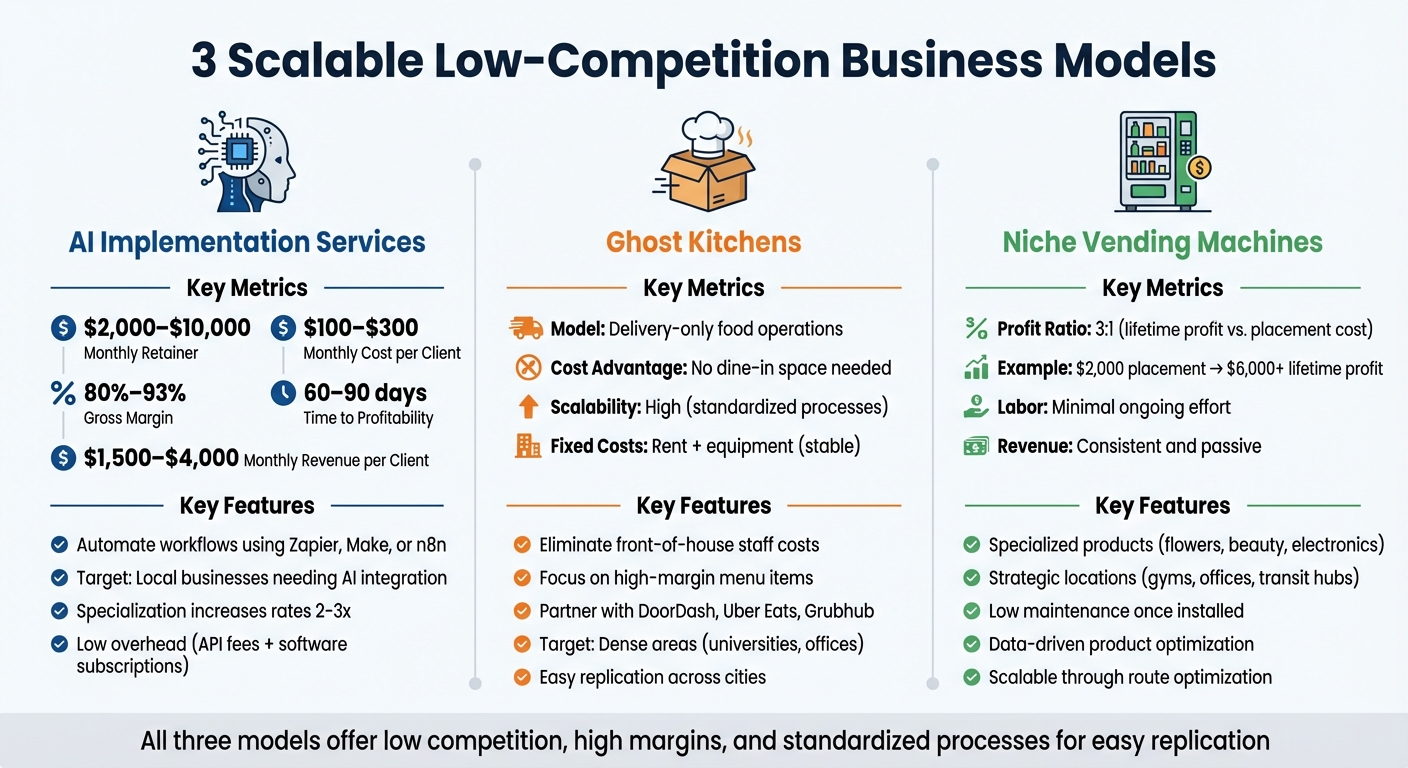
3 Low-Competition Multi-Location Business Models Comparison
Here are three business ideas that stand out for their ability to solve real problems, maintain strong profit margins, and scale easily. These ventures tap into growing demand while facing minimal competition, making them great candidates for multi-location expansion.
AI Implementation Services for Local Businesses
AI is no longer a futuristic concept - it’s here, and small businesses know it. The problem? Many don’t know how to use it effectively. Local professionals often feel overwhelmed by the sheer number of tools and don’t know where to begin. This opens the door for a business that serves as a bridge between AI technology and practical, day-to-day applications.
Using platforms like Zapier, Make, or n8n, you can automate workflows without needing custom software. This makes you the go-to person for integrating AI into tasks like customer support, email marketing, or social media management. The financials are attractive too. Monthly retainers usually fall between $2,000 and $10,000, while costs - mainly API fees and software subscriptions - stay low. For instance, providing AI-driven customer support could bring in $1,500 to $4,000 per month per client, with expenses ranging from just $100 to $300. That’s a gross margin of 80% to 93%.
Specializing in a specific industry, like healthcare, real estate, or law, can make your service even more valuable. Clients are often willing to pay 2-3 times more for solutions tailored to their industry’s unique challenges. A simple way to find potential clients? Look at Google Maps results ranked 10 to 30. These businesses are present but not prominent online, making them prime candidates for modern AI solutions. With the right approach, you could see profitability in as little as 60 to 90 days.
If tech isn’t your thing, another promising option is food service - specifically, ghost kitchens.
Ghost Kitchens
Ghost kitchens are delivery-only food operations that skip the costs of dine-in spaces. By eliminating expenses like prime real estate and front-of-house staff, they focus entirely on fulfilling delivery orders through platforms like DoorDash, Uber Eats, and Grubhub.
The key to scaling this model lies in standardization. Once you’ve streamlined recipes, sourcing, and kitchen workflows, it’s easy to replicate the operation in a new city with minimal adjustments. Fixed costs like rent and equipment remain steady while revenue grows, thanks to operational efficiency.
Success hinges on offering high-margin menu items that travel well and appeal to delivery customers. Testing demand with low-risk menu options allows for quick adjustments. When expanding, look for affordable commercial kitchen spaces in high-demand areas like near universities, office districts, or densely populated neighborhoods.
If food service isn’t your area of interest, consider a low-labor option like niche vending machines.
Niche Vending Machine Networks
Vending machines have come a long way from just dispensing snacks and soda. Today, specialized machines can sell everything from fresh flowers and beauty supplies to electronics accessories and healthy snacks. Placing these machines in strategic locations, such as gyms, offices, or busy transit hubs, can create a profitable and scalable business.
The beauty of this model lies in its simplicity. Once a machine is installed and stocked, it requires minimal ongoing effort while generating consistent revenue. Most costs, such as purchasing the machine and stocking it with initial inventory, are fixed. The goal is to ensure the lifetime profit of each machine far exceeds its placement cost - ideally by a ratio of at least 3:1. For example, if placing a machine costs $2,000, it should generate at least $6,000 in profit over its lifetime.
Scaling involves building relationships with property managers, streamlining restocking routes, and analyzing data to see which products and locations perform best. Once successful in one city, you can replicate the strategy in new markets, making this a straightforward and lucrative model for expansion.
These three business ideas - AI services, ghost kitchens, and niche vending machines - highlight opportunities to grow with minimal competition while addressing real-world needs.
How to Validate Your Business Idea with IdeaFloat
Before scaling your business, it's critical to confirm that your idea solves a problem people are willing to pay for. Surprisingly, 73% of founders give up before determining if their product or service has paying customers. IdeaFloat's AI-powered tools streamline this process, allowing you to test, refine, and even scale your idea in as little as 15 minutes. Here's a closer look at how IdeaFloat simplifies validation.
Testing Your Idea with Problem Validator and Consumer Insights
The Problem Validator helps ensure your idea addresses a real and pressing issue. Using live web research and specialized APIs, it uncovers "weak signals" of demand - hidden opportunities or unmet needs in niche markets. For instance, if you're exploring an AI implementation service for local businesses, the tool might highlight industries like healthcare or real estate actively searching for customized automation solutions.
"IdeaFloat saved us weeks of work by helping us explore demand for new products across different regions and took the guesswork out of finding gaps in the market. A must-have for entrepreneurs looking to scale."
- Nick Sherwing, Founder of woohoPets
The Consumer Insights tool dives into online sentiment, helping you fine-tune your messaging by analyzing discussions in communities where potential customers share their needs. Paired with Competitive Intel Gap Mapping, you can identify your competitors' weaknesses and create an "unfair advantage" to stand out.
Calculating Market Size and Planning Customer Acquisition
Once you've confirmed the problem's urgency, it's time to measure your market potential and plan how to reach your customers. Smart Market Sizing provides data on your Total Addressable Market (TAM), Serviceable Addressable Market (SAM), and Serviceable Obtainable Market (SOM). This helps you understand your market opportunity and estimate first-year revenue potential for each location.
The Go-to-Market Strategy tool creates a detailed customer acquisition plan tailored to your business. It identifies the exact channels where your audience gathers, calculates acquisition costs, and even provides outreach scripts. The AI Community Finder pinpoints over 23 online communities where your target customers are active. For example, if you're launching a ghost kitchen, the tool could uncover local food delivery Facebook groups, Reddit threads on late-night dining, or Instagram influencers popular with college students.
"IdeaFloat has been invaluable for expanding and franchising our business. It replaced months of research and Excel modeling with real-time data insights."
- Soba, Owner of Bar, Pilates, and Yoga Studio
Building Financial Models and Breakeven Analysis
IdeaFloat's Cost Analysis tool helps you separate fixed costs (like rent and salaries) from variable expenses (such as materials and shipping), giving you a clear profitability baseline. The Product & Service Creator allows you to structure your offerings and calculate exactly how many units you need to sell monthly to break even. This is especially useful for scaling across multiple locations.
The Advanced Pricing Research tool scans competitor pricing online and recommends optimal price points to maximize your profit margins - a game-changer when managing higher overhead costs. Meanwhile, the Financial Projections feature delivers month-by-month forecasts for revenue and expenses, displayed in interactive graphs. This makes it easy to see when a new location will transition from loss to profit.
You can also run "what-if" scenarios by tweaking variables like pricing or supplier costs to instantly see the impact on your breakeven point. And with IdeaFloat's free plan, you can start validating your strategy without spending a dime or entering credit card details.
How to Expand Your Business to Multiple Locations
Once your business is profitable, the next big challenge is replicating that success in new locations without losing what made it work in the first place. Expanding successfully requires clear processes, local flexibility, and constant performance monitoring. Here's how to approach each step.
Creating Standard Processes for Each Location
What works informally in one location won't necessarily work in another. Before opening a second location, document every part of your operations - from how customers are greeted to how inventory is managed and complaints are resolved. Think of this as your business's "playbook."
Start by mapping out the customer journey and creating Standard Operating Procedures (SOPs) for all tasks. This operations manual should be detailed enough for anyone to follow and still meet your brand's standards. In fact, franchise businesses that rely on such standardized processes have a 16% lower failure rate compared to independent businesses.
"The operations manual is your franchise's constitution - the definitive guide to running a unit to brand standards." – Digital Applied
Consistency is key, so use the same tech tools across all locations. A unified Point of Sale (POS) system, CRM software, and inventory management tools ensure data is collected and analyzed the same way, avoiding inefficiencies.
To maintain quality, consider sending top-performing employees from your original location to train new hires. This ensures new teams quickly align with your company culture.
Adapting to Each Local Market
Even with standardized processes, each location should reflect its local market. Standardization doesn't mean being rigid. Many successful multi-location businesses follow the 70/30 rule: 70% of operations focus on maintaining brand consistency - like messaging, tech systems, and national campaigns - while 30% allows for local flexibility, such as community engagement, regional pricing, and neighborhood-specific promotions.
| Control Level | Responsibilities | Examples |
|---|---|---|
| Corporate (70%) | Brand identity, core messaging, tech stack, national promos | National campaigns, unified reporting, core service offerings |
| Local (30%) | Community engagement, local events, staff spotlights | Local partnerships, neighborhood-specific social content |
To manage local decision-making, create a "Traffic Light" system. For example:
- Green Light: Tasks like posting pre-approved social media content or forming small local partnerships can be handled by location managers without approval.
- Yellow Light: Custom campaigns or larger partnerships (e.g., over $500) require corporate review within 24 hours.
- Red Light: Major decisions, such as brand changes or crisis management, remain under corporate control.
For local SEO, avoid duplicate content by creating unique pages for each location. Include 600–900 words of original copy, city-specific FAQs, and photos of the local team. This strategy can boost your local search rankings, where organic leads are often 80–90% cheaper than pay-per-click ads.
Tracking Performance and Making Adjustments
To grow successfully, you need to measure performance effectively. Set up location-specific tracking from the beginning, such as using unique phone numbers or URLs (e.g., yourbusiness.com/chicago) to track leads and revenue for each branch. Financial metrics like Monthly Recurring Revenue (MRR) and net profit margins are essential - aim for at least a 10% net profit margin in service-based businesses.
Operational efficiency also matters. If your equipment or space is used less than 70% of the time, you may need to optimize your current setup before expanding further. Similarly, if your customer churn rate exceeds 5% monthly, focus on improving retention before opening new locations.
Take the example of Special Strong, a fitness franchise that grew to over 10 locations across four states by September 2025. Founder Daniel Stein introduced ABC Glofox software to automate member management and centralize reporting. This helped the company track engagement and improve customer service across all franchises.
"ABC Glofox offered the automation and customer support we needed to scale effectively." - Daniel Stein, Founder, Special Strong
Finally, compare your locations to identify strengths and weaknesses. Use the top 25% of performers as models to improve the bottom 25%. If a location struggles, audit its performance to identify whether the issue lies in marketing (low leads) or operations (low conversions or high churn). Fix operational gaps before increasing marketing spend.
Conclusion
The most profitable businesses don’t always grab the spotlight. Low-competition niches - like pet waste removal, eco-friendly landscaping, or AI implementation services - are thriving because they tackle real problems in local markets. These businesses avoid the intense competition that drives up marketing costs and squeezes profit margins. The secret lies in identifying opportunities with steady demand, strong profit margins, and scalable processes that maintain quality as they grow.
Before expanding, it’s crucial to validate your concept. Maxim Atanassov from Future Ventures sums it up perfectly: "Don't scale anything that isn't working. It's like photocopying a mistake. You just get more mistakes". Testing your idea with real-world data - by analyzing problem severity, unit economics, and customer acquisition costs - helps you avoid costly missteps. This approach sets the stage for leveraging advanced tools to refine and strengthen your strategy.
To take the guesswork out of the process, platforms like IdeaFloat offer tools to confirm demand, gain customer insights, and verify financial projections before you dive in.
Once your model is proven in one location, standardization becomes the key to growth. Businesses with well-documented SOPs outperform competitors by 31% and reduce employee turnover by 25%. By clearly defining your processes, adapting to local market needs, and consistently monitoring performance, you can build a foundation for sustainable growth.
The opportunity is undeniable. Unsaturated markets can deliver up to six times the ROI of crowded ones, with advertising costs slashed by 50-80%. With the right approach, you can transform local success into scalable, profitable expansion.
FAQs
How do I pick a low-competition niche in my city?
Begin by diving into your community's needs and spotting areas where demand outweighs supply. Look for service-based businesses that aren’t widely available, such as pet care, home services, or even specialized retail options. Your goal? Solve specific local challenges with solutions that can grow over time - like starting a cleaning service or offering handyman expertise.
To make sure your idea has potential, talk to locals and get their input. Pay attention to gaps in the services already available. This way, you can confirm there’s enough demand and avoid entering an overly crowded market.
What numbers should I track before opening a second location?
Before you consider opening a second location, it's crucial to monitor a few key metrics. Focus on market demand, financial performance, operational capacity, labor availability, and brand consistency. Keeping an eye on these areas will help you determine if your business is ready to grow while maintaining the same level of quality and profitability.
How do I standardize operations without losing local appeal?
To maintain a balance between standardized operations and local appeal, aim for consistency while leaving room for adaptability. Rely on core practices like training programs and operational manuals to ensure quality across the board. At the same time, give local managers the freedom to tailor aspects like customer service, marketing strategies, and community involvement to fit regional tastes. This method keeps your brand identity intact while building stronger connections with local communities, paving the way for growth that respects regional differences.
Related Blog Posts
 Report an issue
Get the newest tips and tricks of starting your business!