Starting a business in Australia in 2026 is easier than ever. With over 437,150 new ventures launched recently, many business ideas now require less than $5,000 to get started. Thanks to advancements in AI, digital platforms, and a growing demand for services like sustainability, wellness, and convenience, opportunities abound for aspiring entrepreneurs. Here’s a quick overview of low-investment ideas:
- Eco-Friendly Ventures: Cleaning services, solar panel maintenance, compost collection, and sustainable fashion.
- Digital Services: AI workflow automation, virtual assistance, social media management, and digital downloads.
- Handmade Products: Jewelry, candles, printables, and custom stickers.
- Convenience Solutions: Subscription home maintenance, Airbnb management, and errand services.
Each idea leverages minimal startup costs, flexible work hours, and Australia’s favorable economic environment. Whether you’re looking to start small or grow fast, these options cater to various skills and budgets.
Pro Tip: Validate your idea early using tools like Google Trends, create a simple online presence, and register for an ABN to get started.
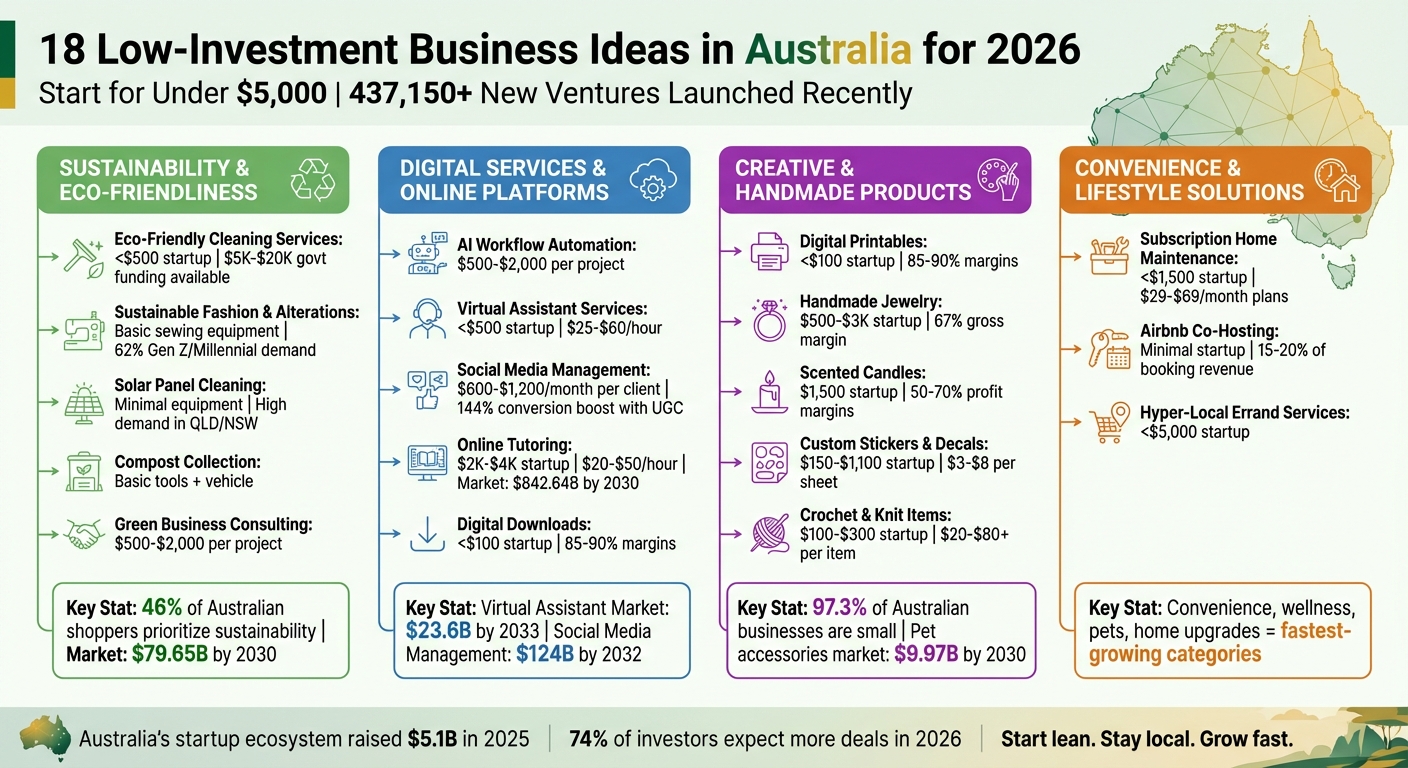
18 Low-Investment Business Ideas in Australia for 2026 by Category
25 Unique Low-Investment Business Ideas You Can Start from Home
sbb-itb-08dd11e
1. Sustainability and Eco-Friendliness
In Australia, 46% of shoppers prioritize sustainability, with many willing to pay an extra 9.7% for eco-friendly products. On a global scale, the sustainability market is expected to hit $79.65 billion by 2030, growing at an annual rate of 23.1% starting in 2025. The following ideas tap into Australia's increasing focus on sustainability while requiring minimal investment. Let’s dive into five potential ventures.
Eco-Friendly Cleaning Services can be launched with under $500, starting with non-toxic, biodegradable supplies. Operating from home, you can target residential clients and small offices aiming to reduce their environmental impact. Take Emma Nguyen from Perth as an example. In 2024, she started an allergy-friendly eco-cleaning business using a $5,000 Microenterprise Subsidy from the Western Australian government. Within just three months, she secured 20 weekly clients and qualified for an additional $20,000 in federal growth funding.
Sustainable Fashion & Alterations is another promising idea. This involves repairing, upcycling, or repurposing deadstock fabrics. With just basic sewing equipment, you can start this venture from home. A great example is ANIÁN, a circular clothing company led by Paul Long. By 2025, ANIÁN created a clothing line entirely from post-consumer waste, eliminating the need for dyes and working directly with mills to reduce waste. This approach resonates strongly with 62% of Gen Z and Millennials, who are actively changing their buying habits to combat climate change.
Solar Panel Cleaning is an ideal service for sunny areas like Queensland and New South Wales. It ensures solar panels operate at peak efficiency and requires minimal equipment and training to get started.
Another low-cost option is Compost Collection Services. This involves collecting food scraps from urban homes and cafes to create nutrient-rich soil. All you need are basic tools and a vehicle to begin.
Finally, Green Business Consulting offers a way to help small and medium-sized enterprises (SMEs) reduce their carbon footprints and waste. You can charge between $500 and $2,000 per project for services like AI-driven sustainability solutions.
According to Phantila Phataprasit, Founder of Sabai Design, "People really do want to support sustainable brands, want to buy products that are sustainable, and those companies are growing faster than their counterparts across the board".
To build credibility and avoid accusations of greenwashing, consider obtaining certifications like B Corp, Fair Trade, or GOTS for textiles.
2. Digital Services and Online Platforms
Australia's digital economy is booming, with AI tools empowering solopreneurs to handle tasks that used to require teams of three to five people. The global virtual assistant market is expected to reach $23.6 billion by 2033, while social media management could grow to over $124 billion by 2032. Here are five digital service ideas that need little upfront investment.
AI Workflow Automation simplifies tasks like customer responses, bookings, and accounting. Fees for such projects typically range from $500 to $2,000. For example, in March 2026, the learning platform Gurushala - backed by the Vodafone India Foundation - integrated AI tools created by Appinventiv, reaching over 150,000 users and generating $2.1 million in revenue. In Australia, tradies are particularly interested in AI solutions for quoting, invoicing, and scheduling.
Virtual Assistant Services are another low-cost option, with startup costs under $500 and hourly rates ranging from $25 to $60 or more. This flexible work model allows you to focus on specific niches, like assisting tradies. Platforms such as Upwork and Fiverr are excellent places to find initial clients.
Social Media Management takes advantage of AI-powered content creation tools, enabling monthly retainers of $600 to $1,200 per client. User-generated content (UGC) is especially effective, with shoppers who engage with UGC being 144% more likely to convert.
Chris Hughes, Founder of Timberware, recommends, "My best advice would be to start with what you can afford and slowly grow your tool arsenal".
Online Tutoring involves an upfront investment of $2,000–$4,000 but offers hourly earnings of $20 to $50 or more. With the global e-learning market projected to hit $842.64 billion by 2030, platforms like Wyzant and Preply simplify the process of finding students, eliminating the need to create your own website.
Digital Downloads offer a scalable way to earn passive income once your content is ready. Products like templates, e-books, design kits, or courses can be sold through Shopify (starting at $5/month) or Etsy. The key is identifying gaps in the market.
Kristen Pumphrey, Founder of P.F. Candle Co, advises, "You have to figure out what's not being fulfilled in the market".
Before starting any digital service in Australia, make sure to register for an Australian Business Number (ABN) and for GST if your annual turnover is expected to exceed $75,000. Open a separate business bank account to keep finances organized, and use social media or pre-launch landing pages to test demand before committing to a full website. These strategies align with Australia's growing creative industries, offering exciting opportunities for low-cost ventures.
3. Creative and Handmade Products
Australia's creative market is buzzing with opportunities, especially for those venturing into handmade crafts. In 2025, an impressive 97.3% of Australian businesses were classified as small, highlighting the vibrant handmade sector. These products often combine low production costs with high margins, particularly in personalized or niche categories. Consumers are also showing a strong preference for ethical choices, with many willing to spend extra for sustainable goods. Below are some ideas that align with these trends.
Digital Printables are a low-cost venture with startup expenses below $100 and net margins of 85–90%. Products like planners, art prints, SVG files, and educational templates can be sold on platforms like Etsy or Shopify. Since there’s no inventory or shipping involved, these items can generate passive income long after they're created.
Handmade Jewelry offers flexibility in startup costs, ranging from $500 to $3,000 for materials. Even basic pieces, which cost as little as $0.70–$2.10 to make, can sell for around $36, delivering a 67% gross margin. Personalized items like name necklaces, birthstone bracelets, and custom wedding jewelry often fetch higher prices because of their emotional appeal - something mass-produced items usually lack.
Scented Candles boast profit margins of 50–70%, with material costs accounting for just 20–30% of the retail price. A $1,500 investment covers wax, wicks, containers, and fragrance oils. Producing candles in larger batches - say, 50 at a time - can significantly lower the time spent per unit.
"You have to figure out what's not being fulfilled in the market. For us, that was creating a unisex candle." – Kristen Pumphrey, Founder of P.F. Candle Co
Custom Stickers and Decals are another affordable option, with professional tools like Cricut costing under $200. Startup costs range from $150 to $1,100, and sticker sheets typically sell for $3–$8 each. Event-driven products, such as wedding decals or branded business stickers, are especially popular. Additionally, the growing pet accessories market, which is expanding at 6.9% annually and projected to hit $9.97 billion by 2030, makes items like custom pet bandanas and collars a promising niche.
Crochet and Knit Items require an initial investment of $100–$300. Finished products can sell for $20–$80 or more, depending on their complexity. Many Australian artisans start on Etsy and later transition to Shopify to save on fees. For instance, selling 1,000 items priced at $25 each on Etsy would net around $22,175 after fees, whereas the same sales on Shopify could bring in approximately $24,000 - a difference of $1,800.
4. Convenience and Lifestyle Solutions
Australians are increasingly embracing services that make life easier and save time. With a growing demand for convenience and the hustle of busy households, 2026 offers promising opportunities for small, mobile businesses that tackle everyday challenges. According to The Business Times, "convenience, wellness, pets, home upgrades and tourism are the fastest-growing spending categories". Here are three affordable business ideas that align with this trend:
Subscription Home Maintenance
Offer homeowners a monthly service plan (priced between $29 and $69) to handle routine household tasks like smoke alarm checks, HVAC filter replacements, and seasonal maintenance. Bundling essential services adds extra value for customers. Starting this type of business typically requires less than $1,500, covering basic tools and initial marketing efforts.
Airbnb Co-Hosting and Management
Help property owners manage short-term rentals by taking care of tasks like guest check-ins, answering inquiries, and coordinating turnovers. This service can generate 15–20% of booking revenue. With just a laptop, scheduling software, and a network of dependable cleaners, the setup costs are minimal.
Hyper-Local Errand and Delivery Service
Cater to households in areas with limited nearby shopping options by running errands like picking up groceries, medications, or important documents. By concentrating on a specific neighborhood, you can reduce travel time and complete more jobs each day. Startup costs for this type of service are typically under $5,000.
"Australia is entering a golden era for micro-businesses that start lean and grow quickly." – The Business Times
These ideas not only address the growing demand for convenience but also require relatively low investment, making them accessible for aspiring entrepreneurs.
Conclusion
Starting a business in Australia in 2026 is more achievable than ever, thanks to a mix of low startup costs and innovative opportunities. Many of the 18 business ideas discussed here can be launched for under $5,000. Whether your interests lie in sustainability, digital services, creative ventures, or convenience-based solutions, the entry point is more accessible than it’s ever been.
The secret to success? Start small and validate early. Use tools like Google Trends to gauge demand before making big investments, and focus on solving real problems within your community. This approach aligns perfectly with the trends shaping Australia’s market, especially in sustainability, digital innovation, and local convenience. With Australia’s startup ecosystem raising $5.1 billion in 2025 and investor confidence high - 74% of investors anticipate closing more deals in 2026 - the timing couldn’t be better.
By leveraging low startup costs and tapping into government support like grants and R&D tax incentives, particularly in areas like climate tech and digital services, you can turn your idea into reality. The fastest-growing sectors - aged care, pet services, regional tourism, and convenience solutions - are ripe for new entrepreneurs ready to take action.
"Start lean. Stay local. Grow fast. These are the Australian small businesses shaping 2026." – The Business Times AU
Choose an idea that matches your skills and passions, register your ABN, set up a simple online presence, and launch your business to start serving your customers. The opportunities are there - it's time to seize them.
FAQs
Which idea is easiest to start with no experience?
Freelance services - like writing, graphic design, or marketing - are great low-cost businesses to dive into, even if you're just starting out. They don’t demand expensive tools or upfront investments, making them beginner-friendly. Plus, you can sharpen your skills while earning along the way. The key is to focus on tasks you’re already somewhat familiar with or feel confident exploring, so you can hit the ground running.
What licenses or insurance do I need in Australia?
In Australia, there are specific licenses and insurance policies that businesses are legally obligated to have. These include workers' compensation insurance to cover employees, public liability insurance for certain industries, and vehicle-related insurance, such as third-party personal injury insurance or a CTP green slip for vehicles. It's important to verify the exact requirements that apply to your business based on its type and location.
How do I get my first customers fast?
To get your first customers quickly, start by tapping into local demand and your personal network. Offer services that people are actively looking for, like pet sitting, digital skills training, or content creation. Use social media platforms and local online communities to promote what you offer.
Create a basic online presence - this could be a simple website or even just a polished social media profile. Then, focus on targeted marketing efforts, such as posting on community boards or joining Facebook groups where your potential customers hang out.
Once you land your first clients, go above and beyond to deliver great service. Happy customers are more likely to refer you to others, helping you grow your customer base quickly through word-of-mouth.
Related Blog Posts
 Report an issue
Get the newest tips and tricks of starting your business!