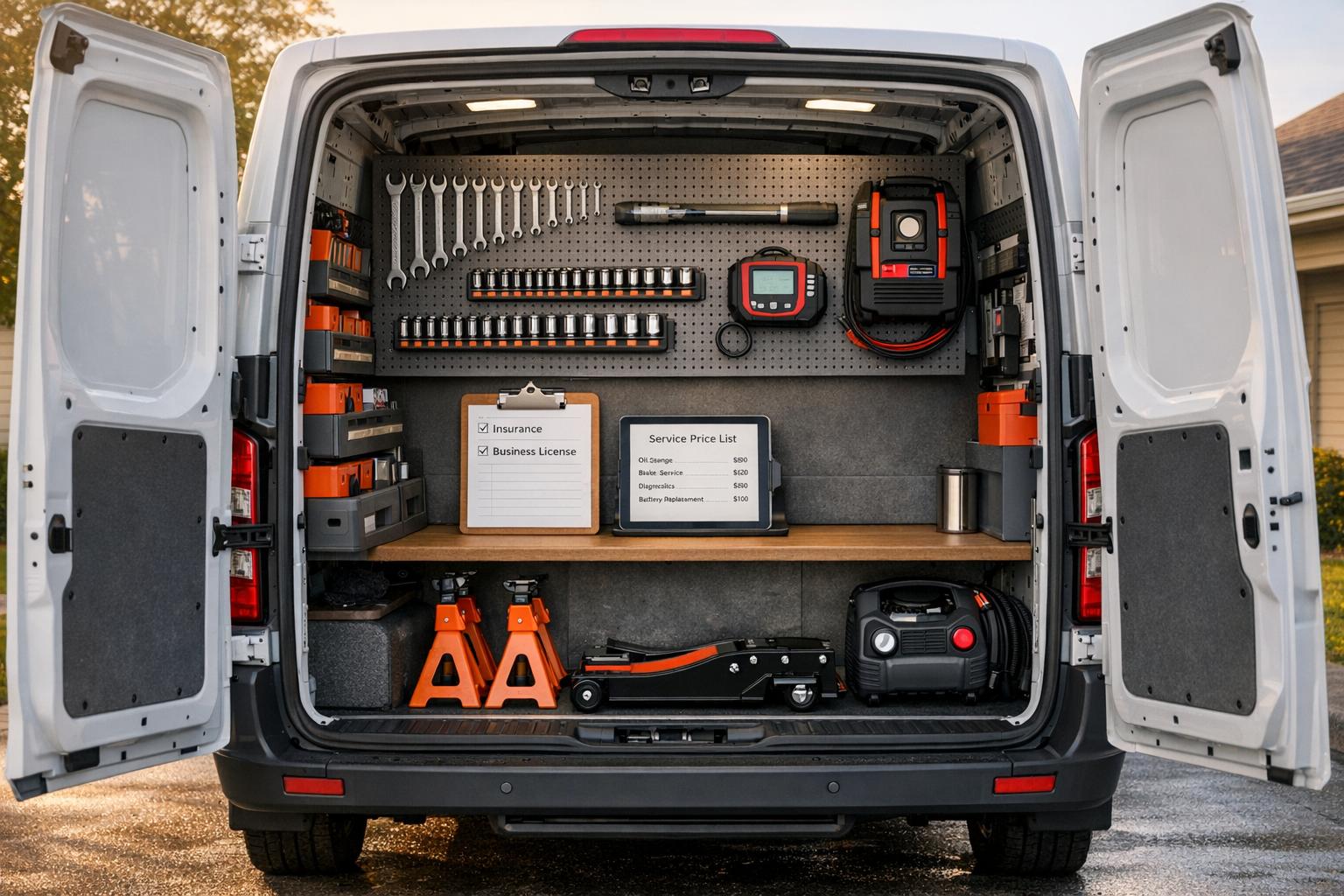
Starting a mobile mechanic business requires minimal upfront costs, offers flexibility, and can generate significant income. Here's a quick summary:
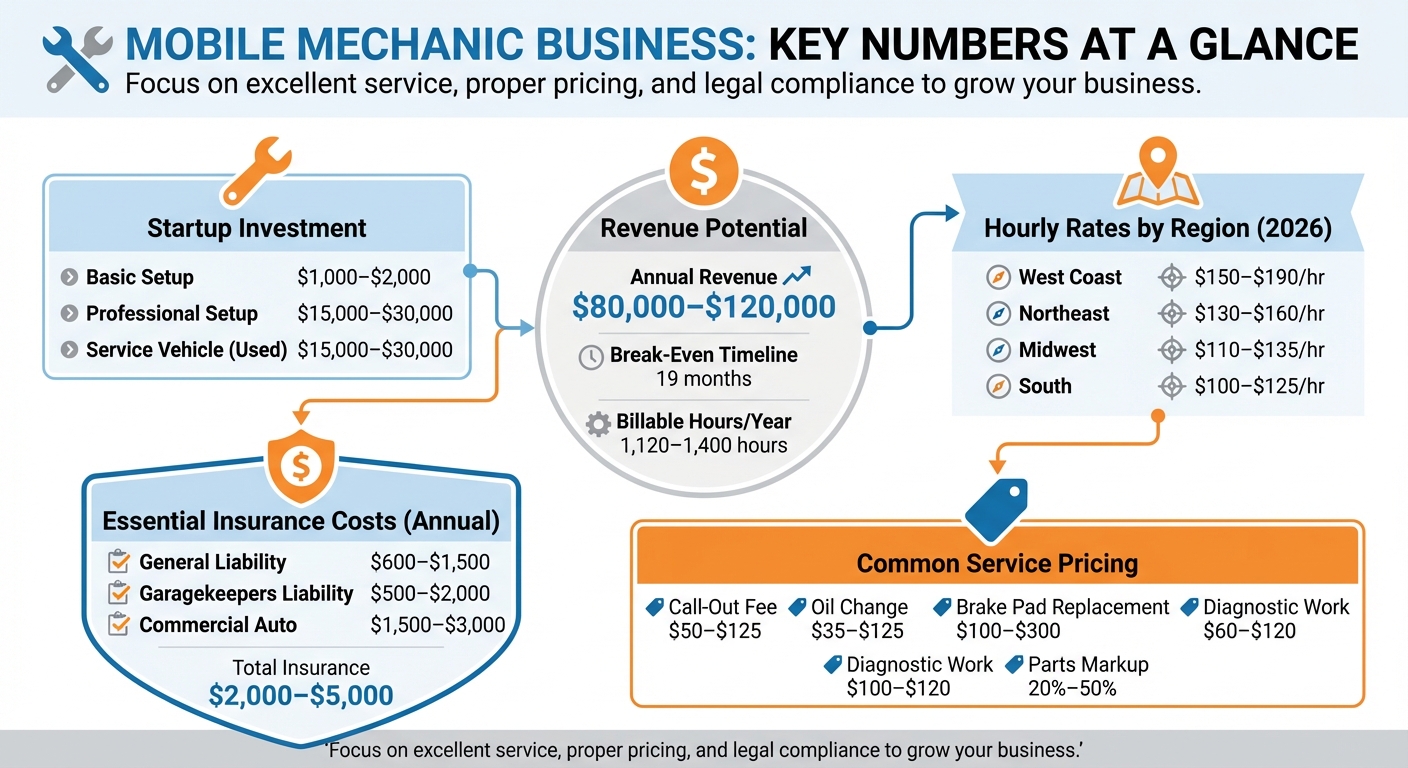
- Start-Up Costs: Begin with $1,000–$2,000 for basic tools or invest $15,000–$30,000 for a professional setup.
- Earnings: Expect annual revenue between $80,000 and $120,000, with most businesses breaking even in 19 months.
- Essential Tools: Prioritize diagnostic tools (OBD-II scanner, multimeter), hand tools, power tools, and safety gear like jacks and protective equipment.
- Pricing: Hourly rates range from $20 to $190 depending on location, with additional fees for travel, parts markup, and specialized services.
- Legal Setup: Form an LLC, get an EIN, and secure licenses, permits, and insurance (general liability, garagekeepers, and commercial auto).
- Vehicle: Choose a reliable work vehicle (pickup, cargo van, or chassis cab) and organize it with modular storage for efficiency.
This business model eliminates the need for a physical garage, reduces overhead, and provides convenience to customers. Focus on excellent service, proper pricing, and legal compliance to grow your business.
Mobile Mechanic Business Startup Costs and Revenue Guide
How to Start a Mobile Mechanic Business - No Step Left Out!
sbb-itb-08dd11e
Tools and Equipment You Need
Starting a mobile mechanic business doesn’t require a massive upfront investment. In fact, you can get started with essential tools for under $2,000 and expand your collection as your business grows. Focus on portable, durable equipment that fits in your vehicle and can handle common repair jobs.
Your tools will generally fall into three categories: diagnostic tools, hand and power tools, and lifting and safety equipment. These essentials will allow you to provide efficient on-site automotive repairs without compromising quality.
Diagnostic Tools and Equipment
With today’s vehicles relying heavily on computer systems, diagnostic tools are non-negotiable. Start with an OBD-II scanner - basic models cost around $50 and can read vehicle error codes. As your business grows, consider upgrading to advanced scanners (starting at $100) that offer live data monitoring and more in-depth diagnostics.
A digital multimeter (under $20) is another must-have for diagnosing electrical issues, while a test light provides quick checks on fuses and relays. A portable battery jump starter (under $100) is also invaluable for roadside assistance calls.
Caleb Markovich from Truckup highlights the importance of accurate diagnostics:
The tool will help you determine the exact cause of the problem and ensure the repairs are done right, saving you and your client time and money.
To protect your diagnostic tools during transport, use specialized cases to prevent damage from bumps and vibrations. Once you’ve identified the issue, you’ll rely on your hand and power tools to get the job done.
Hand and Power Tools
After pinpointing the problem, you’ll need reliable hand and power tools to perform the repairs. Your hand tool collection should include socket sets, wrenches (combination, ratcheting, and torque), pliers (locking, needle-nose, and slip-joint), and screwdrivers (Phillips, flathead, and Torx). Starter kits from brands like Stanley or Craftsman cost between $100 and $200 and cover most basic repairs.
Power tools can save you time and effort. A cordless impact wrench (around $150) is perfect for removing lug nuts or stubborn bolts. Brands like Ryobi and DeWalt offer dependable options at reasonable prices. A portable air compressor ($50–$100) is another handy addition for inflating tires or powering pneumatic tools. Since mobility is key for a mobile mechanic, cordless tools are often more practical than pneumatic ones that require a constant air supply.
Other helpful tools include a rechargeable LED work light (under $30) for illuminating dark spaces and a creeper ($30–$50) to protect your back during undercarriage work. Don’t forget an oil drain pan with at least a 12-quart capacity - it’s essential for handling oil changes on larger vehicles like diesel trucks and preventing spills.
Lifting and Safety Equipment
To safely access vehicles, invest in reliable lifting and safety gear. A portable 2-ton floor jack (under $100) and a pair of sturdy jack stands are must-haves. Look for a jack that’s low enough for sports cars but can also lift higher vehicles like trucks. Always double-check the safety rating on jack stands - a 3-ton model can handle most passenger vehicles.
Protective gear is equally important. Safety glasses, mechanic gloves, ear protection, and steel-toe boots safeguard you from debris, chemicals, and heavy objects. Keep a first aid kit and a fire extinguisher in your vehicle in case of emergencies, especially when working with flammable materials. Since you’ll encounter various terrains - like asphalt, mud, or snow - pack an outdoor rubber mat or moving blanket to cushion your knees and back.
Emilie Vecera from Fullbay shares practical advice:
Protect your knees and back. Pack an outdoor rubber mat, closed-cell sleeping mat, or moving blanket in your vehicle so you have a cushion to kneel or lay on while you work.
Finally, for those rainy or snowy days, a pop-up canopy is a simple way to keep you and your workspace dry.
How to Price Your Services
Pricing your mobile mechanic services is a balancing act. You need to account for customer budgets while ensuring your rates cover all your costs. These costs include your time, fuel, maintenance, tool depreciation, insurance, and even non-billable tasks like travel and paperwork. Most mobile mechanics charge anywhere from $20 to $125 per hour.
However, not all your hours will be billable. A realistic goal is to achieve 1,120 to 1,400 billable hours per year, as travel, sourcing parts, and handling paperwork take up a significant amount of your time. In fact, only about 25–30 hours of a standard 40-hour workweek are typically billable. This means your hourly rate must account for the overhead of non-billable tasks.
Jeel Patel, CEO of FieldCamp, emphasizes the importance of understanding your costs when setting rates:
Setting your hourly rate isn't about copying competitors; it's about covering your real costs and securing sustainable profit.
Setting Hourly Rates and Service Fees
To determine your minimum hourly rate, use this formula:
(Desired Annual Salary + Annual Overhead) ÷ Realistic Billable Hours = Minimum Hourly Rate.
For example, if you aim for a $50,000 salary and have $15,000 in overhead, spread across 1,200 billable hours, your minimum hourly rate would need to be around $54.
Regional differences also play a significant role. In 2026, typical rates for independent mobile mechanics vary by location:
- West Coast: $150 to $190 per hour
- Northeast: $130 to $160 per hour
- Midwest: $110 to $135 per hour
- South: $100 to $125 per hour.
Additionally, you might want to include a call-out fee - anywhere from $50 to $125 - to cover travel, fuel, and the initial inspection. A markup of 20% to 50% on parts can help offset the time spent sourcing them and the warranty risks involved. For jobs in challenging conditions, such as crawl spaces or hazardous areas, consider applying complexity multipliers ranging from 1.2x to 2.0x your base rate.
Charging More for Specialized Services
Some services warrant higher rates due to the expertise, tools, and certifications they require. For instance, maintaining electric or hybrid vehicles can command rates that are 15% to 25% higher than standard automotive work. Similarly, classic car repairs often come with a 20% to 40% premium because of the specialized skills and effort needed to source rare parts.
Emergency and after-hours services should also come with premium pricing. Weekend work might be billed at 1.5x your standard rate, while holidays could go up to 2.0x. Emergency roadside assistance often includes a flat call-out fee of $150 to $250, on top of your hourly rate. Some mechanics also charge an additional $25 to $40 per hour for work done between 6:00 PM and 8:00 AM.
For predictable services like oil changes (typically $35 to $125) or brake pad replacements (around $100 to $300), flat-rate pricing provides customers with upfront clarity. On the other hand, hourly pricing is better suited for diagnostic work (usually $60 to $120) or complex repairs where the time required can vary.
Once you’ve nailed down your pricing, the next step is ensuring your business complies with all legal requirements.
Legal Requirements and Compliance
Before you can start serving customers, you'll need to establish a solid legal framework for your business. Many mobile mechanics choose to form an LLC, which helps protect personal assets, and you'll also need to obtain a Federal Employer Identification Number (EIN) from the IRS. This EIN is essential for filing taxes, opening business bank accounts, and hiring employees.
You'll also need a business license, which typically costs between $50 and $500, depending on your city or county. Some states require specific automotive repair licenses as well. For instance, California mandates registration as an Automotive Repair Dealer (ARD), which costs about $200 annually and requires at least four years of automotive repair experience. In Florida, registering with the Department of Agriculture and Consumer Services costs between $100 and $200, and invoices must include details like "mileage in", "mileage out", and clear service descriptions. These steps lay the groundwork for obtaining the licenses, insurance, and regulatory compliance needed to operate legally.
Licenses and Permits
The licenses and permits you’ll need depend on where you’re located. For example, Hawaii requires at least one ASE certification to qualify for a mechanic license, while Michigan has state-specific tests for specialty or master mechanic certification. On the other hand, states like Alabama and Arizona don’t require professional licensing for mobile mechanics. Washington, D.C., however, charges $551.10 for a Consumer Goods Repair License.
If you handle motor vehicle air conditioners, you’ll also need EPA Section 609 certification to manage refrigerants properly. Additionally, check local zoning regulations to ensure compliance with rules about where you can park your service vehicle.
Insurance and Certifications
Once your legal and licensing requirements are squared away, it’s time to focus on insurance. Insurance is critical when you’re working with expensive tools and customer vehicles, especially on public roads. Comprehensive insurance for a mobile mechanic business typically costs between $2,000 and $5,000 annually. A general liability policy, which covers up to $1 million in third-party injuries or property damage, usually costs $600 to $1,500 per year. However, since general liability doesn’t cover customer vehicles, you’ll need garagekeepers liability insurance, which costs between $500 and $2,000 annually, to protect vehicles in your care.
Personal auto insurance won’t cover business use, so you’ll need commercial auto insurance, which ranges from $1,500 to $3,000 per year and includes liability limits up to $1 million. If you have employees, most states require workers' compensation insurance to cover workplace injuries. To save money, consider bundling general liability and commercial property coverage into a Business Owner’s Policy (BOP).
While ASE certification isn’t mandatory everywhere, it’s often expected and can even reduce insurance costs. The initial testing and registration for ASE certification typically cost between $300 and $700.
State-Specific Requirements
Regulations vary widely across states, so it’s important to understand the specific requirements where you operate. For instance, Texas only requires registering your business name with the Secretary of State. In Connecticut, you’ll need a dealer license and a surety bond. Massachusetts generally requires a $10,000 bond to cover warranty claims or customer disputes.
To stay on top of compliance, consider setting up a digital calendar with reminders for annual renewals of licenses, permits, and insurance policies. Missing deadlines can lead to fines or even suspension of your business operations. Additionally, ensure you’re following proper guidelines for disposing of hazardous materials like used oil, antifreeze, and tires. Your state’s environmental protection agency or Bureau of Automotive Repair can provide detailed instructions.
Choosing and Setting Up Your Service Vehicle
Your service vehicle is more than just a mode of transportation - it’s your mobile workshop, storage space, and even a rolling advertisement. Picking the right vehicle starts with understanding its Gross Vehicle Weight Rating (GVWR). This number tells you the maximum weight your vehicle can safely carry, including its own weight, tools, equipment, and any modifications you make. To avoid exceeding the GVWR, list out all your tools and their weights. Overloading isn’t just risky - it can lead to safety issues, legal troubles, and higher maintenance costs.
Once you know your weight limits, it’s time to explore vehicle options that align with your business needs.
Selecting Your Work Vehicle
Used service vehicles typically cost between $15,000 and $30,000, making them a budget-friendly option for startups. The type of vehicle you choose should depend on your specific requirements:
- Pickup Trucks: These offer higher payload capacity and handle off-road conditions well, making them ideal for rural areas or construction sites. However, their open cargo area leaves tools exposed to weather and theft unless you add a bed cover or service body.
- Cargo Vans: These are more fuel-efficient and provide fully enclosed storage, which is perfect for urban settings where space is tight and expensive tools need protection.
- Chassis Cabs: These allow for maximum customization with aftermarket service bodies or flatbeds. While they’re versatile, the initial cost is higher.
When comparing vehicles, think about your daily mileage and fuel expenses - these will directly impact your operating costs. Also, consider how easily you can access your tools. Features like side-access compartments or bed cargo slides can save time during roadside jobs. Don’t forget to add practical touches like steps, grab handles, and anti-slip surfaces for safer access.
Organizing Your Mobile Workspace
Once you’ve chosen the right vehicle, the next step is setting up the interior to maximize both efficiency and safety. Modular storage systems - such as shelving, toolboxes, and drawer units rated for 250–600 lbs - are great for keeping tools secure and organized. Place heavier items low and centered to maintain stability while driving. OSHA guidelines also emphasize that all tools and materials must be secured to prevent hazards during transit.
For added safety, install a partition between the cargo area and the driver’s seat to stop tools from shifting during sudden stops. Equip your vehicle with interior LED strips and exterior floodlights to ensure visibility during early or late jobs. A pop-up canopy or vehicle-attached shelter can keep you working through rain or snow, while a rubber mat or kneeling pad helps protect your knees on hard surfaces.
Finally, turn your vehicle into a mobile advertisement. Use professional decals to display your business name, logo, and contact details. This simple step can attract new customers as you drive around town.
With a properly equipped and branded vehicle, you’ll be ready to deliver efficient, professional service while growing your business.
Next Steps for Your Mobile Mechanic Business
Now that your setup is complete and pricing is sorted, it's time to focus on the next steps to establish your business and make it thrive. Start by claiming your Google Business Profile. This step is crucial for appearing in local "mechanic near me" searches. Make sure to fully complete your profile by including your service areas, operating hours, and photos of your van and equipment. A detailed profile not only boosts visibility but also builds trust with potential customers.
Set up a dedicated business bank account as soon as your LLC is formed. This keeps your finances organized, simplifies taxes, and protects your legal standing by keeping personal and business expenses separate.
To streamline your workflow, invest in cloud-based shop management software. This allows for paperless invoicing, digital vehicle inspections (DVIs), and automated scheduling. Customers appreciate transparency, and sending photos or videos of repair needs directly to their phones can enhance their confidence and satisfaction.
Don’t forget about insurance. Garage Keepers insurance, which typically costs between $500 and $2,000 annually, is essential to cover customer vehicles while they're in your care. Additionally, ensure you're implementing a call-out fee to cover travel and initial inspection costs, and consistently apply a markup on parts to maintain profitability.
Keep an eye on your comeback rate, which measures the percentage of jobs that require a return visit. Aim for a rate below 3% - this indicates high-quality work and happy customers. To minimize callbacks, use standardized digital checklists for routine jobs like brake inspections. And remember to ask for Google reviews within 24 hours of completing a job. Positive reviews left while the experience is still fresh can significantly boost your reputation.
As a single technician, your annual revenue target should range from $80,000 to $120,000. Once you're consistently booked two weeks in advance or hitting the upper end of that revenue range, it might be time to scale up - whether by hiring additional help or expanding your fleet. Until then, focus on delivering excellent service, fine-tuning your processes, and building a reputation that keeps customers coming back.
FAQs
What repairs should I offer first?
Start by focusing on services that customers often need and that don’t require a lot of equipment or time to complete. Think along the lines of brake repairs, oil changes, tire replacements, and battery diagnostics. These everyday tasks are a great way to establish your reputation while quickly building a loyal customer base.
Once you’ve gained more experience and invested in additional tools, you can branch out into more specialized areas. For example, working on diesel trucks or classic cars can help set your business apart and attract a niche audience in your local area.
How do I set a travel fee?
When deciding on a travel fee as a mobile mechanic, it's important to factor in distance, travel time, and associated expenses. A straightforward approach is to charge a per-mile rate. For instance, the IRS mileage rate (65.5 cents per mile for 2026) can serve as a useful benchmark.
Another option is a tiered system. For example, you could offer the first 20 miles at no cost and then apply a fixed rate for every mile beyond that.
Whatever method you choose, clear communication with your clients is key. Being upfront about your fees helps build trust and ensures there are no surprises.
What insurance do I need to start?
To launch a mobile mechanic business, securing the right insurance is crucial. Here are the key types you'll need:
- General Liability Insurance: Covers property damage or injury claims that might arise while you're working.
- Commercial Auto Insurance: Protects your vehicle and tools during transit or on the job.
- Equipment Protection: Ensures your diagnostic tools and other essential equipment are covered.
Depending on your state laws and how your business is structured, you might also need workers' compensation or extra liability coverage. These policies not only protect your business but also keep you compliant with legal requirements.
Related Blog Posts
 Report an issue
Get the newest tips and tricks of starting your business!