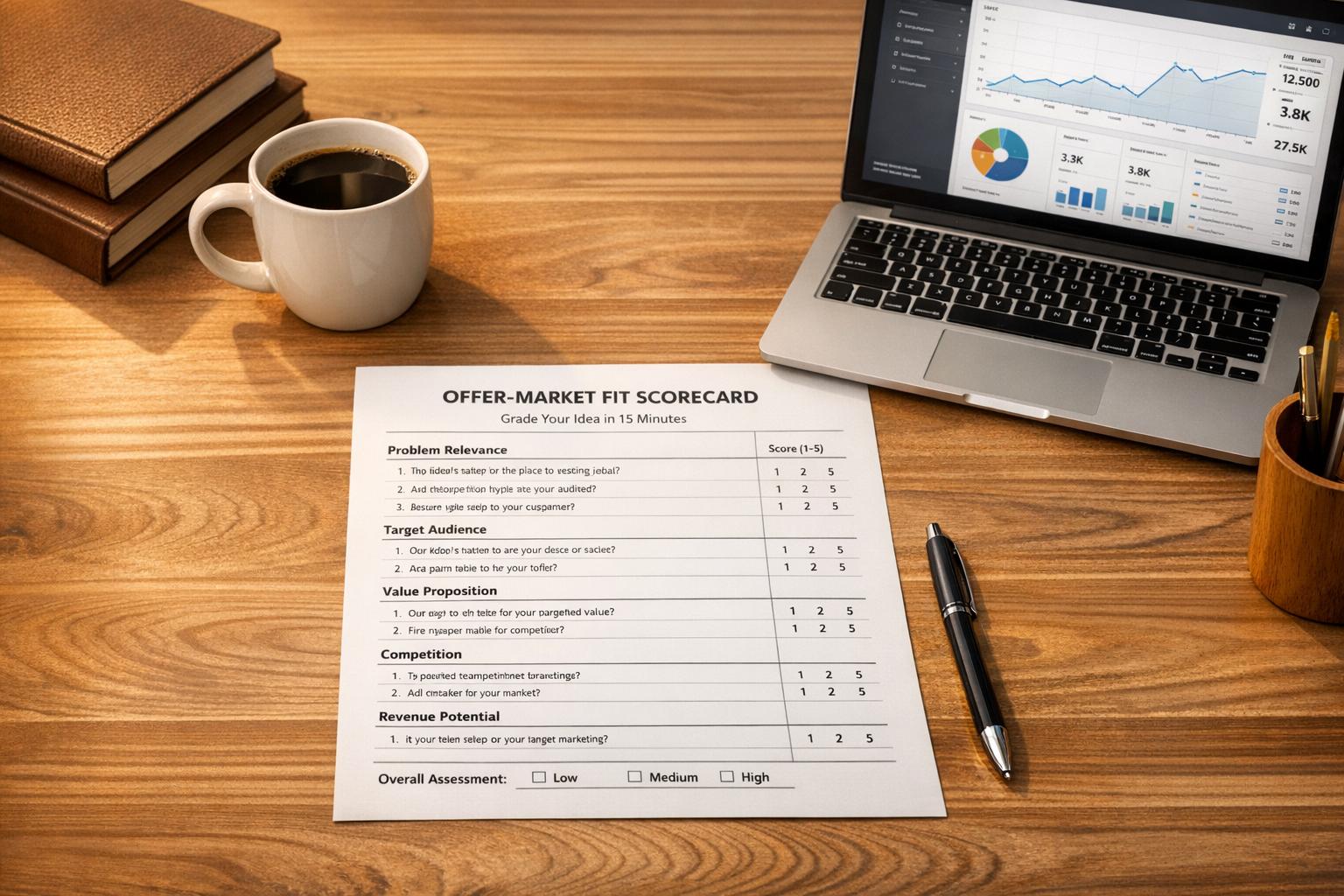
90% of startups fail - often because they build products no one needs. The Offer-Market Fit Scorecard by IdeaFloat helps you avoid this trap by evaluating your business idea in just 15 minutes. Using AI, it grades your idea on problem urgency, consumer demand, competition, and value proposition, giving you a clear score (0–100) and actionable insights.
Why It Matters:
- 72% of startups fail due to misjudging market demand.
- The tool uses real-time data from platforms like Reddit to analyze customer pain points and market gaps.
- A higher score means your idea is ready for launch, while a lower score highlights areas to improve.
How It Works:
- Answer Questions: The AI asks about your target problem, market, and competitors.
- Live Research: It scans the web for customer feedback and demand signals.
- Get a Score: Your idea is graded across five areas, with tailored recommendations for improvement.
What Your Score Means:
- 71–100: Move forward with development.
- 41–70: Refine and validate further.
- 0–40: Reassess or pivot your idea.
This tool saves time and helps you make data-driven decisions, ensuring you focus on ideas with real potential.

How the Offer-Market Fit Scorecard Works in 4 Steps
How to Use AI to Find a $1M Idea [Reddit, Claude]
Step 1: Access the Offer-Market Fit Scorecard
Getting to the Scorecard is quick and easy - it takes less than a minute. The best part? It's available to all IdeaFloat users, whether you're on the Free, Standard, or Pro plan. That means you can start validating your idea right away, no matter your budget.
How to Find the Scorecard
To begin, visit the IdeaFloat homepage and hit the "Get Started" button. If you're new, you'll need to register, which only takes a moment. Already a user? Just click "Log in" to access your portal.
Once inside, navigate to Phase 1: Is This Worth Your Time? This section houses all the tools you need for early-stage validation, including the Offer-Market Fit Scorecard. It's designed to help you determine if your idea addresses a real problem before you commit significant time or money to development.
What makes the process even smoother is the conversational AI integrated into the platform. Instead of filling out static forms, you'll engage in a natural, interactive experience that helps you clarify your concept as you go.
Step 2: Answer Questions About Your Problem, Market, and Competition
The Scorecard guides you through four key sets of questions, using live web data to evaluate your idea's market fit. Here's how it works:
Problem Validator
The Problem Validator ensures you're tackling a clear and measurable issue. It evaluates how urgent and frequent the problem is, assigning higher scores to challenges people face daily that have a significant impact on their time or money. For instance, problems occurring weekly or monthly will score lower. Why is this important? 42% of startups fail because there's no market need for their product. The Scorecard helps you avoid this by testing whether your target audience would be "very disappointed" without your solution - a concept known as the 40% Rule.
Additionally, it checks if people are already using manual workarounds or "hacks" to address the issue. If they aren't actively trying to solve the problem on their own, it might not be pressing enough to support a business. This step ensures you're focusing on a problem worth solving.
Consumer Insights
The Scorecard then dives into customer feedback by analyzing online discussions. It scans platforms like Reddit, Quora, Facebook groups, and other forums where your audience openly shares frustrations, collecting thousands of real-world conversations.
Why does this matter? Because 31% of founders are still figuring out the problem they're solving, and 28% rely solely on customer interviews for validation. The Consumer Insights module highlights the exact words and phrases your audience uses to describe their pain points. Using this language in your messaging reduces "comprehension friction" - the disconnect between how you explain your solution and how customers think about their problem.
The AI also detects demand signals: how often the problem is discussed, whether complaints are increasing, and if people are explicitly asking for solutions. If online conversations are quiet, that’s a warning sign. Armed with this customer language and demand data, you can move on to assess your competition.
Competitor Analysis
This tool maps out your competitive landscape, identifying both direct and indirect competitors. It highlights their strengths, weaknesses, pricing strategies, and market positioning, helping you spot gaps and potential advantages.
The Scorecard goes further by analyzing whether you're building a defensible "moat" - something that sets you apart and is difficult for others to replicate, like proprietary data, network effects, or unique technology. This step ensures you understand where you stand and what opportunities exist to differentiate yourself.
Unique Value Proposition
Finally, the Scorecard helps you define what sets your product apart. It sharpens your selling points and ensures your messaging resonates with customers. This isn’t about catchy slogans - it’s about clearly articulating the job your product does better than any alternative.
"You must first position against the status quo non-AI way of doing things. Then secondarily you need to convince your audience why you are the right AI tool for the job ahead of others in the race." - Kim Caldbeck, Operating Advisor
The AI helps you craft a testable hypothesis using a clear framework, making your value proposition measurable. Only 19% of founders report that the "job to be done" for their product is well-defined and actively tracked. By completing this step, you'll be among that small group. Once your unique angle is clear, you're ready to review your overall Scorecard metrics.
sbb-itb-08dd11e
Step 3: Review Your Score and Metrics
After completing the four question sets, the Scorecard calculates a data-driven score on a 0–100 scale. This approach eliminates emotional bias, offering a clear, objective evaluation. The score is based on five key business areas, each weighted according to its impact on startup success: Problem Validation (25 points), Market Assessment (25 points), Competitive Landscape (15 points), Solution Validation (20 points), and Business Model Viability (15 points). By breaking down the score into these components, you gain a roadmap for refining your idea.
What Your Score Means
Your overall score serves as a snapshot of your idea’s current strength. The sub-metrics provide deeper insights into specific strengths and weaknesses. For instance, Founder Language Clarity evaluates whether you use precise, customer-focused language. A low score in this area suggests your messaging might not connect effectively with your target audience.
The Scorecard also evaluates market demand by tracking signals such as online discussion frequency and indicators of purchase intent, like clicks on pricing pages. Across all submissions, the average score is 67.7, with a median of 68. If your score falls below these benchmarks, you'll know where to focus your efforts for improvement.
Score Interpretation Table
The table below outlines what your score means and suggests next steps:
| Score Range | Viability Status | What to Do Next |
|---|---|---|
| 71–100 | Launch | Strong opportunity. Move forward with MVP development and execute your go-to-market plan. |
| 41–70 | Validate Further | Promising potential. Focus on improving the three weakest areas before making significant investments. |
| 0–40 | Refine Idea | Limited potential. Consider major adjustments or explore alternative ideas. |
This table acts as a decision-making guide. A score in the 71–100 range indicates your idea is well-positioned for success - it's time to act quickly and proceed to development. If you land in the 41–70 range, identify your weakest areas, create a focused plan to address them, and revisit the Scorecard after making adjustments (ideally within four to six weeks). For scores under 40, the data suggests it’s time to reassess your assumptions or pivot to a different concept before committing additional resources.
Step 4: Use Your Results to Take Action
Getting your score is just the beginning - the real value comes from using those insights to make meaningful changes. The Scorecard gives you practical advice to tackle your weakest areas head-on.
AI-Generated Recommendations
After receiving your score, the platform provides personalized recommendations to address your specific challenges. For example, if your Market Assessment score is low, you'll get tips on improving your market research and spotting untapped customer segments. If your Solution Validation needs improvement, you'll receive guidance on testing your product concept before committing to development. The AI doesn’t just highlight gaps - it offers practical solutions, such as identifying effective acquisition channels, creating outreach scripts, and planning launch strategies. It even helps refine your messaging by crafting a concise one-liner pitch using the exact language your customers use online.
Armed with these insights, the next step is to organize and share your findings effectively.
Export Your Results
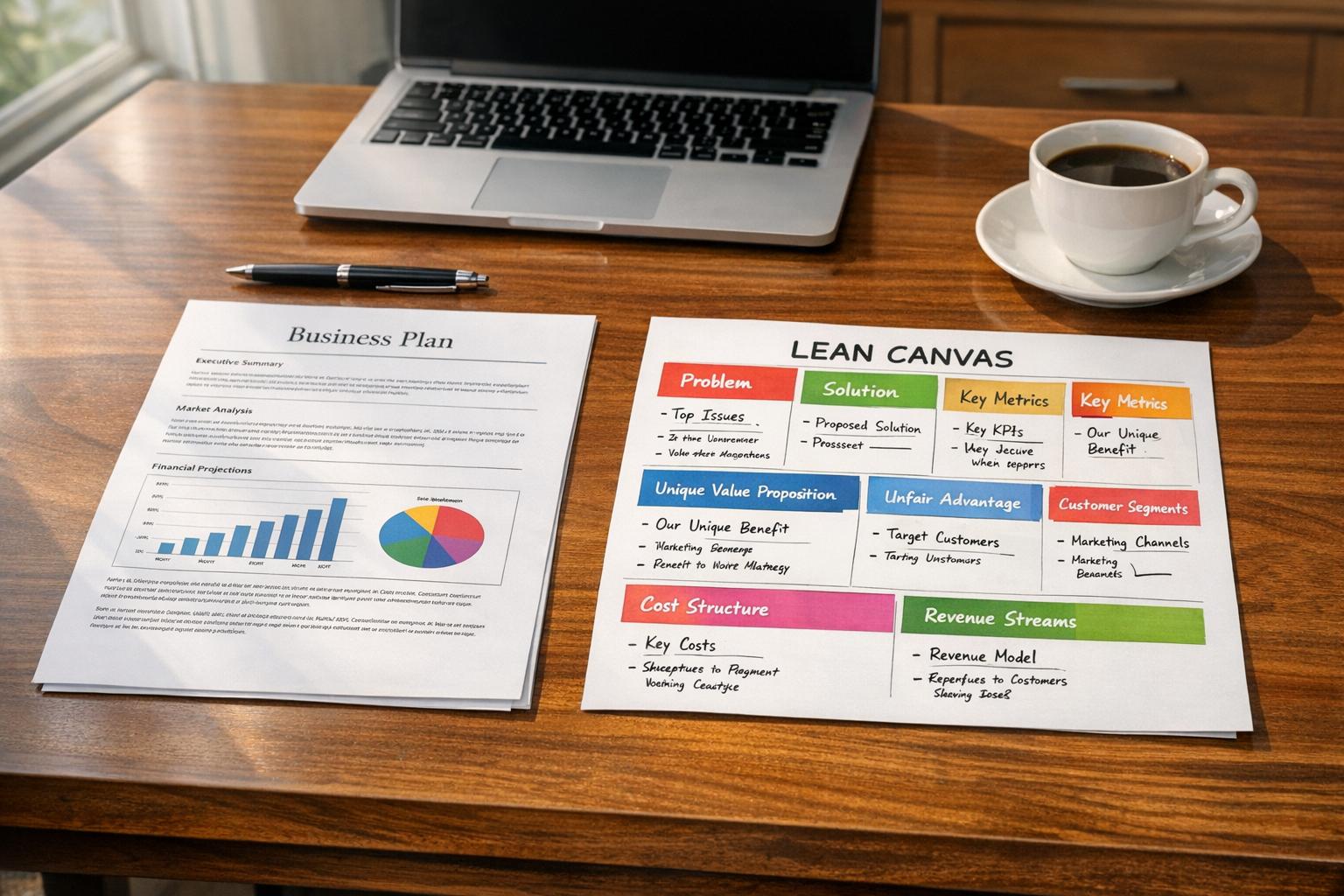
You can export your results in various formats to share with stakeholders, mentors, or investors. The platform's Business Plan Generator creates a polished investor-ready document, complete with visuals and financials, available as a PDF, Word document, or PowerPoint presentation. Additionally, an auto-filled Lean Canvas provides a quick one-page summary you can share instantly. Exports are tailored with your specific data, including market research sources and competitive analysis. You can even generate a Branding Guide that combines your voice, visual identity, and messaging frameworks into one cohesive document. This ensures you’re fully prepared for investor meetings or mentor sessions with professional, well-organized materials that showcase the depth of your validation efforts.
Conclusion: Validate Your Idea with Confidence
Benefits of Using the Scorecard
The Offer-Market Fit Scorecard gives you a straightforward 0–100 score in just 15 minutes. Compare that to traditional validation methods, which can take weeks and often lead to expensive course corrections. This tool replaces guesswork with a structured approach, pushing you to face the facts before committing major resources .
Here's the hard truth: 90% of startups fail because decisions are driven by emotions rather than evidence. The scorecard helps you spot weaknesses and market gaps early, saving you from pouring time and money into ideas with little market demand . Instead of spending months on manual research, you’ll receive up-to-date, actionable insights powered by AI. These recommendations zero in on what needs fixing - whether it's sharpening your market research, fine-tuning your messaging, or reevaluating your pricing strategy.
"Most entrepreneurs make startup decisions based on emotions, not evidence. They fall in love with their idea, ignore red flags, and end up joining the 90% of startups that fail." – Probly Team
This quick and reliable analysis sets a solid foundation for the next steps in your validation journey.
What to Do Next with IdeaFloat
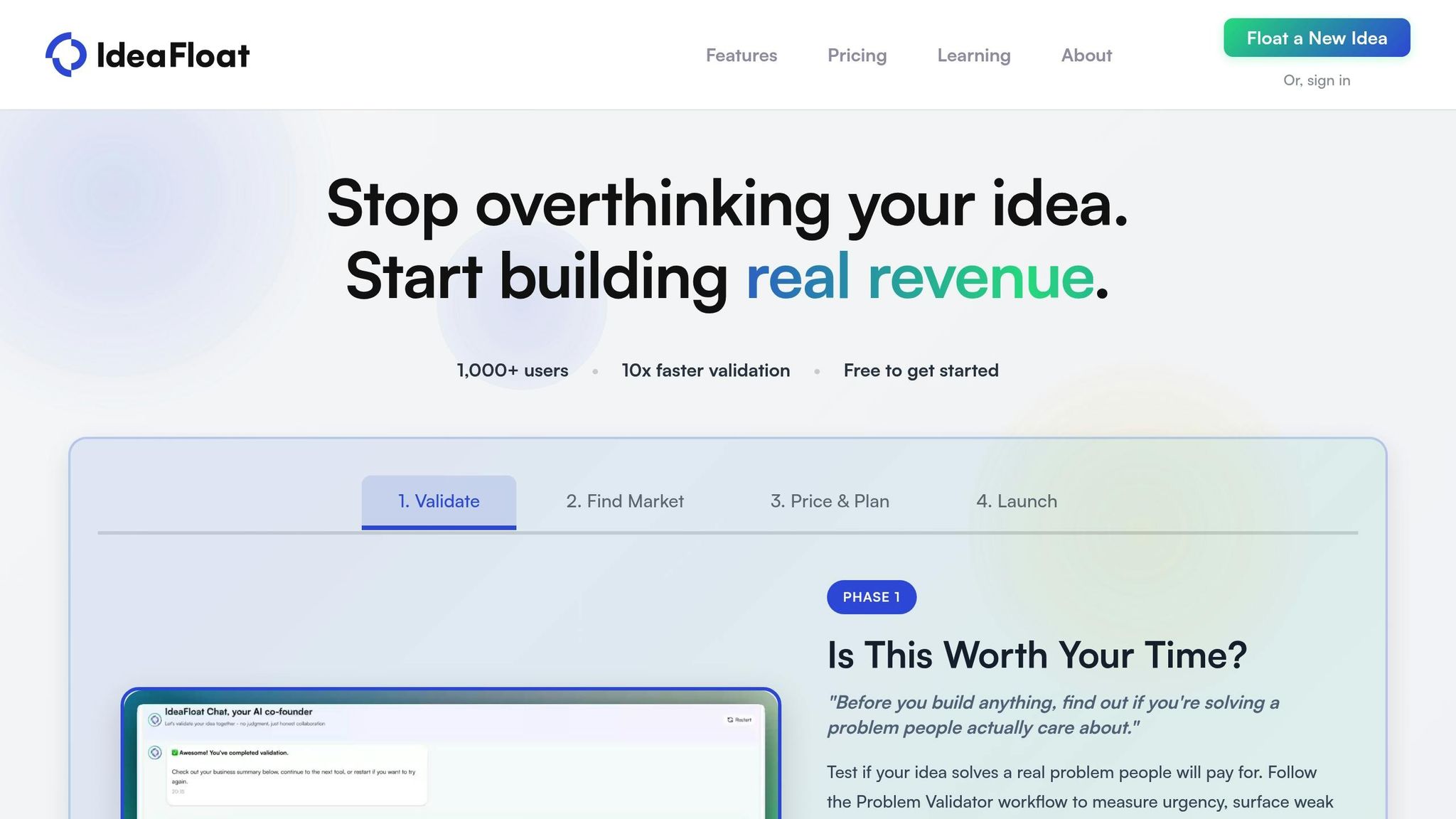
Once your idea is validated, you can use other tools from IdeaFloat to refine your strategy even further. With insights from your scorecard in hand, dive into Phase 2 tools to calculate your TAM, SAM, and SOM - metrics investors want to see backed by real data. Then, head into Phase 3 to conduct cost analyses, refine your pricing with AI-driven tools, and create financial projections to map out your path to profitability. Finally, in Phase 4, focus on building your brand identity, setting up a waitlist landing page, and following your personalized Launch Checklist.
FAQs
How does the Offer-Market Fit Scorecard use AI to evaluate my business idea?
The Offer-Market Fit Scorecard leverages advanced AI to evaluate your business idea by pulling real-time insights from online consumer conversations and current market trends. It pinpoints key demand signals, assesses how well your idea matches customer needs, and assigns a relevance score based on its market fit.
In just 15 minutes, this AI-driven tool uses tailored algorithms to deliver a clear, actionable assessment, giving you the guidance you need to decide whether to refine or move forward with your concept.
What factors contribute to achieving a high score on the Offer-Market Fit Scorecard?
A strong score on the Offer-Market Fit Scorecard hinges on how well your solution aligns with market demand. To start, your idea should tackle a clear and pressing problem - one that your target customers are not just aware of but are also willing to spend money to resolve. Beyond that, your solution needs to stand out. It should directly address the issue, offer a distinct advantage over alternatives, and receive encouraging feedback from early adopters or pilot users.
The size of the market opportunity is another critical factor. A well-defined Total Addressable Market (TAM) and a realistic strategy to capture a meaningful portion of it are essential. Lastly, innovation and defensibility add significant weight. Solutions that bring fresh ideas, are backed by intellectual property, or clearly outpace competitors tend to score higher. When all these elements - solving a validated problem, offering a standout solution, targeting a substantial market, and demonstrating innovation - come together, your score will reflect that strength.
How can I use the Scorecard results to refine my business idea?
The Scorecard provides a straightforward, numerical snapshot of your idea’s strengths and weaknesses across critical areas like market demand, customer needs, value proposition, financial feasibility, and competitive advantage. Pay close attention to sections with the lowest scores - these point to aspects of your idea that need the most work.
To address these weaker areas, take a closer look at your approach. For instance, you might need to reassess the size of your target market to confirm it’s large enough to support your business, fine-tune your value proposition to better align with customer pain points, or double-check your financial assumptions to ensure they’re grounded in reality. Consider using focused research methods, like conducting customer interviews or running small-scale tests, to gather fresh data and validate any changes you make.
As you work through these refinements and update the Scorecard, you’ll likely see your scores improve. This step-by-step process not only sharpens your business concept but also gives you a stronger footing to move forward with confidence.
Related Blog Posts
 Report an issue
Get the newest tips and tricks of starting your business!