Pre-sales validation is about securing paying customers before building a product. This approach minimizes financial risk, ensures demand, and turns interest into real commitments. By following a structured process, you can test your idea, generate revenue upfront, and avoid wasting time on products no one wants.
Key Takeaways:
- What is it? Selling your product idea to customers before development.
- Why it works: Reduces risk, confirms demand, and funds development.
- How to do it:
- Identify customer pain points through interviews.
- Craft a clear value proposition and test it with real people.
- Create a simple landing page to secure pre-orders.
- Use targeted email outreach to engage potential buyers.
- Send invoices to confirm commitments and track results.
This method flips the traditional model ("build first") by proving demand with actual payments. If you can't pre-sell your idea, you save time and money by pivoting early.
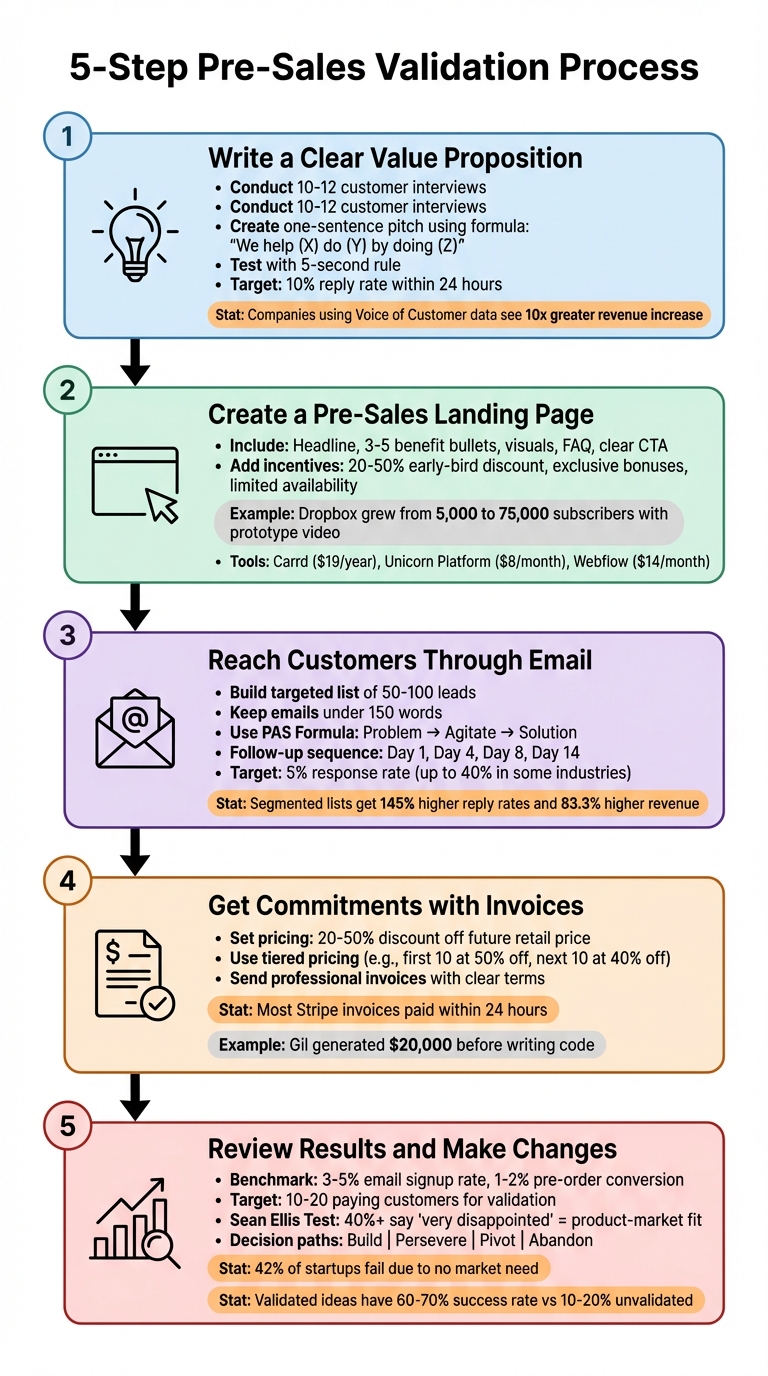
5-Step Pre-Sales Validation Process: From Value Proposition to Product Decision
How I Got My First 50 Customers Before Building A Product
sbb-itb-08dd11e
Step 1: Write a Clear Value Proposition
Find the Problems Your Customers Have
Before asking anyone to pay for your product or service, you need to pinpoint the exact problem you're solving. Start by conducting 10–12 interviews with your ideal customers. Use open-ended questions like, “Can you walk me through your last experience with this problem?” to uncover genuine pain points.
Pay close attention to emotional cues. If someone gets visibly frustrated or animated while describing a problem, you’ve likely hit on something worth solving. Focus on issues that cost people significant time or money - these are the problems they’ll be willing to pay to fix. Record and transcribe these conversations to capture the exact language your customers use. This “Voice of Customer” data will become the backbone of your messaging.
If you already have an audience, you can also analyze existing engagement. Look at which blog posts get the most traffic, which email topics have the highest open rates, or which products are your best sellers. Competitor reviews on platforms like G2 or Capterra can reveal market gaps. Tools like IdeaFloat’s Consumer Insights can even search online communities to uncover how customers talk about their frustrations, giving you their exact words.
"Headaches, problems, desires - human wants - these are your markets!" - Gary Bencivenga
Using Voice of Customer data isn’t just helpful - it’s profitable. Companies that leverage it see a 10x greater year-over-year revenue increase than those that don’t. And since 42% of startups fail because there’s no market need for their product, talking to real people first can save you from becoming part of that statistic.
Create Your One-Sentence Pitch
Once you’ve gathered insights, the next step is to craft a concise, compelling one-sentence pitch. A simple formula like Steve Blank’s works well: “We help (X) do (Y) by doing (Z)”. Another option is an outcome-focused approach: “I help [audience] achieve [result] in [timeframe], without [pain]”. The goal is to highlight benefits, not features, and speak in the customer’s language. Forget the technical specs - focus on how you solve their problem.
Take Warby Parker as an example. The founders identified that “glasses are too expensive” and built their pitch around offering stylish eyewear at an affordable price. This clear, relatable message helped them hit their first-year sales target in just three weeks.
To test your pitch, use the 5-second rule: show it to someone for five seconds. If they can’t immediately tell what you do, who it’s for, and the main benefit, it needs work. Write multiple versions and refine them until they’re crystal clear. Tools like the Hemingway App can help simplify your language to a 6th-grade reading level or lower - clearer messaging is always more persuasive.
"Write a lot of variations. Be descriptive. And then edit and edit and edit." - Jan Bogaert, Product Marketer at HubSpot
Test Your Message with Real People
Now that you’ve polished your pitch, it’s time to test it in the real world. Avoid feedback from friends or family - they’re likely to be biased. Instead, run small, targeted ad campaigns (spending $50–$100) to gauge how a cold audience reacts. This will give you an honest sense of whether your message resonates with people who don’t know you.
Another method is to create a “fake door” landing page. Include a “buy” or “sign up” button for a product that doesn’t exist yet. This will measure actual intent, not just interest. Gabriel Wyner, for instance, validated his language-learning app Fluent Forever by launching a Kickstarter campaign with prototype screens and a roadmap. He raised over $500,000 from more than 1,500 backers before building the product.
You can also engage in online communities like Reddit, Discord, or Slack where your target audience discusses their challenges. Alternatively, send a “founder’s offer” email to a small group of warm leads before creating a public landing page. Aim for a 10% reply rate within 24 hours as a benchmark. If you’re not hitting that, your message might need tweaking.
"Test willingness to pay before you write a single line of code." - Daphne Tideman, Growth Expert
Using “Jobs-to-be-Done” messaging on paywalls has been shown to increase conversion rates by up to 169%. Instead of asking, “Would you like this?” focus on how customers currently solve the problem and what they’ve already spent trying to fix it. This approach helped entrepreneur Jason Quey pre-sell a SaaS tool, generating $3,306 in revenue before a single line of code was written.
A strong, well-tested value proposition sets the stage for creating a compelling landing page and effective email outreach as you move forward.
Step 2: Create a Pre-Sales Landing Page
What Every Landing Page Needs
A landing page is where prospects turn into customers. To make this happen, start with a headline and sub-headline that clearly state your promise and the problem you're solving. Use the PAS Formula: introduce the Problem, amplify the Pain, and then present your Solution. This approach keeps the focus on results rather than just listing features.
Include three to five benefit bullets that highlight the immediate wins your product offers. Pair these with visuals like wireframes, mockups, or prototypes to help visitors picture the final product. Visuals can be a game-changer - Dropbox, for instance, skyrocketed from 5,000 to 75,000 subscribers after showcasing a simple prototype video.
Address common concerns with an FAQ section. Questions like "What happens if the product is delayed?" or "Can I get a refund?" should be answered with transparency. Be upfront about the product's development stage and let buyers know they're supporting its creation. Avoid gimmicks like "fake buy" buttons that lead to unavailable messages - they erode trust and can harm your reputation.
"Being stealthy only looks cool, but it generates less signups and paying customers than telling your story."
– Josh Ledgard, Founder, KickoffLabs
Make your call to action (CTA) impossible to miss. Place it "above the fold" so visitors don’t have to scroll to find it. Use direct, action-driven buttons like "Order Now" or "Join the Waitlist", and link them to payment processors like Stripe or PayPal. Keep forms short and straightforward to minimize friction. A simple, uncluttered page will always perform better than one overloaded with distractions.
You can also boost conversions by adding pre-order incentives to encourage immediate action.
Add Pre-Order Incentives
Incentives are a powerful way to turn interest into early commitment. One popular method is early-bird pricing, offering a discount of 20% to 50% off the future retail price. Use price anchoring to showcase the savings - display the regular price (e.g., $500) alongside the pre-sale price (e.g., $300).
Beyond discounts, offer exclusive bonuses like guides, mini-courses, checklists, or private Q&A sessions that won’t be available later. Another option is early access or private beta entry, giving supporters a chance to use the product before anyone else. Inviting early buyers to provide feedback can also make them feel like collaborators rather than just customers.
To create urgency, limit availability (e.g., "Only 20 spots left") or use countdown timers. This taps into the fear of missing out (FOMO) and motivates quicker decisions. Additionally, consider referral rewards - early supporters who share your pre-sale link could move up the waitlist or unlock extra perks. This turns them into advocates who help spread the word.
| Incentive Type | Description | Primary Benefit |
|---|---|---|
| Financial | Early-bird discounts (20–50% off) | Rewards early adopters and lowers the barrier to entry. |
| Access | Private beta or "first access" | Appeals to those eager to be first. |
| Psychological | Limited spots or countdown timers | Creates urgency and drives fast action. |
| Value-Add | Bonus content (e.g., PDFs, templates) | Boosts perceived value without cutting prices. |
| Social | Referral points or waitlist "bumping" | Encourages viral sharing and organic growth. |
Tools That Make Page Building Easier
You don’t need to be a designer or coder to create a polished pre-sales landing page. Platforms like Carrd (about $19/year), Unicorn Platform (roughly $8/month), and Webflow (around $14/month) make it simple to build conversion-focused pages. Even a basic page with a payment link is enough to test demand.
For an even easier solution, try IdeaFloat’s Waitlist Landing Page tool. It offers ready-made templates with persuasive copy designed to capture emails and generate buzz before your launch. This lets you focus on validating your idea rather than wrestling with design software.
If you prefer AI-driven help, tools like Mixo (approximately $9/month) can create a landing page in minutes based on your product description. No matter which tool you pick, remember: simplicity wins. A clear message paired with a strong CTA will always outperform a flashy page with confusing content. Keep your page centered on the problem you solve, the benefits you offer, and the action you want visitors to take.
Step 3: Reach Customers Through Email
Find and Qualify Your Leads
The first step to effective email outreach is defining a specific audience. Instead of casting a wide net like "small businesses", focus on something more precise, such as "small retail businesses using Intercom for customer support" or "companies hiring onboarding engineers". This level of detail ensures you're targeting people who are most likely to need your solution.
To build your prospect list, start with LinkedIn to find decision-makers by job title. Explore niche communities like subreddits, Indie Hackers, or industry forums where people are actively discussing challenges related to your product. Check job boards for companies hiring roles that indicate they might need your help - like onboarding engineers, which may signal onboarding struggles. You can also review testimonials from similar startups to identify early adopters or use social listening tools on platforms like Twitter/X to find complaints about existing solutions.
Organize your leads in a spreadsheet with columns for Company Name, Person Name, Role, and Contacted Date. Start with 50 to 100 leads. Tools like Hunter.io can help you find email addresses for your target companies. Avoid buying email lists - they often lead to spam complaints and low engagement.
When qualifying leads, focus on past behavior rather than hypothetical interest. Questions like "How are you solving this problem today?" or "How much time or money is this issue costing you?" can reveal genuine intent to buy. This approach, inspired by "The Mom Test", helps you avoid polite but empty praise for your idea. Conduct 15 to 20 customer discovery conversations to identify recurring patterns before moving forward.
"Do things that don't scale" - Paul Graham
If you already have an email list, segment it based on behavior - such as people who have purchased related products, opened emails on similar topics, or signed up through specific lead magnets. Segmented lists tend to perform far better, with 145% higher reply rates and 83.3% higher revenue compared to general lists.
Write Emails That Get Responses
Once you have a targeted lead list, the next step is crafting emails that resonate. Keep your messages short and personal - effective outreach emails are under 150 words, with subject lines no longer than 30 characters. Personalize each email by addressing the recipient by name and referencing their specific needs or past interactions. Use the PAS Formula (Problem, Agitate, Solution) to structure your message: identify their pain point, amplify it using their own words from discovery interviews, and then present your solution.
Wrap up with a yes/no question to make it easy for recipients to reply quickly. For example: "Does this sound like something you'd be interested in testing? Yes or no?" This simple tweak can boost reply rates by 166%.
In 2024, a founder named Gil validated his AI scriptwriting tool, Subscriber, using a 7-day email sequence. By offering 50 lifetime licenses at a discount to an email list of about 1,000 people, he generated $20,000 in revenue before writing any production code. This funding covered three months of development and eventually grew the business to $30,000 in monthly recurring revenue.
To build trust, use price anchoring. Mention your planned future price (e.g., $500) before offering an "early supporter" discount (e.g., $300). Include a money-back guarantee or a clear delivery timeline to ease concerns about pre-launch products.
Follow up 1 to 3 times, ending with a concise "goodbye" email around Day 14 to create urgency. Aiming for at least a 5% response rate is a good benchmark for cold outreach, though some industries can see rates as high as 40%.
| Email Type | Timing | Primary Goal |
|---|---|---|
| First Cold Email | Day 1 | Build a personal connection and identify the problem. |
| Follow-up #1 | Day 4 | A shorter pitch; get straight to the point. |
| Follow-up #2 | Day 8 | Final check-in; restate your value proposition. |
| Goodbye Email | Day 14 | Create urgency by closing the outreach cycle. |
Handle Objections Using Customer Language
Once you’ve engaged your leads, you’ll need to address their objections clearly and effectively. Objections are often emotional rather than logical - even free products can seem "too expensive" if their value isn’t clear. Asking for money early on forces honest feedback and surfaces real concerns.
To overcome objections, use the exact language customers shared during interviews. Instead of just providing a generic response, address the root of their concern. For example, if a lead is worried about data security, don’t just say, "It’s safe." Be specific: "We use Fortune 500-level bank-grade encryption".
In 2023, Stan Rymkiewicz, founder of Orapa, validated his business idea by sending over 100 cold emails. He converted approximately 10 yearly subscriptions by offering a 60% discount and a 90-day guarantee to ease buyer skepticism. Similarly, in 2020, Brian Casel, founder of Ops Calendar, secured $3,000 in pre-sales within six weeks by engaging 20–30 potential leads on Twitter and Quora. He used their feedback to record a screencast walkthrough that addressed their specific concerns.
Simplify technical jargon into relatable benefits. For instance, "256-bit SSL encryption" might sound impressive, but "Bank-grade encryption" is much more relatable to someone worried about security. When addressing pricing concerns, compare your pre-sale price to the higher cost of the problem itself, such as wasted employee time or lost sales.
"People don't need a reason to not buy your thing - that's the default. Everyone has happily gone their entire lives without buying your software." - Patrick McKenzie, Founder, Kalzumeus Software
After addressing objections, pause and let the customer respond. Sometimes, giving them space to think is all it takes to turn hesitation into a yes.
Step 4: Get Commitments with Invoices
Set the Right Price
Once you've nailed down your value proposition and crafted engaging emails, the next step is determining the right price for your pre-sale. This is a delicate balancing act. Price too low, and customers might doubt the quality. Price too high, and early adopters may hesitate to commit to an unbuilt product. A helpful tool here is the Van Westendorp Price Sensitivity Meter, which asks potential customers when a price feels "too expensive", "too cheap", "expensive but worth it", and "a bargain". For pre-sales, aim for a price point that falls between "too cheap" and "expensive, will buy".
To reward early supporters, consider offering a "Founding Member" discount of 20% to 50% off your planned retail price. Use price anchoring to make the discount feel more compelling - clearly display the future retail price on your invoice or landing page. For example, if your SaaS product will retail at $750, you could pre-sell it for $300 to $375.
You can also introduce tiered pricing to create urgency and track demand. For instance, the first 10 buyers get a 50% discount ($375), the next 10 receive 40% off ($450), and the following 10 pay 30% off ($525). This approach not only motivates quick action but also helps you understand how your audience responds to different price points. Every purchase brings you closer to validating your product with real-world commitments.
Send Professional Invoices
Once you’ve agreed on a price, it’s time to turn interest into action by sending a professional invoice. Validation occurs when money changes hands - until then, your product idea isn’t fully proven. A polished invoice not only formalizes the transaction but also reinforces your product’s credibility.
A professional invoice should include:
- A unique invoice number
- Your contact details
- The buyer’s information
- A clear product description
- The date of issuance
- Payment terms
- The total amount due
Make sure the invoice reflects your branding and provides a detailed breakdown of charges. For example, instead of a vague description like "Pre-order for software", use something specific like "Pre-order: AI Scriptwriting Tool – Lifetime License (Early Believer Discount)." This level of clarity builds trust and minimizes potential disputes.
For higher-priced pre-orders, offering partial payments or installment plans can make it easier for customers to commit. Adding a money-back guarantee or a delivery timeline (e.g., "Delivery by June 30, 2026, or full refund") can further reduce perceived risk. Payment tools like Stripe make this process seamless by automating payment reminders and providing a customer portal for managing invoices. Stripe even reports that most invoices are paid within 24 hours.
"An itemized invoice eliminates any ambiguity about what you're billing your client for, reinforcing trust and making disputes less likely." – Stripe
On sales calls, try using the pause technique after presenting your price. By staying silent, you give the customer time to process the offer, which can often lead to a commitment without additional persuasion.
Track Pre-Sales to Confirm Demand
After sending invoices, tracking their performance is essential to gauge market demand. Before you start, set clear "Validation Math" - the revenue you need to fund your product’s initial development phase. Use SMART goals (Specific, Measurable, Achievable, Relevant, and Time-specific) to define success. For example: "If I make 50 pre-sales totaling $15,000 within 30 days, my business idea is validated".
Focus on actual payments rather than just feedback or sign-ups as the true measure of validation. If you’re using tiered pricing, monitor how quickly each tier sells out. For instance, if the first 10 licenses at 50% off don’t sell quickly, it could indicate issues with your pricing or messaging.
Step 5: Review Results and Make Changes
Look at Your Pre-Sales Numbers
Once your pre-sales campaign wraps up, it’s time to compare your results to the SMART goals you set earlier. Use this simple validation formula: "If in [Time] I make [Number] pre-sales, my idea is validated". For instance, if your goal was 50 pre-sales worth $15,000 in 30 days, did you hit that target?
Here’s the bottom line: actual payments matter most. Email signups or waitlist additions are nice, but they only indicate interest - not demand. For example, if you sent out 100 carefully targeted emails and got zero sales, that’s a clear sign your idea needs rethinking. Industry benchmarks suggest that a 3–5% email signup rate shows your message resonates, while a 1–2% pre-order conversion rate indicates real market demand. If you can secure 10–20 paying customers, you’re likely on the right track for an early-stage concept.
Another useful tool is the Sean Ellis Test. If 40% or more of your pre-order customers say they’d be "very disappointed" if your product didn’t exist, you’re probably close to finding product-market fit. Natasha Galitsyna, Co-Founder of EIM Services, sums it up well:
"Until a potential customer has put down money, all of that remains hypothetical."
It’s worth noting that 42% of startups fail because there’s no market need for their product. Validated ideas, on the other hand, have a success rate of 60–70%, compared to just 10–20% for unvalidated ones. Your pre-sales numbers provide a clear indicator of which side you’re on and help guide your next steps.
Make Changes Based on What You Learned
After reviewing your data, use it to pinpoint performance gaps and refine your approach. Start by identifying where things went wrong: Is it the problem (doesn’t exist), the solution (doesn’t connect), the market (too small), or the business model (pricing or acquisition issues)?
For instance, low conversion rates often highlight a gap between interest and willingness to pay. If potential customers showed polite interest but didn’t buy, they might see your product as a “nice-to-have” rather than a “must-have.” Pay attention to objections from non-buyers - they often reveal what’s missing or why they hesitated.
Here are a few areas to consider:
- Pricing issues: If interest was high but conversions were low, experiment with different price points or add more value instead of simply slashing prices. For example, you could bundle exclusive features, offer longer service periods, or provide personalized support to justify the cost.
- Targeting problems: Use the BANT framework (Budget, Authority, Need, Timeline) to check if you’re reaching the right audience.
- Value proposition clarity: Shift your messaging from listing features to solving a specific problem. If multiple prospects mention a missing functionality, that’s a gap worth addressing.
Take Gil’s story as an example. He secured $20,000 in pre-sales for his AI tool before writing a single line of code. This validation helped him eventually grow to over $30,000 in monthly recurring revenue.
Decide Whether to Build or Change Course
Once you’ve made adjustments, step back and assess your overall results. Your numbers will point you toward one of four paths:
- Build: If you hit your goal, congratulations! You’ve proven demand and secured the revenue to fund development. Move forward confidently.
- Persevere: If you came close - say, 40 out of 50 pre-sales - set a new, specific goal with a fresh timeline. Run another focused campaign with minor tweaks.
- Pivot: If you missed your goal but gained valuable insights, redefine your value proposition, adjust pricing, or target a different audience. Test one variable at a time.
- Abandon: If your goal wasn’t met and feedback was minimal or negative, refund pre-orders and reallocate resources. This isn’t failure - it’s smart resource management. Validation typically costs between $100 and $1,000, saving you potentially $50,000 or more in wasted development costs.
As Gil, Founder of Subscriber, puts it:
"If you can't get 50 people to pay for the concept, you've saved yourself months of wasted effort. If you do get those 50 people, you've just been paid $20,000 to build your own dream."
Jason Quey’s experience further proves the power of simplicity. He pre-sold $3,306 using just a Google Document and a PayPal.Me link, showing that a clear offer and the courage to ask for money can validate an idea. You don’t need a polished product or a fancy landing page - just a clear value proposition and a willingness to ask.
Finally, treat silence as feedback. If your audience isn’t responding to your pre-sale offer, it’s a strong signal that something isn’t clicking. Listen closely and adjust as needed.
Conclusion
What You've Learned
Following the steps outlined above, you now have a practical framework to test your idea before committing to full-scale development. This method not only secures early customer buy-in but also minimizes the risk of building something that doesn’t resonate. You've explored how to create a clear value proposition that addresses real customer pain points, design a simple landing page that converts interest into action, and engage potential buyers through targeted email outreach. Most importantly, you’ve seen how invoices - actual payments - serve as the ultimate proof of market demand.
The process is simple: find a problem worth solving, communicate your solution effectively, and ask for payment before you start building. Whether you use basic tools or tiered pricing models, the principle stays consistent - early payments validate the idea and bridge the gap between casual interest and genuine demand.
Why Pre-Sales Validation Works Better
Pre-sales validation takes the traditional startup model and flips it. Instead of building first and hoping customers arrive, you secure commitments upfront, using that revenue to fund development. This approach tackles one of the main reasons startups fail: building products for which there’s no market need. By collecting payments before development, you avoid wasting months on something people don’t want.
"The only way to really get validation is to collect money from people. The faster you can get to that, the more likely it is that your startup is going to succeed." – Gil, Founder of Subscriber
Beyond reducing risk, pre-sales validation gives you confidence. Knowing that paying customers are ready and waiting allows you to focus on delivering quality and value, instead of second-guessing market demand. It’s not a gamble - it’s a strategy that uses confirmed interest to drive your development process.
Related Blog Posts
 Report an issue
Get the newest tips and tricks of starting your business!