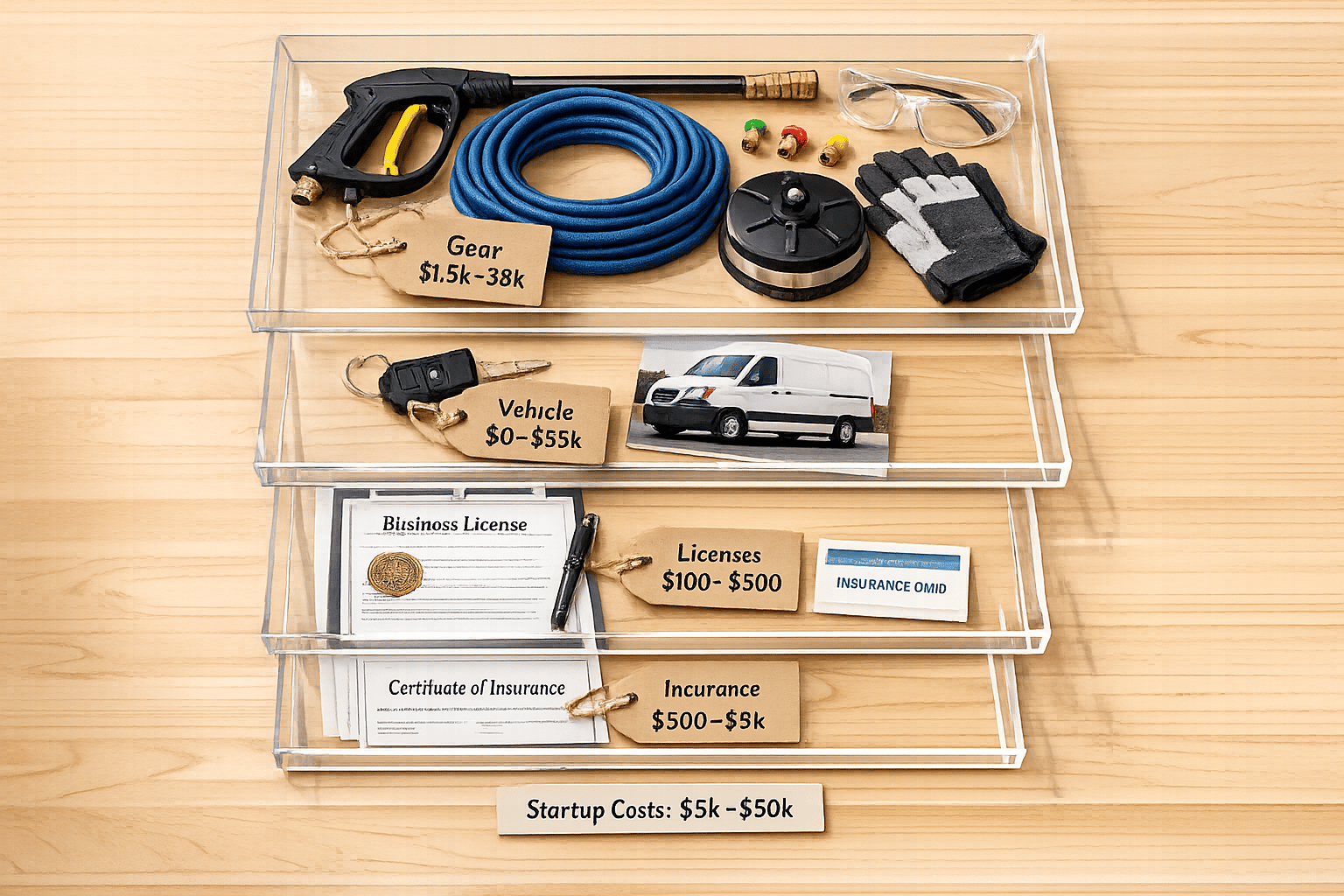
Starting a pressure washing business can cost anywhere from $3,000 to $50,000, depending on the scale of your operation. Here's a quick breakdown:
- Equipment Costs: Basic residential setups start at $3,000, while commercial-grade gear can exceed $20,000.
- Transportation: Options range from using a personal truck (low-cost) to investing in vans or trailers ($5,000–$35,000).
- Licenses and Permits: Expect to pay $50–$500 for LLC formation and $25–$200 for local business licenses.
- Insurance: General liability insurance costs $500–$2,000 annually, with additional coverage for equipment and vehicles.
Key factors like location, job type, and seasonality influence costs. Proper planning - such as setting aside 25–30% of earnings for taxes and investing in durable, professional-grade gear - can help avoid common pitfalls. Most businesses break even within 3–12 months, with profit margins of 40–60%. Prioritize quality equipment, reliable transportation, and legal compliance to build a sustainable operation.
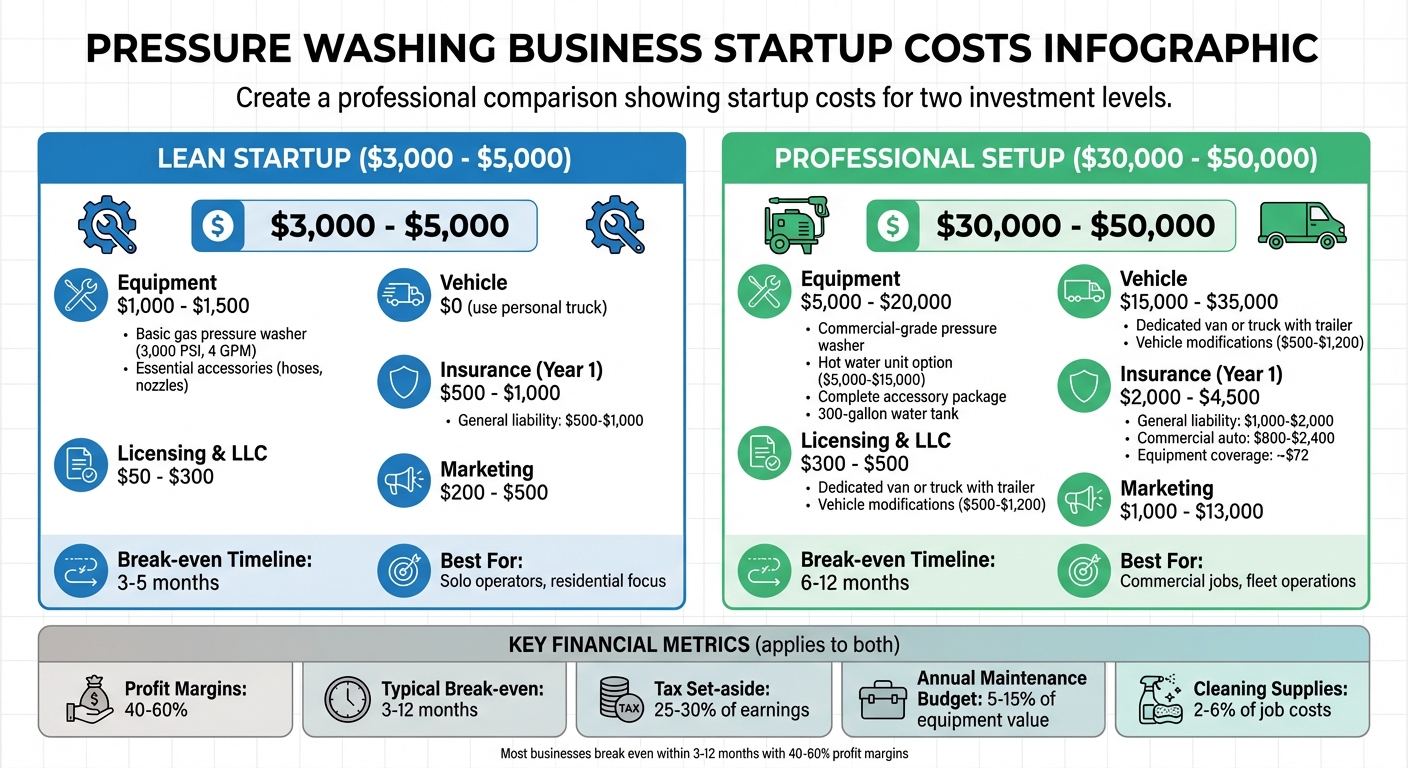
Pressure Washing Business Startup Costs Comparison: Lean vs Professional Setup
How Much Does It Cost To Start A Pressure Washing Business?
sbb-itb-08dd11e
Equipment and Gear Costs
The equipment you choose directly impacts both your startup costs and your ability to present yourself as a professional. For instance, there's a world of difference between a $300 residential machine and a $3,000 commercial unit - not just in price but also in how clients perceive your business.
Pressure Washers: Electric vs. Gas
Electric pressure washers, priced between $100 and $500, are fine for light residential tasks. However, using this type of equipment in a professional setting can hurt your credibility. As NorTex Sales & Service puts it:
"If a client sees that you use a non-commercial pressure washer, they will be less inclined to pay for your services".
For professional jobs, a gas-powered commercial unit is a must. These machines, which cost anywhere from $1,500 to $5,000, are built for heavy use and deliver the power you need. When choosing a machine, focus on both PSI (Pounds per Square Inch) and GPM (Gallons per Minute). For example, a 4 GPM machine at 3,000 PSI will clean faster than a 2.5 GPM unit at 4,000 PSI, which means you can complete more jobs in the same amount of time. Ideally, for residential work, aim for at least 3,000 PSI and 4.0 GPM.
| Feature | Electric Pressure Washer | Gas Pressure Washer |
|---|---|---|
| Typical Cost | $100 – $500 | $1,500 – $5,000 |
| Power (PSI) | 1,500 – 2,500 | 3,000 – 4,000+ |
| Speed (GPM) | 1.0 – 2.0 | 2.5 – 5.5+ |
| Best Use | Light residential, hobbyist | Professional, heavy-duty |
| Mobility | Limited by cord/power source | High (engine-powered) |
| Maintenance | Low | High (oil changes, pump care) |
If you're considering pump options, belt-drive pumps might cost more upfront, but they last three to four times longer than direct-drive models. Buying from a professional dealer ensures you get equipment with replaceable parts and higher-quality components for extended durability. For specialized jobs like grease and oil removal, hot water units - ranging from $5,000 to $15,000 - are essential.
Once you've got the right pressure washer, the next step is optimizing your setup with key accessories.
Nozzles, Surface Cleaners, and Hoses
Surface cleaners are essential for achieving polished results on driveways and decks. A good 20-inch surface cleaner costs between $150 and $900. Rotating nozzles, priced at $20–$100, can significantly cut cleaning time compared to standard nozzles, making them a smart investment.
For hoses, plan to spend $150–$500 on a 200-foot, 4,000 PSI-rated pressure hose and $50–$200 for a 150-foot garden hose. A hose reel, which costs between $50 and $150, keeps your setup organized and extends the life of your hoses. Additional tools like spray wands and nozzle sets (with tips for different surfaces, such as 15°, 25°, and 40°) range from $20 to $300.
If you're working in areas without water access, a 100–300 gallon water tank is a must. These tanks typically cost between $100 and $1,000, depending on the size and features. To apply detergents efficiently, consider downstream injectors, which cost $30–$150.
Cleaning Solutions and Safety Gear
Using professional cleaning solutions allows you to "soft wash" surfaces, relying on chemicals rather than high pressure to remove mold and algae. This method reduces wear on your equipment and protects delicate surfaces like vinyl siding. Starting inventory for cleaning chemicals will cost $100–$500, but for sustained operations, an initial stock closer to $2,000 helps avoid shortages as you build your client base.
Here’s a breakdown of common cleaning supplies:
- Sodium hypochlorite: $100–$500
- Degreasers: $50–$300
- Surfactants: $30–$150
On average, cleaning supplies account for about 2% to 6% of total job costs, making them a manageable and predictable expense.
Safety gear is equally important to protect both your team and your reputation. High-pressure water (3,000+ PSI) combined with chemicals like sodium hypochlorite can cause serious injuries. Invest $50–$200 in durable goggles, chemical-resistant gloves, and non-slip boots. Keep in mind that goggles should be replaced every six months, as chemical exposure can degrade their lenses over time.
Vehicle and Transportation Costs
Once you’ve got the right equipment, the next step is ensuring you have reliable transportation to get to job sites. The vehicle you choose can impact your startup budget, how clients perceive your professionalism, and how smoothly your operations run. Let’s dive into your options and what to consider when making your choice.
Choosing a Vehicle: Trailer, Van, or Truck
Starting small? Many new businesses stick with a personal truck to save money, especially for residential jobs. As your business grows, you’ll likely need to decide between a trailer, a dedicated truck, or a van.
- Trailers are flexible. According to reyco from the Pressure Washing Resource Forum, a trailer setup allows you to switch to another tow vehicle if your primary one breaks down. However, they can be tricky to maneuver in tight spaces and are more prone to theft.
- Dedicated trucks look professional and can handle heavy loads, such as water tanks and equipment. They’re also easier to park in residential neighborhoods or urban areas. But there’s a downside: if the truck breaks down, your entire operation grinds to a halt. Aaron Parker from Southeast Softwash explains:
"If your truck breaks down, your entire setup is out of commission".
- Vans combine the benefits of trailers and trucks. They offer enclosed storage to shield your equipment from weather and theft, plus better maneuverability. High-top models like the RAM ProMaster or Mercedes Sprinter can even get 21–22 MPG when fully loaded. Keep in mind, though, that vans often require modifications - like bulkheads, roof vents, and better ventilation - to store chemicals safely. These upgrades can cost between $550 and $1,100.
Here’s a quick comparison of the pros, cons, and costs of each option:
| Vehicle Type | Estimated Cost | Best For | Key Advantage | Main Drawback |
|---|---|---|---|---|
| Personal Truck | $0 (Existing) | Basic Residential | Lowest startup cost | Limited space; personal wear |
| Trailer | $1,000 – $6,000 | Professional Residential | Swappable tow vehicles | Hard to maneuver; theft risk |
| Dedicated Truck | $5,000 – $30,000 | Commercial/Fleet | Professional image; high capacity | Expensive; single point of failure |
| Van | $24,100 – $35,000+ | Residential/Commercial | Weather protection; secure storage | Requires ventilation upgrades |
One thing to keep in mind: water is heavy. A 300-gallon tank can add around 2,500 pounds to your vehicle. Always double-check your vehicle’s payload or towing capacity to ensure it can handle the load.
Vehicle Modifications for Equipment Storage
To make your vehicle work for your business, you’ll likely need some modifications. These upgrades not only protect your equipment but also help you stay efficient and organized.
- Protective bed coatings: Coatings like Line-X ($500–$900) can shield your truck bed from rust and damage caused by chemicals like sodium hypochlorite.
- Ladder racks: Essential for securing extension ladders, ladder racks cost between $300 and $1,200.
- Ventilation for vans: If you’re using a van, proper ventilation is a must. Options include spinning roof vents to remove fumes, bulkheads to separate the cab from the equipment area, and running machines with the doors open to prevent chemical exposure.
Commercial Auto Insurance Costs
Your personal auto insurance won’t cover business use, so you’ll need a commercial auto policy. Expect to pay between $800 and $2,400 per year - or around $40 to $200 per month - depending on your vehicle, coverage needs, and driving record. If you bundle this with general liability insurance, some providers may offer discounts, which can help reduce costs.
Licenses, Permits, and Regulatory Costs
Getting the right paperwork in order is a must when starting a pressure washing business. Beyond buying equipment and vehicles, setting up the proper legal and regulatory framework ensures you can operate smoothly. While many of these costs are one-time or relatively low annual fees, the specific requirements depend on your location.
Business Registration and LLC Formation
Setting up an LLC is one of the best steps you can take when starting your business. Jennifer Payne, Director of Entrepreneurial Strategy at StartupOwol, emphasizes its importance:
"An LLC separates your personal assets from business liability, which is critical when you are handling high-pressure equipment that can damage client property in seconds".
The fee to form an LLC varies by state, ranging from $50 to over $500. Most states fall in the middle, with costs typically between $100 and $300. Additionally, you'll need a registered agent to handle legal documents for your business. You can either act as your own registered agent at no cost or hire a service, which usually costs between $100 and $300 annually.
Local Permits and Compliance
Permit requirements differ depending on your city or county. A general business license is often required and costs between $25 and $200, with annual renewal fees. In some states, you may also need a contractor's license. For instance, in California, any job exceeding $500 requires a contractor's license, with application fees of around $300. In Maryland, if you use chemicals during pressure washing, a Home Improvement License is necessary.
Environmental permits are becoming increasingly relevant for pressure washing businesses. Since wastewater runoff is a concern, you may need to comply with EPA Clean Water Act (NPDES) rules. Some areas require wastewater discharge permits or even water reclamation systems capable of capturing up to 80% of used water. Failing to meet these requirements can lead to fines starting at $500 per violation. Always check with your local city clerk's office to ensure you're meeting all local regulations - requirements can vary significantly, even within the same metro area.
Employer Identification Number (EIN)
An EIN is essential for opening a business bank account and managing payroll, and it’s free to obtain through the IRS. The application process is straightforward and takes about 10 minutes. Be wary of third-party services that charge for this free process. Once you have your EIN, open a business bank account right away to keep your finances separate - this is key to maintaining the liability protection offered by your LLC.
| Requirement | Estimated Cost | Frequency |
|---|---|---|
| LLC Formation | $50 – $500 | One-time (plus annual state fees) |
| Registered Agent Service | $100 – $300 | Annual |
| General Business License | $25 – $200 | Annual |
| Contractor's License (if required) | ~$300 | Varies by state |
| EIN | $0 | One-time |
| Sales Tax Permit | $0 | One-time |
Insurance Coverage for Pressure Washing Businesses
When planning your budget for equipment and licenses, don't overlook the importance of insurance. It’s not just a safety net for unexpected accidents - it’s often a requirement for working with clients.
General Liability Insurance
General liability insurance is the cornerstone of protection for your business, covering third-party accidents and property damage. This includes legal defense, medical expenses, and repair costs. Most small pressure washing businesses opt for coverage between $1 million and $2 million. The cost? Annual premiums typically fall between $500 and $1,500 for $1 million in coverage. For residential jobs, you might pay around $500 to $1,000 per year, while businesses with higher risks or larger teams could see costs rise to $1,000–$2,000 annually. On a monthly basis, premiums average about $103.
If you’re working on delicate surfaces, consider adding "Care, Custody, and Control" coverage. Standard liability policies often exclude damage to property you’re actively working on, making this rider essential. For seasonal businesses, some insurers offer flexible options, like coverage by the hour ($27.53), day ($121.18), week ($76.69), or month.
But liability insurance isn’t the only coverage you’ll need - protecting your equipment and workforce is just as important.
Equipment and Workers' Compensation Insurance
Equipment insurance (or Business Equipment Protection) shields your tools and machinery from theft, damage, or destruction. Plans can start as low as $6 per month.
If you hire employees, workers' compensation insurance is mandatory. Costs vary depending on the level of risk involved in the work. For example, cleaning driveways or sidewalks typically costs less than high-risk jobs like roof cleaning or high-rise projects. Keep in mind that workers' compensation is separate from general liability insurance, which only applies to third-party injuries.
Comparing Insurance Options
Comparing and bundling your coverage can save money while ensuring your business is well-protected. Each type of insurance serves a specific purpose, whether you’re a solo operator or managing a team. For example, bundling general liability insurance with property and business interruption coverage in a Business Owner's Policy (BOP) can often lower your overall costs.
| Policy Type | Solo Operator (Budget) | Established Business (Pro) |
|---|---|---|
| General Liability | $500–$1,000/year | $1,000–$2,000/year |
| Equipment Protection | ~$72/year ($6/mo) | Included in BOP or with higher limits |
| Commercial Auto | Often uses personal insurance | $800–$2,400/year |
| Workers' Comp | Usually not required | Required by most states for employees |
Your premiums will depend on factors like location, crew size, coverage limits, deductibles, claims history, and the services you offer. Businesses in densely populated areas or those offering high-risk services, such as roof cleaning, typically face higher premiums than those focusing on ground-level work.
Finding the right balance between cost and comprehensive coverage is a critical step in building a secure and thriving pressure washing business.
Cost-Saving Strategies and Budget Planning
Once you've mapped out your core investments, it’s time to focus on strategies that keep your budget tight without sacrificing quality. Starting a pressure washing business doesn’t have to wipe out your savings - making smart, cost-conscious choices can go a long way.
Buying Used Equipment and Vehicles
Opting for used commercial-grade equipment can save you a significant chunk of money. Steer clear of consumer-grade machines from big-box stores - they’re not built to handle the demands of commercial work and often lack replaceable pumps, which means they won’t last long. Instead, shop for pre-owned professional-grade equipment from specialized dealers like PowerWash.com. For example, a used 4 GPM (gallons per minute) pressure washer might cost between $1,000 and $2,500, while a brand-new one could set you back $3,000 to $5,000. When choosing, prioritize GPM over PSI (pounds per square inch); a 4 GPM machine at 3,000 PSI will get jobs done faster than a lower GPM option.
When it comes to transportation, use your personal vehicle to start, which eliminates upfront costs. If you need to upgrade, consider buying a used service truck for around $5,000 instead of financing a brand-new van. And don’t forget: you can write off 100% of your equipment and vehicle costs in the first year under the Section 179 deduction, up to $1.22 million.
Bundling Insurance Policies
Another way to save is by bundling your insurance policies. Combining general liability, commercial auto, and inland marine insurance not only simplifies management but can also lower premiums and make it easier to generate Certificates of Insurance quickly. Look for companies like NEXT Insurance, Thimble, or The Hartford that specialize in coverage for pressure washing businesses. To stay cost-efficient as you grow, re-quote your policies every six months or whenever you add vehicles to ensure you’re getting the best rates.
Sample Startup Cost Breakdown
Here’s a comparison of what a lean startup versus a more professional setup might look like in terms of costs:
| Category | Low-End (Lean Startup) | High-End (Professional) |
|---|---|---|
| Core Equipment (Washer, Pump) | $1,000 | $5,000 |
| Accessories (Surface Cleaner, Hoses) | $200 | $1,500 |
| Vehicle/Trailer | $0 (Use Personal) | $15,000 – $30,000 |
| Licensing & LLC Formation | $50 | $500 |
| Insurance (Initial Premiums) | $500 | $2,500 |
| Marketing & Digital Setup | $200 | $13,000 |
| Total Estimated Startup | $1,950 – $3,000 | $32,500 – $52,500+ |
Most pressure washing businesses break even within 3 to 12 months. Profit margins typically range between 40% and 60%. To avoid costly breakdowns, budget 5% to 15% of your equipment’s value annually for maintenance. For marketing, focus on hyper-local efforts like door hangers and Facebook groups to keep customer acquisition costs around $150 per customer in suburban areas.
Conclusion
Starting a pressure washing business requires careful planning, particularly when it comes to equipment, legal requirements, and financial management. Statistics show that around 20% of pressure washing businesses don’t make it past their first year, often due to poor preparation and underinvestment.
"The people who succeed are the ones who treat it as a business first and a cleaning job second." – StartupOwl
To succeed, you’ll need to prioritize operational efficiency while securing your business with solid legal and financial protections. Setting up an LLC shields your personal assets, and general liability insurance is crucial for handling the risks associated with high-pressure cleaning. Additionally, failing to obtain the proper permits or licenses could lead to hefty fines and legal troubles. These measures lay the foundation for a business built to last.
Profit margins in this industry are typically strong, ranging from 40% to 60%, with many businesses breaking even within about five months. Whether you start small or go all-in with a bigger investment, the key is aligning your budget with your target market while delivering quality service that supports premium pricing.
FAQs
What pressure washer specs should I buy first?
When launching a pressure washing business, it's crucial to understand PSI (pounds per square inch) and GPM (gallons per minute). For residential cleaning, aim for equipment with at least 2,500 PSI and a GPM of 2.0 or higher. This combination is powerful enough to tackle most tasks effectively while avoiding the expense of unnecessarily heavy-duty gear. It’s a practical starting point that keeps you ready for a wide range of jobs.
Do I need permits to pressure wash in my city?
Yes, many cities require permits to run a pressure washing business. These often include obtaining a local business license and securing permits for the proper disposal of waste or chemical-laden water. Be sure to contact your local government offices to learn about the specific regulations and requirements in your area.
What insurance policies do clients typically require?
Clients often expect liability insurance as a standard requirement when hiring pressure washing services. This type of coverage provides protection for both your business and the client, offering peace of mind in case of accidents, damages, or injuries that might happen during the job.
Related Blog Posts
 Report an issue
Get the newest tips and tricks of starting your business!