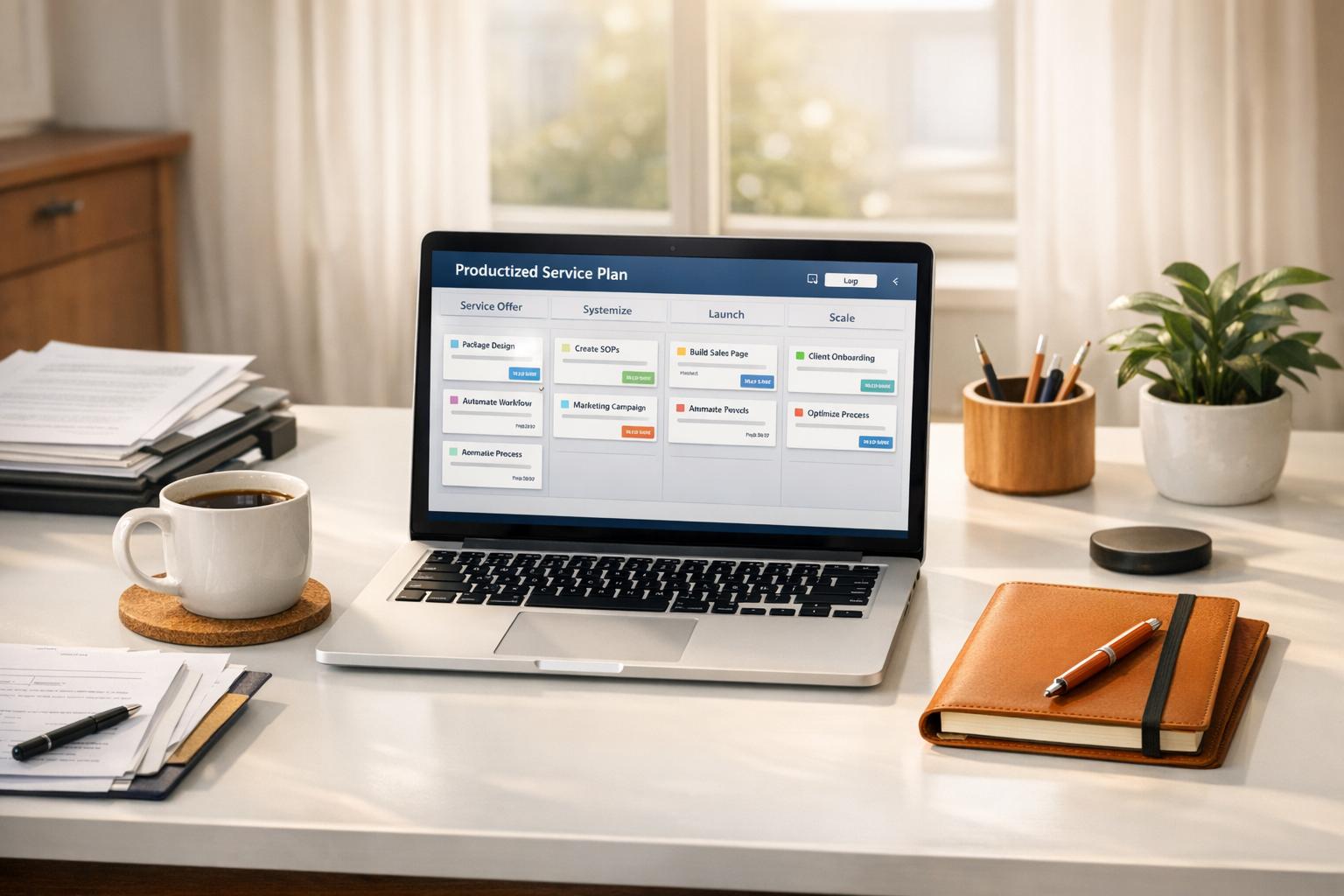
Tired of trading hours for dollars? In just 30 days, you can turn your custom services into a productized service that offers fixed pricing, clear deliverables, and predictable timelines. This shift makes scaling easier, reduces chaos, and boosts profitability. Here's the process:
- Evaluate your current service: Identify inefficiencies like scope creep, unpredictable revenue, and time-draining tasks.
- Define your offer: Standardize deliverables, set clear boundaries, and create pricing tiers or subscription models.
- Build systems: Document workflows with SOPs and automate repetitive tasks using AI tools.
- Launch and refine: Test your service with early clients, gather feedback, and adjust your process.
The Only Guide You Need To Productize A Service
Step 1: Evaluate Your Current Service
Before diving into productization, take a close look at your current service model and its weaknesses. Many service providers find themselves stuck in a cycle of working harder but not necessarily earning more. On top of that, inconsistent workloads and unpredictable revenue can make scaling feel impossible. Traditional service models often rely on trading time for money, which creates a ceiling on your growth - you can only bill so many hours in a day.
Identify Problems in Your Current Model
Start by pinpointing where your current setup is costing you time and money. Some of the most common issues include irregular cash flow and the "feast-or-famine" cycle, which makes it tough to plan for consistent growth or future investments. When revenue is unpredictable, it’s hard to make confident business decisions.
Beyond revenue challenges, watch for other signs of inefficiency, like scope creep, endless revisions, and constant back-and-forth negotiations - all of which eat away at your profits. If you’re spending too much time on custom proposals or reworking project timelines, those non-billable hours can add up quickly. Take a look at past projects: How often did you have to adjust the scope? How accurate were your time estimates? Where did you lose money? These patterns can reveal what parts of your service need standardizing.
Once you’ve identified these problem areas, you’ll be in a better position to create a streamlined, scalable model that plays to your strengths.
Pick Your Productized Service Model
With the challenges clear, it’s time to decide on a productized service model that fits your expertise. The idea here is to turn your skills into a repeatable offering that you can sell over and over again. Services that have a fixed scope, defined deliverables, and consistent workflows are perfect candidates for productization. Think about which parts of your current service are repetitive, require minimal input from clients, and follow predictable timelines.
For example, if you’re a designer who follows the same steps for logo creation, that could easily be packaged as a one-time service. On the other hand, if you’re a bookkeeper handling recurring monthly tasks, a subscription model might make more sense. The key is to choose a structure you can deliver reliably without overextending yourself.
Once you’ve selected your model, the next step is to confirm that it has real market potential.
Test Your Idea With IdeaFloat
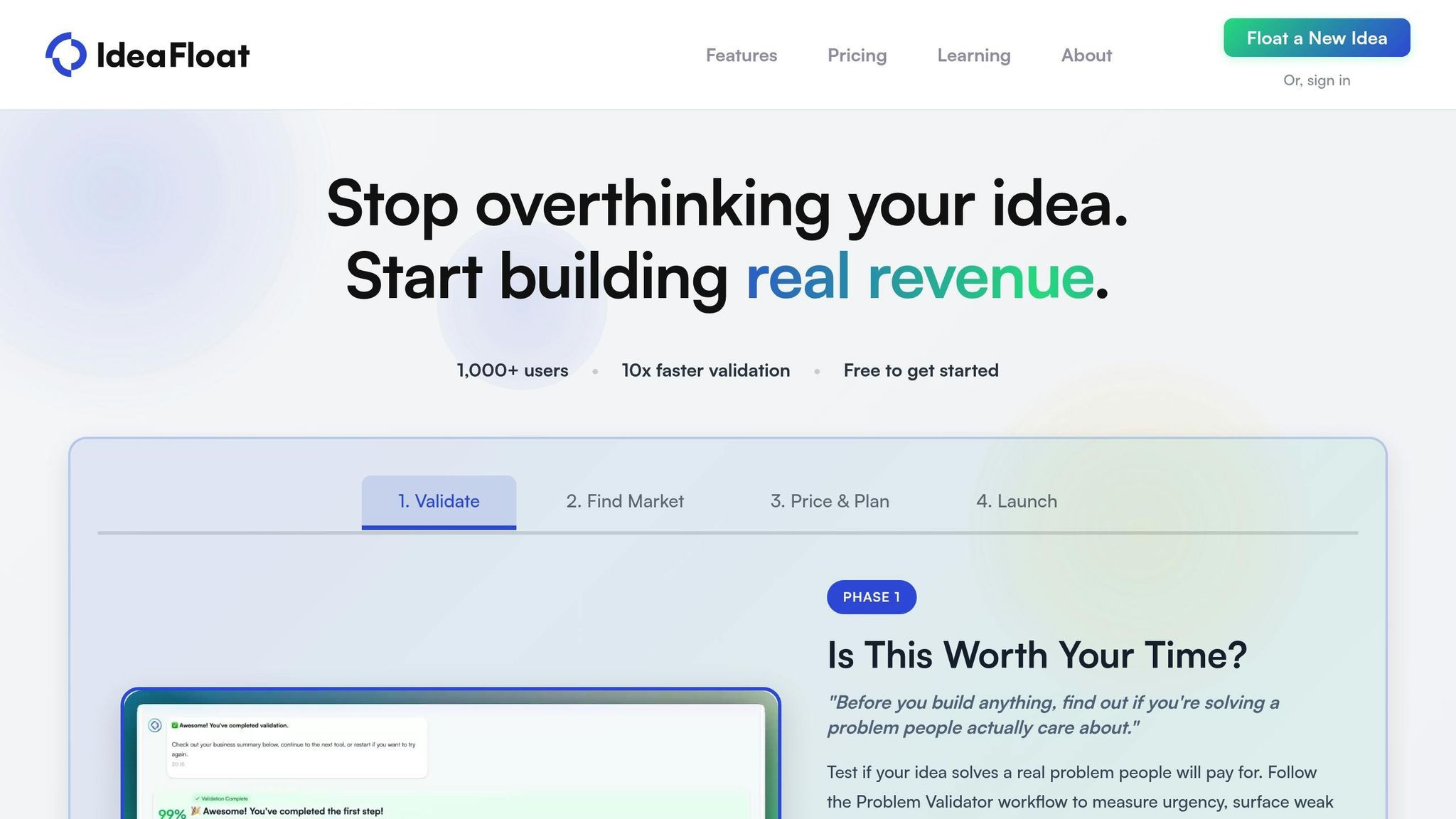
Before committing time to building systems and workflows, make sure your productized service solves a problem people are willing to pay for. Use IdeaFloat’s tools - like the Problem Validator, Competitor Analysis, and Smart Market Sizing tool - to confirm there’s enough demand for your idea. These tools allow you to quickly validate your concept, ensuring you’re on the right track before diving deeper. This step sets the foundation for the next phase of your 30-day transformation.
Step 2: Define Your Productized Offer
With your idea validated, it’s time to craft your offer. This is where you turn your service into a product that can be sold repeatedly without starting from scratch every time. The key is to set clear boundaries around what you deliver, how much it costs, and what’s excluded. This clarity helps avoid drawn-out negotiations and shields your profit margins from scope creep.
Set Scope, Deliverables, and Limits
Start by listing every task you currently handle for clients - even the seemingly minor ones like sending follow-up emails or organizing files. Once you’ve got a comprehensive list, group these tasks into logical categories or “pillars” using action verbs like "gather", "build", or "launch." This creates a structured roadmap for your service.
Under each pillar, detail the specific actions and deliverables clients will receive. For instance, if you’re a social media manager, your "Create" pillar might include a set number of posts, video edits, and a content calendar. Be as specific as possible - vague deliverables often lead to misaligned expectations. Next, define 4 to 6 key milestones with clear timelines, such as Onboarding, Content Creation, and Final Delivery. These milestones not only guide the process but also serve as selling points by showing clients exactly how their project will unfold.
Anything that falls outside the defined scope should be treated as an add-on service rather than being included for free. This approach protects your time and ensures your projects remain profitable.
Create Pricing Tiers and Packages
Productized services work best with fixed fees rather than hourly billing. To determine your pricing, break down each deliverable into time estimates, calculate the total hours required, and multiply that by your hourly rate. Add a 20% buffer to account for revisions and unforeseen adjustments. This method provides a baseline price that covers your costs while safeguarding your margins.
Once you’ve priced your core offer, consider creating tiered packages to give clients options. For example, you could offer:
- A Basic package for essential deliverables
- A Standard package with additional features
- A Premium package that includes perks like priority support or extra revisions
If your service is recurring, think about using a subscription model. The key here is to focus on selling outcomes rather than hours. Clients care about the results they’ll achieve, so price your service based on the value you deliver, not the time you spend.
Write Your Value Proposition
Your value proposition should make it crystal clear why someone should choose your productized service over doing it themselves or hiring a traditional freelancer. Highlight the benefits, such as faster turnaround times, consistent pricing, proven methods, or specialized expertise. You can use tools like IdeaFloat's Unique Value Proposition tool to craft messaging that resonates with your target audience and showcases what sets your offer apart.
Frame your service around a signature process or framework to position yourself as the expert for a specific outcome. For example, instead of saying, "I do web design", you could say, "I use my 5-Step Launch Framework to create high-converting landing pages for SaaS startups in just 14 days." This level of clarity not only supports premium pricing but also simplifies your marketing by targeting a specific audience with a clear promise.
Transparency is essential. Clients should know exactly what’s included, how much it costs, and what’s not covered before they even contact you. With your value proposition nailed down, you’ll be ready to build systems and automate workflows in the next step.
sbb-itb-08dd11e
Step 3: Build Systems and Automate Workflows
Now that you've nailed down your offer, it's time to focus on creating systems that are consistent and scalable. This is where productized services stand out from traditional freelancing - you’re not just completing tasks; you’re building a machine that can run smoothly and grow. The key? Standardizing workflows with clear, actionable procedures.
Write Standard Operating Procedures
Standard Operating Procedures (SOPs) are like a detailed playbook for your business. They break down every task into simple, repeatable steps, ensuring that you or your team can deliver consistent results every time. Think of them as the backbone of your process - they prevent scope creep and guarantee predictable outcomes for each client [8].
Start by documenting every single task you perform, from onboarding a new client to delivering the final product. Be specific. For instance, an onboarding SOP might include steps like sending a welcome email within 24 hours, scheduling a kickoff call, collecting brand assets via a shared form, and setting up project milestones in your project management tool. Each task should outline what needs to happen, the order it should happen in, and who is responsible for it.
Keep these SOPs organized and accessible in a shared workspace so your team can reference them whenever needed. As Omid G from Assembly.com advises:
Only automate what is predictable. Never automate any task that has nuance and cannot be taught to someone.
In other words, your SOPs should clearly highlight which tasks are straightforward enough to automate and which require human judgment.
Use AI Tools to Save Time
AI is reshaping the way productized services operate. Take this example: in 2025, one agency owner replaced three writers with a single person supported by AI, improving both productivity and quality. AI can handle repetitive tasks, giving you more time to focus on strategy and building client relationships.
Here’s how AI can help: it can speed up research, create first drafts, analyze data, and even manage routine client communications. For instance, if you’re crafting content for clients, AI can handle the initial research and generate outlines, leaving you to refine the strategy and polish the final product. Similarly, if you’re conducting marketing audits, AI can gather and analyze the data, while you interpret the results and provide actionable recommendations.
Tools like IdeaFloat can streamline workflows, create templates, and ensure consistent messaging across projects. The results can be striking - some agencies have seen profit margins jump from 30% to 60% by automating repetitive tasks. In one case, automating processes reduced costs per client by 80%, from $4,000 for manual work to just $800. As ConsultingSuccess.com puts it:
The consultants who thrive in the AI era won't be those who compete with technology - they'll be those who amplify their expertise through technology while delivering uniquely human value.
Manual vs. Automated Workflows
Deciding what to automate comes down to balancing efficiency with quality. Not every task is suited for automation, so it’s important to evaluate which workflows are worth keeping manual and which can be streamlined.
Here’s a quick comparison:
| Workflow Type | Time Investment | Cost (at $100/hour) | Best For | Scalability |
|---|---|---|---|---|
| Manual | 40 hours | $4,000 | Complex strategy, relationship building, nuanced decisions | Limited - requires direct involvement |
| Automated | 8 hours | $800 | Routine tasks such as client onboarding, data collection, and report generation | High - runs with minimal oversight |
Manual workflows give you full control and are ideal for tasks that require flexibility, creativity, or relationship-building. However, they can be time-consuming and limit your ability to scale. Automated workflows, on the other hand, are perfect for predictable, repetitive tasks. They save time and allow you to focus on higher-level work.
Start by automating the most straightforward tasks, such as client intake forms, scheduling, status updates, and data collection. Leave strategic thinking, problem-solving, and relationship management to your team. As you refine your systems, you’ll naturally discover which tasks can be automated without compromising quality. This approach helps you scale your business while maintaining the personalized service that clients value.
Step 4: Launch and Refine in 30 Days
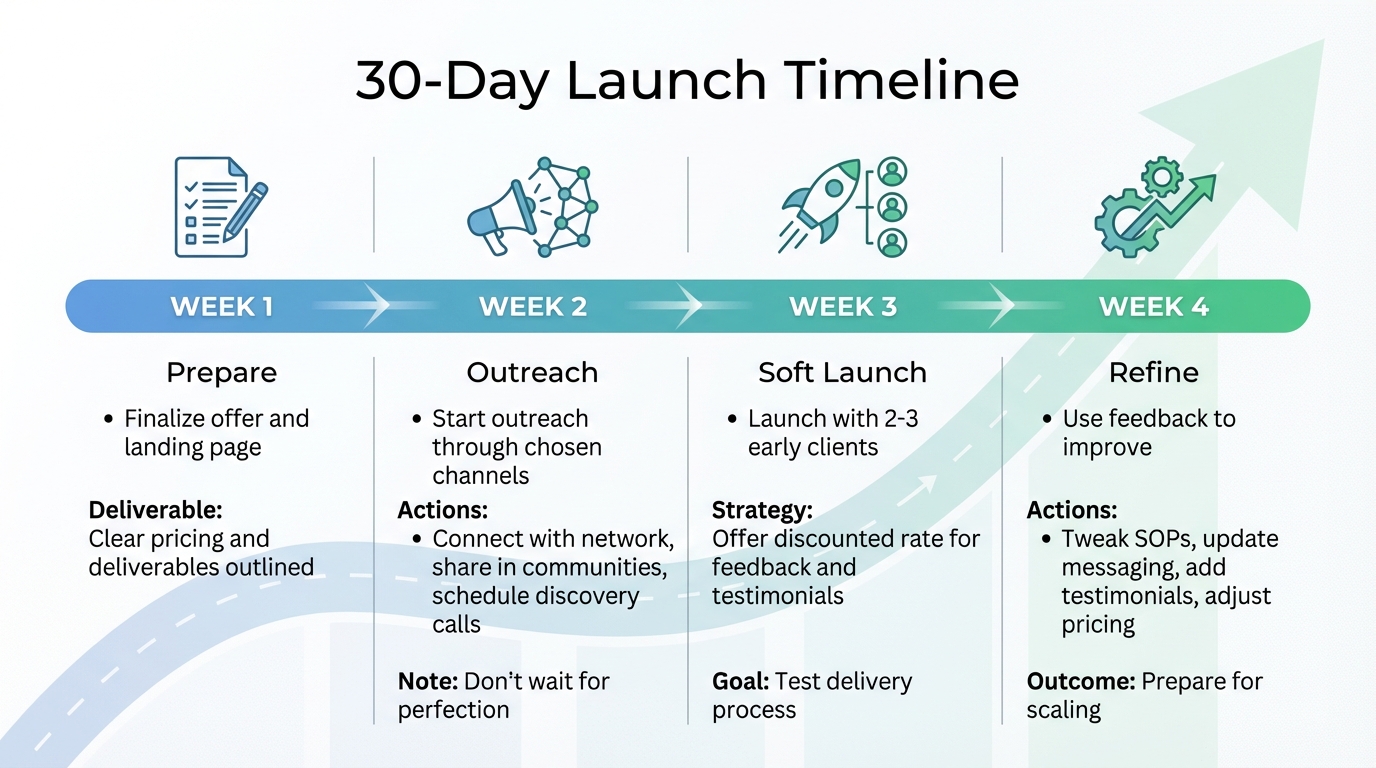
30-Day Productized Service Transformation Timeline
With your systems fine-tuned, it’s time to bring your productized service to life. Launch it, gather feedback, and make adjustments as you go.
30-Day Week-by-Week Plan
Breaking your launch into smaller weekly goals helps you stay organized and avoid feeling overwhelmed.
- Week 1: Wrap up your offer and landing page. Make sure pricing and deliverables are clearly outlined.
- Week 2: Start outreach using your chosen channels. Don’t wait for perfection - connect with your network, share in relevant communities, and schedule discovery calls.
- Week 3: Begin a soft launch with 2–3 early clients. Offer a discounted rate in exchange for detailed feedback and testimonials. This is a great opportunity to see what’s working (and what’s not) in your delivery process. For example, Ayman, a Client Ascension student, used this approach to refine his service into a productized YouTube sales funnel, eventually scaling to over $44,000 per month.
- Week 4: Use client feedback to tweak your Standard Operating Procedures (SOPs) and messaging. Add testimonials to your landing page and adjust pricing if needed. As Daniel Fazio, Co-founder at Client Ascension, advises:
“In the first 30 days, immerse yourself in learning and practice. Build your online presence by day 35, and spend the next 60 days aggressively pursuing clients with clear value propositions.”
During this final week, focus on preparing your service for scaling and document any process improvements.
Launch Faster With IdeaFloat
If you’re looking to speed things up, IdeaFloat can help. Their tools - like the Waitlist Landing Page, Community Launch Map, Go-to-Market Strategy, and Launch Checklist - can handle much of the groundwork that usually takes weeks. These resources make it easier to stay on track and manage every step of your launch.
Once your service is live, shift your focus to tracking performance and refining your approach.
Track Results and Make Changes
Keep an eye on key metrics like monthly recurring revenue, delivery timelines, client feedback, churn rate, support tickets, and conversion rates. These indicators will help you spot issues and improve your service.
For example, in April 2025, Affinity, a productized service agency, used client feedback during their beta phase to improve their Circle build offer. One client suggested adding a requirements checklist for their 4-week process, which reduced stress for everyone involved. Another client with significant content migration needs showed them the importance of offering two pricing tiers for different project sizes.
Set up simple tracking systems right from the start. If clients are leaving after the first month, conduct exit interviews to understand why. If delivery times are falling behind, revisit your SOPs to find bottlenecks. And if certain pricing tiers aren’t selling, experiment with new packages or adjust your messaging.
Conclusion
Transforming your service in just 30 days is all about experimenting, learning, and tweaking along the way. You've worked through evaluating your current model, crafting a clear offer with set pricing, creating repeatable systems, and testing everything with real clients who provide invaluable feedback.
With your model assessed and your offer clearly defined, think of this transformation as a complete operational upgrade. Break down your true costs, document your processes from the start, and test your pricing through real conversations before you scale. As Omid G highlights, thanks to AI and automation tools, "one person with the right tech stack can do what used to require a team." This shift is your chance to build a service business that operates like a SaaS company - with steady revenue, better margins, and room to grow. Tools like IdeaFloat can help you speed up the launch process and get started quickly.
The key to long-term success is ongoing refinement. Keep an eye on important metrics like monthly recurring revenue, delivery times, client feedback, and churn rates. Use this data to make adjustments and strengthen your systems. Every interaction with a client is an opportunity to fine-tune your processes. Start small, launch quickly, and adapt based on what you learn. Your service doesn’t need to be perfect right out of the gate - it just needs to solve a real problem with reliable, repeatable processes. This approach sets the stage for evolving from a traditional service model to a scalable, streamlined operation.
FAQs
How do I choose the best service to turn into a productized offering?
To choose the best service to turn into a product, start by reviewing what you currently offer. Focus on a service that consistently provides high value to clients and meets these three criteria: it delivers clear, measurable outcomes, has steady demand across multiple clients, and is profitable without relying on hourly billing.
After identifying a potential service, validate your idea by reaching out to 10–15 prospects who fit your ideal client profile. Ask them if the proposed outcome, price, and delivery timeline address a pressing need. If the majority give positive feedback, you've likely found a winner. If not, tweak the scope or consider exploring a different niche.
When you're ready to define your service, use this straightforward formula: Service + Niche + Clear Price = Easy to Buy. Test it with a pilot client to ensure it delivers as planned. A successful pilot can pave the way for scaling your productized service in just 30 days.
What are the most important steps to automate in a productized service?
Automating a productized service means simplifying repetitive tasks to ensure consistency and efficiency as you scale. Here are some key areas to focus on:
- Client onboarding: Streamline the beginning of the client journey with automated intake forms, scheduling tools, and welcome materials. This helps create a smooth and professional first impression.
- Contract management: Use e-signature tools to handle agreements quickly and eliminate the need for manual follow-ups.
- Billing and payments: Set up recurring invoices and automated payment reminders to keep transactions seamless and on time.
- Service delivery: Develop workflows that assign tasks, track progress, and ensure consistent results across all projects.
- File sharing: Automate the secure delivery of final assets to clients as soon as tasks are completed.
- Client communication: Schedule automated updates, milestone alerts, and feedback requests to keep clients in the loop without extra effort.
By automating these processes, you can create a system that runs efficiently while still delivering a personalized experience for your clients.
How can I test if there’s demand for my productized service?
To make sure your productized service addresses real market needs, start by having one-on-one conversations with 10–15 potential clients. Talk about the problem you’re aiming to solve and your proposed fixed-price package. These discussions will give you insights into how pressing the problem is, whether your solution resonates, and what pricing feels fair. If most of these prospects express interest or agree to a trial, it’s a good sign you’re on the right track.
Next, set up a straightforward landing page that clearly explains your service, includes pricing details (e.g., $2,500 per month), and features a strong call-to-action like "Sign Up Now." Use small-budget ads on platforms like Facebook or LinkedIn to target your ideal audience. Keep an eye on click-through rates and sign-ups - if you’re seeing conversion rates of 2–3% or higher, that’s a positive indicator of demand. To test payment willingness, consider offering a limited-time pre-sale discount.
Lastly, gather feedback through a short survey or worksheet. Ask clients about their expectations and the results they’re hoping for. Combine this feedback with your earlier conversations to fine-tune your service’s scope, pricing, and positioning before diving into major development or automation efforts.
Related Blog Posts
 Report an issue
Get the newest tips and tricks of starting your business!