If you’re thinking about starting a handyman business, here’s what you need to know:
- Market Opportunity: The handyman industry is growing fast, with U.S. revenues hitting $4.5 billion in 2021 and expected to nearly double globally by 2031. Profit margins can reach 90%, and experienced operators can earn $60,000–$80,000 annually or more.
- Startup Costs: You can start for under $1,000 if you already have tools and a vehicle. Costs may rise depending on licenses, insurance, and marketing.
- Licensing: Rules vary by state. Some states allow small jobs without a license, while others require one for all paid work. Always check local regulations to avoid fines.
- Pricing: Handymen typically charge $60–$85 per hour or use flat rates for simpler jobs. Always factor in overhead costs, travel time, and material markups.
- Marketing: Build an online presence with a website, Google Business Profile, and social media. Use local advertising like yard signs, vehicle wraps, and direct mail to attract clients.
This guide covers everything from legal requirements and pricing strategies to marketing tips, helping you launch a successful handyman business. Whether you’re looking to work solo or grow a team, the demand is there - let’s dive in.
The Ultimate Guide to Starting Your Handyman Business
Step 1: Get the Required Licenses and Permits
Handyman Licensing Requirements by State: Thresholds, Bonds, and Insurance
Check Your State's Licensing Requirements
Handyman licensing rules can vary widely across the United States since there’s no universal federal standard. Each state - or sometimes even individual cities and counties - sets its own regulations.
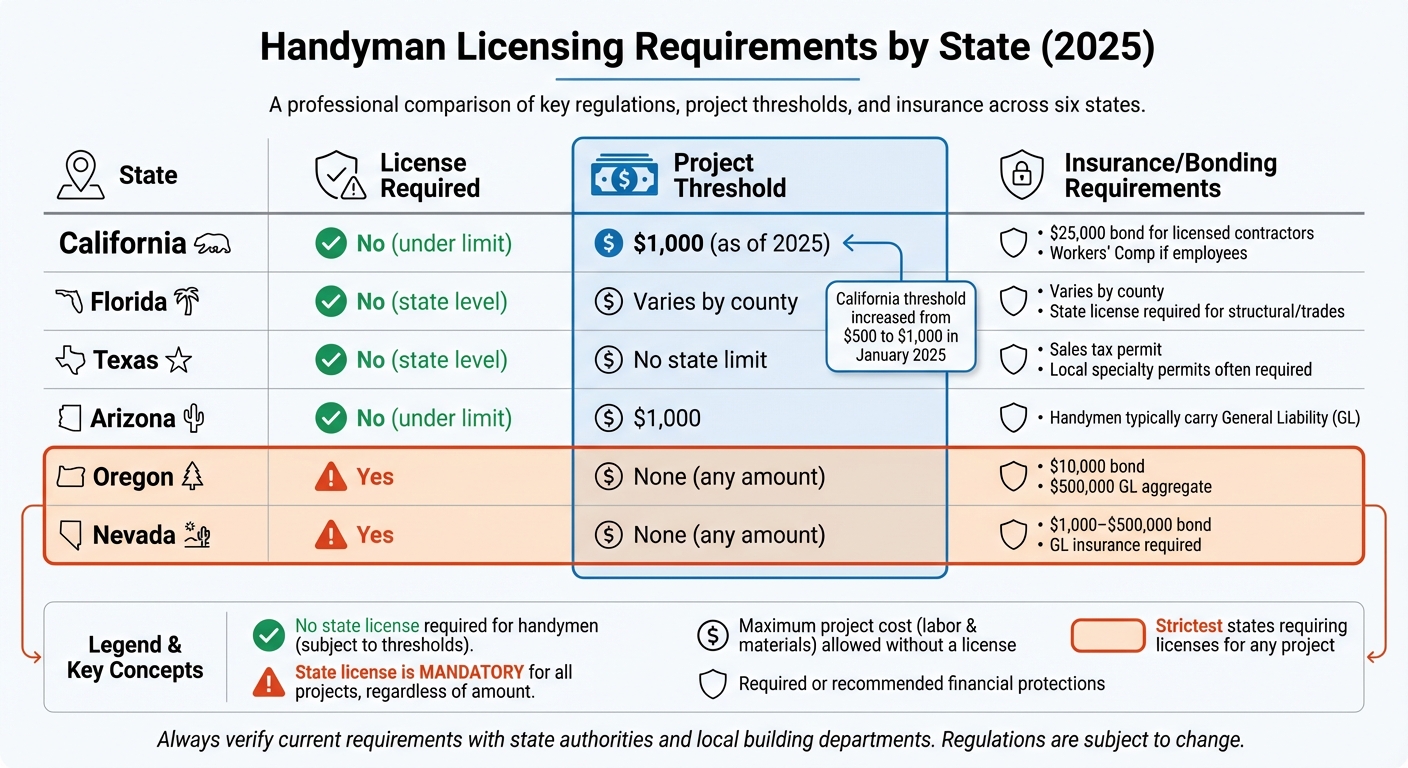
Many states use a "handyman exemption" based on project value. This means you might not need a contractor's license as long as the total cost of the job (including labor and materials) stays below a specific dollar amount. However, if your project exceeds that limit, a full contractor's license is required. For instance, California is raising its threshold from $500 to $1,000 starting January 1, 2025, while North Carolina requires licensing for projects worth $40,000 or more.
Some states don’t offer exemptions at all. Places like Nevada, Oregon, Washington, Maryland, and the District of Columbia require licensing or registration for any paid construction work, no matter the cost. And skipping proper authorization can lead to hefty fines. In California, for example, violations can cost up to $15,000 per incident.
Additionally, most states restrict handymen from performing specialized tasks like electrical, plumbing, HVAC, or structural work unless they hold the necessary trade licenses. Curran Clark, Co-Founder & Licensed Insurance Producer, emphasizes:
"Licensing requirements change frequently. Always verify current requirements with state authorities and local building departments before performing or advertising work".
Even in states with minimal statewide requirements, local ordinances may impose additional rules. Here’s a comparison of requirements in some major states:
| State | License Required | Project Threshold | Insurance/Bonding Requirements |
|---|---|---|---|
| California | No (under limit) | $1,000 (as of 2025) | $25,000 bond for licensed contractors; Workers' Comp if employees |
| Florida | No (state level) | Varies by county | Varies by county; state license required for structural/trades |
| Texas | No (state level) | No state limit | Sales tax permit; local specialty permits often required |
| Arizona | No (under limit) | $1,000 | Handymen typically carry General Liability (GL) |
| Oregon | Yes | None (any amount) | $10,000 bond; $500,000 GL aggregate |
| Nevada | Yes | None (any amount) | $1,000–$500,000 bond; GL insurance required |
Even in states like Texas or Florida, where there are no statewide licensing mandates, local governments may still require handyman certificates or business permits.
Register Your Business
Choosing the right business structure is an important step. Many handymen go with either a Sole Proprietorship or an LLC. While Sole Proprietorships are simpler and cheaper to set up, an LLC provides better protection for personal assets in case of business debts or lawsuits. Though forming an LLC involves higher upfront costs, the added security can be worth it.
If you’re operating under a name other than your own, you’ll need to register a DBA (Doing Business As) with your county clerk. You’ll also need to apply for an Employer Identification Number (EIN) from the IRS. It’s free, quick, and can be done online.
To keep your finances organized, open a separate business bank account. This is especially important if you’ve set up an LLC, as it helps maintain the liability protection that comes with it. Finally, don’t forget to secure a local business license, as most cities and counties require one even if a state trade license isn’t needed. Check with your local building department to confirm any specific requirements or fees.
Get Insurance and Bonding
Insurance is a critical safety net for any handyman. General Liability (GL) insurance covers property damage and bodily injury, and most handymen opt for coverage ranging from $300,000 to $1,000,000.
If you have employees, Workers' Compensation insurance is usually required by law. You might also need Commercial Auto Insurance if you use your vehicle primarily for work, as personal auto policies typically don’t cover business-related accidents. Additionally, Tools and Equipment Insurance can protect your gear from theft or damage.
Certain states mandate surety bonds to ensure you complete projects as agreed. Bond amounts can vary significantly - ranging from $5,000 in Alaska to $500,000 in Nevada, depending on the license classification.
Yoni Assulin, General Contractor at ASL Remodeling, stresses the importance of insurance:
"One claim can wipe you out. Get insured first - even if it slows you down at the beginning".
Charlie Hughes, Co-Founder & Licensed Insurance Producer, also warns:
"Hiring unlicensed workers for regulated work can void insurance coverage and building code protections".
For specialized projects like electrical or plumbing work, subcontracting to licensed professionals is a smart way to stay compliant and avoid added liability.
With all your licenses, registrations, and insurance in place, you’ll be ready to focus on competitive pricing and effective marketing strategies.
Step 2: Set Your Pricing
Pick a Pricing Model
When it comes to setting prices, you’ve got three main options: hourly rates, flat fees, or a hybrid model. Each one works better depending on the type of job you’re tackling.
Hourly pricing is ideal for unpredictable repairs or troubleshooting. For example, diagnosing why a door won’t close properly or working in older homes with potential hidden issues fits this model. It ensures you’re covered if surprises arise. As of 2026, the national average for hourly rates ranges from $60 to $85. Self-employed handymen often charge $50 to $80, while corporate services charge between $75 and $130 per hour.
Flat-rate pricing is better for straightforward, repeatable tasks. Think mounting a TV, installing a ceiling fan, or replacing a faucet - jobs where you can confidently estimate the time required. For instance, mounting a TV typically costs $150 to $250, while ceiling fan installations range from $200 to $400. The upside is that the more efficient you are, the more you earn per hour. However, if unexpected complications arise, your profit could take a hit.
A hybrid approach blends the two. You charge a flat rate for the main task but switch to hourly billing if complications occur or the customer adds extra work. This approach provides customers with upfront pricing while protecting you from scope creep.
When setting your rates, don’t forget to factor in non-billable time like driving, shopping for materials, paperwork, and cleanup. It’s also smart to establish a minimum service fee - usually between $125 and $200 - to ensure smaller jobs remain profitable after accounting for travel and setup.
Lastly, research local market rates to ensure your pricing stays competitive.
Research What Competitors Charge
Once you’ve chosen a pricing model, check what others in your area are charging. Start by contacting at least three local competitors and requesting quotes for common tasks like faucet installation or TV mounting. Use platforms like Thumbtack, Angi, Yelp, and Facebook Marketplace to gather more data.
Pricing varies significantly by location. For example, handymen in high-cost cities like San Francisco or New York charge $85–$150 per hour, while rates in rural areas range from $35 to $70. Specialized services, such as smart home setups or light electrical work, often command higher rates of $75 to $150 per hour.
Laura Thornton, CEO of TNT Home Services, shares her approach to pricing:
"We never ever want to price ourselves out of the market. So, we have to pay very close attention to make sure we're in the middle. I like to be a little bit on the higher end of the middle".
Also, look into what competitors charge for extras like trip fees ($50 to $80), minimum service fees, and material markups, which usually range from 20% to 50%. Reading customer reviews can reveal gaps in their service - like poor responsiveness or refusal to take on small jobs - allowing you to justify charging more for better service.
If you want to save time, tools like IdeaFloat's Advanced Pricing Research can analyze local market data and help you fine-tune your rates.
Calculate Costs and Profit Margins
To set profitable rates, you first need to calculate your break-even point. Add up all your monthly expenses - insurance, vehicle costs, tools, software, phone, and other overhead - and divide that total by the number of billable hours you expect to work each month.
For example, if your monthly overhead is $3,000 and you plan to work 100 billable hours, your cost per hour is $30. That’s the minimum you need to cover your expenses.
Next, factor in your desired hourly wage and profit margin. In the handyman industry, profit margins typically range from 20% to 50%. So, if your overhead is $30 per hour, you want to pay yourself $40 per hour, and you’re aiming for a 30% profit margin, your rate should be around $91 per hour.
Don’t forget to include material markups. A standard markup of 20% to 50% covers your time spent shopping, transporting, and handling returns. Steve Mills, owner of Steve Mills Handyman Services, explains his method:
"My time spent shopping and delivering materials would be billed at my regular rate. Any materials I purchase would be billed at cost plus 10%".
For more challenging jobs - like working in tight crawl spaces, older homes, or high-risk tasks - apply a complexity multiplier of 1.2x to 2.0x to your base rate. And remember, complex jobs often take 20% to 30% longer than expected, so build that into your pricing to avoid underestimating.
sbb-itb-08dd11e
Step 3: Market Your Handyman Business
Use Local Advertising
Local advertising can be affordable and highly effective if approached strategically. Simple tools like vehicle wraps and yard signs act as constant, mobile advertisements in your service area, keeping your business visible around the clock. Direct mail is another proven method for home services - sending postcards or brochures to targeted neighborhoods has shown an impressive average ROI of 945% for many businesses. Focus on areas with new developments or neighborhoods where you've recently worked to create a concentrated service route.
Building relationships with professionals like realtors, property managers, and complementary service providers (think pool cleaners or interior decorators) can also be a game-changer. These connections often lead to mutual referrals and a steady stream of work. Additionally, donating services to local school fundraisers or auctions can help you establish goodwill while attracting clients who value community involvement.
To complement these local efforts, make sure your business has a strong online presence.
Build Your Online Presence
Think of your website as your business’s digital storefront - it’s where potential customers go to validate your services. Include clear descriptions of what you offer, before-and-after photos of completed projects, and an easy-to-use "Click to Call" button. Since most local service searches happen on smartphones, ensure your site loads quickly and is mobile-friendly.
Claiming and optimizing your Google Business Profile is another must. Add high-quality photos, respond promptly to reviews, and encourage satisfied customers to leave feedback. Did you know that over 70% of customers will write a review if you simply ask them? These reviews not only build trust but also improve your local search rankings, especially as review activity now plays a role in search algorithms.
Platforms like Nextdoor and Craigslist can help you connect directly with your community. On Craigslist, use attention-grabbing titles like "Next-Day Appointments Available" or "Mention Craigslist for $10 Off." Include clear contact information and before-and-after photos to make your ad stand out. On Nextdoor, participate in local conversations and respond to recommendation requests to increase your visibility.
Social media is another powerful tool. Platforms like Facebook and Instagram allow you to share project highlights, DIY tips, and other engaging content that showcases your expertise. This keeps your business top of mind for homeowners. You can also run targeted ads to reach people in specific areas.
Yoni Assulin, founder of ASL Remodeling, emphasizes the importance of customer interaction:
"Nothing has helped me more than being reachable and reliable. Return calls fast, show up on time, and you'll get more referrals than any ad can buy."
Create Your Brand with IdeaFloat

A strong, unified brand ties all your marketing efforts together, making your business instantly recognizable. IdeaFloat’s Logo Generator provides multiple logo options and detailed brand guidelines, so you can easily apply your branding to business cards, vehicle wraps, and more.
Once your branding is in place, IdeaFloat’s Waitlist Landing Page tool can help you generate buzz before your official launch. This tool uses AI to craft persuasive copy, allowing you to capture emails and start booking jobs right away.
To further streamline your efforts, the Community Launch Map pinpoints where your audience is active online - like local Facebook groups or Nextdoor neighborhoods. It even provides pre-written posts tailored to these communities, so you can engage effectively without the guesswork.
Finally, the Launch Checklist ensures your branding, website, and community outreach efforts are all aligned. This step-by-step roadmap simplifies the process, helping you maximize your impact as you prepare to launch. With IdeaFloat’s integrated tools, you can seamlessly tie your brand to your marketing strategy and hit the ground running.
Step 4: Validate and Launch Your Business
Test Market Demand with IdeaFloat
Now that your marketing groundwork is in place, it’s time to confirm there’s demand for your services in your area. Start by doing a little detective work - search for "handyman near me" on Google Maps. Pay close attention to customer complaints for top-rated businesses. Are there recurring issues like slow response times for small jobs or delays in completing projects? If so, you may have found a gap in the market that your business can address.
IdeaFloat's Problem Validator can help you take this a step further. This tool measures whether your services meet urgent local needs. Dive into Consumer Insights to uncover niche demands that aren’t being met. For example, homeowners may need specialized services like smart home installations, quick rental property turnovers, or assistance tailored to elderly homeowners. Focusing on these underserved areas can give you a competitive edge.
Once you’ve confirmed demand, you can move forward with a plan to connect with your target audience.
Plan Your Go-to-Market Strategy
The next step is to figure out the best way to reach potential customers. IdeaFloat's Go-to-Market Strategy tool can help by pinpointing the platforms your audience uses most. Whether it’s local Facebook groups, Nextdoor, or partnerships with realtors and property managers, the tool identifies the best channels for your outreach. It even calculates customer acquisition costs and provides ready-made scripts to streamline your marketing efforts.
Set clear, short-term goals to measure your progress. For instance, aim to secure 10–20 clients and gather 5–10 Google reviews within your first three to six months. Pay attention to which job estimates convert into actual business and which ones go to competitors. This data can help you fine-tune both your pricing and sales approach over time.
With demand confirmed and a solid strategy in place, the next step is to ensure your financials are in order.
Build Your Financial Projections
Before you officially launch, make sure your business is set up to be financially viable. Use tools like IdeaFloat's Financial Model and Cost Analysis to calculate your break-even point. This involves dividing your monthly overhead costs - things like insurance, licensing fees, and vehicle expenses - by the number of billable hours you expect to work.
Startup costs for a handyman business typically fall between $2,000 and $10,000, with profit margins ranging from 15% to 50%. The national average hourly rate in 2026 is projected to be $60–$85, but your actual rate will depend on factors like your location and operating expenses.
IdeaFloat's Financial Projections & Breakeven Analysis tool offers a detailed, month-by-month breakdown of your expected revenue and expenses. This can help you decide if you’ll need financing and estimate when your business will start turning a profit.
Andrew Fisher, the owner of Valley Patios, shares this advice for new handymen:
"New handymen sometimes focus too much on keeping costs down to the detriment of growing their business. Buy high-quality tools. Invest in marketing."
When setting your hourly rate, don’t forget to factor in "invisible time" - things like travel, setup, and administrative work. It’s also a good idea to compare your estimated job costs with actual expenses in real time. This will help you spot areas where you might be underestimating labor or materials.
Conclusion
Starting a handyman business involves four key steps: ensuring legal compliance, setting the right prices, marketing effectively, and validating your business before launch. These steps provide a clear roadmap to help you build a solid foundation.
The first step, legal compliance, is crucial. Licensing requirements can vary widely depending on the state, so make sure you understand and meet these regulations. Additionally, securing liability insurance is non-negotiable. As Yoni Assulin from ASL Remodeling emphasizes:
"One claim can wipe you out. Get insured first - even if it slows you down at the beginning".
When it comes to pricing, it’s essential to consider all your costs, including overhead, travel, and administrative work. Typical profit margins range from 15% to 50%, with startup costs between $2,000 and $10,000. Your rates should reflect local market conditions to remain competitive while covering expenses.
Marketing and business validation are where your plans turn into action. Start by claiming your Google Business Profile - 97% of people searching for local services begin their search online. Analyze your competitors to find service gaps, and set clear, short-term goals to attract your first customers and grow steadily.
The handyman industry is expanding, with over 1.6 million jobs in the U.S. and an expected increase of 57,200 jobs over the next eight years. By following these four steps, you can position yourself for success in a growing market while avoiding common pitfalls.
FAQs
What steps do I need to take to start a handyman business legally in the U.S.?
Starting a handyman business in the U.S. involves a few essential steps to ensure you're operating within the law. Here's what you need to do:
First, check your state's licensing requirements. These can vary depending on where you live. While most states require a general business license, others might need specific trade licenses for tasks like plumbing or electrical work. Make sure you know what’s required for the services you plan to offer.
Next, register your business with local authorities. This process includes picking a business name, applying for a federal Employer Identification Number (EIN) from the IRS, and deciding on a legal structure. Many choose a sole proprietorship for simplicity, but forming an LLC can help protect your personal assets.
Lastly, get general liability insurance. This is crucial for protecting your business and is often a legal necessity in many areas. It provides coverage for potential risks and ensures you’re prepared for unexpected situations.
By taking these steps, you'll set your handyman business up for success while staying compliant with local laws.
How can I set the right prices for my handyman services?
To figure out the right pricing for your handyman services, start by choosing a pricing method: hourly rate, flat rate, or a mix of both. The choice will depend on the nature of the jobs you handle and what works best for your business model.
Next, take a close look at your expenses. This includes everything from tools and supplies to travel costs. Your pricing should not only cover these overhead costs but also remain competitive with other handyman services in your area. Be sure to factor in the complexity of the work, what others in your region are charging, and your own level of expertise when setting your rates.
You might also want to explore estimating tools or software to make the quoting process faster and more accurate. The key is finding a balance - your prices should be profitable for you while still being fair and appealing to customers.
What are the best ways to market a handyman business and attract local clients?
To draw in local clients for your handyman business, focus on creating a strong online presence. Start by listing your business on local search directories and ensuring you're visible on platforms like Google Maps. Local search optimization makes it easier for nearby customers to discover your services.
Encourage happy clients to leave positive reviews online. These reviews can go a long way in building trust and influencing potential customers to choose your business. Beyond that, consider diving into community-based marketing. Participate in local events or join neighborhood social media groups to connect with residents and showcase your services. This approach not only helps you meet potential clients but also positions your business as a reliable, community-focused option.
Don’t underestimate the power of word-of-mouth referrals. Deliver top-notch service that leaves customers eager to recommend you to friends and family. By combining these strategies, you can increase your visibility and steadily grow your client base.
Related Blog Posts
 Report an issue
Get the newest tips and tricks of starting your business!