
Starting a tutoring business can be a low-cost, high-profit venture with flexible options for growth. Here's what you need to know:
- Subjects: Focus on areas where demand is strong, like math, reading, STEM, and test prep (SAT, ACT, GRE). Specializing in niche subjects like AP Calculus or Python coding can help you stand out.
- Pricing: Rates vary by location and expertise. Tutors earn $25–$80 per hour on average, with specialized test prep tutors charging $150+. Options include hourly rates, package deals, or subscriptions.
- Finding Clients: Use platforms like Wyzant or Tutor.com, advertise locally with flyers, and build trust through referrals. A Google Business Profile can increase visibility.
With minimal startup costs ($0–$500) and profit margins of 60%–90%, tutoring offers a scalable way to turn your skills into income. Start by identifying your strengths, confirming local demand, and setting competitive rates.
How to Start a Tutoring Business in 2026 | Step-by-Step
sbb-itb-08dd11e
Step 1: Pick Your Subjects
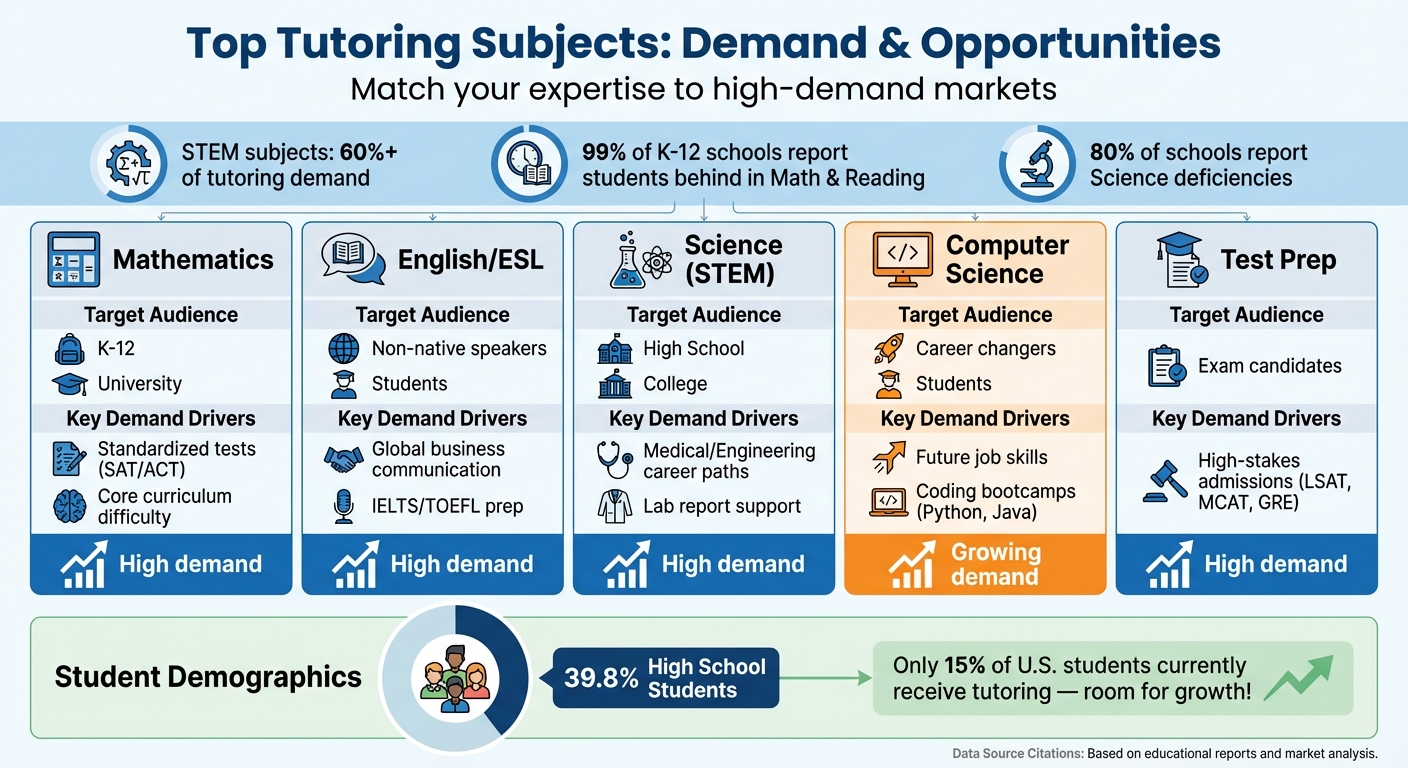
Tutoring Business Subject Demand and Target Audiences Comparison
Match Your Skills to Subject Areas
Start by figuring out which subjects you’re best equipped to teach. Take practice tests if you're preparing to offer exam tutoring, and identify any gaps in your knowledge. Your academic background, professional certifications, or teaching experience can help validate your expertise. For instance, a CPA might excel at tutoring accounting, while a former high school teacher could leverage their classroom skills. Specializing in a niche - like AP Chemistry, LSAT prep, or Python coding - can help you stand out, charge higher rates, and attract clients seeking focused expertise.
Once you’ve identified your strengths, the next step is to confirm local demand for these subjects.
Research Subject Demand
STEM subjects dominate, making up more than 60% of tutoring demand. Math and reading are particularly critical, with 99% of public K–12 schools in the U.S. reporting that students were behind grade level in these areas at the start of the 2022–23 school year. Science isn’t far behind, with 80% of schools highlighting deficiencies. High-stakes test prep for exams like the SAT, ACT, GRE, and LSAT also remains a key driver of demand as students navigate intense college admission pressures.
To better understand local needs, connect with school counselors and teachers to learn which subjects students are struggling with. Look into your district’s performance reports to identify underserved areas. Platforms like Nextdoor or local Facebook groups can also reveal frequently requested subjects. Additionally, analyzing local tutoring centers can help you spot opportunities. For example, general math tutoring may be common, but there could be a shortage of tutors specializing in AP Calculus or advanced statistics.
| Subject Category | Target Audience | Key Demand Drivers |
|---|---|---|
| Mathematics | K-12, University | Standardized tests (SAT/ACT), core curriculum difficulty |
| English/ESL | Non-native speakers, Students | Global business communication, IELTS/TOEFL prep |
| Science (STEM) | High School, College | Medical/Engineering career paths, lab report support |
| Computer Science | Career changers, Students | Future job skills, coding bootcamps (Python, Java) |
| Test Prep | Exam candidates | High-stakes admissions (LSAT, MCAT, GRE) |
Define Your Target Students
After confirming demand, narrow your focus to the specific student groups that match your expertise. Think about which age group aligns with your teaching style and the level of complexity you’re comfortable handling:
- Elementary students (K-5): Need help with basic reading and arithmetic, often taught through interactive methods like games and hands-on activities.
- High school students (9-12): Require support for honors and AP classes, as well as standardized test prep. This often involves breaking down challenging concepts into manageable steps.
- College students: Seek specialized assistance with advanced courses that move at a faster pace.
- Adult learners: Focus on career changes or professional certifications, benefiting from flexible and practical teaching approaches.
High school students make up the largest share of the tutoring market, accounting for 39.8% of revenue, largely driven by anxiety around college admissions. However, only 15% of U.S. students currently receive tutoring, leaving plenty of room to grow across all age groups. To prepare, review syllabi and textbooks during quieter periods to refresh your knowledge. You might also consider piloting your services with a small group at a reduced rate to gather feedback and testimonials. This groundwork will help you fine-tune your methods and position yourself for success in the next phase.
Step 2: Set Your Prices
Once you've identified your subjects, the next step is to figure out how much to charge for your services competitively.
Check Competitor Rates
Start by researching what other tutors in your area are charging. Look up 10–15 local tutors using tools like Google, Care.com, or Superprof. Rates can vary quite a bit depending on where you live. For example:
- New York City: $65–$85 per hour (25–30% above the national average)
- Chicago: $45–$70 per hour (10–15% higher than average)
- Rural/Suburban Areas: $30–$50 per hour
- Online Tutoring: $25–$50 per hour (lower due to competition and no travel costs)
Your qualifications and how you deliver your sessions also play a role. Certified teachers can typically charge $20–$40 more per hour than non-certified tutors. Similarly, in-person sessions often cost $10–$20 more to account for travel time and expenses. To get a clearer picture of your local market, check platforms like Nextdoor or local Facebook groups, and talk to school counselors. They can give you insights into what parents expect and which subjects are in high demand - this can help you set premium rates for specialized services. Tools like IdeaFloat's Advanced Pricing Research can also help you analyze competitor rates and develop a pricing strategy.
Select a Pricing Model
Once you've done your homework, choose a pricing structure that fits your services and appeals to your clients. Here are three common options:
| Pricing Model | Description | Pros | Cons |
|---|---|---|---|
| Hourly Rates | Charge $25–$80 per hour in the U.S. | Flexible for clients; easy to start with | Income can be unpredictable |
| Package Deals | Offer bundles (e.g., 10 sessions at a discount) | Predictable income; encourages commitment | Requires upfront payment |
| Subscriptions | Monthly plans (e.g., $400/month for weekly lessons) | Steady cash flow; reduces client turnover | May require automated billing systems |
Many tutors use a mix of these approaches. For example, you might start with hourly rates for trial sessions, then offer packages or subscriptions for long-term clients. Group sessions can also be a great way to boost income - charging $20–$30 per student for subjects like Algebra or SAT prep can quickly add up.
Once you've chosen a model, make sure to account for all your costs so you can set a rate that ensures profitability.
Calculate Costs and Margins
Your hourly rate needs to cover more than just the time spent tutoring. Don’t forget to include:
- Preparation Time: Lesson planning, grading, and sourcing materials
- Administrative Tasks: Scheduling, invoicing, and communication
- Overhead Costs:
- Liability insurance: $300–$600 annually
- Background checks: $30–$50
- Software subscriptions for video calls or scheduling
- Travel Expenses: Gas, parking, and vehicle maintenance for in-person sessions. Some tutors add extra fees for commutes over 30 minutes.
Here’s how to calculate your rate: Take your target monthly income, add your monthly expenses, and divide by the number of billable hours you can realistically work. For instance, if your goal is to take home $4,000 per month, and you have $1,000 in costs, with 80 billable hours, you’d need to charge at least $62.50 per hour.
Tools like IdeaFloat's Financial Model can help you track your income and expenses, calculate your breakeven point, and plan for profitability. Also, consider implementing a 24-hour cancellation policy to protect your earnings.
"When first starting out, I would recommend charging the bare minimum, maybe $20 or $30 per hour. If you have an advanced degree in a technical field or special education... you might be able to charge a little more."
- Greg Freebury, Owner of Think and Evolve Tutoring
Test your pricing for a year. If you’re consistently booking 80% of your available hours, it’s a good sign that you can raise your rates for new clients.
Step 3: Find Clients
You've got your subjects and pricing sorted - now it’s time to connect with students. With the global private tutoring market hitting $98.15 billion in 2021 and expected to grow even more by 2028, the demand is there. The real challenge? Making sure parents and students can find you.
Use Online Platforms
A great starting point is listing your services on tutoring marketplaces like Wyzant, Tutor.com, Care.com, Superprof, and Varsity Tutors. These platforms attract parents actively searching for tutors, so you’re not starting from scratch. Create a standout profile that includes:
- A professional headshot
- Clear, outcome-driven descriptions (e.g., "helped 200+ students improve grades by at least one letter")
- Transparent pricing, with specific packages like "Monthly Math Mastery: 4 sessions for $280"
- Certifications (e.g., from the National Tutoring Association)
- Background check badges from services like Checkr or Sterling
Make it easy for potential clients to act by including a link for a free 15-minute consultation or a similar call to action.
Don’t stop there - tap into community platforms like Nextdoor and local Facebook groups to reach families in your area. Setting up a Google Business Profile is another smart move. This ensures your service shows up when someone searches “tutor near me” on Google or Google Maps. For help choosing the best platforms, tools like IdeaFloat's Go-to-Market Strategy can analyze your target market and suggest the most effective channels.
If you’re looking to expand your reach further, traditional advertising can be a simple yet effective addition.
Advertise Locally
Print flyers that include your business name, credentials, subjects, contact details, a trust statement, and a QR code linking to your website. Printing 100 flyers costs around $15, making this an affordable option. Post them on bulletin boards in places like coffee shops, libraries, and grocery stores - anywhere parents might see them.
You can also visit local schools and leave flyers or business cards in the main office. Reach out to student advisers or counselors, as they often recommend tutors to parents. Attending local fairs, festivals, or parent-teacher meetings is another way to connect directly with potential clients.
Combining these local efforts with your online presence helps build trust and attract the right clients.
Get Referrals
Satisfied parents and students can be your best marketing tool. Introduce yourself to school counselors and teachers - they’re often the first people parents ask for tutor recommendations. Join parent groups and PTAs to build relationships and strengthen your reputation within the community.
Consider offering referral incentives, like a free session or a discount for each new student referred. Positive reviews also go a long way, so encourage happy parents to leave reviews on your Google Business Profile. These reviews not only boost your credibility but also improve your local search rankings.
As Christine Colling from Durable wisely points out, "Parents don't hire the cheapest tutor. They hire the one they trust most." Building trust is key, and you can do this by delivering consistent results and maintaining professional communication. Including a trust statement, like “I maintain an active background check,” on all your materials can also make a big difference. Colling adds, "'I maintain an active background check' is a sentence that closes deals."
Wrapping It Up
We’ve walked through the essentials of building a successful tutoring business: choosing subjects that align with your expertise and market needs, setting competitive prices, and reaching clients through trusted platforms. With the private tutoring industry thriving, the opportunity is there for the taking, especially with low startup costs and the potential for strong profit margins.
The most important step? Start now. Complete a background check this week - it’s a small investment of $30 to $50 that goes a long way in gaining parents' trust. Create a Google Business Profile to increase your visibility in local searches. Instead of charging by the hour, consider offering monthly packages. This approach not only stabilizes your income but also encourages longer-term commitments from clients.
As your business gains momentum, be sure to revisit your strategies. Update your business plan to reflect shifts in the market. Review your pricing annually and adjust as needed. For instance, if you’re consistently booked solid, it might be time to increase your rates.
If you’re looking for extra guidance, tools like IdeaFloat can be a game changer. They’ll help you refine your niche, assess your market potential, and build a tailored strategy, including financial modeling and professional landing pages. It’s a one-stop solution to transform your skills into a thriving business.
Your first student is out there waiting - take the leap and start your tutoring journey today.
FAQs
Do I need a teaching credential to tutor?
In the United States, private tutors generally aren't required to hold formal teaching credentials. That said, having a solid educational background or deep knowledge in your subject area is key to establishing trust and credibility with clients. To operate legally, most areas require a general business license, and some locations may also mandate additional local permits, particularly if you’re running a home-based tutoring service. Be sure to review your state and city regulations to stay compliant.
How do I choose my first tutoring niche?
To get started, think about the subjects you feel confident teaching - whether it's math, science, or even test prep. Choose areas that not only interest you but are also in high demand. This combination makes it easier to attract clients and establish your reputation. It's also worth considering how profitable different subjects are. For example, fields like math or programming often allow you to charge higher rates. By aligning your strengths with what the market needs, you can carve out a niche that's both rewarding and financially worthwhile.
What’s the fastest way to get my first 5 clients?
The fastest way to land your first five tutoring clients is by blending online tools with local networking. Start by signing up on tutoring platforms and listing your services on community sites like Nextdoor. At the same time, reach out to school counselors in your area - they can help establish trust and introduce you to families in need of tutoring. Make sure your profile looks professional, clearly targets your audience, and highlights your skills where parents and students are already looking for help.
Related Blog Posts
 Report an issue
Get the newest tips and tricks of starting your business!