Starting an e-commerce business can be affordable, but hidden costs often surprise new entrepreneurs. Here's what you need to know upfront:
- Core Costs: Website platforms range from $14 to $39/month, domains cost $10–$30/year, and payment processors typically charge 2.9% + $0.30 per transaction.
- Additional Expenses: Expect business registration fees ($480–business registration fees ($480–$1,180),180), insurance (~$42/month), and potential software subscriptions.
- Marketing: Initial campaigns may cost $200–$1,000, and ongoing marketing could use 7.7%–20% of your revenue.
- Profit Planning: Calculate fixed and variable costs to determine your breakeven point and set prices that maintain profit margins.
Preparation is key. Use tools like IdeaFloat for financial projections and cost analysis to avoid common pitfalls. Start small, focus on essential expenses, and scale as you grow.
How Much Money Do YOU NEED to start an eCommerce brand in 2023?
Tools You'll Need and What They Cost
When planning your e-commerce budget, understanding the costs of essential tools is crucial. Most e-commerce businesses rely on three main categories of tools: a website platform, payment processing, and inventory management. Choosing the right combination can help keep your monthly expenses manageable.
Website platforms come with a range of pricing options. For example, Shopify's Basic plan is $39 per month, BigCommerce starts at $29 per month, and Ecwid offers plans beginning at $14.08 per month. Square Online even has a free plan, though it comes with higher transaction fees. Additionally, registering a domain will typically cost between $10 and $30 annually. To test your concept, tools like IdeaFloat's Waitlist Landing Page and Logo Generator can help you attract early interest and create branding materials without any upfront costs.
Payment processors usually charge 2.9% plus $0.30 per transaction. Popular options like Stripe, PayPal, and Shopify Payments fall within this range. Some processors, like Authorize.net, include a $25 monthly fee in addition to transaction costs. If you use an external processor on platforms like Shopify, keep in mind the "third-party transaction fee", which can range from 0.6% to 2%, depending on your subscription plan. Before launching, it's a good idea to test your checkout process with a real transaction to ensure everything, including discount codes and shipping calculations, works as expected.
Inventory and dropshipping tools depend on your fulfillment model. Dropshipping apps such as SaleHoo cost around $27 per month, while access to supplier directories may require an additional $67 annually. If you're managing inventory yourself, most platforms include basic tracking features in their subscription fees. For instance, Shopify's $29 per month plan supports real-time inventory management. If you outsource fulfillment, third-party logistics (3PL) providers charge variable rates based on storage and shipping needs. Additionally, you should budget approximately $8 per item for product samples to check quality. IdeaFloat's Product & Service Creator can help you determine how many units you'll need to sell each month to reach profitability.
To summarize, a typical setup includes a website platform ($29–$39 per month), a dropshipping app ($27 per month), a domain (about $15 annually), and variable payment processing fees. This brings your baseline monthly costs to around $60–$70. One-time expenses, such as premium themes (ranging from $0 to $200) or specialized apps for email marketing or customer reviews, could add to your initial investment. Shopify's Michael Keenan notes:
The overall cost of building and running a new ecommerce website is approximately $29 per month.
This estimate assumes you're using only the built-in features without any additional add-ons.
To get started, consider all-in-one hosted platforms that bundle essential features. Take advantage of free trials (typically lasting 3 to 15 days) to explore different interfaces. You can also use AI tools to cut costs on tasks like copywriting and image editing. Knowing your tool costs in detail before launching will make budgeting much easier.
Finally, review any recurring and one-time fees to complete your financial planning.
Recurring and One-Time Fees
When running an e-commerce business, you'll encounter a mix of ongoing monthly charges and upfront expenses. Knowing how these costs break down can help you manage cash flow effectively and plan for steady growth. These fees, combined with your core tool expenses, shape the foundation of your budget.
Transaction and Payment Fees
Every sale you make comes with a cost. Payment processors like Stripe, PayPal, and Shopify Payments typically charge 2.9% plus $0.30 per transaction. If you're using Shopify's Basic plan but rely on an external processor, you'll also pay an additional 2.0% third-party transaction fee. For example, a $50 order would result in approximately $1.75 in processing fees. While this may seem small, it adds up - selling $10,000 in a month could mean around $290 in payment fees. Higher-tier Shopify plans offer some relief: the Grow plan lowers the third-party fee to 1.0%, and the Advanced plan reduces it further to 0.6%.
Marketing and Advertising Costs
Reaching your first customers often requires an investment in advertising. Many new e-commerce businesses allocate between $200 and $1,000 for initial campaigns. On average, small businesses spend about 7.7% of their annual revenue on marketing, though during the launch phase, this figure can climb to 12% to 20%. Tools like IdeaFloat's Go-to-Market Strategy can help you pinpoint customer acquisition costs, identify the best platforms for your audience, and streamline your ad spending with ready-made outreach scripts.
Business Registration and Licensing
To legally operate, you’ll need to register your business. Filing fees for forming an LLC or corporation vary by state, ranging from $40 to over $500, while business licenses typically cost between $50 and $400. Additionally, you’ll need an SSL certificate for secure transactions, which can cost anywhere from $0 to $480 annually, though many hosting platforms include it as part of their services. If you’re operating as a sole proprietor or LLC, don’t forget to account for self-employment taxes, which are roughly 15.3% of your income. On the bright side, the IRS allows you to deduct up to $5,000 in startup costs during your first year of reporting income.
Understanding these recurring and one-time expenses is essential for creating accurate financial forecasts and setting yourself up for long-term success.
sbb-itb-08dd11e
How to Build a Profit Model That Works
Once you’ve got a handle on your costs, the next step is building a financial model to check if your business can be profitable. This means figuring out how many sales you need to break even, setting prices that keep your margins intact, and projecting revenue over time. Without these numbers, profitability is just guesswork.
Cost Analysis and Financial Projections
Start by revisiting your expenses - both fixed and variable - to get a clear picture of your monthly burn rate. Tools like IdeaFloat's Cost Analysis can help. Fixed costs, like a $500 monthly subscription fee, stay the same no matter how much you sell. Variable costs, on the other hand, grow with your sales. For example, if packaging costs $2.00 per box, that expense increases with every unit sold.
Once you’ve categorized your costs, create month-by-month projections. This will help you see when you might need more funding and when you can expect to turn cash flow positive. Don’t forget to account for hidden costs - like returns, currency exchange fees, or packaging - that can eat into your margins. Most businesses should plan for an 18–24 month runway since profitability is often delayed by early reinvestments.
With your costs mapped out, the focus shifts to pricing strategies that support your margins.
Pricing and Revenue Streams
Your pricing strategy needs to balance your costs with your market positioning. A simple approach is cost-plus pricing: calculate your cost per unit, then divide it by (1 minus your desired profit margin). For example, if your product costs $20 to produce and ship, and you want a 40% margin, your target price would be $20 ÷ 0.60 = $33.33.
Pricing too low can leave you stuck in a high-volume, low-margin trap, while pricing too high without a strong value proposition could scare off customers. Tools like IdeaFloat's Advanced Pricing Research can analyze market trends and competitor pricing to help you find the sweet spot. You can even manually tweak prices and instantly see how it affects your breakeven point. Keep in mind, even a 1% price increase can boost operating profit by 3% to 8%.
It’s also helpful to know how your industry typically performs. For instance, apparel businesses average a 54.28% gross profit margin, while food and grocery margins are closer to 26.09%. Knowing these benchmarks can guide your pricing decisions.
Breakeven and Market Sizing
Understanding your breakeven point is crucial - it’s the number of units you need to sell to cover all your fixed and variable costs. The formula is simple: Fixed Costs ÷ (Selling Price per Unit – Variable Cost per Unit). For example, if your fixed costs are $3,000 per month, you sell a product for $50, and your variable cost per unit is $20, you’d need to sell 100 units per month to break even ($3,000 ÷ $30 = 100).
To ensure your sales goals are realistic, use tools like IdeaFloat's Smart Market Sizing. It calculates your TAM (Total Addressable Market), SAM (Serviceable Available Market), and SOM (Serviceable Obtainable Market), giving you a solid estimate of your potential revenue. For instance, if your breakeven analysis shows you need to sell 1,200 units annually, but your market can realistically support only 500 customers, it’s a sign you need to rethink your pricing or cost structure. Adjusting your variable costs or prices based on breakeven analysis can help steer your business toward profitability.
Sample E-commerce Budget Template
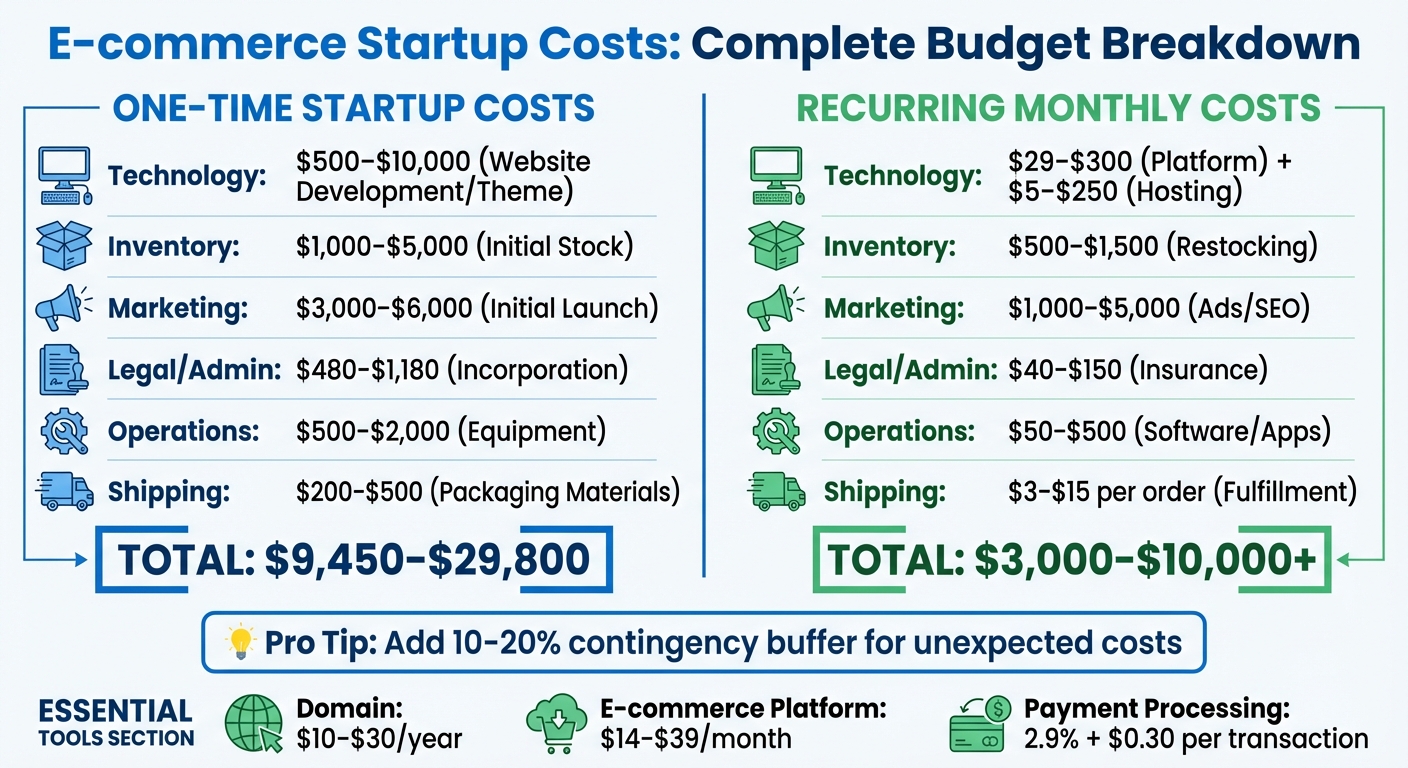
E-commerce Startup Costs Breakdown: One-Time vs Monthly Expenses
This template is designed to help you estimate both startup costs and ongoing monthly expenses for your e-commerce business. The table below breaks down one-time startup costs and recurring monthly expenses, offering a clear view of your initial investment and your monthly financial commitments. These figures are based on typical averages for small e-commerce businesses in the United States.
| Expense Category | One-Time Startup Cost (USD) | Recurring Monthly Cost (USD) |
|---|---|---|
| Technology | $500–$10,000 (Website Development/Theme) | $29–$300 (Platform); $5–$250 (Hosting) |
| Inventory | $1,000–$5,000 (Initial Stock) | $500–$1,500 (Restocking) |
| Marketing | $3,000–$6,000 (Initial Launch) | $1,000–$5,000 (Ads/SEO) |
| Legal/Admin | $480–$1,180 (Incorporation) | $40–$150 (Insurance) |
| Operations | $500–$2,000 (Equipment) | $50–$500 (Software/Apps) |
| Shipping | $200–$500 (Packaging Materials) | $3–$15 per order (Fulfillment) |
| Total Estimates | $9,450–$29,800 | $3,000–$10,000+ |
To account for unexpected costs - like price fluctuations, returns, or unforeseen fees - consider adding a contingency buffer of 10%–20%. For instance, if your estimated startup costs are $15,000, set aside an additional $1,500–$3,000 as a safety net.
Once you've outlined your budget, you can use tools to simulate various financial scenarios. Tools like IdeaFloat's Financial Projections make this process much simpler. Input your numbers - say, a $50 product price, $20 variable cost per unit, and $3,000 in fixed monthly costs - and instantly see how these figures affect your breakeven point, cash flow, and profitability. Want to test the impact of increasing your ad spend from $2,000 to $3,500 per month? The tool recalculates everything, including your income statement, balance sheet, and runway, without needing complex spreadsheets.
As Tori Dunlap, Founder of Her First $100K, wisely said:
Money is a learned skill, just like anything else, and you're going to be bad at it... give yourself grace and understand that you're learning this skill.
Use this template as your starting point. Refine it as you gather actual vendor quotes and track your expenses during the first few months of operation.
Key Takeaways for E-commerce Entrepreneurs
Starting an e-commerce business doesn’t require a fortune, but it does demand thoughtful planning. By choosing hosted platforms with built-in features, using free templates, and starting with dropshipping, you can significantly reduce upfront expenses. Focus your initial budget on three essentials: a domain name for your brand identity (around $10–$30 annually), a dependable e-commerce platform for your online store ($5–$300 monthly), and a secure payment processor to handle transactions (typically 2.9% + $0.30 per sale).
Once you’ve outlined your costs, the next step is to validate your business idea. Testing market demand early is critical - 93% of small businesses face financial struggles without proper validation. Tools like IdeaFloat can help you gauge interest by validating your idea, creating financial projections, and even building a waitlist landing page to capture potential customers before making heavy investments in inventory or custom web development.
Understand the difference between startup and ongoing costs. Separate one-time expenses - like incorporation fees, initial equipment, or a premium website theme - from recurring monthly fees such as hosting, software subscriptions, and marketing. This distinction helps you build a realistic 12-month financial plan. It’s also wise to set aside a contingency fund for unexpected costs, such as returns, price changes, or supply chain hiccups. A clear financial plan gives you the tools to make informed decisions and tackle early challenges with confidence.
Managing your finances effectively is a skill you can develop. Nearly two-thirds of small business owners fund their startups with personal or family savings, and 71% carried debt in 2023. Tools like IdeaFloat’s Cost Analysis and Product & Service Creator can help you calculate what you’ll need to launch and operate each month. You can also determine how many units you’ll need to sell to break even. Additionally, IdeaFloat’s Community Launch Map can identify where your target customers spend time online and even generate custom posts to drive traffic to your store.
Start small and scale up. Focus on essential expenses at first - like secure checkout, basic hosting, and minimal inventory - and reinvest your early profits into growth. By using validated financial insights and tools like those offered by IdeaFloat, you can move smoothly from testing your concept to building a profitable business. This lean approach allows you to turn your e-commerce idea into a revenue-generating operation faster and with less risk than traditional methods.
FAQs
What unexpected costs should I plan for when starting an e-commerce business?
Starting an e-commerce business can come with a range of hidden expenses that many new entrepreneurs don't anticipate. For instance, you'll need to budget for website development, domain registration, and hosting services - essential components for getting your store online. On top of that, payment platforms often deduct transaction fees, and investing in inventory management tools might be necessary to keep your operations running smoothly.
Then there’s marketing. Whether it’s paid ads or email campaigns, these costs can pile up faster than you might expect. Don’t forget about recurring expenses like subscription fees for software, handling returns, or making adjustments to shipping costs. By accounting for these less obvious expenses upfront, you’ll be better equipped to manage your budget and build a strong foundation for your e-commerce business.
How do I calculate the breakeven point for my e-commerce business?
To figure out the breakeven point for your e-commerce business, you’ll need to calculate how many sales are necessary to cover both your fixed and variable costs. Here’s a straightforward way to do it:
- Pinpoint your fixed costs: These are expenses that stay the same regardless of how much you sell. Think website hosting, software subscriptions, or rent.
- Work out your variable costs per unit: These are costs that fluctuate with each sale, like production, packaging, or shipping.
- Determine your average selling price per unit: This is the price you charge customers for each product.
- Apply the breakeven formula:
Breakeven Point (units) = Fixed Costs ÷ (Selling Price per Unit - Variable Cost per Unit)
This formula gives you the exact number of units you need to sell to cover all costs. Once you hit this number, every additional sale contributes to profit. Knowing your breakeven point is key - it helps you set achievable sales targets and adjust your pricing to keep your business on solid ground.
What are the essential tools for managing e-commerce startup costs effectively?
To keep e-commerce startup costs under control, it’s essential to use the right tools to simplify your operations and manage your budget. Start with website builders - platforms that let you design and host your online store - along with payment processing software and inventory management tools to track stock levels and sales. These tools help ensure your store operates smoothly while staying cost-efficient.
On top of that, budgeting tools like spreadsheets or financial forecasting software can be a game-changer. They make it easier to plan for and track expenses such as hosting fees, transaction charges, and marketing spend. By keeping a close eye on these costs, you can avoid overspending and work toward a profit model that’s sustainable for the long term.
Related Blog Posts
- How To Work Out Start-Up Costs: A Step-by-Step Guide
- Hidden Costs That Kill New Businesses
- How to Start an E-commerce Business With Just $300
- How to Start an E-commerce Business With Just $300: Complete Guide