Start your resume writing business in just 21 days with a clear, actionable plan. This guide outlines everything you need to get started, from validating your idea to landing your first clients. Here’s what you’ll achieve:
- Validate Demand: Confirm job seekers need your services using tools, surveys, and competitor analysis.
- Set Up Your Business: Define your niche, create service packages, and establish pricing.
- Build Your Online Presence: Launch a professional landing page and engage with potential clients on platforms like LinkedIn and Reddit.
- First Clients in 21 Days: Use strategic outreach and targeted marketing to secure paying customers.
The resume writing industry is booming, with $304.6 million in revenue last year and solo writers earning $50,000–$100,000 annually. With low startup costs (as little as $500) and high demand, this is a real opportunity to create a profitable business. Follow this step-by-step plan to turn your idea into income fast.
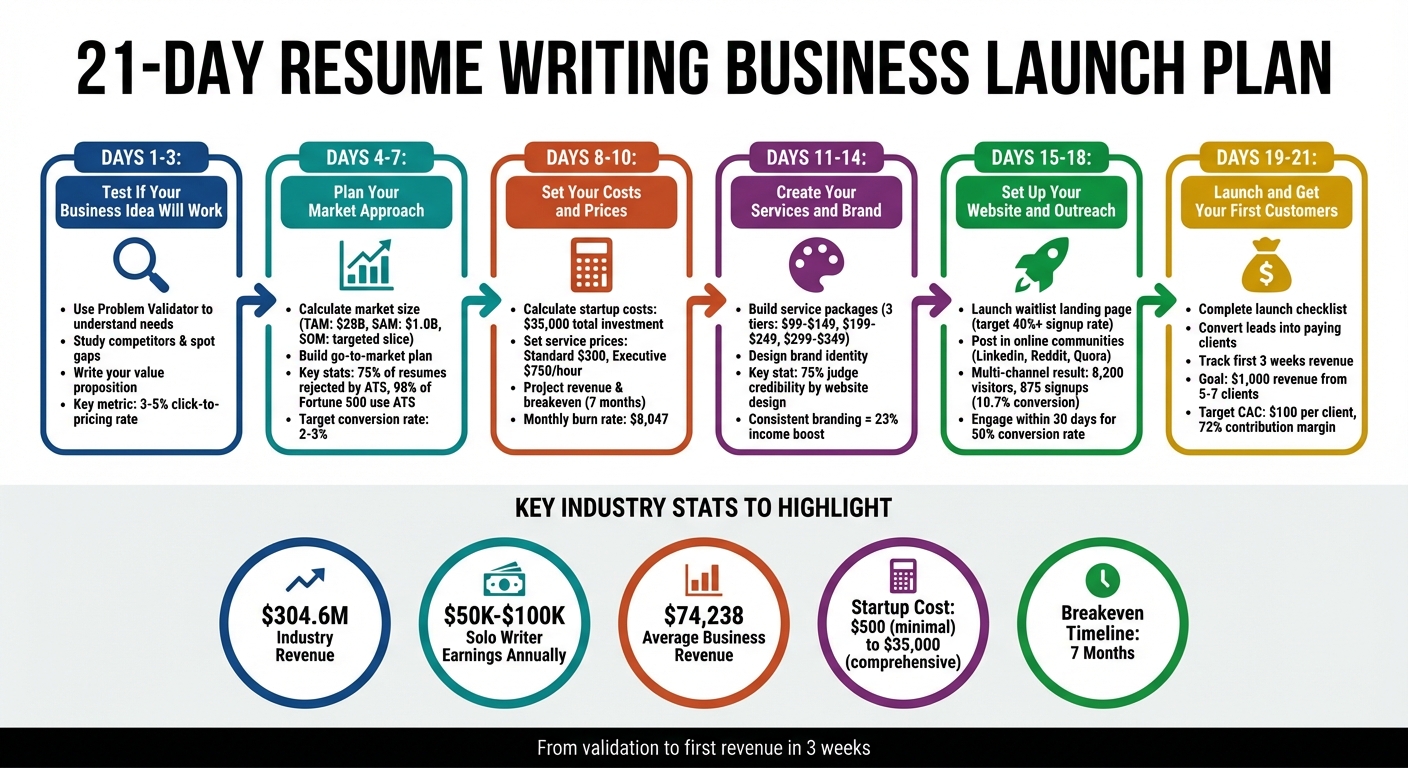
21-Day Resume Writing Business Launch Plan Timeline
How I Built a $2k Per Month Resume Writing Side Hustle
sbb-itb-08dd11e
Days 1-3: Test If Your Business Idea Will Work
Before diving in, it’s crucial to confirm that job seekers are willing to pay for your resume expertise. And the best way to do that? Use real data instead of relying on guesses. Here’s how to check if your idea holds up.
Use Problem Validator to Understand Customer Needs
Start with IdeaFloat's Problem Validator to confirm if job seekers genuinely need professional resume help. This tool helps you spot early demand signals before you spend money. The goal here is to uncover the exact resume-related issues job seekers are struggling with.
Head to forums like Reddit, LinkedIn, or Facebook and search for posts where people say things like, "I've applied to 50 jobs and heard nothing." These posts reveal the pain points job seekers face - and the language they use to describe them. Later, this language will be gold for crafting your marketing copy. If you notice recurring frustrations, like dealing with Applicant Tracking Systems (ATS), you’ve identified a problem worth solving.
Take it a step further by conducting 10 discovery calls. Ask questions like, "When did you last update your resume, and what happened?" This will help you pinpoint their biggest challenges. Keep in mind that 31% of early-stage founders are still figuring out the core problem they’re solving. If you can’t find at least 10 people willing to talk about their resume struggles, it might be a warning sign.
Once you’ve confirmed there’s demand, the next step is analyzing your competition to find gaps in the market.
Study Competitors and Spot the Gaps
Look at competitors broadly - this includes established resume services, DIY template platforms, and even feedback from online communities. If no competitors come up, expand your search.
Pay special attention to 1-star and 2-star reviews on platforms like Trustpilot or Google Reviews. These reviews often highlight common issues, like slow service or generic templates. If you see these complaints popping up repeatedly, you’ve found an opportunity. Also, take note of competitors’ pricing - what’s their range for budget, mid-tier, and premium services? This can help you identify underserved price points, such as a premium executive option or a more affordable alternative.
To gauge demand further, look at job postings for roles like "In-house Recruiter" or "Career Consultant." This can give you an idea of what companies are willing to pay for similar skills. Check Google Trends, too, to see if interest in resume services is steady, growing, or declining.
These insights will help you create a strong value proposition that sets you apart.
Write Your Value Proposition
A clear value proposition makes all the difference. Use this formula to craft yours: "Unlike [Competitor X], which [weakness], we [differentiator] for [specific audience] who need [specific outcome]".
For example: "Unlike generic resume mills, we craft achievement-driven career stories for mid-career professionals aiming for interview callbacks within 60 days." This statement is effective because it targets a specific group, highlights a unique approach, and promises a clear result. Guarantees like this can justify charging premium prices.
"Price is the fastest path to real signal. I use Buy buttons, paywalls or concierge quotes to learn willingness to pay and positioning in one move." – Alex Robb, Founder, Launching Next
Test your value proposition by setting up a simple landing page with pricing tiers - such as a Basic Resume for $199, a Premium Package for $499, and an Executive Package for $999. Share it in online communities and track how many visitors click through to the pricing section. A good benchmark is a 3% to 5% click-to-pricing rate from qualified traffic. If your numbers are lower, revisit your discovery calls and refine your messaging.
These initial steps will give you a solid foundation to plan your next moves in the following days.
Days 4-7: Plan Your Market Approach
Now that you've validated demand, it's time to dive deeper. You need to figure out exactly how many people need your services and how to reach them. This is the moment where you shift from "This might work" to "Here’s my audience and my plan to connect with them."
Calculate Your Market Size
With demand checked off, the next step is to quantify your market. This will help confirm whether your business idea can scale. IdeaFloat’s Smart Market Sizing tool can help you calculate three key metrics: TAM (Total Addressable Market), SAM (Serviceable Addressable Market), and SOM (Serviceable Obtainable Market). These numbers are not just for you - they’re essential if you plan to pitch to investors or secure funding.
Here’s how the resume writing market looks in the U.S.:
- TAM: Includes the broader career services industry, which is valued at $28 billion. This also covers adjacent markets like career coaching ($270 million), interview preparation ($200 million), and cover letter tools ($80 million).
- SAM: The U.S. resume writing service market alone was valued at $1.0 billion in 2024 and is projected to grow to $1.7 billion by 2033, with a CAGR of 7.0% starting in 2026.
- SOM: This is the portion of the market you can realistically capture. For example, if you focus on mid-career tech professionals, your SOM will be a smaller, more targeted slice of the SAM - but it will also be easier to reach.
Why is this important? Because the U.S. job market is massive - 70 million job seekers annually - and 75% of resumes are rejected by Applicant Tracking Systems (ATS) before a human even sees them. With 98% of Fortune 500 companies using ATS, offering ATS-optimized resumes could address a major pain point for millions.
To refine your market further, segment by experience level (entry, mid-career, executive), industry (tech, healthcare, federal), and service complexity (basic rewrites vs. full career branding). This segmentation helps you set realistic revenue goals. For context, the average annual revenue for a resume writing business in the U.S. is $74,238, and there are 4,103 such businesses nationwide. The market is active but fragmented, leaving plenty of room for you to carve out a niche.
Armed with these insights, you’re ready to plan your market approach.
Build Your Go-to-Market Plan
With clear market data in hand, the next step is crafting a strategy to connect with job seekers and turn them into paying clients. Your go-to-market plan should focus on visibility through social platforms rather than cold outreach. LinkedIn, in particular, is a goldmine. It’s become a hybrid of self-help, job fairs, and professional networking, making it the ideal place to find clients.
Start by sharing actionable resume tips like, “Recruiters spend only 6 seconds on an initial resume review - here’s how to make yours stand out”. Engage authentically with job seekers, especially those facing layoffs or career frustrations. Avoid hard sales tactics - people respond better to genuine interactions.
Other platforms like Reddit and Quora are also worth exploring. On Quora, answer specific, high-intent questions such as, “How do I explain a career gap on my resume?” or “What’s the best way to write a resume for remote jobs?” These answers can drive traffic back to your service without coming across as spammy. On Reddit, look for posts in subreddits like r/resumes or r/careerguidance, where people are actively seeking advice. Use the language you uncovered earlier to resonate with their concerns.
Example outreach message:
"I saw your post about struggling with [specific pain point]. I’ve helped [specific niche] secure interviews in under 60 days by [specific differentiator]. If you’re interested, I’d be happy to share a quick checklist on [specific topic]."
If you’re considering paid ads, keep an eye on your CAC (Customer Acquisition Cost). Here’s a breakdown of typical costs:
- Facebook/Instagram Ads: $10 to $25 per lead
- Google Ads: $15 to $40 per lead
- LinkedIn Ads: $40 to $80 per lead
While LinkedIn has the highest CAC, it also attracts higher-intent clients who are more likely to pay premium prices.
Finally, create a lead magnet to capture emails. Offer something immediately useful, like a checklist of “Top 10 Resume Mistakes to Avoid” or “10 Resume Phrases Hiring Managers Are Sick Of”. This helps you build an email list, giving you a warm audience to market to when you officially launch your services. Aim for a 2% to 3% conversion rate from qualified traffic. If your numbers fall short, revisit your messaging to ensure it directly addresses the pain points you identified earlier.
Days 8-10: Set Your Costs and Prices
Now that you've laid the groundwork with market validation and planning, it's time to focus on the financial aspects that will keep your business afloat. By carefully calculating your costs and pricing your services strategically, you can ensure a profitable business model.
Calculate Your Startup Costs
Start by identifying how much capital you'll need to get your business off the ground. For example, launching a resume writing service typically requires an initial investment of about $35,000. Tools like IdeaFloat's Cost Analysis can help you break these expenses into categories:
- Website development: $15,000
- CRM and payment setup: $8,000
- SEO and initial content: $4,000
- Branding and visuals (logo, templates, etc.): $3,000
- Remote office setup (computer, internet, etc.): $2,500
- Software licenses (writing and design tools): $1,500
- Legal entity setup: $1,000
In addition to startup costs, you'll need working capital to cover at least six months of operating expenses. With a monthly burn rate of $8,047, this means setting aside approximately $48,282 to sustain operations while you build your client base.
Once you've accounted for these costs, the next priority is setting prices that not only cover expenses but also generate a profit.
Set Your Service Prices
Pricing your services correctly is crucial. Using tools like IdeaFloat's Advanced Pricing Research, you can establish a pricing structure that reflects both market demand and the value you offer. Research shows that service providers who base their pricing on data rather than guesswork tend to charge 20% to 40% more, avoiding the common pitfall of underpricing.
Here’s how you might structure your pricing:
- Standard resume package: $300 (based on a rate of $75/hour for four hours of work).
- Executive-level services: $750/hour for a 40-hour commitment.
- Add-ons: A standalone cover letter might cost $199, but when bundled with a resume, you could offer it for $125.
Using techniques like "charm pricing" (e.g., $297 instead of $300) for services under $500 can make prices more appealing. For premium services over $1,000, round numbers can signal high quality.
"Price your service business for the value you deliver, not your comfort level." - Kateryna Quinn, Forbes Next 1000
Don’t forget to factor in your own salary. If you’re not paying yourself, your business isn’t truly profitable. Also, account for self-employment taxes, which might take 25% to 35% of your profits. Reassess your pricing every quarter to reflect changes in your expertise and costs.
Project Your Revenue and Breakeven Point
Once your pricing is set, project your revenue to determine how long it will take to break even. For a resume writing service, breakeven is often achieved within seven months. To cover a monthly burn rate of $8,047, you’ll need to sell about 15 to 20 packages per month.
Using an average order value of $357 (including upsells like cover letters and LinkedIn profile optimizations), you can create a month-by-month revenue projection. In your first year, you might aim for an EBITDA of $24,000, with growth potential reaching over $3.8 million by Year 5 as you scale.
Early on, expect variable costs to be high. For example, digital marketing might consume up to 70% of your revenue, and outsourced writer fees could take up 160%. Over time, focus on improving efficiency - reduce digital marketing costs to 30% and writer fees to 120%. Additionally, implementing quality controls can minimize free rewrites and increase upsell rates. For instance, boosting the percentage of clients who purchase cover letters from 30% to 60% could increase total revenue by 15%.
Keep a close eye on your Customer Acquisition Cost (CAC). If your initial CAC is around $100, work to lower it to $80 by refining your targeting and encouraging word-of-mouth referrals. Once your unit economics are positive - earning more per client than it costs to acquire and serve them - you’ll be ready to scale your business efficiently.
Days 11-14: Create Your Services and Brand
Now that you’ve nailed down your pricing, it’s time to package your services and develop a professional brand identity. These steps help transform your pricing strategy into clear, appealing service options and a polished brand that resonates with your target audience.
Build Your Service Packages
Organize your offerings into three distinct tiers: Good, Better, Best. This structure caters to entry-level, mid-career, and executive clients, making it easier to meet their specific needs [5, 34]. Here’s how you can design your packages:
- Starter Pack ($99–$149): Perfect for recent graduates or entry-level professionals. Includes a resume rewrite, one round of revisions, and editable files in both PDF and Word formats.
- Pro Pack ($199–$249): Tailored for mid-career professionals looking for promotions or career shifts. Features a resume rewrite, cover letter, LinkedIn bio revamp, and two rounds of revisions.
- Premium Pack ($299–$349): Designed for executives and senior leaders. Includes everything in the Pro Pack, plus a one-on-one Zoom coaching session and a custom job-hunting checklist.
Focus on creating packages with clear deliverables that solve problems rather than offering standalone documents. You can also add optional upsells like mock interviews, ATS optimization reports, or industry-specific guides to further enhance your services.
"A resume is just personal branding. It's not about what someone's done, it's about how they make someone feel." - Sawaram Suthar, Founder
Tailor your messaging and services to niche markets. For instance, tech professionals might need different positioning than nonprofit workers or stay-at-home parents reentering the workforce. To streamline your process, create intake forms that ask about job level, career goals, and budget. This helps qualify leads and minimizes the risk of ghosting.
Design Your Brand Identity
Your brand identity should immediately convey professionalism and trust. Research shows that 75% of users judge a business’s credibility based on its website design, and 81% of consumers need to trust a brand before making a purchase. You don’t need to break the bank - AI-powered tools can help you create a complete visual identity quickly and affordably.
Use platforms like Looka, Canva, or IdeaFloat’s logo generator to design four essential logo variations:
- A primary logo for your website header
- A secondary logo for alternative layouts
- A simplified submark for social media avatars
- A 32x32 pixel favicon for browser tabs [35, 36]
Stick to a clean, professional look by limiting your color palette to five or six colors - one primary, one secondary, and a few neutrals. Generate a consistent HEX-coded palette to ensure uniformity across all platforms [35, 40].
Before finalizing your logo, test its readability at smaller sizes and check its uniqueness using reverse image searches or the USPTO database. Save high-resolution logo files in multiple formats: SVG for scalability, PNG for web use, and PDF for documents [37, 39].
Beyond visuals, establish a brand voice that feels approachable and supportive. Career services should sound warm and encouraging, helping clients feel confident rather than judged. Write a brief brand story that explains your mission, the problem you solve (e.g., helping moms return to work), and what sets your approach apart [35, 9]. Pair this with a concise tagline, such as “Reliable service. Real people. Zero stress”.
For added professionalism, design business cards with one side featuring your logo and the other including a QR code that links to your booking calendar. Use Canva’s "Magic Design" and "Magic Resize" tools to create social media graphics and resize them for platforms like Instagram, Facebook, and LinkedIn. Consistency is key - applying your brand kit (colors, fonts, logos) across all touchpoints, from email signatures to invoices, can boost your income by up to 23%. A unified brand not only strengthens your credibility but also helps convert the leads you’ve been working hard to attract.
Days 15-18: Set Up Your Website and Outreach
With your brand polished and service packages ready, it’s time to establish your online presence and connect with potential clients. Over the next four days, focus on creating a high-converting landing page and engaging in online communities to drive traffic.
Launch Your Waitlist Landing Page
Your landing page should be designed to turn visitors into subscribers. Start with a headline that addresses a key pain point, like "Getting filtered out by ATS? Let's fix that." Follow it with a brief explanation of what you’re offering and a clear call-to-action button, such as "Join the Waitlist" or "Get Early Access".
Keep your email opt-in form simple - ask for just an email address. Additional fields can hurt your conversion rate. Landing pages that minimize friction can achieve signup rates of 40% or higher. To entice signups, offer a valuable lead magnet, such as an ATS-friendly resume template, a "30-Minute Resume Makeover" worksheet, or a LinkedIn headline swipe file. These freebies solve immediate problems while positioning you as an expert.
Incorporate psychological triggers to boost signups. For example, add a live signup counter or mention limited pilot availability to create urgency. Real urgency can increase conversions by up to 300%. A referral system that rewards both the referrer and the new subscriber is another effective way to grow your list.
"A waitlist is a relationship, not a database." - Waitlister.me
Once subscribers join your waitlist, nurture the relationship with a 3-5 email sequence. Use these emails to share your story, provide updates on your services, and offer behind-the-scenes insights. Subscribers added to your waitlist and engaged within 30 days are more likely to convert - up to 50%. However, if you delay beyond 90 days, conversion rates typically drop below 20%. Stay visible and keep providing value to maintain momentum.
With your landing page optimized for signups, shift your focus to driving traffic through online community engagement.
Post in Online Communities
Your waitlist page is the central hub for your outreach efforts. Now, it’s time to bring in visitors by engaging in LinkedIn groups, Reddit forums, and Quora, where job seekers and career changers are actively looking for advice. The key is to provide value first and promote second - particularly on platforms like Reddit. Join relevant subreddits like r/resumes, r/careerguidance, or industry-specific communities (e.g., r/design or r/writing) a few weeks beforehand to build trust and credibility.
On LinkedIn, update your profile headline to directly address job seekers, such as "I help people tell their messy job story with confidence." Use the platform’s "Featured" section to pin your waitlist landing page. Share quick, actionable tips or transformation stories, and comment on posts from people discussing layoffs or job-hunting struggles. Offer genuine advice and include a subtle link to your free resource.
On Reddit and Indie Hackers, position your posts as requests for feedback rather than direct promotions. For instance, you could say, "I built a resume service for designers getting ghosted by ATS - would love your honest feedback on my approach." On Quora, search for questions about resume gaps, career transitions, or standing out with limited experience. Provide thoughtful answers and include a soft link to your lead magnet or waitlist.
A multi-channel approach can yield much better results than relying on a single platform. For example, a coordinated launch across LinkedIn, Product Hunt, Reddit/Indie Hackers, and Twitter/X generated 8,200 visitors and 875 signups, with a conversion rate of 10.7%. LinkedIn alone brought in 180 signups from 1,200 visitors, converting at 15%. Responding to comments within 15-30 minutes can also boost visibility.
"The best pre-launch content follows a simple formula: share what you're learning while building." - Jan van Musscher, Founder
To simplify this process, use tools like IdeaFloat’s Community Launch Map, which identifies relevant online communities and provides pre-written posts tailored to each platform. By day 18, you’ll have an active subscriber list and be well-prepared for your official launch.
Days 19-21: Launch and Get Your First Customers
The final stretch of your 21-day launch plan is all about execution. You've laid the groundwork - your brand is ready, your landing page is live, and you've sparked interest online. Now it's time to turn that interest into revenue. Stay focused, responsive, and track every dollar as you bring your first customers on board.
Complete Your Launch Checklist
Before you announce your launch, double-check everything. Make sure your payment systems are working, email limits are set, and alerts are in place to monitor activity. Test your onboarding process - clients should be able to fill out forms and schedule consultations in less than three minutes.
Get your marketing assets ready ahead of time. This includes 10–15 polished screenshots of your service packages, a 2–3 minute demo video explaining your process, and pre-designed social media templates. If you're using platforms like Product Hunt or Indie Hackers, schedule your posts to go live at 12:01 AM PST to maximize visibility during their 24-hour activity window.
For your email waitlist, send out a "We're Live" announcement between 9–11 AM in your primary time zone. Include a direct signup link and offer a limited-time early-bird discount (e.g., $50 off your Pro Package). This creates urgency and can result in 10–25% of your email list converting on launch day. During the first week, respond to every social mention and support email within four hours - this quick engagement can turn casual visitors into loyal customers.
"The most common mistake? Building for 6+ months before getting any customer feedback. Don't do this." – Startup Listing
With everything in place, you're ready to turn leads into paying clients.
Convert Leads into Paying Clients
Focus on leads who take action, like booking a consultation or making a payment. These are the people most likely to convert. Reach out personally to your 50–100 most relevant contacts. Use tools like Google Calendar, Calendly, or TidyCal to make booking consultations seamless.
For example, if someone comments on your post about struggling with applicant tracking systems, send a direct message like:
"I saw your comment about challenges with applicant tracking systems. I just launched a service tailored to this - would you be open to a quick 15-minute call to see if I can help?"
Use a detailed intake form (Google Forms works well) to gather information from potential clients. Ask questions like "What job level are you targeting?" and "Why do you want to work with me?" Adding a "Why work with me?" question can reduce client ghosting, as noted by Sawaram Suthar:
"The minute I added a 'Why do you want to work with me?' question [to the intake form], I stopped getting ghosted." – Sawaram Suthar, Co-founder, The Next Scoop
To make a strong impression on your first clients, go the extra mile. Offer small bonuses, like improving their LinkedIn headline for free or providing a tailored job search checklist. These thoughtful touches can lead to word-of-mouth referrals that help your business grow.
Track Your First 3 Weeks of Revenue
By day 21, aim for $1,000 in revenue from 5–7 clients. If your Starter Package is priced between $99 and $149, you’ll need about seven sales. For a Pro Package priced between $199 and $249, four or five clients will get you to your goal.
Keep track of every transaction using Stripe or PayPal to ensure accurate financial records. Pay close attention to your Customer Acquisition Cost (CAC) - aim for around $100 per client during this phase - and your contribution margin, which should ideally hit 72% after variable costs.
Use a simple spreadsheet to log key metrics like email signups, consultation bookings, conversion rates, and revenue by package tier. If onboarding or delivering your service takes longer than 14 days, you risk losing clients to churn. To stay on top of things, set aside time for a "Friday Review Day" to evaluate your progress, tackle any issues, and plan for the week ahead.
"Your first sale is the hardest. Once you get one, you know your process works." – Jack Nicholaisen, Founder, Businessinitiative.org
Finally, capture every positive comment, testimonial, or social mention as they come in. Add them to your homepage or follow-up emails. These early wins act as social proof, making it easier to convert future leads into paying customers.
Conclusion: What You've Accomplished and What's Next
After completing this 21-day plan, you’ve built a functioning, revenue-generating resume writing business. You’ve validated your service model by gathering feedback from at least 10–15 potential clients, set up payment systems and client agreements, launched a professional landing page, and closed your first sales. These achievements demonstrate that your business is on solid ground. As Sean O'Connor from monday.com says:
"A successful launch doesn't happen by accident. It comes from a clear, shared plan that helps every team understand what needs to happen, when it needs to happen, and how their work contributes to the final release".
Now, it’s time to refine and optimize. Use the data from your first three weeks of revenue to figure out which service tiers are performing best and identify the types of clients you enjoy working with most. If your Customer Acquisition Cost (CAC) is around $100, aim to lower it to $80 by leveraging organic LinkedIn engagement and referrals. Keep an eye on your upsell attach rates - for example, increasing cover letter adoption from 30% to 60% could double your Average Order Value without needing to onboard more clients.
To scale, start transitioning from single resume rewrites to bundled packages that include LinkedIn optimization and strategy sessions. Consider hiring a virtual assistant or subcontractor to handle routine tasks, freeing up your time for high-impact client work. As Laura DeCarlo, founder of Career Directors International, points out:
"You can never build a six-figure business as a solo entrepreneur unless you have packages. It's just way too hard!".
With scaling strategies in place, shift your focus to improving financial performance and gathering client testimonials. Most resume writing businesses reach breakeven within seven months. To ensure you’re on track, aim to maintain a contribution margin of around 72% and prioritize collecting ROI-driven testimonials from clients who secure interviews or job offers.
You’ve laid a strong foundation, and the toughest part is behind you. Now, use every piece of feedback to fine-tune your services and build momentum for long-term success.
FAQs
What niche should I pick first?
Focusing on a specific client segment - like tech professionals, recent graduates, or career changers - can give your business a sharper edge. Specializing helps you fine-tune your services, craft more effective marketing strategies, and even position yourself to command higher rates. Take time to study competitors in your chosen niche to spot any gaps you can fill or ways to improve what you offer. This targeted approach not only makes your services stand out but also boosts your chances of success.
How do I get my first clients without ads?
Getting your first clients doesn’t have to involve spending money on ads. Instead, focus on cost-effective strategies that build your credibility and connections. Here’s how:
- Build an Online Presence: Use platforms like LinkedIn to highlight your skills and share valuable insights. This not only demonstrates your expertise but also makes you more discoverable to potential clients.
- Leverage AI Tools: AI tools can help you identify and connect with people who might need your services. They can also streamline tasks like outreach and content creation, saving you time.
- Engage Locally: Offer free consultations or share helpful content within your community. Hosting workshops or participating in local events can also establish you as a go-to expert in your area.
By focusing on strong relationships and delivering excellent service, you create a foundation for referrals and repeat business. This approach allows your client base to grow naturally over time.
What should I do if my landing page doesn’t convert?
If your landing page isn’t turning visitors into customers, it’s time to take a closer look at its messaging, layout, and call-to-action (CTA). Start by ensuring your message aligns with what your audience truly needs. Does it solve their problems or address their concerns? If not, tweak it to make your value proposition crystal clear and relatable.
Use tools for real-time tracking and analysis to pinpoint where users might be dropping off. These insights can guide you in making precise, data-backed changes. Experiment with different layouts or CTAs to see what resonates most.
Don’t forget the power of testing. Run A/B tests on various elements, such as headlines, button colors, or even the tone of your copy. Dive into user behavior data and feedback to fine-tune your approach. This cycle of testing and refining is key to turning more visitors into loyal customers.
Related Blog Posts
- Profitable Business Ideas You Can Start This Weekend
- Zero to $10k: First Month Business Strategy
- The 5-Day Business Validation Challenge That Actually Works
- From Service to Productized Service in 30 Days (Playbook)