Starting a mobile car detailing business is a great way to offer professional cleaning services directly to customers without the overhead of a physical location. Here’s what you need to know to get started:
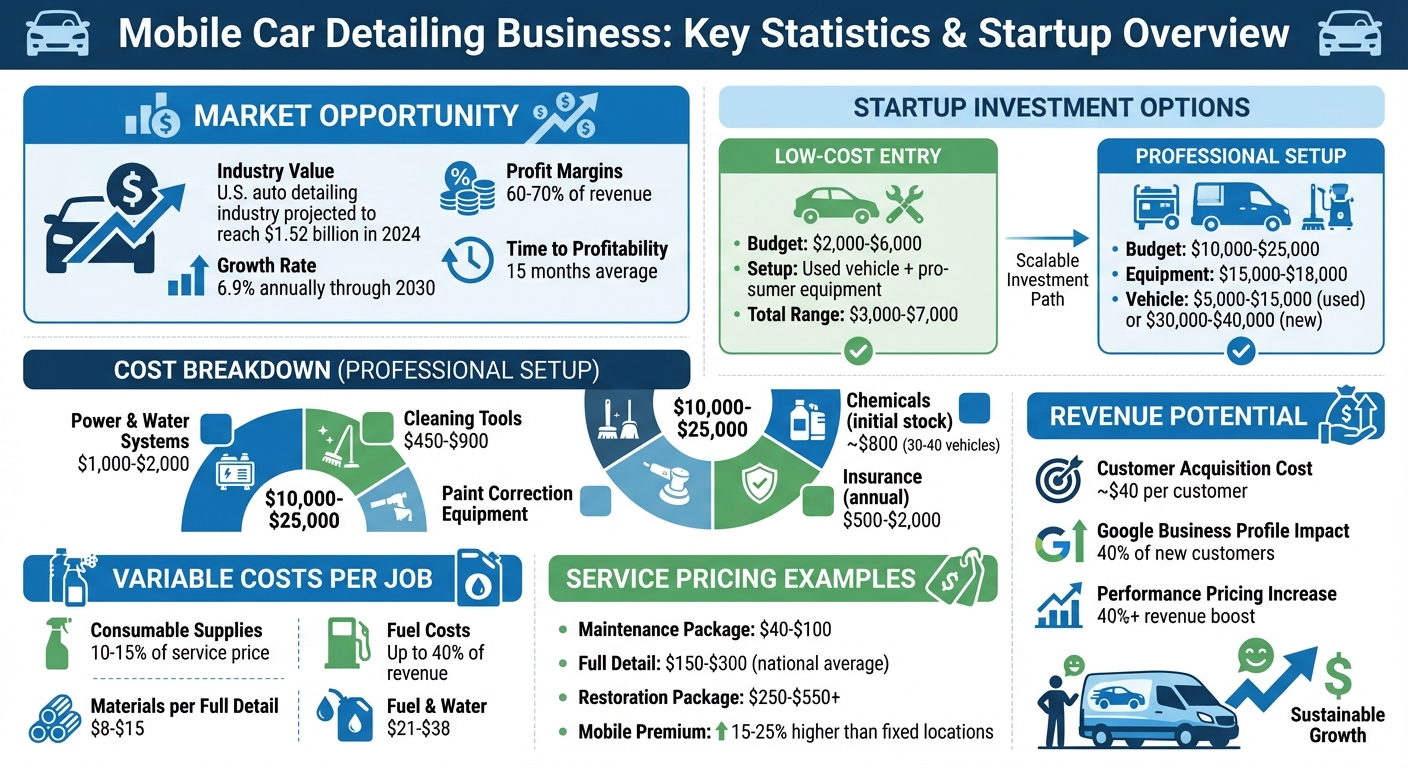
- Low Startup Costs: Start small with $2,000–$6,000, or scale up with $10,000–$25,000 for a more professional setup.
- High Profit Margins: Mobile detailers often keep 60–70% of their revenue as profit.
- Growing Market: The U.S. auto detailing industry is projected to grow at 6.9% annually through 2030, making this a promising business opportunity.
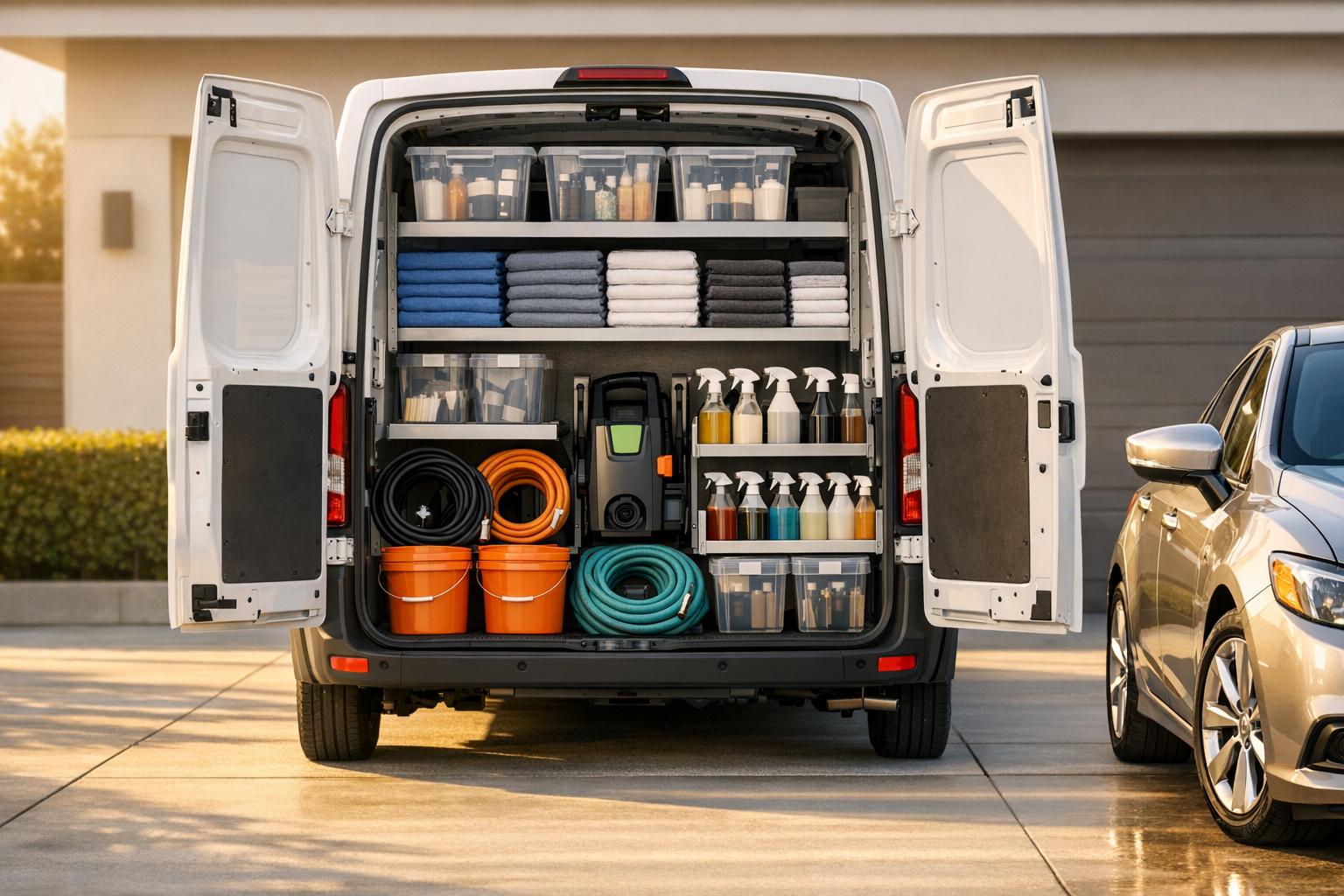
- Basic Equipment: Invest in a water tank, generator, pressure washer, wet/dry vacuum, microfiber towels, and cleaning chemicals. A used van or even a sedan can work as your service vehicle.
- Pricing Strategy: Base prices on labor, materials, and overhead. Offer tiered packages (e.g., Maintenance, Full Detail, Restoration) and add-ons like pet hair removal or headlight restoration.
- Marketing: Optimize your Google Business Profile, build a simple website, and use social media to showcase before-and-after results. Partner with local businesses for group services and offer referral discounts.
Mobile Car Detailing Business Startup Costs and Profit Breakdown
How to Start a Mobile Car Detailing Business with ONLY $600 in 2025 (Step-by-Step)
sbb-itb-08dd11e
Step 1: Calculate Your Startup Costs and Budget
Figuring out how much money you need to launch and sustain your mobile detailing business is a crucial first step. You can start small with an investment as low as $2,000 or go for a more professional setup that could cost over $142,000. The size of your budget depends on whether you're starting solo with a used van or planning a multi-vehicle operation.
Fixed Costs vs. Variable Costs
Fixed costs are the expenses that stay the same regardless of how many cars you detail. These include one-time purchases like your service vehicle, which could range from $5,000–$15,000 for a used van or $30,000–$40,000 for a new one. Professional detailing equipment is another big-ticket item, with pressure washers costing $300–$800 and wet/dry vacuums priced between $100–$400. You'll also need to account for recurring expenses, such as annual insurance premiums ($500–$2,000) and software subscriptions. If you're going for a professional setup, expect to spend $15,000 to $18,000 on equipment alone.
Variable costs, on the other hand, change based on how many cars you service. These include expenses like cleaning chemicals, microfiber towels, and fuel. Consumable supplies typically make up 10–15% of your service price, while fuel costs can take up as much as 40% of your revenue. Keeping a close eye on these monthly expenses is important as they will grow with your service volume.
To refine your budget and forecast cash flow, you can use tools like IdeaFloat.
Calculate Startup Costs with IdeaFloat
Planning your budget accurately can help you avoid cash flow problems. IdeaFloat's Cost Analysis tool is designed to help you categorize all your expenses, from initial equipment purchases to ongoing fuel costs. It separates one-time startup costs (CAPEX) from recurring operating expenses (OPEX), giving you a clear view of your monthly spending. This breakdown helps align your budget with your business goals, setting you up for a solid start.
Most mobile detailing businesses reach profitability in about 15 months. To get through the initial phase, you’ll need enough working capital to cover early losses. IdeaFloat’s Financial Projections feature can calculate how long it will take to break even and help you figure out the right amount of working capital to keep your business afloat during this period.
Step 2: Select Your Tools and Equipment
Once you've set your budget, it's time to choose the gear you'll need for your mobile detailing business. Start with the basics: a reliable water source, power source, pressure washer, vacuum, microfiber towels, and specialized cleaning chemicals. While vans like the Ford Transit or Mercedes Sprinter are popular for their spaciousness, you can get started with something as simple as a pickup truck with a camper shell or even a sedan.
If you're operating independently, you'll need a 50–100 gallon water tank and a portable generator (3,500–4,000 watts). A 100-gallon tank, which weighs about 1,000 pounds when full, can handle up to 10 cars before needing a refill. To deliver water effectively, you'll also need a pump with at least 40 PSI, which typically costs between $400 and $800.
"Your first few customers won't care if you have the fanciest gear - they care about results." - Oleksandr Bratkov, Founder, Fresh Layer Mobile Detailing
When picking your tools, focus on quality rather than cutting corners. High-quality microfiber towels and professional-grade equipment help prevent damage to vehicles and save you money in the long run by avoiding frequent replacements of cheaper tools. For example, color-coding your towels - using black for wheels and blue for glass - helps avoid cross-contamination. A 6 HP shop-grade wet/dry vacuum from brands like Ridgid or DeWalt is another must-have. Household vacuums simply don't have the suction power or the right attachments to clean tight car interiors.
Required Equipment for Mobile Detailing
Let’s break down the key components of your toolkit. You’ll need power and water systems, cleaning tools, paint correction equipment, and chemicals. Here's a rough cost breakdown:
- Power and water systems: $1,000–$2,000
- Cleaning tools: $450–$900
- Paint correction equipment: $150–$400
Electric pressure washers (1,500–2,000 PSI) are a great choice for mobile detailing. They're quieter and easier to maintain than gas-powered models. For paint correction, you'll need a dual-action polisher and buffing pads. Supplies like microfiber towels (50+), brushes, and wash mitts will run you $300–$500. To stock up on chemicals - soap, all-purpose cleaners, degreasers, glass cleaners, and wax - expect to spend around $800. This initial stock should be enough for 30–40 vehicles.
Before taking on paying clients, practice your techniques - like the two-bucket wash method or dual-action polishing - on your own car or a friend's vehicle. This helps you build confidence and consistency.
Low-Cost vs. Premium Equipment Options
Once you know what you need, weigh the pros and cons of budget-friendly versus premium equipment. The main differences come down to durability, power, and how long the gear will last. For instance, Oleksandr Bratkov, founder of Fresh Layer Mobile Detailing, started his business in October 2025 with about $6,000 in equipment and a used Ford E-250 cargo van purchased for $8,000. By choosing reliable, used gear, he grew his operation into a consistent 5-star business without overspending upfront.
Investing in quality equipment pays off. Cheaper tools might save you money in the short term but could end up costing more in repairs and replacements. For a lean startup, you can use your personal vehicle and pro-sumer equipment for around $3,000–$7,000. If you're aiming for a more robust setup with a dedicated cargo van and commercial-grade tools, expect to spend $10,000–$25,000. Opting for a used cargo van with around 80,000 miles can save you roughly $20,000 compared to buying new.
For chemicals, start with mid-range brands like Meguiar's or Chemical Guys. Once your client base grows, you can transition to buying in bulk or investing in premium specialist brands. As for generators, the Honda EU3200i is often called the "gold standard" for being quiet and dependable, though budget brands like Champion are available if you're just starting out.
To keep your operation running smoothly, set aside 1%–2% of your revenue from each job in a separate account for tool repairs and replacements. Every hour spent fixing broken equipment is an hour you could be working for a client.
With your tools ready, you're now set to figure out pricing and prepare for a successful launch.
Step 3: Set Your Service Prices
Now that you’ve invested in quality tools, it’s time to focus on pricing your services in a way that ensures profitability. The U.S. auto detailing industry is projected to reach $1.52 billion in 2024, growing at 10.3% annually. This growth shows there’s potential for success - but only if your pricing strategy is on point. Your prices need to cover costs, fairly compensate your time, and still feel reasonable to your customers.
A simple formula to use is: (Labor + Materials + Overhead) x Markup. For example, let’s break down the cost of a full detail. Supplies might cost $8–$15, with fuel and water adding another $21–$38. If you’re spending three hours on the job at $40 per hour, that’s $120 in labor. Add $12 for materials and $30 for overhead, then apply a markup of 1.5 to 2.0. This puts the final price between $243 and $324 - right in line with the national average of $150–$300. This approach ensures you’re covering costs while delivering value.
Mobile services often command a 15–25% premium over fixed-location shops because of the added convenience for customers. Busy professionals, for example, are often willing to pay $200 or more to have their car detailed at their office while they work. To fine-tune your pricing, research competitors in your area using platforms like Google Maps, Yelp, and Nextdoor. Adjust based on your neighborhood’s income level - higher-income areas can support higher rates, while working-class areas may require more competitive pricing.
"The detailer charging $99 for full details is working twice as hard for half the money." - Oleksandr Bratkov, Founder, Fresh Layer Mobile Detailing
Avoid locking in a price over the phone. Always inspect the vehicle first and provide a range - such as $150–$200 - before confirming the final price. A car with pet hair and mud will take more time and specialized products than a well-maintained vehicle. Apply surcharges when necessary: 25–50% more for trucks and SUVs, and 15–25% extra for dark-colored vehicles like black or navy, which require more effort to perfect. By setting clear base prices and adding surcharges when appropriate, you can ensure your services remain profitable.
Create Service Packages and Add-Ons
Offering tiered packages can make your pricing more flexible and appealing to a wider range of customers. Consider three tiers: Maintenance, Full Detail, and Restoration.
- Maintenance Package: Includes an exterior wash, wheel cleaning, tire shine, and quick vacuum, priced between $40 and $100.
- Full Detail: Adds deep interior cleaning, shampooing, leather conditioning, and wax, priced between $150 and $300.
- Restoration Package: Includes advanced services like paint correction, clay bar treatment, premium sealants, and engine bay cleaning, with prices ranging from $250 to $550 or more.
Bundling services is another great way to increase your average sale. For instance, instead of charging $100 for interior detailing and $120 for exterior detailing separately, you could offer both for $199. Customers feel like they’re getting a deal, and you boost your earnings per job. Add-ons like pet hair removal ($35–$75), headlight restoration ($50–$100), and engine bay cleaning ($50–$150) are also high-margin options that take little extra time but significantly increase revenue.
Recurring revenue is another opportunity to explore. Offer monthly maintenance plans at a 15% discount to encourage long-term loyalty. For example, a customer paying $85 per month for regular washes is more valuable than one who only books a single annual detail. Switching to performance-based pricing - where rates adjust based on the car’s condition - can also increase your revenue by over 40% without requiring extra work.
Optimize Pricing with IdeaFloat
If you’re unsure about setting competitive rates, IdeaFloat’s Advanced Pricing Research can help. This tool analyzes competitor prices from platforms like Google Maps, Yelp, and Facebook Marketplace, giving you clear insights into what other mobile detailers in your area are charging. You can either let the AI optimize your prices based on market data or manually adjust them using the insights provided.
The platform also helps calculate your true costs, factoring in monthly overhead like fuel, insurance, and software subscriptions, divided by your expected billable hours. This ensures every service you offer is profitable. It even shows how many jobs you need to complete each month to break even and start earning a profit. By understanding both your costs and market position, you can confidently set prices that attract customers while maintaining a healthy profit margin of 60–70% of total revenue.
Step 4: Build Your Marketing and Customer Acquisition Plan
Once you've nailed down your pricing, the next big task is making sure customers can find you. Did you know that an optimized Google Business Profile can bring in about 40% of new customers? That makes it one of the most effective tools in your marketing arsenal. The demand for services is growing rapidly, so the key is to position yourself where potential customers are already searching. A strong online presence sets the stage for your broader marketing efforts.
Start by creating a Google Business Profile that includes accurate service areas, 10–15 high-quality before-and-after photos, and a steady stream of reviews. Make it a habit to respond to every review and post updates weekly to keep your profile active. Pair this with a simple, mobile-friendly website that clearly showcases your services, pricing, and a prominent "Book Now" button. Budget around $20–$40 per month for platforms like Wix or Squarespace, or invest $200–$400 for a basic five-page site. Platforms like Instagram and TikTok are perfect for showing off your work - time-lapse videos of detailing jobs or "before-and-after" transformations build trust. After completing a service, send satisfied customers a direct link to leave a Google review.
Create Your Online Presence
In 2026, having a strong digital storefront is non-negotiable. Start by setting up your Google Business Profile with accurate details, high-quality photos, and an up-to-date service area to improve local search rankings. Offering online booking forms makes scheduling easy for customers. People now expect seamless online booking, transparent pricing, and secure payment options.
Your website should focus on conversions, with five essential pages: Home, Services/Pricing, About, Gallery, and Contact. Make sure it’s mobile-friendly and includes a "Book Now" button on every page. Social media platforms like Instagram and TikTok are ideal for visually showcasing your work. Use time-lapse videos and location-specific keywords like "mobile car detailing [City]" to attract local traffic.
| Online Channel | Primary Purpose | Key Optimization Tip |
|---|---|---|
| Google Business Profile | Local Search Visibility | Upload 10–15 high-quality photos and collect 5-star reviews |
| Business Website | Conversion & Booking | Include a "Book Now" button and clear package pricing |
| Instagram/TikTok | Visual Proof & Trust | Post time-lapse videos of detailed transformations |
| Facebook Groups | Community Engagement | Join neighborhood groups and offer "new neighbor" specials |
| Nextdoor | Hyper-local Referrals | Introduce yourself to nearby residents as a local business owner |
Use Local Marketing Methods
While online marketing is essential, face-to-face strategies can deliver quicker results when you're just starting out. Partnering with apartment complexes and office parks is a smart way to secure multiple jobs in one location. For example, work with property managers to host a "Detailing Day" where you service several vehicles at once. Offer residents a discount (like $10 off) and give management a complimentary detail in exchange for promoting your services through email or flyers.
Office parks are another great opportunity. Collaborate with HR teams to offer group rates and sign-up links for bookings of five or more employees. This not only cuts down on travel and fuel costs but also increases your daily earnings. You can also approach small businesses with fleets of 10–30 vehicles, such as plumbers, HVAC companies, or medical transport services, to set up biweekly maintenance plans. These partnerships provide steady, recurring income and help avoid the unpredictability of one-off jobs. Attending local car shows and community events is another great way to build trust and brand recognition - set up a booth, perform live demos, and connect with potential customers. Finally, implement a referral program offering $20–$25 discounts for referrals, helping you maintain a customer acquisition cost of around $40 per customer.
Plan Your Go-to-Market Strategy with IdeaFloat
Combining local efforts with a well-structured launch plan ensures a stronger market entry. Once your pricing and service quality are in place, focus on connecting with customers. If you’re unsure where to start, IdeaFloat’s Go-to-Market Strategy tool can guide you. It identifies the best channels for your area, calculates acquisition costs, creates launch timelines, and even provides outreach scripts designed to convert.
A 90-day launch plan might look like this:
- Days 1–30: Set up the basics, like your LLC, Google Business Profile, and starter kit.
- Days 31–60: Soft launch with discounted services to collect reviews.
- Days 61–90: Focus on pitching to businesses and fine-tuning your pricing.
IdeaFloat also offers tools like the Community Launch Map, which pinpoints online communities where your customers are active, and even provides pre-written post templates to drive engagement. Their Waitlist Landing Page builder helps you capture emails and generate buzz before your official launch, while the Logo Generator ensures your branding looks professional. Using these resources lets you launch with confidence, knowing your strategy is well thought out and data-backed.
Step 5: Validate Your Idea and Launch
Once you've sorted out your costs, tools, pricing, and marketing strategy, it's time to validate your idea and prepare for launch. Testing demand before making a big investment is critical. While the U.S. car wash and detailing industry is valued at $10 billion, about 20% of new businesses fail in their first year. Testing your business model early can be the key to avoiding that fate. Think of this step as your safety net: it’s your chance to confirm demand, refine your brand, and adjust your approach before officially opening.
Test Your Business Idea Before Opening
Start small with what’s called the $500 test phase. Instead of diving into a full equipment setup, spend just $500 on basic supplies and offer your service to one or two paying customers at a discounted rate of $50–$75. This lets you figure out if you enjoy the work and, more importantly, if people in your area are willing to pay for it. Christine Colling puts it simply:
"The $500 test phase lets you find out which camp you're in [loving the work vs. hating the labor] without risking serious money."
Next, try a beta test with friends and family. Offer to detail two or three cars for free, and in exchange, ask for Google reviews and permission to use before-and-after photos. Be upfront with your request: "Can I detail your car for free in exchange for a Google review?" Josh Belk, owner of Belk Mobile Detailing, underscores the importance of this step:
"Reviews are everything in this business."
To test the waters on a larger scale, consider running a social media contest. Josh Belk’s Mother's Day gift card promotion is a great example. For just $67 in Facebook ads, he generated $2,200 in gift card sales, proving there was strong demand for his services as a gift option. You could try something similar, like a contest offering “a free car wash every month for a year,” to collect email addresses and gauge local interest.
Another useful tool is IdeaFloat's Problem Validator. This tool helps you gather real data about customer needs, pinpoint critical feedback, and decide your next steps. It’s a structured way to confirm you’re solving a problem people care about before committing more time or money.
These steps not only confirm demand but also help you lay the groundwork for building a strong brand.
Design Your Brand Identity
Once you've validated your market, it’s time to create a distinctive brand identity. Start by identifying your niche. Are you catering to luxury car owners, environmentally conscious customers, or corporate fleets? Specializing in a specific market can help you stand out and justify higher pricing. John Smith, a detailing expert with 20 years of experience, explains:
"Specializing in a specific niche, such as high-end vehicles or eco-friendly detailing, can set you apart from competitors and justify premium pricing."
When picking a business name, use the "bar test": can you say it in a noisy bar without needing to repeat or explain it? Avoid names that are too clever or vague, as they might require extra marketing to make sense. Once you’ve nailed down a name, use IdeaFloat's Logo Generator to create a professional logo and branding guidelines. Depending on your budget, you could spend $200 for a logo from a design student or $5,000+ for a full professional branding package. If funds are tight, IdeaFloat’s tools can help you create a polished look without breaking the bank. Their Branding Guide also ensures your messaging stays consistent across all customer interactions.
Build a Waitlist and Create Early Interest
Generate buzz before your official launch by building a waitlist. IdeaFloat's Waitlist Landing Page builder is a great tool for creating a page that collects email addresses while sparking excitement. Aim for 50–100 sign-ups before launch.
Get involved in local online communities like Facebook, Nextdoor, and LinkedIn groups to introduce yourself as a new business owner. Offer a "New Business Launch Discount", such as 25% off for the first 10 customers, to quickly test price sensitivity in your area.
You can also use IdeaFloat's Community Launch Map to identify where your potential customers spend time online. This tool can help you craft posts that engage these communities and drive traffic to your business.
Finally, make sure your Google Business Profile is fully optimized with photos and reviews from your beta tests. Upload 10–15 high-quality pictures and aim for at least 10–15 reviews to boost your visibility in search results. Oleksandr Bratkov, owner of Fresh Layer Mobile Detailing, shares his experience:
"I did 10 free details before charging full price. Those reviews launched my business."
Conclusion and Next Steps
Starting a mobile car detailing business isn’t about having the most expensive tools or being a technical wizard - it’s about smart planning, fair pricing, and building systems that can grow with you. With the U.S. auto detailing industry projected to hit $20.2 billion by 2025 and on-demand services like mobile detailing growing at 6.9% annually through 2030, there’s plenty of opportunity for success if you execute well.
First, focus on establishing your legal and operational foundation. Register as an LLC to protect your personal assets, open a business bank account, and secure both General Liability and Garage Keepers insurance. Invest in essential equipment like a reliable vehicle, a 50–100 gallon water tank, and a pressure washer with a rating of 1,500–2,000 PSI. Starting costs can range from $3,000 to $6,000, allowing you to begin lean and scale as your business grows.
Next, create a pricing structure that reflects the value you provide. A three-tier model - offering Maintenance, Full Detail, and Premium Restoration packages - can make it easier for customers to choose while creating opportunities for upselling. Always price your services based on the convenience and quality you deliver, not just the time spent.
In today’s digital-first world, a strong online presence is non-negotiable. Optimize your Google Business Profile with high-quality before-and-after photos and encourage reviews from your earliest clients. Offering an introductory discount in exchange for honest feedback can help you build credibility quickly. Automate booking and payment systems to streamline operations and reduce administrative work by as much as 40%. Tools like IdeaFloat can help you design a professional logo, build a waitlist landing page, and craft a cost-effective go-to-market strategy.
Once your foundation is solid, test your approach with a pilot run. Offer a discounted or free detail to a small group of customers to gather feedback and refine your process before scaling. With the mobile detailing market expected to reach $282.85 billion by 2035, there’s no better time to take the leap. Follow the steps outlined here, leverage IdeaFloat’s tools, and turn your vision into a thriving business.
FAQs
Do I need a van to start mobile detailing?
You don’t need a van to kick off a mobile car detailing business. Plenty of entrepreneurs start with just the essentials and a smaller vehicle, like a compact car, especially if funds are limited. While a van might make it easier to transport more tools and could give off a more professional image, what really matters is aligning your vehicle choice with your budget, the size of your operation, and the needs of your target customers. A van is optional, not mandatory.
How many cars per day do I need to break even?
To figure out your break-even point, start by calculating your monthly expenses (let’s say they range between $500 and $1,000) and your average profit per car, which typically falls between $150 and $200. Based on these figures, you’d need to detail about 5 to 7 cars per week, or roughly 1 to 2 cars per day if you’re working a 5-day week. Keep in mind, your actual results will vary depending on factors like your specific costs, pricing strategy, and overall efficiency.
What insurance do I need for mobile detailing?
Running a mobile detailing business means working closely with clients' vehicles - often high-value ones - which comes with its share of risks. To protect your business and your clients, it's crucial to have the right insurance coverage. Here are the key types to consider:
- General Liability Insurance: This covers accidents, property damage, or injuries that might occur during your operations. For instance, if a client trips over your equipment, this policy can help cover the costs.
- Garage Keepers Liability: If you're temporarily responsible for a client's vehicle, this policy protects against damages like theft, vandalism, or accidents while the car is in your care.
- Commercial Auto Insurance: Since your business relies on transportation, this coverage is essential. It protects your work vehicles in case of accidents or damages during business operations.
- Tools and Equipment Coverage (Inland Marine Insurance): Your detailing tools and equipment are the backbone of your business. This policy ensures they're covered against theft, loss, or damage, even when they're on the move.
Additionally, having tailored auto insurance is critical. It safeguards both your business vehicles and the clients' cars you work on, offering peace of mind for both parties during operations.
Related Blog Posts
- How to Start a Pressure Washing Business With Under $1,000
- How to Start a Mobile Car Detailing Business: Complete Guide
- How to Start a Mobile Car Detailing Business: From $0 to $5K/Month
- Mobile Detailing Startup Costs: Packages, Pricing, Profit