
Not all business ideas are built to grow efficiently. To figure out if your idea is scalable or just keeping you busy, focus on these key areas:
- Market Demand: Is there a real need? Are people already spending money to solve this problem?
- Revenue Potential: Can the market size support your financial goals? Calculate TAM, SAM, and SOM to estimate your opportunity.
- Cost Efficiency: Will your costs grow slower than your revenue? Check your unit economics and breakeven point.
- Growth Strategy: Can you acquire customers affordably and sustain growth without overspending?
The biggest mistakes? Skipping idea validation, ignoring market size, and underestimating costs. Follow a structured process to test your idea with minimal investment and avoid wasting time and money. Tools like landing pages, small ad budgets, and customer interviews can help you gather data quickly.
Bottom line: A scalable business grows revenue faster than costs. If every new customer increases your expenses proportionally, it’s time to rethink your approach.
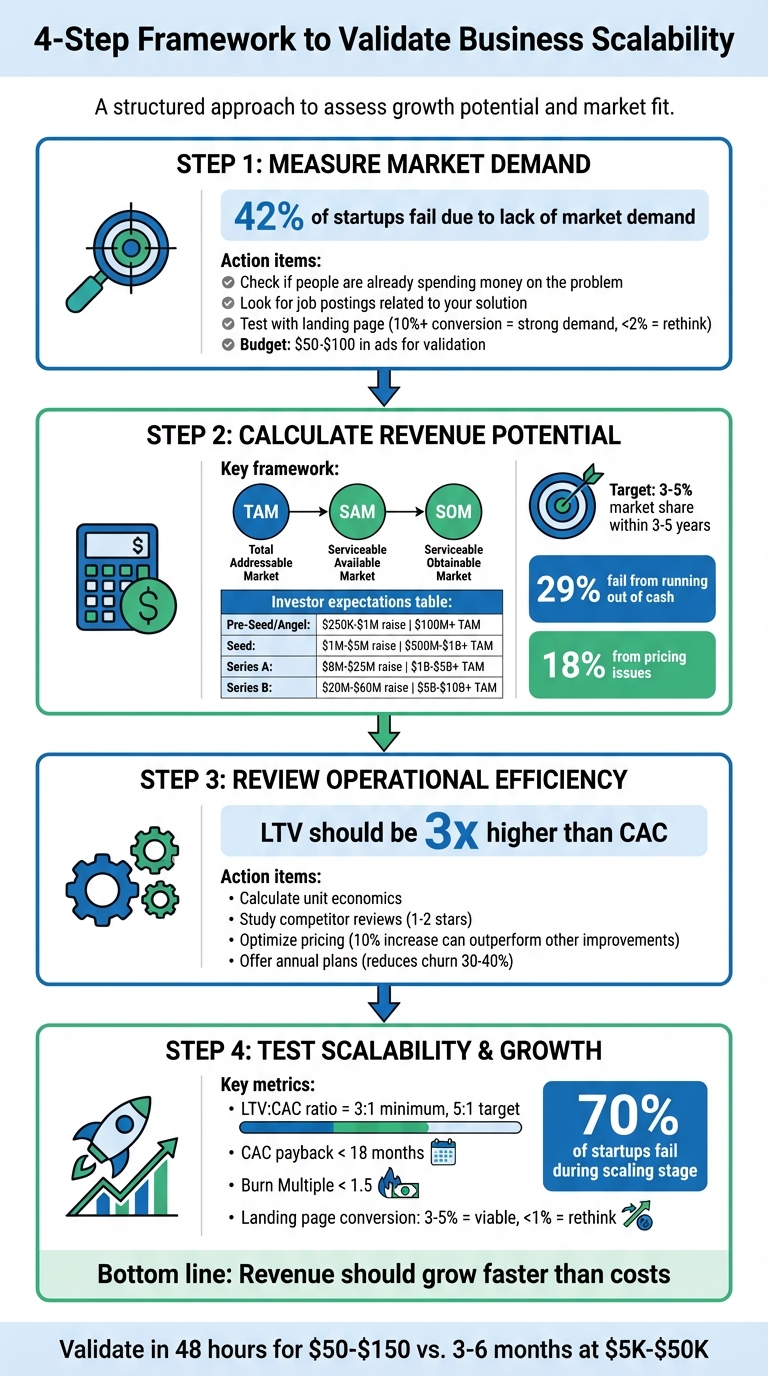
4-Step Framework to Validate Business Scalability
How to Validate Your Startup Idea for $50 (Same Method That Built a $100M Brand)
sbb-itb-08dd11e
Step 1: Measure Market Demand
Before pouring resources into your idea, make sure there's a real market need. Why? Because 42% of startups fail due to a lack of market demand. That means nearly half of these businesses were solving problems that didn’t matter enough to customers.
So, what’s the clearest sign of demand? People are already spending money to address the issue. Whether it’s through tools, hiring consultants, or dedicating employees to handle the problem manually, these are strong indicators of a pain point worth solving. If no one is spending resources, it’s a red flag - the problem might not be pressing enough. For instance, check LinkedIn or Indeed for job postings related to your solution. If companies are willing to pay full-time salaries to manage the issue, there's likely a market for an automated alternative.
Once you’ve identified potential demand, take the next step: confirm it directly with your target audience.
Verify the Problem
To separate real opportunities from fleeting ideas, gauge how urgently people want a solution. When you talk to potential customers, their interest should be immediate. Ideally, they’ll ask when your product will launch or even offer to pay upfront. If responses sound lukewarm - like “that could be useful” or “it’s not a big deal” - the demand is likely weak.
"When talking to potential customers, their eyes should light up. They should be engaged in the conversation and ready to pull out their wallets on the spot to pay for your solution."
– Webb Brown and Ajay Tripathy, Founders, Kubecost
Cold outreach is another way to test the problem’s importance. If strangers are willing to meet and discuss the issue, it’s a good sign the problem matters. Look for evidence of makeshift solutions, like messy spreadsheets, duct-taped tools using Zapier, or time-consuming manual processes. These workarounds highlight gaps that your product could address.
To make this process easier, tools like IdeaFloat’s Problem Validator can help. It walks you through structured workflows to measure urgency and identify weak signals, using live customer feedback instead of guesswork.
Learn Customer Language
The words customers use to describe their frustrations are marketing gold. Browse Reddit threads, Discord channels, and niche forums to see how people talk about the problem in their own words. Scanning 1–3 star reviews on platforms like G2, Capterra, or Amazon can also reveal common complaints and missing features in existing solutions.
When you use the same phrases your customers do, your messaging instantly connects. It shows you understand their problem deeply. IdeaFloat’s Consumer Insights tool can help by analyzing conversations across the web to uncover this language and confirm demand.
Finally, test your idea with a simple landing page. A conversion rate of 10% or higher from cold traffic (like ads) signals strong demand. If it’s under 2%, you may need to rethink your messaging or offer. You can run this test with as little as $50–$100 in targeted ads to gather meaningful data before committing to development.
Once you’ve validated demand, you’re ready to move on to assessing your idea’s revenue potential in the next step.
Step 2: Calculate Revenue Potential
Once you've confirmed there's demand for your product, the next step is figuring out if the opportunity can generate enough revenue to sustain a business. Even if customers love your idea, the market size must support your financial goals. For example, no business can hit $500 million in revenue if the total market caps at $300 million. This step connects market demand with financial feasibility.
Why Market Sizing Matters
Investors want more than just a "good idea" - they need proof the market opportunity is big enough to justify their investment. In fact, venture capitalists prioritize markets first, teams second, and products third. That’s why understanding your Total Addressable Market (TAM), Serviceable Addressable Market (SAM), and Serviceable Obtainable Market (SOM) is so important.
TAM, SAM, and SOM: Breaking It Down
- TAM: Start with the biggest number - the maximum revenue you could generate if you captured 100% of the global market. This represents your business's full potential.
- SAM: Narrow it down to the portion of TAM you can realistically target, based on your product, geography, and business model.
- SOM: Finally, calculate the specific slice of SAM you can realistically capture over the next 3–5 years. This considers factors like competition and your sales capacity.
Two Ways to Size Your Market
There are two main methods to calculate market size:
- Top-down: Use industry data from sources like Gartner or Forrester. For example, if the global market is $6 billion and your region accounts for 40%, your regional TAM would be $2.4 billion.
- Bottom-up: Start with your customer base. Multiply the number of potential customers by your average revenue per customer. Investors often prefer this approach because it shows you understand your pricing and target market.
What Investors Expect
Market size expectations vary by funding stage. Here's a quick look:
| Funding Stage | Typical Raise | Minimum TAM Requirement |
|---|---|---|
| Pre-Seed / Angel | $250K - $1M | $100M+ |
| Seed | $1M - $5M | $500M - $1B+ |
| Series A | $8M - $25M | $1B - $5B+ |
| Series B | $20M - $60M | $5B - $10B+ |
For your SOM, aim for 3–5% market share within 3–5 years. Early on, this might look like 0.1–0.5% in the first two years, scaling up to that 3–5% range by year five. Make sure your SOM aligns with your hiring plan - if you’re projecting $10 million in revenue, you’ll need the sales team to back that up.
Tools like IdeaFloat’s Smart Market Sizing can simplify this process. Instead of spending weeks crunching numbers in Excel, you can generate TAM, SAM, and SOM figures backed by reliable data in minutes.
Assess Profitability and Breakeven
Now that you know the size of your opportunity, it’s time to ask, Can this business make money? This is where profitability and breakeven analysis come into play. Your breakeven point is the sales level where revenue equals expenses - where the business stops losing money.
Breaking Down Costs
Start by categorizing your costs:
- Fixed costs: These are expenses that don’t change with sales volume, like rent, salaries, and insurance.
- Variable costs: These fluctuate with sales, such as materials, packaging, and shipping.
Next, calculate your contribution margin by subtracting the variable cost per unit from the selling price. This shows how much each sale contributes to covering fixed expenses.
Breakeven Calculation
To find your breakeven point in units, divide your total fixed costs by the contribution margin per unit. For example, if your fixed costs are $10,000 per month and each unit contributes $50, you’ll need to sell 200 units to break even. To calculate breakeven in dollars, divide fixed costs by the contribution margin ratio (contribution margin ÷ selling price).
"Achieving break-even is a major milestone for a new business – it signals you've built enough revenue to cover ongoing costs."
– Accion Opportunity Fund
This analysis is critical - 29% of startups fail due to running out of cash, and 18% fail because of pricing or cost issues. A clear breakeven analysis can help you avoid these pitfalls. To stay safe, add a 10% buffer to account for unexpected expenses.
IdeaFloat’s tools, like Financial Projections and Cost Analysis, can automate this process. They offer month-by-month revenue tracking, expense monitoring, and insights into how much capital you’ll need to sustain your business. The platform’s Product & Service Creator even calculates the exact number of units you need to sell to reach profitability.
Once you’ve confirmed profitability, the next step is to focus on improving operational efficiency.
Step 3: Review Operational Efficiency
You've verified demand and crunched the numbers, but now it's time to examine the nuts and bolts of how your business will actually function. This step determines whether your idea can scale efficiently or if it will get bogged down in rising costs and inefficiencies. The focus here is on understanding your cost structure, evaluating competitors, and fine-tuning your pricing strategy.
Calculate Costs
Start by breaking down all your expenses. Separate them into startup costs (like equipment, software, and legal fees) and operational costs (such as subscriptions, materials, and payroll). This categorization helps you understand which expenses are fixed and which will grow as sales increase.
Pay close attention to cost behavior - how your expenses shift as your business scales. Scalable businesses thrive on operating leverage, where fixed costs remain steady even as revenue grows. For instance, a SaaS product might see server costs rise only slightly while revenue increases significantly. On the flip side, if you need to hire a new employee for every new customer, you're creating a high-cost structure that limits scalability.
Another crucial metric is unit economics. Your Customer Lifetime Value (LTV) should be at least three times higher than your Customer Acquisition Cost (CAC). If you're spending $100 to acquire a customer who only generates $150 in revenue, that's a red flag. To scale efficiently, look for ways to automate processes and leverage cloud-based tools, which allow you to grow without a proportional increase in costs.
To simplify this analysis, tools like IdeaFloat's Cost Analysis feature can help you identify both startup and ongoing expenses in one place. Pair it with their Financial Projections tool to get a clear picture of how your costs will evolve as you grow.
Study Competitors
Understanding your competition is key to finding your niche. Start by identifying both direct competitors (those offering the same product or service) and indirect competitors (those solving the same problem in a different way). Then, dig into their weaknesses.
A great way to uncover competitor flaws is by reading their 1-star and 2-star reviews on platforms like G2, Capterra, and Reddit. Look for recurring complaints - maybe their customer support is slow, their pricing is confusing, or their features don't meet expectations. These pain points are your opportunities to stand out. For example, if multiple competitors struggle with onboarding, you could win customers by offering a smoother, more intuitive experience.
Next, compare their pricing models and feature sets. Are they charging per user, per usage, or a flat rate? What do they include in their base plans versus charge extra for? This analysis helps you position your offering more effectively. If competitors charge $50/month for a basic plan, you can either justify a higher price with added value or undercut them with a leaner, more affordable option.
"IdeaFloat saved us weeks of work by helping us explore demand for new products across different regions and took the guesswork out of finding gaps in the market."
– Nick Sherwing, Founder of woohoPets
Tools like IdeaFloat's Competitor Analysis feature can make this process easier. It scans the internet to identify all players in your space, evaluates their strengths and weaknesses, and highlights underserved segments you can target. Knowing where competitors fall short can help you refine your pricing and overall strategy.
Optimize Pricing
Setting the right price is one of the most impactful decisions you’ll make. A small change in pricing - say, a 10% increase - can often have a bigger effect on revenue than improving customer acquisition, retention, or even product quality. Yet many founders either guess their pricing or mimic competitors without testing.
Avoid the trap of cost-plus pricing, where you simply add a markup to your costs. Instead, base your pricing on the value your product delivers. For instance, if your software saves a business $10,000 annually, charging $1,000 per year is an easy sell - even if your costs are only $100.
Experiment with pricing until you find the point where customers start showing resistance - this indicates you're approaching the maximum value they’re willing to pay. Offering annual plans with discounts (e.g., 20% off) can also boost cash flow and reduce churn by as much as 30% to 40%.
IdeaFloat’s Advanced Pricing Research tool can help you nail this process. It uses AI to analyze competitor pricing and customer willingness to pay, applying proven pricing strategies to maximize your profit margins. Their Product & Service Creator even calculates how many units you need to sell each month to reach profitability.
Once you've streamlined your operations and pricing, you're ready to test how scalable your business idea really is.
Step 4: Test Scalability and Growth Potential
You’ve validated demand, crunched the numbers, and fine-tuned your operations. Now it’s time to see if your business can grow without being bogged down by rising costs. This step helps separate ideas with true growth potential from those that may lead to diminishing returns.
Once you’ve confirmed demand and cost efficiency, the next focus is on expanding your customer base effectively.
Plan Go-to-Market Strategy
After validating demand and streamlining operations, the next step is creating a go-to-market (GTM) strategy that brings in customers without overspending. A common mistake here is relying too heavily on performance marketing - pouring funds into platforms like Google or Meta ads. While these channels can work initially, they often lead to higher Customer Acquisition Costs (CAC) as competition grows. Businesses that scale successfully often lean on strategies like Product-Led Growth (PLG), community-driven distribution, or viral loops to bring down acquisition costs over time.
In the first 90 days, aim to show that you can acquire customers at a fraction of their Lifetime Value (LTV). A solid LTV-to-CAC ratio starts at 3:1 and should improve to 5:1 as your business matures. If your CAC payback period stretches beyond 18 months, it’s a sign your business model may not scale in its current form.
Before committing to large-scale investments, run small pilot tests to validate your acquisition channels. For example, create a landing page and spend $50–$150 on ads to measure conversion rates. If your conversion rate is between 3%–5%, your channels are likely viable. However, if it’s below 1%, it’s time to rethink your offer. These small-scale experiments can save you from the costly mistake of launching a product that lacks market demand - a misstep that contributes to the failure of 35% of startups.
"The single most expensive mistake in entrepreneurship is skipping validation. Building a product nobody wants costs time, money, and momentum that you cannot recover." – Digital Applied
Tools like IdeaFloat’s Go-to-Market Strategy tool can help pinpoint customer locations, estimate acquisition costs, and even provide pre-written outreach scripts. Their Community Launch Map goes a step further, identifying key online communities and generating custom posts to drive traffic to your business.
Review Financial Projections
Once your GTM strategy is in place, it’s crucial to revisit your financial projections to ensure your scaling plan is sustainable. Financial projections are the backbone of determining whether your business can achieve long-term growth or if it risks running out of cash before reaching profitability. Keep in mind that scaling isn’t just about adding revenue - it’s about increasing revenue while keeping costs relatively stable.
Pay attention to operating leverage. As your business grows, profit margins should improve because fixed costs like rent and salaries stay the same while sales increase. Monitor your unit economics closely - costs per customer and per transaction should decrease as you scale, not contribute to growing losses.
Also, keep an eye on your Burn Multiple, which measures how much you’re spending for every new dollar of Annual Recurring Revenue. A Burn Multiple above 2.0 is a warning sign, while scalable businesses should aim for a target below 1.5.
When building projections, account for worst-case scenarios, such as delays in market entry or losing a major customer. Nearly 70% of startups fail during the scaling stage, often because they grow inefficiently, and 20% run out of cash before achieving scale. Your financial plan should address questions like: Do you need outside funding? How much should you raise? When will you break even?
For scalability, the market you’re targeting should be worth billions and growing by at least 10% annually. Use a bottom-up approach to calculate your Serviceable Obtainable Market (SOM) - the realistic share you can capture in the first few years. This ensures your Year 1 revenue goals are based on solid data.
IdeaFloat’s Financial Projections & Breakeven Analysis tool offers month-by-month revenue and cost forecasts through interactive graphs. Combined with their Financial Model, you can track income and expenses to get a clear picture of whether your business idea is truly profitable.
Conclusion
Figuring out if an idea can scale means taking a deep dive into market demand, revenue potential, operational efficiency, and customer acquisition strategies. Each step builds on the last, helping you move from relying on instinct to making decisions backed by solid data. Ultimately, the difference between success and failure isn’t about how much you love your idea - it’s about whether the market truly wants it and if you can deliver it profitably.
The stats don’t lie: skipping validation and ignoring market needs are major reasons businesses fail. Tools like IdeaFloat make what once took months achievable in just 15 minutes. Instead of spending $5,000–$50,000 and 3–6 months building in secret, you can validate your idea in 48 hours for just $50–$150. Users repeatedly highlight how these structured tools cut out the guesswork and save them weeks of effort on market research.
By following this process, you shift from relying on hunches to making clear, data-driven decisions. Use frameworks to calculate your market size (TAM/SAM/SOM), identify competitor weaknesses through customer reviews, and test pricing strategies before committing resources. Simple smoke tests, like running ads with small budgets, can reveal real interest. For example, a landing page with a 3–5% conversion rate on a waitlist is a green light to proceed, while anything below 1% might mean it’s time to rethink your approach.
Your idea needs proof - not just optimism. Stick to these steps, leverage data, and use structured tools to ensure you’re building something scalable, not just staying busy. These steps provide a clear path to turn a hopeful concept into a profitable, scalable business.
FAQs
What are the fastest ways to validate demand without building the product?
To quickly confirm if there's a demand for your idea without fully building the product, try these approaches:
- Run "smoke tests": Use ads or simple landing pages to measure interest and see if people engage or sign up.
- Talk to potential customers: Conduct interviews to understand their needs, pain points, and willingness to pay for a solution.
- Leverage AI tools: Analyze market trends and customer behavior using AI-powered platforms to uncover demand patterns.
- Offer pre-sales or early access: See if people are willing to commit financially before the product exists.
These strategies allow you to gather quick, actionable feedback while saving time and resources, ensuring you're not building something no one wants.
How do I estimate TAM, SAM, and SOM if reliable market data is limited?
When reliable market data is hard to come by, you can still estimate TAM (Total Addressable Market), SAM (Serviceable Available Market), and SOM (Serviceable Obtainable Market) using logical assumptions and trusted sources.
Here’s how to break it down:
- TAM: This represents the entire revenue opportunity within your market, assuming no limitations. Think of it as the total potential value of the market if you could capture 100%.
- SAM: Narrow this down to the specific segment you can realistically target based on your product or service's capabilities and market reach.
- SOM: This is the slice of SAM that you can reasonably expect to capture within a short-term timeframe, typically 1 to 3 years.
Approaches to Estimate
- Proxy Data: Use data from similar industries, competitors, or adjacent markets to draw parallels and estimate potential market size.
- Top-Down Approach: Start with a broad market size figure (like industry reports or national statistics), then refine it by applying filters - geography, demographics, or specific use cases.
- Bottom-Up Approach: Build your estimate starting with smaller, specific data points, such as average customer spend and the number of potential customers, then scale up.
Key Tip
Always document your assumptions clearly. Whether you're using industry benchmarks or making logical estimates, transparency about your methodology builds trust and credibility with stakeholders.
What numbers should I watch to know if my model scales (CAC, LTV, payback, burn)?
To figure out if your business model can handle growth, keep an eye on these important metrics:
- CAC (Customer Acquisition Cost): How much it costs to bring in a new customer.
- LTV (Lifetime Value): The total revenue you can expect from a customer during their time with your business.
- Payback Period: The time it takes to earn back what you spent on acquiring a customer.
- Burn Rate: How quickly your business is using up cash.
These numbers help you understand if your business can expand without breaking the bank.
Related Blog Posts
- IdeaFloat: The 15-Minute Business Plan Solution
- I Validated My Business Idea in 24 Hours - Here's The Exact Process
- Idea to Numbers: The 20-Minute Profit Check
- I Have a Business Idea - Now What? 30-Day Roadmap