
Starting a service business? Choose a high-demand, low-competition niche tailored to your city size. Here's the key: success depends on understanding local demand and avoiding oversaturated markets. Whether you're in a small town, medium city, or large urban area, aligning your business idea with local needs can increase your chances of thriving.
Key Takeaways:
- Small Towns (<50,000 residents): Focus on essential, underserved services like pet grooming, lawn care, or handyman work. Residents often drive long distances for these.
- Medium Cities (50,000–500,000 residents): Look for niche services like mobile tire repair, premium men's grooming, or tutoring. These markets balance opportunity with manageable competition.
- Large Cities (>500,000 residents): Specialize to stand out. Ideas include construction cleanup, specialty health food delivery, or event planning for specific industries.
How to Succeed:
- Use local data (Google searches, Yelp listings) to find demand gaps.
- Validate your idea with a simple landing page or small ad campaign.
- Match your skills to market needs and focus on solving specific problems.
Pro Tip: Tools like Google Trends, Ahrefs, and IdeaFloat can help validate demand and refine your business idea before you invest.
Starting small and scaling strategically is the way forward. Let’s dive deeper into ideas and strategies for each city size.
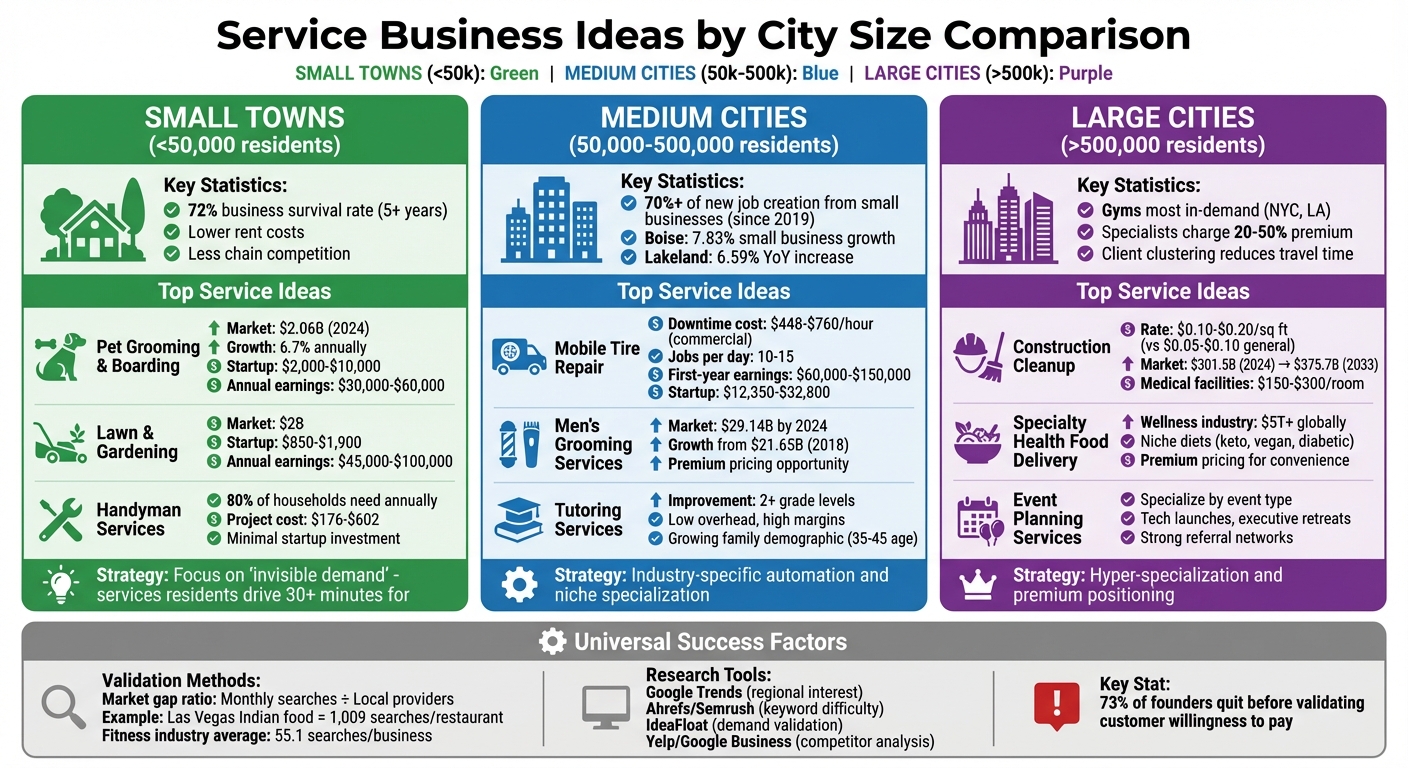
Service Business Ideas by City Size: Demand and Competition Guide
12 Incredibly Simple Service Businesses You Can Start Today
sbb-itb-08dd11e
How to Find High-Demand, Low-Competition Opportunities by City Size
Pinpointing the right service business opportunity means identifying gaps in your local market. This isn’t about guessing - it’s about using data to find where demand outpaces supply. Your approach will depend on whether you’re targeting a small town, a mid-sized city, or a bustling metropolitan area.
Using Local Market Data and Demographics
Start by calculating the market gap ratio. Divide the total monthly Google searches for a service by the number of local providers listed on Yelp or similar directories. For instance, in Las Vegas, Indian food sees 1,009 monthly searches per restaurant - the largest demand-to-supply gap among major U.S. cities. In the fitness industry, there’s an average of 55.1 searches per business across the 50 largest U.S. cities.
In small towns, focus on services residents might drive 30 minutes or more to access - like specialty pet grooming, auto detailing, or niche medical services. For medium and large cities, dive into U.S. Census and Bureau of Labor Statistics data to estimate your potential market. Consider the number of potential customers, the percentage likely to need your service, and the price they’d pay. Also, track new business registrations. For example, Indianapolis saw a 361% increase in business listings in 2025, hinting at a less saturated market.
Using Online Tools for Market Research
Once you’ve reviewed local data, enhance your research with online tools. Google Trends’ "Interest by Region" feature helps pinpoint where demand for specific services is highest, distinguishing small-town needs from big-city trends. Tools like Ahrefs and Semrush let you search for terms such as "[service] in [city]"; when you find low keyword difficulty paired with high local search volume, you’ve likely found an opportunity.
Platforms like SimilarWeb can estimate competitor traffic and show how established businesses attract customers in your area. Check forums like Reddit, Quora, and industry-specific boards for phrases like "frustrated with" or "wish there was" to uncover underserved niches. For instance, the keyword "reputation management medical practice" generates 1,400 monthly searches, revealing a potential gap in professional services.
Before diving in, try a smoke test. Build a simple landing page explaining your service, then run a small paid ad campaign to measure local interest. Another tactic: analyze competitor reviews on platforms like Clutchpilot. Businesses with more than five reviews often see three to five times more inquiries than those with none. Use these findings to shape your offerings.
Matching Services with City-Specific Needs
Once you’ve gathered data, align your services with the unique needs of each city size. In small towns, look for essential services by analyzing local search data and talking to business owners about unmet needs. Facebook Marketplace and local "Buy/Sell" groups are also great for spotting recurring "Looking for recommendations" posts.
"Most people start a business backward. They pick something they want to do - not something their community actually needs."
– The Ruralpreneur
For medium and large cities, focus on professional services like legal, accounting, or medical practices. Offer automation tools or digital solutions to address time constraints. Look for regulatory gaps, such as new compliance challenges like HIPAA, which small and medium businesses often struggle with. In large cities, deep specialization works best (e.g., "Instagram ads for HVAC companies"), while moderate specialization (like "Digital marketing for local businesses") ensures a broader client base in smaller markets.
Here’s a quick breakdown of strategies for different city sizes:
| City Size | Recommended Strategy | Example Validation Method |
|---|---|---|
| Small Town | Spot "Invisible Demand" (long-drive services) | Interview 5 local business owners about outsourcing needs |
| Medium City | Industry-Specific Automation | Check keyword difficulty for "[industry] + [service]" terms |
| Large Urban | High-Ticket Specialized Services | Calculate supply-demand ratio using search data vs. Yelp listings |
Service Business Ideas for Small Towns (Under 50,000 Residents)
Small towns often present untapped opportunities for service businesses. With less competition and strong community loyalty, these areas can be ideal for entrepreneurs. Did you know that 72% of businesses in rural areas survive at least five years, compared to only 67% in large cities? Add to that lower rent costs and a lack of major chain competitors, and the appeal becomes clear. One way to spot opportunities is to focus on services that residents currently drive 30 minutes or more to access. Below are three service ideas that fit the unique needs of small-town communities.
Pet Grooming and Boarding
Pet ownership has been steadily rising, with 65% of households owning pets as of 2016, compared to 56% in 1988. This has fueled a grooming market worth $2.06 billion in 2024, growing at 6.7% annually through 2030. In small towns, the lack of professional groomers often forces pet owners to travel long distances for basic care. The trend toward high-maintenance breeds, like "Doodles", only increases demand, as these pets typically need grooming every 6–8 weeks.
Starting a pet grooming business can be surprisingly affordable. A home-based setup might cost between $2,000 and $10,000, with monthly overhead as low as $100–$300. Annual earnings can range from $30,000 to $60,000. Grooming services generally cost $40–$65 for small dogs and over $100 for larger breeds. To maximize revenue, consider bundling grooming with luxury boarding or supervised playtime. Certifications in pet CPR and first aid can also justify charging 15–25% more.
Lawn and Gardening Services
Small-town properties tend to have larger yards, creating steady demand for lawn care and landscaping. This sector, valued at $2 billion, offers a reliable income stream, with annual earnings ranging from $45,000 to $100,000 for local operators [20, 22]. Building customer trust through consistent service and quality products is key, as loyal customers typically spend 67% more than new ones.
Getting started doesn’t require a huge investment. Basic equipment costs include $500–$1,000 for a mower, $100–$400 for a trimmer, and $250–$500 for a leaf blower - totaling $850 to $1,900. If you already own some tools, you can keep start-up costs even lower. Over time, a strong reputation for reliability can help you secure repeat clients and grow your business.
Handyman and Home Repair
Handyman services are in high demand, with 80% of American households needing them each year. The global market for these services is expected to grow from $448.89 million in 2024 to $1.57 billion by 2033. Small towns often lack reliable contractors for common home repairs, from fixing leaky faucets to installing shelves and addressing electrical issues. Typical project costs range from $176 to $602, and starting a handyman business requires minimal upfront investment since it’s primarily skill-based.
"Reliable handyman services consistently generate demand in rural communities."
An example of success in this sector is TMT Automotive, a rural business that achieved consistent annual growth of 8% to 12% over a decade by focusing on dependable local service. Trust is critical in this field, and word-of-mouth referrals can be a powerful growth driver. Offering incentives, like $15 off for both the referrer and the new customer, can help accelerate your business growth.
These service ideas are not only well-suited for small towns but can also serve as a foundation for scaling up in larger markets later.
Service Business Ideas for Medium Cities (50,000–500,000 Residents)
Medium-sized cities strike a balance between urban opportunities and smaller-market competition, making them fertile ground for niche service businesses. Since 2019, small companies (those with fewer than 500 employees) have driven over 70% of new job creation in the U.S., with medium cities often leading this trend. For instance, Boise City, Idaho, recorded an impressive 7.83% rise in small business growth, while Lakeland-Winter Haven saw a 6.59% year-over-year increase, largely fueled by families in the 35–45 age range.
"The growth that we have seen is that people are moving here and bringing their business ideas with them." – Amy Wiggins, CEO of Lakeland Chamber
These cities often lack the specialized services that larger urban areas take for granted. This creates opportunities for businesses that cater to both busy professionals and growing families. Success lies in tailoring your offerings to the unique mix of suburban convenience and urban spending power. Below are some ideas well-suited for medium-sized cities.
Mobile Tire Repair
With high commuter and delivery traffic, mobile tire repair services are in demand in medium cities. For commercial truck operators, every hour of downtime can cost between $448 and $760, making on-site repairs a high-priority service.
"When an 80,000-pound truck breaks down on a highway at three in the morning, the fleet operator does not comparison shop... They pay whatever it costs to get that truck rolling again." – Michael Nielsen, Editor & Publisher at HeavyDutyJournal.com
A mobile tire technician can handle 10–15 jobs daily, with potential earnings ranging from $60,000 to $150,000 in the first year. Startup costs can vary, with a basic setup costing $12,350 and a more professional operation requiring around $32,800. These expenses typically include a service van and essential equipment.
Securing just one fleet account with 20 vehicles needing quarterly service could result in 80 service calls annually. Pricing is straightforward: flat tire repairs range from $25 to $65, while mounting and balancing four tires costs $80 to $150. Building partnerships with towing companies and joining motor club service networks can quickly help fill your schedule. Unlike traditional tire shops, mobile services appeal to customers willing to pay extra for convenience.
Men's Grooming Services
The male grooming industry is booming, with projections showing it could grow to $29.14 billion by 2024, up from $21.65 billion in 2018. While medium cities usually have standard barbershops, there’s often a lack of specialized grooming centers offering luxury services like beard consultations, skincare treatments, and premium grooming products. This creates a chance to provide a high-end, tailored experience.
Smaller, boutique-style environments often perform best, allowing customers to interact with products - testing, smelling, or sampling high-margin grooming items. Offering additional services like tanning, eyelash treatments, or specialized beard care can help justify premium pricing. Medium cities offer enough population density to support these niche services while avoiding the intense competition found in larger markets. Plus, consumers increasingly value experiences that contribute to their overall well-being.
Tutoring Services
Educational support services are another solid option for medium cities. Despite the rise of online platforms, many families still prefer in-person tutoring. Research shows that effective tutoring can improve students' reading and math skills by more than two grade levels. Medium cities provide the perfect environment for a solo tutor working from home, with the potential to expand by hiring subject-specific experts in areas like math, science, or writing as demand grows.
This business model benefits from low overhead costs and high profit margins. Success often hinges on building trust and a strong community network - something large digital platforms struggle to replicate. With more families in the 35–45 age range moving to these cities, the demand for academic support services remains steady. Medium cities offer the population density needed to sustain a tutoring business while avoiding the overcrowded competition of major urban centers.
Service Business Ideas for Large Cities (Over 500,000 Residents)
Big cities are bustling with opportunities for specialized services. For example, gyms are among the most in-demand businesses in cities like New York and Los Angeles, where supply struggles to meet demand. But standing out in crowded urban markets means finding your niche. Instead of competing as a generalist, focusing on underserved segments can help you thrive. Client clustering - serving customers in close proximity - also cuts down on travel time and boosts profits.
"Clients pay premium rates to specialists, not generalists." – PainOnSocial
In large cities, hyper-specialized services often win. Take the cleaning industry: it’s worth $93.1 billion, and specialized services can charge 20% to 50% more than general cleaning. By targeting specific groups - like busy professionals, health-conscious individuals, or corporate clients - and offering convenience-focused solutions, businesses can carve out a profitable niche. Below are a few ideas tailored to the unique dynamics of urban markets.
Construction Cleanup Services
With constant urban development, post-construction cleanup is a steady and lucrative niche. Unlike general cleaning, which costs $0.05–$0.10 per square foot, post-construction cleanup typically fetches $0.10–$0.20+ per square foot. The North American home improvement market, valued at $301.5 billion in 2024, is expected to grow to $375.7 billion by 2033, fueling ongoing construction activity.
Specialized cleaning for medical facilities also commands much higher rates - $150–$300 per room compared to $50–$100 for standard offices. Certifications like OSHA bloodborne pathogen training or EPA-approved chemical handling not only justify premium pricing but also reduce liability risks. This niche is perfect for entrepreneurs ready to invest in proper equipment and training.
Specialty Health Food Delivery
With the wellness industry now exceeding $5 trillion globally, urban professionals and health-conscious individuals are increasingly turning to meal prep services or personal chefs. Offering niche diets - like keto, vegan, or diabetic-friendly options - can help you stand out from generic food delivery platforms. The high population density in cities ensures there’s a market for these specialized services.
To succeed, consider flexible delivery options or even in-home chef experiences tailored to specific dietary needs. Building partnerships with local gyms or sports clinics can also create referral opportunities and establish your credibility in health-focused communities. As wellness shifts from being a luxury to a lifestyle, urban consumers are willing to pay extra for meals that cater to their specific needs and save them time.
Event Planning Services
Event planning thrives in large cities, where corporate clients, startups, and high-net-worth individuals frequently host events like weddings, private parties, and corporate gatherings. But the key to success lies in specializing. Instead of offering generic services, focus on specific event types - such as tech product launches, executive retreats, or cultural celebrations.
Partnering with local venues, caterers, and entertainment providers can help reduce client acquisition costs while building a strong referral network. Urban markets also provide the volume needed for scalability. By hiring coordinators who specialize in different event categories, you can expand your offerings. Additionally, optimizing your local SEO and maintaining an active Google Business Profile ensures your services stay visible in competitive markets.
Validating Service Business Ideas with IdeaFloat
When exploring high-demand, low-competition service niches, making sure your idea resonates with potential customers is essential. Surprisingly, about 73% of founders give up before verifying if customers are willing to pay for their service. That’s where IdeaFloat steps in, cutting months of uncertainty down to just 15 minutes with real-time insights. With over 1,247 ideas validated so far, it’s designed to help entrepreneurs ensure their services address pressing, frequent, and costly needs.
Testing Problems and Demand
Before diving into a launch, it’s crucial to confirm that your service solves a real and urgent problem. IdeaFloat’s Problem Validator uses AI to analyze factors like demographics, pain points, and online behavior to assess the urgency of a problem. For instance, if you’re thinking about starting a pet grooming service in a town of 30,000 people, the tool can evaluate regional demand. It checks whether local pet owners are actively searching for grooming options or expressing frustrations about a lack of services.
"IdeaFloat saved us weeks of work by helping us explore demand for new products across different regions and took the guesswork out of finding gaps in the market." – Nick Sherwing, Founder of woohoPets
Analyzing Market Size and Competition
Once you’ve confirmed demand, the next step is understanding your market potential. IdeaFloat’s Smart Market Sizing tool calculates your Total Addressable Market (TAM), Serviceable Addressable Market (SAM), and Serviceable Obtainable Market (SOM). This gives you a clear picture of both the total opportunity and what’s realistically achievable. Unlike generic tools, it uses verified data for precise results. On top of that, the Competitor Intel Gap Mapping feature identifies underserved areas and competitor weaknesses. For example, if you’re launching a mobile tire repair service in a city of 200,000 people, the tool can estimate your revenue potential for the first year while pinpointing neighborhoods with limited mobile repair options.
"It replaced months of research and Excel modelling with real-time data insights." – Soba, Owner at Bar, Pilates, and Yoga Studio
With a clear understanding of your market, the next step is figuring out how to connect with potential customers.
Building a Go-to-Market Plan
IdeaFloat’s Go-to-Market tools make it easier to design a customer acquisition strategy tailored to your specific niche and market. Depending on the size and dynamics of your target city, the platform identifies the most effective channels for reaching your audience. Whether it’s through local SEO, Facebook groups, or direct B2B outreach, IdeaFloat provides actionable steps and even pre-made outreach scripts. This could include optimizing your Google Business Profile for local searches, engaging with over 23 niche online communities, or creating a waitlist landing page to capture early interest.
"Any existing business that is considering scaling up or changing direction should be using IdeaFloat. It is an incredibly powerful tool." – Bernie Fitzsimon, Managing Director at LighthouseHQ
How to Start Your Service Business
Ready to launch your service business? Here's a step-by-step approach to get started the right way.
Select and Validate Your Service Idea
Start by choosing a city-specific service idea from this guide, but don’t dive in without confirming demand. The key is to focus on solving a specific problem for a well-defined group. For instance, you might target "fixing email deliverability for B2B SaaS founders".
Reach out to at least 30 potential customers to see if they face this problem, how they’re solving it now, and what they’d pay for a solution. Remember, words like "that sounds great" don’t mean much unless they’re willing to prepay or sign a letter of intent. If they won’t commit, keep refining your idea. Try running 1–3 manual pilot projects to ensure you can deliver the service consistently without overloading yourself.
For a more localized approach, tools like the Problem Validator can help confirm whether there’s real demand in your area. Tailor your testing based on the size of your market - whether it’s small, medium, or large. Before you spend money on equipment or marketing, ask yourself: Can I get five paying customers within the next seven days? If the answer is no, you might need to rethink your audience or service.
Develop a Launch Plan and Budget
You don’t need a massive budget to get started. A lean launch can cost under $2,000, with expenses like $200 for hosting, $500 for initial marketing, and $1,000 for essential tools. Pricing your service should align with local market rates. For instance, handyman services often charge between $176 and $602 per project, while starting a mobile detailing business might require an investment ranging from $5,000 to $25,000.
Create a simple financial model to track every dollar going in and out. Tools like IdeaFloat's Financial Projections can help you forecast revenue and costs month by month, giving you a clear picture of when you’ll break even and whether outside funding is necessary. If you’re starting in a small town, keep overhead low by working from home or using subcontractors. In larger cities, expect higher costs for customer acquisition and consider premium pricing for specialized services like construction cleanup or gourmet food delivery.
Once your plan and budget are set, you’ll be ready to move forward.
Execute and Monitor Progress
Execution is where the rubber meets the road. Start with a clear checklist and track your key metrics from day one. For example, if you’re using SEO to drive leads, aim for a 10–20% conversion rate from organic traffic. Automate reports to monitor keyword rankings and customer inquiries so you can quickly adjust if something isn’t working.
To scale effectively, consider productizing your service. Instead of offering custom quotes, create fixed-price packages. This approach not only simplifies delegation but also makes growth more manageable. For local services like lawn care or cleaning, route planning software can help you maximize efficiency and complete more jobs each day. Implement a CRM early to manage leads and automate invoicing, saving you from chasing payments.
Stay plugged into online communities where your customers spend time. Platforms like Facebook groups, Nextdoor, and local "Buy/Sell" pages often feature posts like "Looking for recommendations on…" that can reveal new opportunities or unmet needs. As your business grows, create detailed checklists and Standard Operating Procedures for every task. This ensures your service remains consistent and high-quality as you scale.
Conclusion
Choosing the right service business isn’t about jumping on the latest trend or copying what’s working elsewhere. It’s about understanding your market and offering services that meet its specific needs. Whether you’re in a small town, a mid-sized city, or a bustling metro area, success comes from aligning your business with local demand and carefully validating your idea before taking the plunge.
Research is the foundation of success. As the ZenBusiness Editorial Team explains:
"Your idea to start a specific business in a particular city is only as good as the research you've done. Supply and demand are driving factors for business success, and if your city is already overserved by your planned business type, then you could be on a dead-end path."
Use data-driven insights - like local search trends, competitor analysis, and community feedback - to confirm demand before you invest. Tools like IdeaFloat simplify this process, offering resources tailored to your city’s demographics and helping you move forward with confidence.
Once you’ve validated your idea, the next step is specialization. Narrowing your focus can set you apart from the competition. For instance, offering a targeted service like LinkedIn strategy for technical founders instead of broad marketing can help you charge premium rates and establish yourself as an expert. Start with a specific niche, gather feedback from real customers, and expand once you’ve proven your approach works.
FAQs
How do I calculate local demand vs. competition?
To figure out local demand compared to competition, start by estimating the size of your target market and their spending power. Multiply the population in your area by the average per capita spending for your type of business to get a sense of overall demand.
Next, evaluate the competition. Use tools like local SEO data and market saturation analysis to see how many similar businesses are already operating nearby. By combining these insights, you can better understand the demand in your area and whether the level of competition is something you can handle.
What’s the fastest way to validate my service idea locally?
The fastest way to spot "invisible demand" is by identifying services that people in your area need but can’t easily access locally. Pay attention to where residents are traveling for specific services. For example, businesses like pet grooming or cleaning often do well in areas where options are scarce.
To validate this demand, get involved with your community. Conduct surveys, have casual chats with locals, or simply observe their routines and preferences. This groundwork can help ensure there’s a real need before you commit to any big investments.
How specialized should my service be in my city size?
The type of services you offer often depends on the size of your city and the local demand. In smaller towns, providing a range of general services can be effective since the customer base is smaller. Offering a mix of essential services allows you to meet broader needs and attract more clients. On the other hand, if you're in a larger city, focusing on niche services can help you stand out. Specializing allows you to appeal to specific groups, build a strong reputation, and even charge higher rates. Tailor your strategy to fit your city's size, competition, and the unique needs of your local market.
Related Blog Posts
- Are 'boring businesses' the best way to make money in 2025?
- 27 Low-Competition Business Ideas With High Margins (2025)
- Low-Competition Businesses That Can Expand Into Multiple Locations
- 20 Businesses You Can Start in Australia Without a Shopfront