Pricing can make or break your business. Set it too low, and customers might doubt your product’s quality. Go too high, and you risk losing potential buyers. Testing your pricing before launch ensures you’re making data-driven decisions, not guesses.
Here’s how to do it:
- Create a Pricing Hypothesis: Start with customer data and market research. Segment your audience (e.g., price-sensitive, value-driven) and design pricing tiers (Entry, Standard, Premium).
- Gather Customer Feedback: Use surveys like the Van Westendorp Price Sensitivity Meter or Gabor-Granger Technique to understand what customers are willing to pay. Conduct interviews to uncover deeper insights.
- Run Pricing Experiments: Test different price points with A/B testing or early access programs. Focus on customer behavior, not just what they say.
- Leverage AI Tools: Automate competitor analysis and model profitability scenarios to refine your pricing strategy.
- Review and Adjust: Monitor key metrics like conversion rates, ARPU, and churn. Use data to fine-tune pricing and ensure long-term profitability.
Key takeaway: Testing pricing upfront can prevent costly mistakes and help you maximize revenue. Even small adjustments can significantly impact your bottom line.
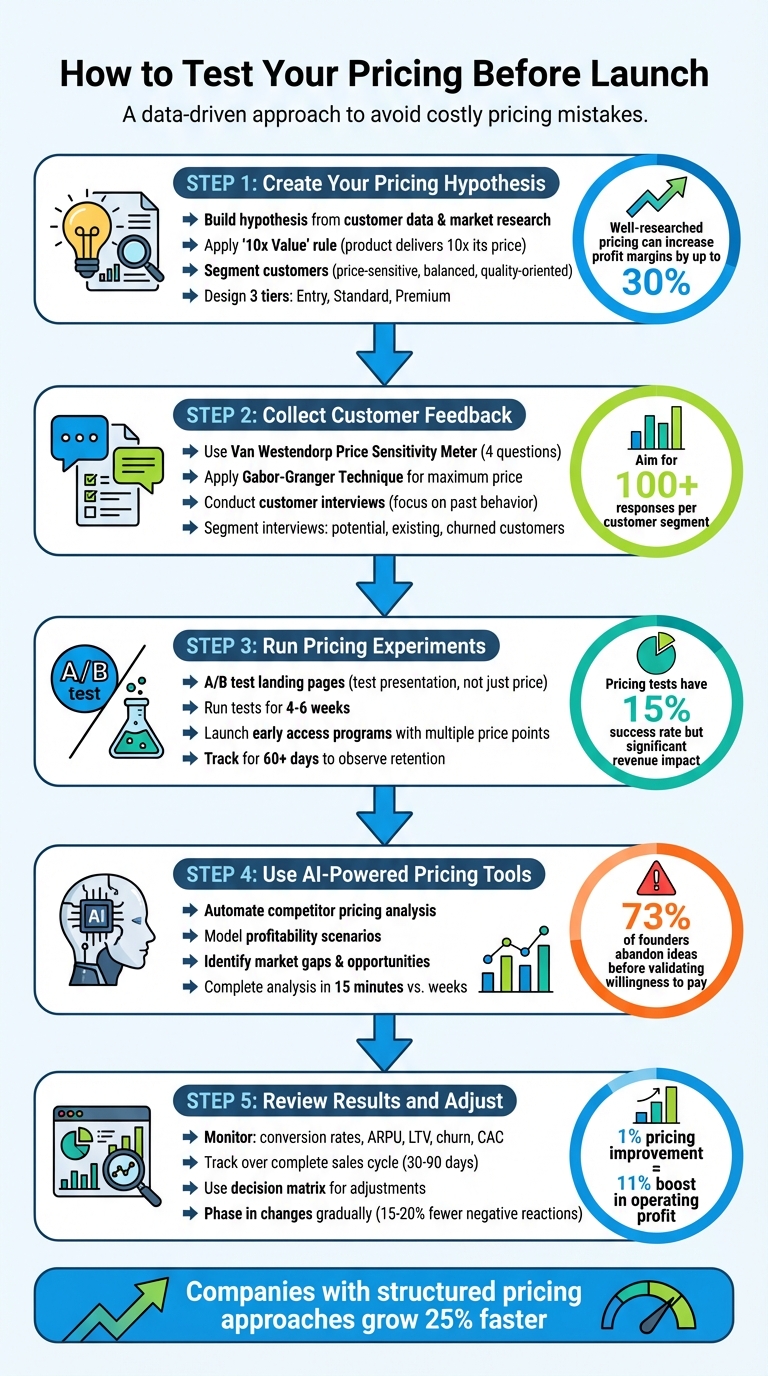
5-Step Process to Test Product Pricing Before Launch
How To Validate Your SaaS Pricing Before Launch
sbb-itb-08dd11e
Step 1: Create Your Pricing Hypothesis
A solid pricing hypothesis lays the groundwork for effective market testing. Start by building your hypothesis around customer data, how they perceive value, and what alternatives exist in the market. While many founders spend fewer than 10 hours on pricing decisions, well-researched strategies can increase profit margins by up to 30%.
A useful guideline is the "10x Value" rule: your product should deliver at least ten times the value of its price. For example, if you charge $50/month, your customers should feel like they’re getting $500/month worth of value - whether that’s in time saved, revenue earned, or problems solved. This approach makes it easier to justify your pricing during sales conversations and improves customer retention.
Identify Your Customer Segments
To tailor your pricing effectively, start by segmenting your customers:
- Price-sensitive: These customers focus on affordability and tend to make frequent, smaller purchases.
- Balanced customers: They look for mid-range pricing with good value for the cost.
- Quality-oriented: Willing to pay premium prices for exclusivity and superior service.
For B2B products, the segmentation shifts slightly:
- Price-driven: These clients prioritize the lowest cost and require minimal service.
- Value-driven: They want a variety of options to choose from, focusing on what matters most to their business.
- Relationship customers: These clients value trust and personalized support over price. They respond well to high-touch service and dedicated account management.
Tools like IdeaFloat’s Problem Validator can help identify pain points in your customer base. A severity score of 80–100 often indicates strong demand for premium pricing. The more urgent the problem, the higher the likelihood customers will pay for a solution.
By understanding these customer profiles, you can create pricing tiers that align with each segment’s willingness to pay.
Create Your Initial Pricing Tiers
Using your customer segmentation, design a three-tier pricing structure - Entry, Standard, and Premium. This model is widely successful because it uses psychological anchoring: the middle option often appears to offer the best value. For example:
- B2B SaaS for small businesses typically ranges from $50–$500/month.
- Mid-market companies often pay between $500–$5,000/month.
- B2C SaaS products usually fall between $5–$50/month.
To refine your pricing, research competitors. Look at their structures - whether they use flat rates, tiered pricing, or usage-based models - and note which features are tied to higher tiers. Identify the "trigger feature" that motivates customers to upgrade.
When setting your initial prices, aim slightly above market expectations. It’s easier to lower prices later than to raise them. Remember, your initial pricing isn’t just a placeholder - it shapes how customers perceive your product’s value. In fact, a 10% improvement in pricing strategy can have a greater impact on revenue than a 10% boost in customer acquisition, retention, or product quality.
Step 2: Collect Customer Feedback
Getting customer feedback is key to fine-tuning your pricing tiers before launch. It’s not just about validating your assumptions; it’s about understanding how your customers think about value. Surveys and interviews are two powerful tools for gathering this information.
Use Surveys to Test Price Sensitivity
Pricing surveys help you figure out the price range customers are willing to pay. One popular method is the Van Westendorp Price Sensitivity Meter, which asks four targeted questions to identify where perceived value and cost align:
- At what price would this product be too expensive to consider buying?
- At what price would this product feel expensive but still worth considering?
- At what price would this product seem like a great deal?
- At what price would this product be so cheap that it might seem low-quality?
These questions help pinpoint your "acceptable pricing range" - where customers feel they’re getting value without overpaying. This method works best when customers have prior experience with similar products and pricing.
Another effective tool is the Gabor-Granger Technique, which gauges the maximum price a customer is willing to pay. You ask a question like, "Would you buy this product at $29/month?" If they say yes, you raise the price: "$49/month?" You continue until they say no. This process creates a revenue curve that shows how demand changes as prices increase.
Aim for at least 100 responses per customer segment for reliable data. Be sure to include a "would not purchase" option to avoid skewing results and ask respondents to rate their confidence in their answers. Discard responses with low confidence scores to keep your data accurate.
While surveys are great for quantifying price sensitivity, they don’t always explain why customers feel the way they do. That’s where interviews come in.
Conduct Customer Interviews
Interviews go beyond numbers to reveal the motivations and thought processes behind pricing decisions. They help you understand the "why" behind the data, but they also come with challenges. People don’t always tell the truth - sometimes they say what they think you want to hear. As Rob Fitzpatrick, author of The Mom Test, explains:
"People will lie to you if they think it's what you want to hear".
To get honest answers, focus on past behavior rather than hypothetical scenarios. Instead of asking, "Would you pay $50 for this?", try, "What do you currently pay to solve this problem?" or "How much time and effort does this cost you now?". These kinds of questions are grounded in real spending habits.
Segment your interviews into three groups for deeper insights:
- Potential customers: Learn what they currently spend on alternative solutions.
- Existing customers: High-value users can highlight which features they value most.
- Churned customers: Understand at what point they felt the cost outweighed the value.
Here’s an example: In 2024, Silvia Frucci, a go-to-market leader at Optum, conducted pricing interviews with 12 provider practices. The feedback revealed that customers’ willingness to pay was much lower than expected. As a result, Optum decided to scrap the full product launch and instead integrate the most valuable features into their existing offerings. This decision, based on just 12 interviews, prevented a costly failure.
"Talk to at least one person. Most companies are not even doing that".
Madhavan Ramanujam, a pricing expert, points out: Half of the 60 software companies surveyed admitted they had never conducted a pricing study. Yet companies that validate their pricing through even a small number of interviews see up to 30% higher profit margins compared to those that don’t.
Step 3: Run Pricing Experiments
Now that you’ve collected feedback, it’s time to test your pricing with real customer behavior. Surveys and interviews give you an idea of what customers say they’ll pay, but actual experiments reveal what they’ll do. This step takes you from theoretical insights to actionable validation.
A/B Test Landing Pages with Different Prices
Using the insights from your surveys and interviews, A/B testing helps you observe how customers respond to different pricing strategies in real-time. This method allows you to compare performance between two variations, focusing not just on the price itself, but also on how it’s presented. Interestingly, research indicates that pricing page tests have a 15% success rate - the lowest among major page types - but when they work, the revenue impact can be significant.
Start by testing how you present and frame pricing. Most successful experiments don’t involve changing the actual price but rather how it’s communicated. For example:
- Highlight a "recommended" tier with a badge or visual cue.
- Default the pricing toggle to annual billing and emphasize savings.
- Simplify feature comparison tables to showcase 5–8 key benefits instead of overwhelming users with too much detail.
If you’re using tools like IdeaFloat’s Waitlist Landing Page, you can create different versions of your pricing display to measure metrics like click-through rates, sign-ups, and bounce rates. Run these tests for 4–6 weeks to capture the full customer journey, as many purchase decisions happen long after the initial visit. Focus on revenue metrics like Average Revenue Per User (ARPU) and total revenue, not just conversion rates, since a lower price might increase sign-ups but hurt profitability.
"Focus on presentation and framing, not price changes. Most successful pricing tests don't change the actual price - they change how the price is communicated." - GrowthLayer
Stick to one variable per test. Changing both the price and the tier structure at the same time makes it hard to pinpoint what’s driving the results. Keep features, messaging, and design consistent across test groups. For instance, making pricing clearer and more prominent on comparison pages has been shown to boost performance by 14.1%.
Launch Early Access Programs with Multiple Price Points
Beyond A/B testing, early access programs are another way to validate pricing by observing real purchasing behavior. These programs allow you to test different price points with customers who are willing to pay for early access, offering a practical way to bridge the gap between theoretical pricing and actual sales.
Segment your audience carefully to avoid trust issues. Showing different prices for the same product to the same group of customers can damage trust if they compare notes. Instead, test with new customers, specific geographic regions, or distinct audience segments. If you’re running a subscription model, conduct the experiment for at least 60 days to observe renewal rates and churn behavior.
Track more than just conversion rates. Monitor churn to ensure that an attractive initial price doesn’t lead to retention problems later. Focus on metrics like Customer Lifetime Value (LTV), retention rates, and ARPU to understand the long-term financial impact. Also, pay attention to qualitative feedback, such as customer objections during onboarding or support tickets related to perceived value. For statistically reliable results, aim for at least 1,000 trials per pricing variant to detect a 10% change in conversion rates.
Step 4: Use AI-Powered Pricing Tools
AI tools can take your pricing strategy to the next level by analyzing real-time market data and conducting in-depth competitor analysis. While traditional methods like surveys and A/B testing focus on understanding individual customer behavior, AI tools broaden the scope. They help you identify larger market patterns, transforming scattered data points into actionable market insights. These tools work hand-in-hand with your experiments, connecting your findings with live market intelligence.
Scan Competitor Pricing Automatically
Tracking competitor prices manually can eat up a lot of time and may still leave gaps in your analysis. Tools like IdeaFloat's Advanced Pricing Research use AI to automate this process, analyzing online market pricing and applying economic theories to recommend prices that maximize profits. This tool doesn’t just track - it identifies opportunities, such as market gaps and competitor weaknesses, that manual research might miss. With real-time benchmarks and reliable APIs, what used to take weeks can now be completed in just 15 minutes.
Here’s a striking stat: 73% of founders abandon their ideas before validating whether customers are willing to pay. That’s why tools like these are so crucial - they take the guesswork out of pricing and help you move faster.
"IdeaFloat saved us weeks of work by helping us explore demand for new products across different regions and took the guesswork out of finding gaps in the market."
- Nick Sherwing, Founder, woohoPets
Model Profitability with Different Prices
Once you’ve gathered competitive data, the next step is to model how different price points affect profitability. IdeaFloat's Financial Model allows you to simulate various pricing scenarios, showing their impact on revenue, costs, and breakeven points before you commit to a full-scale launch. This isn’t just about calculating revenue - it gives you a complete financial overview, including net profit and margins.
Pay close attention to your actual margins. A subscription fee that looks promising on the surface might hide high acquisition or operating costs. By blending pricing research with a detailed cost breakdown, you can ensure your pricing strategy supports sustainable growth before you hit the market.
Step 5: Review Results and Adjust
Monitor Key Metrics
Running pricing experiments is just the beginning; the real work lies in analyzing the data to make informed decisions. Focus on metrics that reveal both immediate and long-term performance. Key areas to monitor include:
- Conversion rates: Trial-to-paid conversions and sign-up rates.
- Revenue metrics: Average Revenue Per User (ARPU) and Customer Lifetime Value (LTV).
- Retention indicators: Churn rate and Net Promoter Score (NPS).
- Efficiency metrics: Customer Acquisition Cost (CAC) payback period.
Keep in mind that over 70% of statistically significant results don’t translate into meaningful business outcomes. It’s important to differentiate between statistical significance and economic significance. For example, a price adjustment might show a valid improvement statistically, but if the revenue increase doesn’t outweigh the added operational complexity, it’s not worth pursuing.
Also, watch for variations across customer segments. Price elasticity can differ by as much as 3–5x between groups. Extend your tracking over a complete sales cycle - typically 30 to 90 days. This matters because 43% of positive short-term results tend to fade when observed over 12 months or more.
Here’s a quick breakdown of essential metrics and their importance:
| Metric | What It Reveals | Why It Matters |
|---|---|---|
| ARPU | Average Revenue Per User | Balances conversion rates and pricing to show overall revenue impact. |
| LTV | Customer Lifetime Value | Determines if the pricing strategy supports long-term profitability. |
| Churn Rate | Percentage of customers leaving | Highlights if customers feel the product’s value is declining. |
| CAC Payback | Time to recover acquisition costs | Evaluates how efficiently marketing spend is recouped. |
| Trial-to-Paid | Conversion percentage | Measures the immediate success of your pricing strategy. |
Adjust Pricing Based on Data
Once you’ve gathered insights from these metrics, use them to refine your pricing strategy. A decision matrix can help weigh factors like projected revenue impact, implementation complexity, competitive positioning, and customer perception. Even small changes can make a big difference - a 1% improvement in pricing can result in an 11% boost in operating profit.
When rolling out major changes, consider a gradual approach. Companies that phase in pricing updates tend to see 15–20% fewer negative reactions compared to sudden, widespread changes. For existing customers, maintaining their current rates while applying new pricing to new sign-ups can preserve trust and minimize backlash.
Don’t stop at numbers - qualitative feedback is just as valuable. Look at customer support tickets, survey responses, and shifts in NPS to understand the "why" behind the data.
"Pricing is a psychological game as much as an economic one".
Finally, be cautious of hidden costs. For instance, lowering prices might increase conversions, but if it also drives up resource usage, your overall cost to serve could rise, cutting into your profits.
Conclusion
Testing your pricing before launch is a critical step. With around 35% of startups failing due to a lack of market need, validating your pricing helps ensure you don’t fall into that category. By following the five steps in this guide, you’re replacing guesswork with insights drawn from actual customer behavior.
Even a small change in pricing can make a big difference. For example, a mere 1% improvement in pricing can lead to an 11% boost in operating profit. Companies that take a structured approach to pricing tend to grow 25% faster than those that don’t. The goal here isn’t to get it perfect right away - it’s to start with a strong foundation based on real-world feedback.
Keep in mind that pricing is not just about numbers; it’s also about perception. Your price communicates quality, defines your brand, and determines which customers you attract - or push away. Starting with a higher price gives you the flexibility to offer discounts later, avoiding the challenge of raising prices down the line, which can damage customer trust.
With the data you’ve gathered from each step of this guide, you now have a pricing strategy rooted in evidence, not assumptions. This approach helps you avoid the pitfalls of both underpricing and overpricing. You’re set to launch confidently, focus on delivering value, and grow your business with a pricing strategy that truly supports your goals.
FAQs
How many pricing options should I test?
There’s no one-size-fits-all answer to how many pricing options you should test. However, starting with 2 to 4 options is a practical approach. This range strikes a balance - it provides enough data for meaningful comparisons without making things overly complex. The key is to focus on clearly defined price points or strategies, then analyze how customers respond to each. Ultimately, the right number will depend on factors like your product, target market, and the resources you have available.
How do I test pricing without upsetting customers?
Testing pricing strategies without alienating customers requires careful techniques like A/B testing, customer surveys, or even AI-driven pricing tools. These methods help you understand what customers are willing to pay while minimizing the risk of backlash.
For instance, A/B testing allows you to compare customer reactions to different price points in real time. Surveys, on the other hand, provide direct insights into how customers perceive the value of your product or service. To maintain trust, implement changes gradually and be transparent about why adjustments are being made. This way, customers feel included and respected in your pricing decisions.
What’s the best metric to pick a winning price?
The most effective way to determine the right price is by observing how customers react to various price points. Two important metrics to focus on are willingness to pay and conversion rates. These can be evaluated through methods like A/B testing or by studying consumer behavior patterns. By leveraging these insights, businesses can fine-tune their pricing strategies to better meet customer expectations and achieve a stronger alignment with the market.
Related Blog Posts
- How to Price Your Product: A Beginner's Guide
- Idea to First Customer in 14 Days: Scripts, Templates, Checklist
- Idea to Pricing: A Simple Formula for Your First 3 Offers
- Use ChatGPT to Go From Idea to Offer in One Weekend