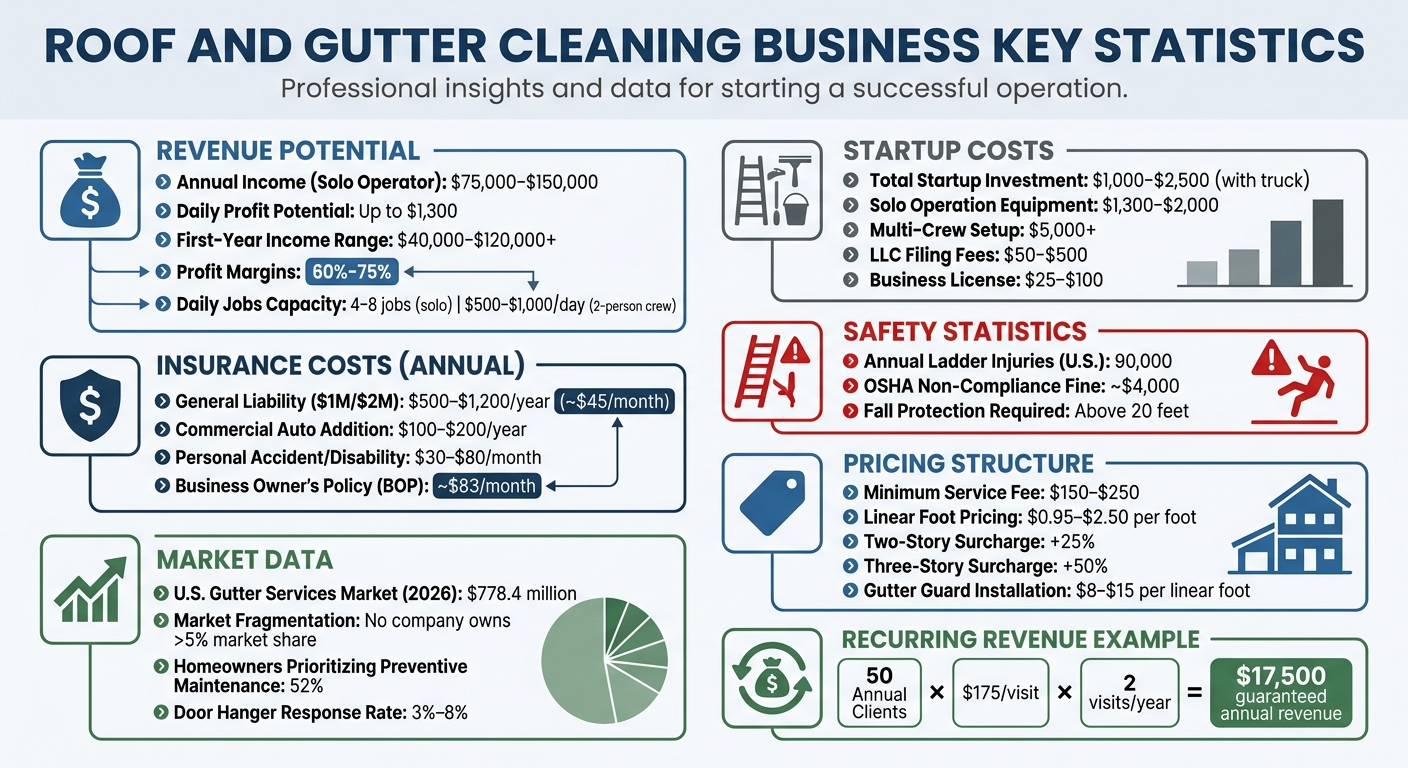
Roof and gutter cleaning can generate $75,000–$150,000 annually for solo operators, with daily profits reaching up to $1,300 in some areas. Startup costs are low, ranging from $1,000 to $2,500 if you already own a truck. However, safety is critical - 90,000 ladder-related injuries occur in the U.S. annually. Here's how to build a profitable business while minimizing risks:
- High Demand: Homeowners need this service to prevent costly water damage. Seasonal contracts in spring and fall ensure steady income.
- Profit Margins: Typical margins are 60%–75%, with add-ons like gutter guard installations boosting revenue.
- Safety First: Invest in insurance, proper training, and safety gear like ladder stabilizers and harnesses. A single accident can derail your business.
- Legal Setup: Form an LLC for liability protection, secure general liability insurance, and comply with local regulations.
- Marketing: Use Google Business Profile, door hangers, and referrals to attract clients. Highlight your safety standards to build trust.
- Pricing: Start with a $150–$250 minimum fee or $0.95–$2.50 per linear foot. Adjust for multi-story homes, heavy debris, or premium services.
Roof and Gutter Cleaning Business: Startup Costs, Revenue & Safety Statistics
Step 1: Validate and Plan Your Business
Research Your Market and Validate Demand
Before diving into the gutter cleaning business, it’s crucial to confirm there’s enough demand in your area. The U.S. gutter services market is projected to hit $778.4 million by 2026. To get started, drive around established residential neighborhoods and look for homes that fit the ideal profile - two-story houses with mature trees and well-kept landscaping. These homes tend to accumulate more debris and are often owned by individuals willing to pay for professional services rather than risk doing it themselves.
Next, check out your competition. Search for "gutter cleaning near me" and request quotes from 3–5 local providers. This will give you a sense of pricing and service expectations in your area. While competition is a good sign of demand, be wary of oversaturated markets where established companies dominate. Keep in mind that this industry is highly fragmented, with no single company owning more than 5% of the market share.
To further test demand, try distributing door hangers in neighborhoods you’ve identified as high-potential during peak seasons like spring and fall. A response rate of 3% to 8% is a strong indicator of interest. You can also use tools like IdeaFloat’s Problem Validator to gauge whether homeowners in your area see clogged gutters as a pressing issue. With around 52% of homeowners now prioritizing preventive maintenance to avoid costly water damage, framing your service as essential property protection can make a big difference in attracting customers.
These steps will help you gather the insights you need to create a focused and effective business strategy.
Write Your Business Plan
Once you’ve validated demand, it’s time to put together a business plan that reflects your findings. A well-researched plan ensures your services and pricing fit the needs of your local market, setting you up for success.
Start by defining your core services, such as debris removal, downspout flushing, and minor repairs. To boost profitability, consider offering high-margin services like gutter guard installation, which can be priced between $8 and $15 per linear foot. Adding these premium options can help differentiate your business from competitors.
Your plan should also outline daily workflows and include a list of essential equipment. For a basic solo setup, you’ll need extension ladders (fiberglass is safer near power lines), ladder stabilizers to avoid property damage, leaf blowers, and safety harnesses. Expect to spend $1,300 to $2,000 for a solo operation or upwards of $5,000+ if you’re planning to run a multi-crew business.
Financial projections are another key part of your plan. Depending on market density and seasonal trends, first-year income can range from $40,000 to $120,000+. Keep in mind that demand spikes during October–November (post-leaf drop) and March–April (after winter debris), so think about offering additional services like pressure washing or window cleaning during slower months[6,14].
For legal and financial protection, consider structuring your business as an LLC rather than a sole proprietorship. This will shield your personal assets from liabilities tied to working at heights. Your marketing strategy should focus on local SEO, optimizing your Google Business Profile, and targeted campaigns like door hangers in prime neighborhoods. To build a steady income stream, offer annual service contracts with 10–20% discounts for two cleanings per year. This not only ensures predictable revenue but also reduces the cost of acquiring new customers[6,13].
With a clear plan in place, you’ll be ready to tackle the challenges of starting your gutter cleaning business.
sbb-itb-08dd11e
Step 2: Handle Legal Requirements and Insurance
Register Your Business
Setting up a solid legal structure is key to protecting your personal finances from business risks. One of the first decisions you'll face is whether to operate as a Sole Proprietorship or form a Limited Liability Company (LLC). While a sole proprietorship is less expensive to establish, it doesn't shield your personal assets. On the other hand, an LLC creates a clear separation between personal and business finances, which is especially important when working in riskier environments like rooftops.
"An LLC provides a legal separation between your personal assets and your business assets. This separation is crucial because it gives you personal liability protection." - ZenBusiness
To establish an LLC, you'll need to file Articles of Organization with your state. The filing fees vary, typically ranging from $50 to $500. You'll also need to appoint a registered agent with a physical address in your state to handle legal documents on your behalf. After that, obtain an Employer Identification Number (EIN) from the IRS, which you can do quickly online. Once you have your EIN, open a dedicated business bank account to ensure your personal and business finances remain separate.
Don't overlook local requirements. Many cities and counties mandate a general business license, which usually costs between $25 and $100. Additionally, certain areas may require specific licenses for contractors or home improvement work, especially for roofing-related services. Check with your local city hall or county clerk's office to confirm what's needed in your area, as regulations can vary widely. Lastly, ensure you file any required annual or biennial reports with your state to maintain compliance and avoid penalties or even business dissolution.
Once your legal framework is in place, the next step is securing the right insurance to protect your business.
Get the Right Insurance Coverage
Insurance is a non-negotiable part of running a roofing or gutter cleaning business - it’s your safety net when things go wrong. The most important policy is General Liability Insurance, which covers property damage (like cracked roof tiles) and injuries caused by your work. A typical $1M/$2M general liability policy costs between $500 and $1,200 annually, or about $45 per month on average. Make sure your policy explicitly includes coverage for high-risk activities like working at heights, as some standard policies may exclude these.
If you plan to hire employees, Workers' Compensation Insurance is a legal requirement in most states. This type of coverage ensures medical expenses and lost wages are covered if an employee gets injured on the job. Additionally, you’ll need Commercial Auto Insurance, as personal auto policies often don’t cover vehicles used for business purposes. Adding a business-use endorsement to your personal auto policy typically costs an extra $100 to $200 per year.
For solo operators, Personal Accident or Disability Insurance is worth considering. This type of insurance replaces your income if you're injured and unable to work, with monthly costs typically ranging from $30 to $80.
Many clients, including homeowners and property managers, will require proof of insurance before hiring you. Keep a digital copy of your Certificate of Insurance (COI) handy for quick access. You might also want to look into bundling policies. A Business Owner’s Policy (BOP), which combines general liability and property insurance, costs around $83 per month and can save you money on premiums.
Step 3: Buy Equipment and Safety Gear
Tools and Equipment You'll Need
Once you've handled the legal and insurance essentials, it's time to invest in the tools that will keep your workers safe and your business running efficiently. The equipment you choose directly impacts both safety and profitability. One key piece of gear is a 24–28 ft fiberglass extension ladder, ideal for its non-conductive properties when working near power lines. Expect to pay somewhere between $250 and $400 for a new one.
"Fiberglass is non-conductive (important near power lines)." – Bizzby Team
To stabilize your ladder and protect gutters, a ladder stabilizer is a must. These typically cost $40 to $80. For clearing dry leaves quickly, a cordless leaf blower is a great choice, priced between $80 and $200. When dealing with wet debris, a gutter scoop and bucket will do the job, costing just $8 to $15.
If you’re working on steep roofs with a pitch greater than 6:12, safety becomes even more critical. Consider roof walkboards and a safety harness kit (with anchors) priced at $80 to $150. Alternatively, a professional gutter vacuum system like SkyVac can clean gutters from the ground using carbon fiber poles, which is safer and more efficient. Basic systems start at $400 to $800, while high-end setups range from $1,500 to $2,500.
Personal Protective Equipment (PPE)
PPE isn't just a recommendation - it's essential for preventing injuries. Start with heavy-duty rubber gloves to protect your hands from sharp edges, rusty screws, and harmful bacteria or mold found in decaying debris. Pair these with safety glasses or goggles to guard against flying debris and high-pressure sprays. Together, these items will cost around $20 to $40.
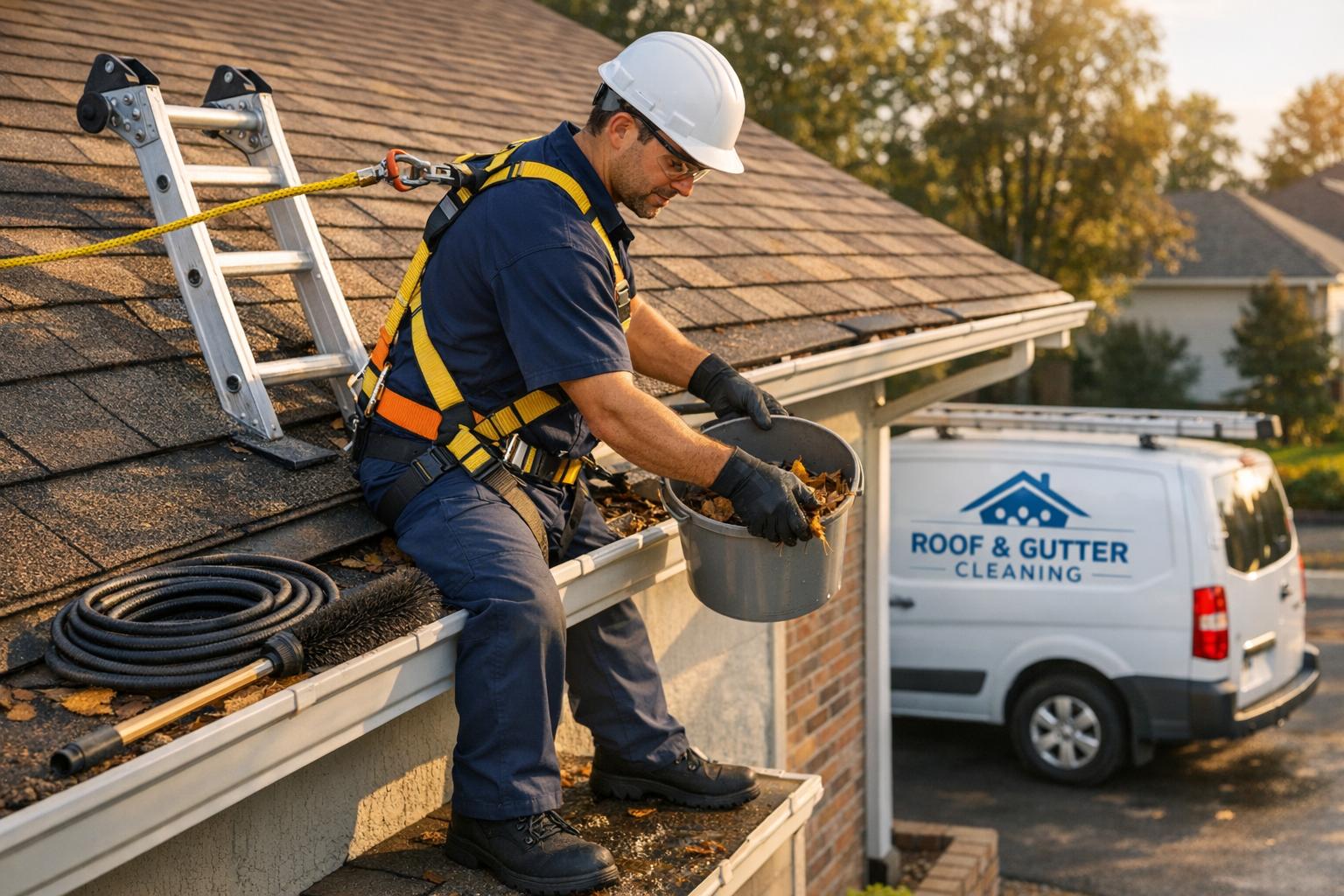
For secure footing on wet or sloped surfaces, invest in non-slip boots, which range from $100 to $200. If you're working at heights above 20 feet, OSHA mandates the use of a fall arrest system. Skipping this requirement could result in fines of approximately $4,000. A complete "Compliance in a Can" kit, including a full-body harness, lanyard, rope, and roof anchor, meets OSHA standards and costs about $125.
Make it a habit to inspect your gear daily. Replace worn ladder feet, frayed harness straps, or any damaged equipment immediately. Cutting corners on safety gear is never worth the risk - medical bills, lost work time, or lawsuits far outweigh the initial investment in proper PPE.
With the right tools and safety gear in hand, you're ready to focus on creating effective safety protocols for your business operations.
Step 4: Set Up Safety Protocols and Risk Management
Train Workers on Safety Standards
Proper training is the backbone of workplace safety, especially when dealing with equipment and heights. Meeting OSHA compliance standards is non-negotiable - your operations must align with federal safety requirements for working at heights. Every worker should know how to set up ladders correctly. This includes positioning ladders on stable, level ground, maintaining the proper angle to avoid tipping, and using ladder stabilizers to distribute weight safely and prevent damage to gutters.
For roofs with pitches steeper than 6:12, workers need additional training to handle roof walkboards and safety harnesses effectively. It's also crucial to perform a hazard assessment before starting any job. Workers should look out for risks like power lines (requiring fiberglass ladders), loose gutter brackets, or even biological threats like mold in decaying debris. Comprehensive training ensures workers are equipped to handle these challenges and lays the groundwork for reducing risks proactively.
Reduce Risks Before They Happen
Training is only the first step - proactive measures are essential to minimize risks on-site. Prevention is always better than reacting to accidents. Start by monitoring the weather daily. Rain, high winds, or storms can create hazardous conditions, turning ladders into slip risks and affecting stability at heights. Communicate with customers beforehand to ensure items below the work area are secured or covered.
When using pressure washers, begin with the lowest setting to avoid accidental damage, and ensure workers wear proper eye protection. Keep the job site tidy by using a bucket attached to the ladder to collect wet debris instead of letting it fall to the ground, reducing slip hazards for everyone. After cleaning, flush downspouts with a garden hose to confirm proper water flow and catch hidden clogs. Ignoring these clogs could lead to costly foundation damage, potentially exceeding $5,000.
How to start a roof and gutter cleaning business from scratch
Step 5: Set Prices, Market, and Launch Your Business
Once you've nailed down safety and legal requirements, the next step is figuring out pricing, marketing your services, and officially launching your business.
Calculate Your Service Prices
Pricing your services correctly is critical to covering your costs and staying profitable. A minimum service call fee of $150 to $250 is a good starting point to account for fixed overhead costs like insurance, fuel, and equipment wear and tear. Jonathan D. Byrd I, Founder of Clean Pro Gutter Cleaning, explains:
"The $218 floor exists because fixed overhead - commercial auto insurance, general liability, fuel, and equipment depreciation - creates a baseline service call cost regardless of home size".
You can choose from three main pricing methods: linear foot pricing ($0.95–$2.50 per foot), flat rates based on square footage, or tiered packages. Homes with two stories typically require a 25% price increase, while three-story homes need a 50% bump. Additional surcharges should also be factored in for steep roof pitches (10%–25%), heavy debris or neglect (15%–50%), and gutter guard removal ($0.25–$0.75 per foot). Aim for profit margins of 35%–50% for residential jobs and 25%–40% for commercial jobs.
To ensure profitability, calculate your labor rate by including wages, taxes, and insurance. Don’t forget to account for the cost of premium safety gear and training when setting your rates. You can boost your average ticket price by offering add-ons like downspout flushing ($5–$10 per spout), minor repairs ($75–$200), or gutter brightening ($1–$2 per foot). Tools like Google Earth can help you provide accurate remote quotes within ±2%.
During busy seasons like October and November, consider raising prices by 10%–20% to reflect higher demand. For a high-margin upsell, offer gutter guard installations - a single job can generate as much revenue as 8 to 12 standard cleaning jobs.
Attract and Acquire Customers
Your Google Business Profile is key to showing up in local "near me" searches. Add before-and-after photos, detailed service descriptions, and seasonal updates to make your profile stand out. Posting photos from every job builds trust, especially since 75.5% of buyers rely on online reviews as much as personal recommendations. Running Local Services Ads can also help. These ads come with a "Google Guaranteed" badge, which boosts credibility, and you only pay for qualified leads. Highlight your safety-first approach and insurance coverage to set yourself apart.
Platforms like Nextdoor are great for connecting with local homeowners. Engaging in neighborhood discussions can generate 5–10 leads per conversation. Sam O'Brien from Nextdoor emphasizes:
"Nearly every house has eavestroughs, yet few homeowners think to empty them out. This makes gutter cleaning advertising essential for your business".
Distribute door hangers in areas with mature trees - 500 hangers can yield a 3%–8% response rate during peak seasons. Build partnerships with roofers, landscapers, and real estate agents to create a referral network. As Gutterprovac.com notes:
"A roofer saying, 'Call this person for gutters' carries way more weight than a Google ad".
Offer incentives like $25 off the next service for every new customer referral. Before launching, use tools like IdeaFloat's Waitlist Landing Page to collect emails and generate excitement - it helps you make a strong first impression.
Turn one-time customers into annual service contract clients for spring and fall cleanings. For example, 50 recurring clients paying $175 per visit (twice a year) can bring in $17,500 in guaranteed annual revenue. To encourage sign-ups, offer a 10%–20% discount on yearly contracts. While working on a home, knock on five neighboring doors to offer a "same-day" discount - this approach has a 30%–40% success rate since it reduces travel costs.
Start Your Operations
With pricing and marketing set, focus on efficient operations to grow your business quickly and effectively.
As a solo operator, you can handle 4–8 jobs daily, while a two-person crew can bring in $500–$1,000 per day during peak season. In your first 30 days, prioritize setting up your Google Business Profile, distributing door hangers, and running a $50 ad on Nextdoor to secure your first 20 clients. Take before-and-after photos of every job to share on social media and Google.
When hiring, prioritize reliability and safety over technical skills. Train employees on ladder setup, hazard identification, and proper use of personal protective equipment (PPE) before sending them out. Always flush downspouts after cleaning to test flow - this not only adds value but also prevents costly foundation damage.
Introduce gutter guard installations early to boost conversion rates to 20%–30%. Offer discounts of $10–$20 per home when booking three or more houses on the same street. This reduces travel time and increases earnings per hour. Use routing software to group jobs by zip code, keeping non-billable drive time under 15%. Finally, proof of insurance often seals the deal with customers, giving them confidence in your services.
Conclusion
Running a successful roof and gutter cleaning business starts with careful planning, strict safety measures, and putting customers at the center of every decision. Steps like securing proper insurance, forming an LLC, and using professional-grade equipment aren't just smart - they're essential for reducing risks and working efficiently. As the Bizzby Team wisely notes:
"Insurance... closes more jobs than any sales pitch".
Creating steady income streams is another key to success. For example, locking in 50 recurring clients at $175 per visit, twice a year, could bring in $17,500 annually. Add premium services like gutter guard installations, and your earnings can grow even further.
Safety should never take a backseat. Use stabilizers, avoid working in unsafe conditions, and make sure to flush downspouts properly to prevent expensive damage. Investing in high-quality equipment and proper training not only ensures safety but also helps earn the trust of your clients quickly.
By embracing these safety practices, you'll protect both your team and your business reputation while enjoying the financial benefits. The building exterior cleaning industry offers appealing profit margins and low startup costs for those who prioritize safety and professionalism.
Commit to delivering top-notch work every time, and your dedication to safety will help you build a solid foundation for long-term success. Safety isn't just a precaution - it's the key to building trust, avoiding accidents, and growing your business steadily.
FAQs
Do I need special permits to clean roofs and gutters in my city?
Whether you need permits to clean roofs and gutters depends entirely on the rules in your area. Some places might require you to have a general business license, a home improvement contractor's license, or even a special trades license. The best way to find out is to contact your local city or county government. They’ll provide the specifics on what’s required. Staying compliant with local laws is a crucial part of getting your business up and running.
What’s the safest way to handle steep or multi-story roofs?
To work safely on steep or multi-story roofs, it's crucial to focus on fall protection and stick to safety guidelines. Start by using the right equipment, such as harnesses, lanyards, and anchor points that comply with OSHA standards. Make sure workers are trained in how to use this gear and how to identify potential hazards. Always inspect equipment before use to ensure it's in good condition. For added stability, consider using scaffolding or aerial lifts. Lastly, wear non-slip footwear and secure your tools to reduce the chances of falls or injuries.
How do I estimate gutter length for an accurate quote?
To figure out the length of gutters needed, start by measuring the total length required based on your property’s size and layout. One handy way to do this is by using a gutter calculator, which takes your home’s square footage into account to give you an estimate.
For more precise results, many contractors use satellite imagery and advanced tools to analyze property details. This approach ensures quotes are accurate and reflect the exact materials required, helping with both pricing and profitability.
Related Blog Posts
- How to Start a Pressure Washing Business With Under $1,000
- Pressure Washing Startup Costs: Gear, Licences, ROI
- Roof & Gutter Cleaning: From $0 to $5K/Month Starter Plan
- How to Start a Pressure Washing Business for Under $1,000