Starting a business while keeping your full-time job is a smart way to test ideas, build skills, and earn extra income without risking financial stability. In Australia, 1 in 5 workers already earns money through side hustles, averaging $688 per month. Popular options like freelancing, e-commerce, online education, and tech services require minimal time (5–10 hours weekly) and investment to start. The gig economy is booming, valued at $582 billion by 2025, making now a great time to explore opportunities.
Here’s a quick summary of business ideas you can start today:
- Freelance Services: Copywriting, virtual assistance, and online tutoring can bring in $20–$101 per hour.
- E-Commerce: Try dropshipping, print-on-demand, or selling handmade goods with platforms like Shopify.
- Education & Coaching: Teach skills or provide fitness and wellness coaching, earning $62–$164 per hour.
- Tech-Based Businesses: Software development, IT consulting, or digital marketing can yield $50–$300+ per hour.
Starting small while keeping your job reduces risks and increases your chances of success. Tools like IdeaFloat can help validate your ideas, and registering for an Australian Business Number (ABN) is free, and you can learn how to launch your business through our free courses. With flexible work arrangements becoming more common, balancing a side hustle alongside your career is easier than ever.
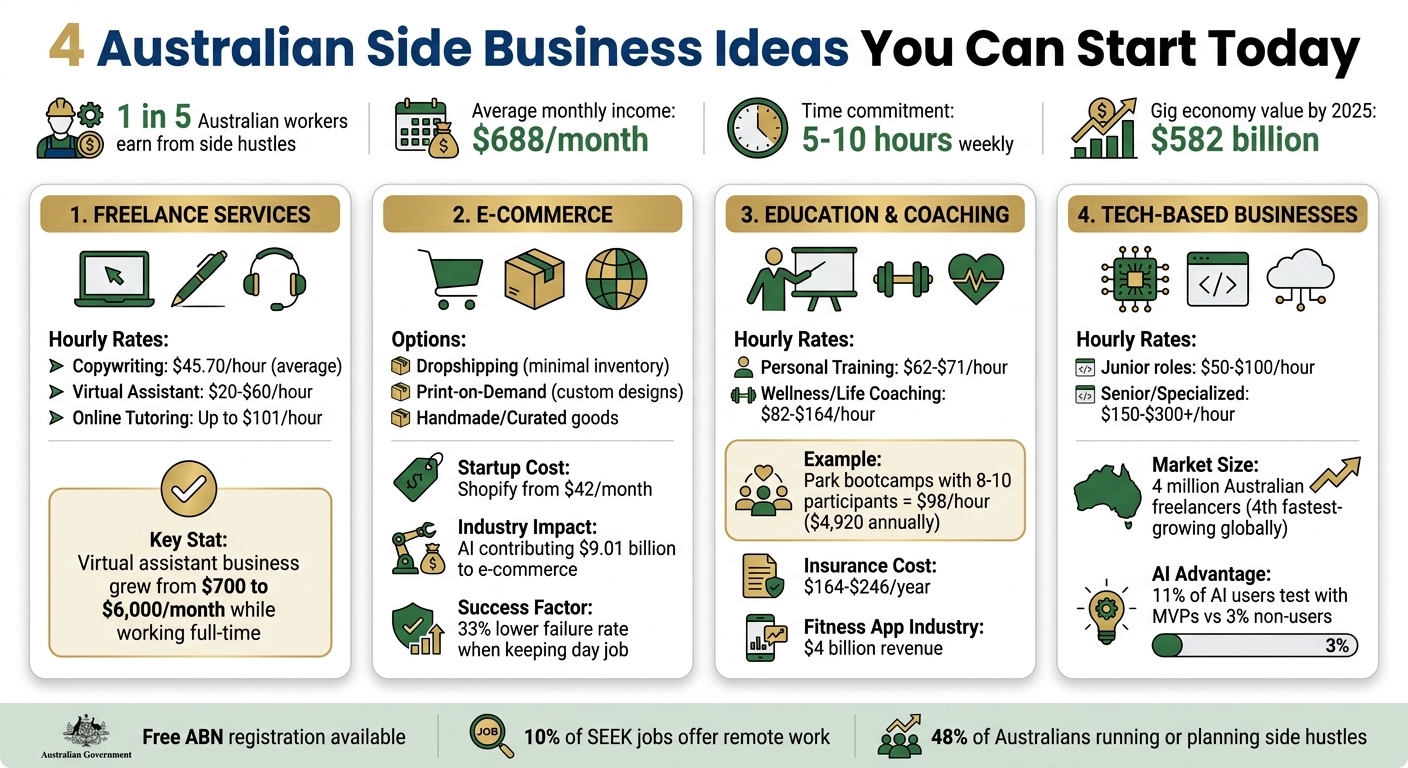
4 Side Business Ideas in Australia: Hourly Rates and Startup Requirements Comparison
10 Simple Businesses You Can Start for Under $100 in Australia
sbb-itb-08dd11e
1. Freelance Services
Freelance services provide an affordable and flexible way to start a side hustle while keeping your current job. With just a laptop and an internet connection, you can use your skills to generate income without worrying about inventory or office expenses. Evenings and weekends can become your most productive hours.
One popular option is copywriting and content creation, which offers both flexibility and strong earning potential. Australian writers, for instance, average $45.70 per hour. With 99% of marketers now incorporating AI into their workflows daily, there’s growing demand for skilled writers to refine AI-generated content, making this a promising field.
Another great choice is virtual assistance, where you can handle tasks like managing emails or scheduling calendars remotely. This role typically pays between $20 and $60 per hour. Take Ariana Rodriguez’s story as an example: she launched her virtual assistant business in 2021 with a $2,000 investment. Within months, while still working full-time, her income jumped from $700 to $6,000 per month - enough to bring on a subcontractor.
Online tutoring is another option, especially if you have expertise in subjects like math, English, or test preparation. With rates reaching up to $101 per hour, this can be a highly rewarding way to share your knowledge. To get started, make sure to register for a free Australian Business Number (ABN), list your services on popular gig platforms, and schedule sessions that fit around your primary job.
Freelancing offers a world of possibilities, and with the right strategy, it can quickly become a reliable source of extra income.
2. E-Commerce
After finding success in freelancing, e-commerce presents another great way to expand your income without requiring a huge upfront investment. Selling products online eliminates the need for a physical storefront. You can start small, test your ideas, and grow as demand increases. With AI projected to contribute $9.01 billion to the e-commerce industry this year, automation tools now simplify daily operations, making it easier than ever to get started. Let’s dive into some popular e-commerce models that combine automation and creativity.
Dropshipping is a great starting point because you don’t have to worry about managing inventory. When a customer places an order, your supplier ships the product directly to them. Dropshipping expert Tan Choudhury breaks it down:
"The actions you need to take to get started really are not that difficult: build a Shopify store, order, create product videos, then market on social media."
Automation tools like AutoDS or DSers streamline tasks such as importing products and fulfilling orders [17,21], so you can focus on creating effective marketing campaigns.
Print-on-Demand (POD) is another low-risk option that allows you to add your personal touch to products. You can design custom items like t-shirts, mugs, or tote bags, and companies such as Printful or Gelato handle the printing and shipping once orders come in [21,22]. If you’re not a designer, AI tools like Midjourney or DALL-E can help you create eye-catching designs without hiring outside help.
For those with a talent for crafting or sourcing unique products, selling handmade or curated items is an ideal choice. Start small by testing your products at local markets or craft fairs. Once you see demand, set up a simple Shopify store (plans start at $42/month) and use social media platforms to attract customers. Shopify Magic can even generate product descriptions and marketing copy for you automatically. Both POD and handmade models require very little money to get started.
Before committing too much time or money, it’s smart to validate your idea. Use pre-launch pages and social media insights to gauge interest. Tools like Google Trends and Ahrefs can help you understand what buyers are searching for [15,16]. On social media, engagement rates of 4–6% on Instagram and 9–35% on TikTok are strong indicators of interest. Plus, research shows that entrepreneurs who keep their day jobs while launching a business reduce their odds of failure by 33% compared to those who quit right away.
3. Education and Coaching
Turning your professional skills into a teaching or coaching side business can be a rewarding way to earn extra income without hefty startup costs. In Australia, the wellness industry is thriving as more people focus on mental health and personal growth.
Take personal training, for example. It stands out as one of the most lucrative side hustles in Australia, with freelance trainers typically earning between $62 and $71 per hour. Similarly, wellness and life coaches often charge hourly rates ranging from $82 to $164 (approximately $100–$200 AUD).
But there’s more to explore beyond personal training. Digital skills training offers another profitable path, especially as Australian businesses continue to adopt advanced technologies. By targeting niche areas - like "AI tools for productivity" or "Instagram Reels for Cafes" - you can carve out a unique space in the market. With many developers already using AI tools, there’s a growing need for coaches who can help others integrate AI into their workflows. A great way to attract clients is by offering a free 15-minute discovery call to showcase your expertise before transitioning to paid sessions.
If fitness and nutrition coaching is more your style, getting certified is key. Thanks to Australia's Fee-Free TAFE initiative, you can complete Certificate III and IV in Fitness qualifications without paying tuition fees. For example, in 2025, Sam from Western Sydney took advantage of this program to earn his certification at no cost. He then launched Saturday morning bootcamps at a local park, charging about $12 per participant. With 8–10 attendees per session, Sam brings in roughly $98 per hour, adding nearly $4,920 annually to his income while maintaining his full-time job. And with the fitness-app industry generating nearly $4 billion in revenue last year, hybrid coaching models that combine in-person sessions with AI-powered tracking apps are gaining traction.
Whether you focus on digital skills or fitness coaching, these ventures allow you to leverage your expertise and turn it into a scalable income stream. Before starting, make sure to cover the essentials: secure professional indemnity and public liability insurance (which typically costs around $164–$246 per year, or $200–$300 AUD) and register for an Australian Business Number (ABN). Start small with a few clients to test your approach and fine-tune your services.
4. Technology-Based Businesses
Software Development and IT Consulting
If you have skills in software development, UX/UI design, or IT consulting, you can turn those abilities into a profitable side hustle. Many professionals in Australia are already doing this by taking on freelance contracts while keeping their full-time jobs. It’s a great way to work on varied projects, stay updated with industry trends, and avoid long-term commitments.
Freelance contracting rates in these fields highlight their earning potential. For example, junior roles typically earn $50–$100 per hour, while those with senior or specialized expertise can command $150–$300+ per hour.
Australia’s freelancing community is thriving, with over 4 million freelancers making it the fourth fastest-growing globally. Platforms like Toptal, Upwork, and Airtasker make it easier to connect with clients and manage projects. To simplify your workflow, consider offering "productized services" - these are fixed-price packages with clearly defined deliverables, which can make both selling and delivering services more straightforward.
Before diving in, make sure your tax situation is in order to avoid any compliance issues. You can also use AI-powered tools to test market demand and refine your services. Interestingly, business owners who use AI are almost four times more likely to test their ideas with minimum viable products (MVPs) - 11% compared to just 3% of non-AI users. Once you’ve landed your first few clients, it’s wise to build a three- to six-month emergency fund before expanding your efforts.
Some of the most promising areas for tech-based side hustles include cybersecurity and digital marketing. With 48% of Australians either already running or planning to start a side hustle, you’ll be joining a growing community of professionals exploring new opportunities beyond their day jobs. This flexible approach allows you to leverage your technical skills while keeping a steady income.
Conclusion
Starting a side business while keeping your full-time job isn’t just a fallback plan - it’s a smart move. It gives you the financial security to handle bills and unexpected costs while you see if your business idea holds up in the real world. Plus, you gain new skills, explore different industries, and create an additional income stream without betting everything on an unproven concept.
Take Brian Winch, for example. He started his business while still working a full-time job, using his regular income to provide stability as he built his venture.
To turn this approach into a thriving business, there are a few key steps to follow. Before getting started, make sure to secure an ABN, open a separate business bank account, and review your employment contract to avoid any conflicts. Use tools like IdeaFloat to gauge market demand and test your idea before committing significant time or money. Doing this groundwork can save you from costly missteps and ensure your idea addresses a problem people are willing to pay to solve.
Right now, the Australian market is ripe with opportunities. With 10% of jobs on SEEK offering remote work and more employers supporting flexible schedules, it’s easier than ever to juggle a side business alongside your career. Whether you’re freelancing, launching an online store, teaching virtual classes, or developing tech solutions, starting small gives you the chance to grow steadily as your business gains momentum.
Take it one step at a time and keep testing your ideas. Every successful entrepreneur started where you are now - with an idea and the determination to see it through. Your full-time job isn’t a barrier; it’s the foundation for your future.
FAQs
Do I need an ABN to start a side hustle in Australia?
If you're starting a side hustle in Australia, you don't need an ABN (Australian Business Number) unless your annual earnings exceed $75,000. That said, having an ABN can make handling taxes easier and adds a layer of legitimacy to your business operations.
How do I validate my business idea before spending money?
To ensure your business idea has potential without breaking the bank, focus on getting to know your target audience and testing demand. Start by clearly defining the problem your business aims to solve. Then, research whether there’s a genuine need for your solution.
Engage directly with potential customers through surveys, interviews, or by creating a simple version of your product or service - often called a minimum viable product (MVP). This allows you to gather feedback and gauge interest without a large upfront investment.
Pay attention to early indicators of demand. Things like inquiries, sign-ups, or enthusiastic feedback can signal that your idea has traction. This approach helps you minimize the risk of pouring resources into an idea that might not succeed.
What should I check in my job contract before starting a business?
Before diving into a side business while still employed, it's crucial to carefully examine your job contract. Pay close attention to clauses related to intellectual property and confidentiality - using your employer's resources or ideas without proper authorization could lead to serious legal trouble.
Also, watch for any ‘outside interests’ clauses that might require you to get approval before starting a side business. Additionally, be aware of restrictive covenants, which could impose limitations on your activities even after you leave your job. Having a clear understanding of these terms will help you stay compliant and avoid potential conflicts as you work on building your side hustle.
Related Blog Posts
- 21 Low-Investment Business Ideas for Women in Australia
- Best Small Business Ideas in Australia Under $5,000
- What Business Can You Start in Australia With $10,000? 15 Realistic Ideas for 2026
- 27 Part-Time Business Ideas in Australia You Can Start on Weekends