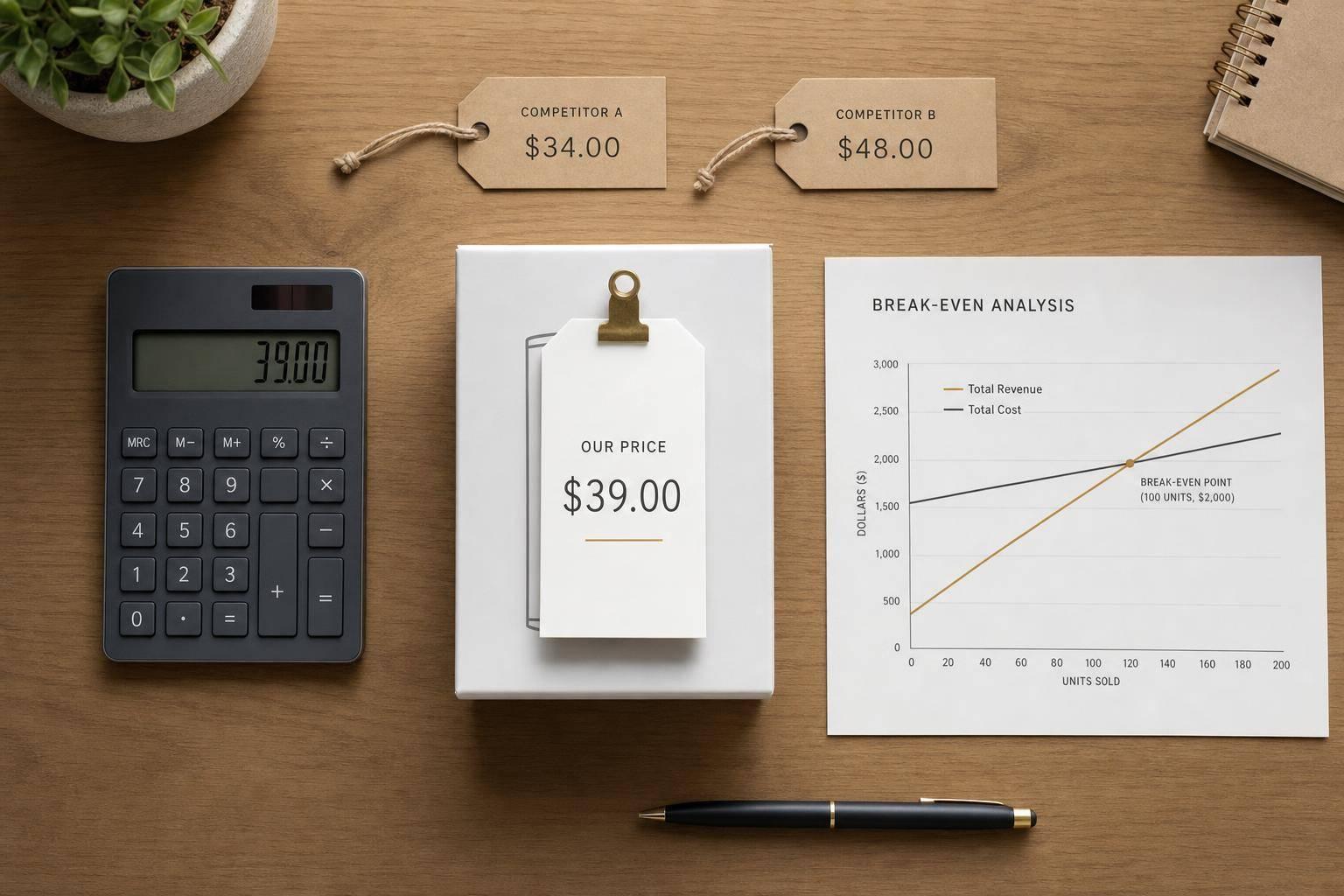
Price framing can lift conversions without tricking people. The short version: show the full cost up front, make renewal terms plain, and use price formats that fit the offer.
I’d sum it up like this:
- Use charm pricing like $19/month for low-cost, self-serve offers
- Use rounded pricing like $5,000 for premium services or high-trust sales
- Use tiers and decoys to help buyers compare plans side by side
- Use outcome framing to tie price to a clear result
- Use bundles only when the math is easy to check
- Test pricing changes with live traffic for 2 to 4 weeks and aim for 300 to 500 visitors per version
- Watch more than conversion rate: track ARPU, churn, refunds, and billing questions
The line is simple: if I change how a price looks but keep the offer and terms plain, that’s solid pricing. If I hide fees, blur renewals, or fake comparisons, that’s where the problem starts.
A few points stand out right away. The FTC’s Junk Fees Rule took effect on May 12, 2025 for live-event ticketing and short-term lodging ads, pushing sellers to show the true total price more clearly. And in January 2026, the FTC alleged that some users thought they were paying a one-time fee when they were being put on monthly plans. That tells me the same thing most buyers already know: surprise charges damage trust fast.
Psychological Pricing Strategies: How to Influence Consumer Perception
Quick comparison
| Tactic | Best use | Example | What it does | Main risk |
|---|---|---|---|---|
| Charm pricing | Low-cost SaaS, digital products, subscriptions | $19/month | Can make a price feel lower at a glance | Can make higher-ticket offers feel cheap |
| Rounded pricing | Consulting, retainers, premium plans | $5,000 | Makes the offer feel more confident and direct | Looks clean, then gets undercut by added fees |
| Tiered anchoring | 3 to 4 SaaS plans | $20 / $40 / custom | Helps buyers compare instead of guessing | Weak or fuzzy plan differences |
| Decoy pricing | 3-plan lineup | $59 vs. $69 | Pushes attention to the stronger plan | A bad-fit plan made only to steer people |
| Outcome framing | ROI-led SaaS, consulting, services | $0.99 per resolved ticket | Links price to a business result | Loose claims or shaky success rules |
| Bundle pricing | Multi-part offers | $499 bundle vs. $1,184 standalone | Makes one purchase path easier to review | Inflated item prices to fake savings |
| Price testing | Any offer with traffic | A/B test $19 vs. $24 | Replaces guesswork with data | Calling a winner too early |
If I had to give one rule for the whole piece, it would be this: make the price easy to compare, easy to verify, and easy to accept.
Where Smart Pricing Ends and Manipulation Begins
Use this simple test: smart pricing helps people compare real choices. Manipulation does the opposite. It hides cost, terms, or value. Once you look at pricing that way, three guardrails matter most: transparency, renewal clarity, and honest comparisons.
Transparency comes first. Every required charge should appear before checkout. A good example is the FTC's Junk Fees Rule, which takes effect on May 12, 2025. It requires live-event ticketing and short-term lodging ads to show the true total price more prominently than other pricing details. The rule allows only a few exclusions: government charges, shipping charges, and optional ancillary goods or services. When buyers can see the full total up front, checkout feels smoother and trust is easier to keep. If the final amount changes at checkout, the pricing page needs work.
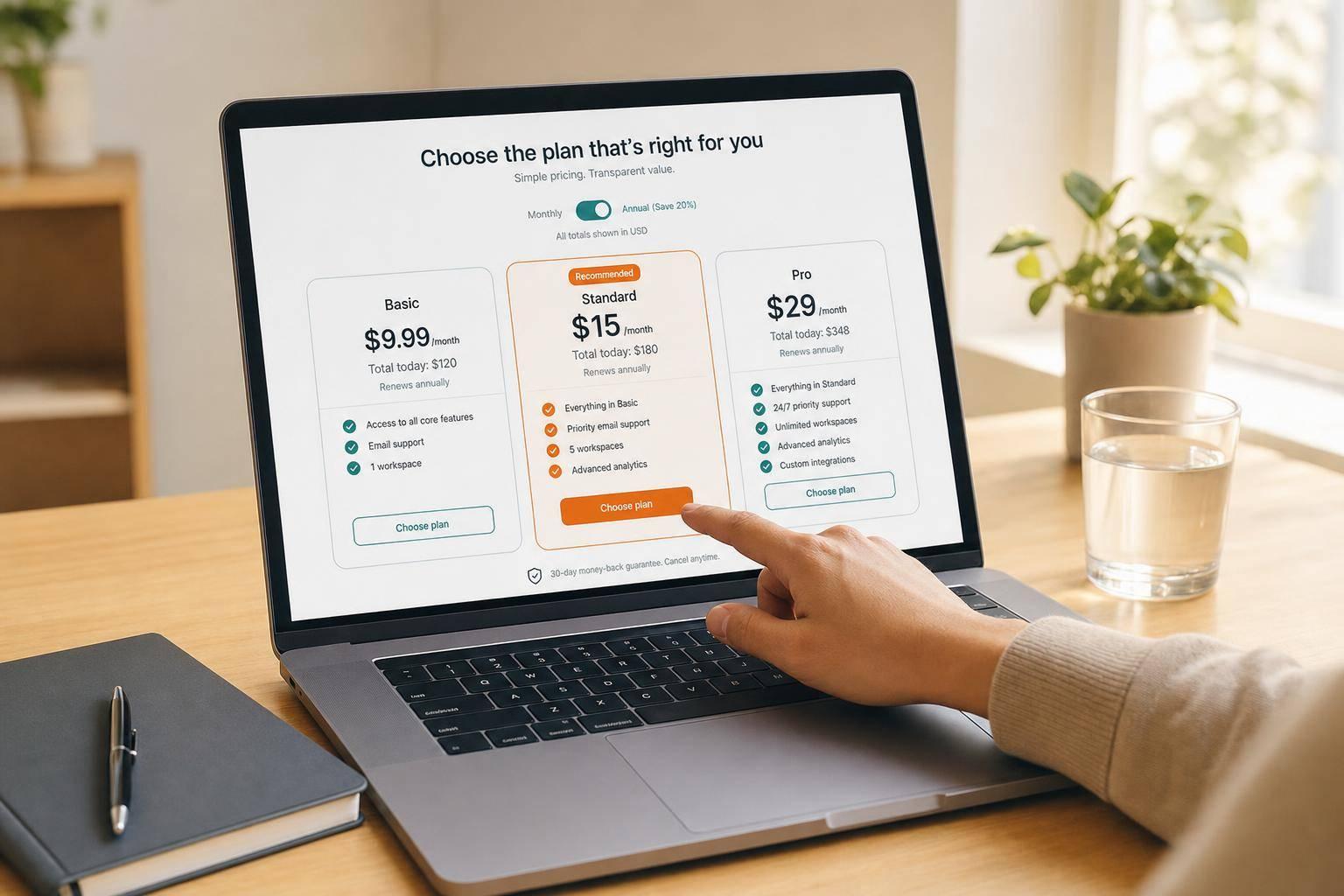
Renewal clarity is the second guardrail. Put the full billing cycle and renewal terms right next to each subscription price. For example: $39/month, auto-renews every 30 days. That kind of plain wording helps stop surprise charges, which can hurt both trust and retention. In January 2026, the FTC alleged that users believed they were paying a one-time fee when they were actually signed up for monthly plans.
Honest comparisons are the third guardrail. Comparison only works when it's real. Pricing tiers should reflect actual differences in value, and discounts should point back to real past prices. Labels like "Most popular" should line up with what buyers actually choose. If a pricing tactic only works because people miss something - like prechecked add-ons, buried renewal terms, or countdown timers on evergreen offers - it fails the basic test of customer respect.
These guardrails help keep pricing persuasive without misleading the buyer. The next sections show how they work in practice.
1. IdeaFloat's Data-Backed Pricing Research
Once the guardrails are in place, the next job is finding a price you can defend.
A lot of founders set pricing by gut feel. IdeaFloat takes a different route. Its pricing research uses current market data to show what similar offers can support right now. So instead of guessing, you can see a starter-plan range that lines up with current demand. From there, you can use charm pricing, anchoring, and bundles with more confidence.
Before you test any psychological pricing move, set a floor price based on direct and indirect costs. That gives you a number the business can live with, not just one that looks good on a pricing page.
The research also helps show how the offer comes across: budget, competitive, or premium. That matters a lot before you build tiers or bundles, because the anchor price in a side-by-side comparison has to feel believable or the whole setup falls flat.
It also helps to track one revenue-quality metric for each offer so you know what’s working and what needs work. For example:
- SaaS: trial-to-paid and churn
- Products: AOV
- Consulting: proposal acceptance rate
Once that baseline is set, the research points to what you should test next.
2. Charm Pricing
Once you’ve set a floor price you can defend, it’s worth testing whether a just-below number makes the offer feel easier to buy. Charm pricing means setting a price right under a round number - like $19 instead of $20 or $97 instead of $100. The idea is simple: buyers tend to lock onto the first digit, so $19 can feel lower than $20.
This works best for entry-level SaaS plans, self-serve digital products, subscriptions, and other low-stakes purchases. A starter plan at $19/month can feel a bit easier to approve than $20/month. But the same move doesn’t always fit higher-ticket offers. In those cases, a clean, rounded price can project more confidence than a fractional one.
There’s also a line you don’t want to cross. The headline price should be the actual total, not bait. This stays ethical when the full price and billing terms are shown clearly all the way through checkout.
When you test this, watch the numbers in the right order:
- Conversion rate on the pricing page, cart, and checkout
- Revenue per visitor
- Churn for subscription offers
That last one matters a lot. If sign-ups go up but churn jumps too, the price is probably too low.
If the offer is premium instead of entry-level, the next tactic is a rounded price.
3. Rounded Premium Pricing
When an offer is high-trust and high-touch, a round price sends a clear signal: confidence. $5,000 feels like a serious engagement. $4,997 feels more like retail. That difference may look small on paper, but it changes how the offer comes across.
For someone weighing a consulting retainer or an enterprise SaaS tier, the question usually isn’t, “What’s the cheapest option?” It’s, “Is this the right partner?” That’s why the full offer matters, not just the number at the bottom. Your price should fit that bigger picture. It still needs to be honest and fully disclosed. The goal is framing, not deception.
This works best when buyers are judging skill and fit, not hunting for a deal. Rounded pricing tends to fit:
- Consulting retainers
- Done-for-you services
- Premium SaaS tiers
- Cohort programs
For low-ticket self-serve offers, charm pricing usually matches what buyers expect a lot better.
There’s also a simple practical upside: rounded pricing can make budget approval move faster because finance teams can scan the total in a second. If you test this, use accepted proposal rate as your main metric. Fewer discount requests after the switch is a good sign that the positioning is landing.
If you need more than one price point to frame value, tiered anchoring does the heavy lifting.
4. Tiered Plan Anchoring
When buyers see several pricing tiers next to each other, they stop judging price on its own and start weighing options. That shift matters. Instead of asking, “Is this too expensive?” they start asking, “Which one fits me best?” Done well, tiered pricing helps people pick the right plan for their budget and use case, not just spend more.
Once your floor price is set, tiers help buyers sort themselves. A simple setup works well:
- Free to lower friction
- Standard as the default pick
- Pro to set a higher anchor
- Enterprise to frame the top end
Buyers often land on the middle tier. IdeaFloat’s own pricing uses this setup: Free at $0/month for exploration, Standard at $20/month for validation, Pro at $40/month for scale, and Enterprise with custom pricing for larger teams. That $40 Pro plan makes $20 feel like a fair place to start.
But the anchor only works if each tier has clear limits and honest differences. Show the full price, billing cycle, what’s included, and any extra charges. If overage fees or user caps are buried in the fine print, the whole thing stops feeling helpful and starts feeling slippery. The point is to help buyers self-select, not box them into a confusing choice.
You’ll also want to watch what buyers do after they sign up. Track share of sign-ups by tier, preferred-plan conversion, and ARPU. If people often downgrade from your preferred plan, that usually points to a weak value promise at that tier, not a pricing issue.
Once tiers make the choice clearer, decoy pricing can make the preferred plan stand out even more.
5. Ethical Decoy Pricing
Building on tiered anchoring, decoy pricing adds a weaker middle option that makes your target plan look like the best deal. The logic is simple: the middle option is clearly weaker than the target plan, so buyers can spot the better choice fast. That idea is called asymmetric dominance.
Here’s a practical setup with three tiers:
- Starter at $29/month: 1 user, 3 campaigns, email support
- Standard at $59/month: 3 users, 10 campaigns, chat support
- Growth at $69/month: 10 users, unlimited campaigns, priority support, CRM integrations
In this case, Standard is the decoy. It’s only $10 less than Growth, but it gives buyers fewer users, limits campaigns, and leaves out integrations. So for many people, Growth feels like the obvious pick because that extra $10 gets them a lot more. But this only works when all plans are real and the tradeoffs are easy to compare.
That part matters. The decoy has to be a real, fully buyable plan with honest limits. Its job is to make value clearer, not to hide the true cost.
This works best for tiered offers where feature differences are plain to see. For simple offers or one-off products, adding more tiers usually just creates noise.
To test it, watch target-plan conversion and ARPU. A clean way to do that is with an A/B test:
- Version A: two tiers
- Version B: the same setup, plus the decoy tier
If target-plan conversion and ARPU go up without spikes in churn or complaints, the decoy is doing its job. If churn climbs or support starts hearing more pricing confusion, that’s a warning sign. At that point, the decoy may be nudging people into a plan that doesn’t fit - which is where smart framing turns into misaligned selling.
Once the preferred plan is clear, the next step is framing its value honestly.
sbb-itb-08dd11e
6. Outcome-Based Value Framing
Once the plan choice is clear, the next step is to frame the price around the result buyers care about most.
A lot of pricing pages lead with features: seats, projects, integrations, storage. That puts the burden on the buyer. They have to translate those features into business value on their own. Outcome-based framing does that job for them.
The ethical version is straightforward: frame price around the result, not the features. Instead of opening with seats or usage caps, tie the offer to a measurable outcome so buyers can judge the value without picking through a feature list. That moves attention away from product specs and toward business impact.
This works best when the outcome is easy to measure and tied directly to something the buyer already tracks, like revenue gained, tickets resolved, hours saved, or leads generated. A customer service AI that charges $0.99 per fully resolved ticket, and $0 when a human takes over, makes the value case clear right away. The buyer can do the math fast, without guesswork.
Keep the outcome definition and total cost in plain sight. Show:
- the unit price
- a realistic monthly range
- the exact success criteria
For example: $0.99 per resolved ticket, with most customers handling 3,000–7,000 tickets per month for a typical monthly spend between $2,970 and $6,930. A ticket counts as resolved if it's closed and not reopened within 72 hours.
Track conversion rate against a feature-focused control as your main metric. Then watch ARPA and billing-related support questions as secondary signals.
When buyers need more than one outcome, bundle pricing can package those results into one clear offer.
7. Transparent Bundle Pricing
When one result depends on several pieces, turn them into one clear buying choice. The point of a bundle is to make the decision easier, not to blur the price.
Show the standalone prices, the bundle total, and the savings right away. For example, a SaaS Launch Bundle might include core access at $49/month, onboarding at $299, and three months of priority support at $99/month. Standalone total: $1,184. Bundle price: $499 for year one, then $49/month after that.
The same idea works for services. A fractional CMO could package a strategy workshop ($1,500), monthly reporting ($500), and implementation support ($2,000) into a Growth Sprint Bundle: "Individual services total $4,000. Bundle at $3,200." The math is plain to see, each part is named, and nothing is tucked away in the fine print.
Once the bundle is framed clearly, set a discount that feels honest, not like ad copy. Use a 15%–30% discount for SaaS and digital bundles and 10%–25% for physical kits. Then connect the bundle to a clear use case so buyers get why those items belong together. "Everything you need to launch in 30 days" lands better than a generic "bundle deal" because it points to a concrete result.
When you test a bundle against standalone offers, watch average order value (AOV) and refund or complaint rates. If AOV goes up without a jump in complaints, the bundle is working. If refunds or complaints start climbing, the promise or terms were probably not clear enough.
How to Match Each Tactic to the Right Offer
Once you know which tactic you want to use, the next step is simple: match it to how the buyer makes decisions.
Charm pricing works best for fast, low-risk purchases. Think SMB SaaS, entry-level digital products, and consumer subscriptions. In those cases, buyers often move quickly, so pricing like $49 or $99 can help the offer feel easier to act on. But use that same approach on a premium advisory package, and the signal changes. Instead of feeling polished, it can come off as bargain pricing.
Rounded pricing fits offers where trust and authority do a lot of the selling. That includes consulting retainers, fractional executive packages, and agency services. With tiered SaaS plans, anchoring tends to work best when you have at least three clearly different options and the top tier helps make the middle plan feel like the sensible pick.
A few common matches look like this:
- Use decoy pricing inside subscription lineups.
- Use outcome framing on service pages.
- Use bundles when several deliverables are being sold as one result.
The main point is to match the tactic to buyer intent, not just the number on the page. If someone is buying in a self-serve flow and moving fast, lean on charm pricing and clear anchoring. If they're slowing down, comparing options, and weighing risk, rounded pricing, outcome framing, and plain bundle pricing usually fit better.
And one more thing: keep the presentation steady. Use one USD format and one rounding rule across every plan, page, and checkout flow.
Once the tactic fits the offer, consistency does the rest.
Comparison Table: When Each Pricing Tactic Works Best
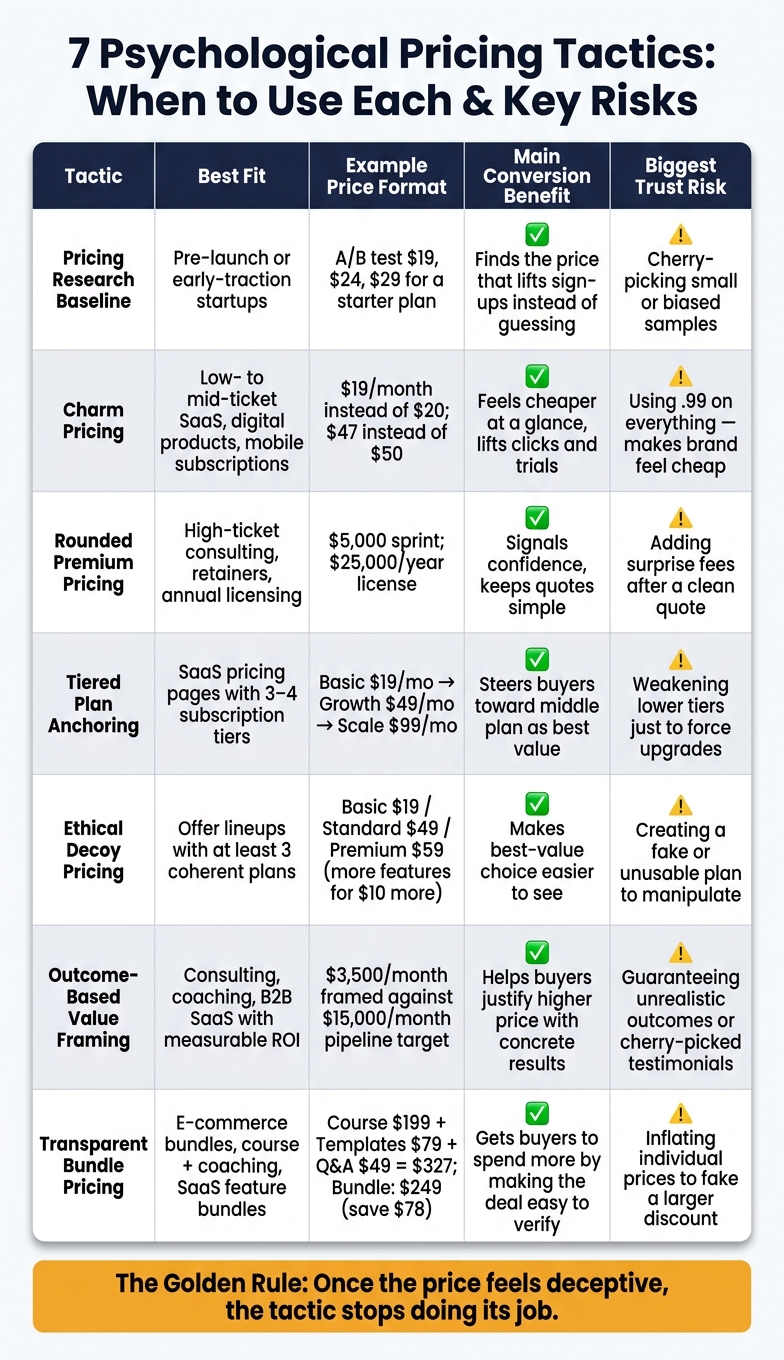
7 Psychological Pricing Tactics: When to Use Each & Key Risks
Each tactic lines up with a different kind of buyer situation. This table shows the best fit, the price format, the main conversion upside, and the trust risk that can trip you up.
| Tactic | Best Fit | Example U.S. Price Format | Main Conversion Benefit | Biggest Trust Risk to Avoid |
|---|---|---|---|---|
| Pricing Research Baseline | Pre-launch or early-traction startups testing price points before scaling | A/B test $19, $24, and $29 for a starter plan | Finds the price that lifts sign-ups and revenue instead of relying on guesswork | Cherry-picking small or biased samples to justify a higher price |
| Charm Pricing | Low- to mid-ticket SaaS plans, digital products, or mobile app subscriptions | $19/month instead of $20/month; $47 instead of $50 | Feels cheaper at a glance, which can lift clicks and trials | Using .99 or .97 on everything, especially high-ticket offers, which can make the brand feel cheap |
| Rounded Premium Pricing | High-ticket consulting, retainers, or annual licensing deals | $5,000 sprint; $25,000/year license | Signals confidence and keeps the quote simple | Adding surprise fees after a clean quote |
| Tiered Plan Anchoring | SaaS pricing pages with 3–4 subscription tiers | Basic $19/month, Growth $49/month, Scale $99/month | Steers many buyers toward a middle plan that feels like the best value | Weakening lower tiers just to force upgrades |
| Ethical Decoy Pricing | Offer lineups with at least three coherent plans | Basic $19, Standard $49, Premium $59, with Premium offering more users or priority support for just $10 more | Makes the best-value choice easier to see through comparison | Creating a fake or unusable plan just to manipulate choices |
| Outcome-Based Value Framing | Consulting, coaching, and B2B SaaS where ROI is easy to show | $3,500/month framed against a $15,000/month pipeline target | Helps buyers justify a higher price by tying cost to concrete results | Guaranteeing unrealistic outcomes or using cherry-picked testimonials |
| Transparent Bundle Pricing | E-commerce bundles, course + coaching packages, or SaaS feature bundles | Course $199 + templates $79 + Q&A $49 sold separately; bundle all three for $249 and show the $78 savings | Gets buyers to spend more overall by making the deal easy to check | Inflating individual list prices just to make the bundle discount look larger |
The pattern behind failed pricing is pretty simple: once the price feels deceptive, the tactic stops doing its job.
After you pick the tactic, presentation matters just as much. Show the full total, spell out billing terms, and leave no room for surprise charges.
Price Presentation Rules That Keep Trust Intact
After you pick the tactic, the next job is simple: make the price easy to read. If the price looks confusing or half-hidden, even a smart pricing plan can fall apart.
Use the shortest honest format. Write $29/month for subscriptions. Use rounded whole numbers for premium offers. Skip extra cents when they don't help. Clean formatting makes the offer feel useful, not sneaky.
Put the billing period, renewal term, and total commitment right next to the headline price. For discounts, use percentages under $100 and dollar-off amounts over $100.
Keep fees and planned price increases beside the price, not buried in fine print. That kind of openness helps protect trust.
A buyer should be able to see the cost, what's included, and what happens next at a glance. Once the page is clear, test which version converts better.
Test Pricing With Data Instead of Guesswork
After you pick a pricing tactic, check it with live traffic. Clean up the page first. Then test which price gets the best result. Gut feel can point you in the wrong direction. A structured test gives you something far better: proof.
The most reliable method is a simple A/B test. Show half of new visitors one price and the other half a different price. Keep the copy, features, and design the same. That way, price is the only thing changing.
Let the test run for two to four weeks so you account for weekday and weekend patterns. And try to get 300–500 visitors per version before you call a winner. While the test is live, track:
- Conversion rate
- ARPU
- Early churn within 30 days
A lower price might boost sign-ups and still be the wrong move. If ARPU drops hard or churn goes up, you haven't found a win. You've found a trade-off, and that needs a closer look.
Before the test starts, set your floor price using cost data. Use IdeaFloat to narrow your price range, test customer reaction, and check margins before you go live. Conversion matters, but profit matters too. If your costs leave almost no margin at a certain price, that price can't be your floor. Move it up before testing.
That margin check also helps protect trust. A price can look good on the page and still fail once the math hits the business.
Use data to swap guesswork for a process you can repeat: model first, test one variable at a time, and keep a price change only when the numbers show the business is in better shape. Then use the winning price as your baseline and test again when the offer changes.
Conclusion
These tactics work best when they cut friction without cutting trust. Charm pricing, tiered anchoring, decoy pricing, outcome framing, and clear bundles can help buyers decide faster. But that only works when the price is honest, the terms are easy to see, and the value holds up.
Smart pricing should pass three tests: it tells the truth, keeps buyer choice intact, and lines price up with real value. From there, make the smallest change that fits the offer.
Start with one pricing change. Keep the page clean. Make renewal terms, fees, and cancellations easy to spot.
Test price changes on live traffic, and judge them by conversion, ARPU, refund requests, and billing-related support volume.
If pricing helps buyers decide faster without surprise or pressure, it’s working as strategy - not manipulation.
FAQs
How do I know if my pricing feels manipulative?
Pricing starts to feel manipulative when it hides the ball or tries to rush people into a decision. The biggest red flags are poor transparency and fake urgency. That usually shows up as fine print or asterisks that undercut your main claim, hidden details that should be easy to spot, or pricing that makes the actual cost hard to figure out.
If you want to keep trust intact, be direct. Say what’s included. Clearly label features that are planned or proposed instead of making them sound available today. And if prices are going up, give people 30 to 45 days’ notice. Your pricing should match the value you actually deliver - not the value you hope people assume they’re getting.
Which pricing tactic should I test first?
Start with a 3-tier pricing model: Basic, Standard, and Premium.
It works because of psychological anchoring. Once people see three options side by side, the middle choice often feels like the best deal. That tends to pull more customers toward it.
It also makes the decision easier. Instead of sorting through too many choices, people can compare a small, clear set of options and move faster. That can cut choice overload and lift conversion rates by 17% to 25%, while still serving different budget levels in an ethical way.
What metrics matter most after a price change?
After a price change, watch the numbers that show what’s happening to sales, customer behavior, and profit.
Focus on metrics like:
- Conversion rate
- Average order value
- Customer lifetime value
- Abandonment rate
- Upgrade frequency
- Churn rate
- Revenue per user
You’ll also want to keep an eye on profit margins, breakeven point, and total revenue by customer segment. That way, you can see whether the new pricing is helping you hit your financial goals - or quietly working against them.
Related Blog Posts
- The Pricing Strategy That Doubled My Conversion Rate Overnight
- Pricing Services the Easy Way: A 3-Tier Ladder That Sells Itself
- How to Price Products for Healthy Margins Without Killing Demand
- How to Price a New Product When You Have No Sales History